 Add to Chrome
 Add to Firefox
 Add to Edge
SpeakerCard-1M: An Evidence-Grounded Speaker Card Corpus for In-the-Wild Speaker Verification
Jun 03, 2026
Modern speaker verification (SV) systems rely on speaker embeddings that are effective but difficult to interpret or query in natural language. Most existing speech-text corpora target controllable synthesis or utterance-level captioning, and provide limited speaker-level supervision for in-the-wild speaker recognition. This paper introduces SpeakerCard-1M, a bilingual speaker-centric resource for evidence-grounded SV, derived from VoxCeleb1/2 and CN-Celeb1/2, where the "-1M" suffix refers to the 1.78M utterance-level captions contained in the release. We adopt a tool-first, LLM-last approach: ten acoustic probes produce field-level evidence, the evidence is aggregated into speaker profiles under a schema that separates relatively stable traits from utterance-level states, and bilingual Speaker Cards are rendered by a constrained LLM that sees only the structured fields. The release includes 56.7K Speaker Card records over 10.2K speakers, 1.78M utterance-level captions, and speaker-ID-disjoint hard-negative triplets. We further define two SV-oriented cross-modal protocols, bidirectional Speaker-Text Retrieval (T2S-R / S2T-R) and Attribute-Conditioned Verification (AC-Verify), and compare a dual-encoder baseline against recent audio language models under a zero-shot forced-choice setting. Joint audio-text training increases VoxCeleb1-O EER by 0.31% absolute over the audio-only baseline. Under a style-symmetric LLM-generated counterfactual protocol, eight recent audio language models (7B-30B+ parameters, both open- and closed-source) score 49-77% on pitch-level AC-Verify under two-way forced choice, compared with 88.66% reached by our dual encoder.

GRACE: Gradient-aligned Reasoning Data Curation for Efficient Post-training
May 13, 2026Existing reasoning data curation pipelines score whole samples, treating every intermediate step as equally valuable. In reality, steps within a trace contribute very unevenly, and selecting reasoning data well requires assessing them individually. We present GRACE, a gradient-aligned curation method that views each reasoning trace as a sequence of optimization events and scores every step by two complementary signals: its alignment with the answer-oriented gradient direction, and its consistency with the preceding reasoning trajectory. Step-level scores are aggregated into a sample-level value for subset selection, using only the model's internal optimization signals and no external reward models or step annotations. To make this scalable, GRACE introduces a representation-level gradient proxy that estimates step-level alignment from token-level upstream signals in a single forward pass. Post-training Qwen3-VL-2B-Instruct on MMathCoT-1M, GRACE reaches 108.8% of the full-data performance with 20% of the data and retains 100.2% with only 5%, with subsets that transfer effectively across model backbones.
Predictive Radiomics for Evaluation of Cancer Immune SignaturE in Glioblastoma: the PRECISE-GBM study
May 11, 2026Background: Radiogenomics allows identification of radiological biomarkers for genomic phenotypes. In glioblastoma, these biomarkers could potentially complement patient stratification strategies. We aim to develop and analytically validate radiological biomarkers that capture immune cell signatures within IDH-wildtype glioblastoma microenvironment using radiogenomic analysis. Methods: This was a retrospective multicenter study using curated open-access anonymized imaging and genomic data from TCGA-GBM, CPTAC, IvyGAP, REMBRANDT and CGGA datasets. Imaging data consisted of MRI-based radiomic features extracted from necrotic core, enhancing and edema regions of deep learning-based auto-segmented tumors. Radiomic feature selections were performed using nested cross-validated LASSO. Support vector machine and ensemble models were trained using seventeen immune and cell-specific score labels extracted from deconvoluted transcriptomic data using pan-cancer and glioblastoma immune signature matrices as reference standards. Seventeen classifier models trained in three cross-cohort strategies were validated on three held-out datasets assessing stability and generalizability. Results: One-hundred-and-seventy-six patients were included in the study. The immune-related radiomic signatures obtained after feature selection were shape, first order and higher order radiomic features. Models predicting macrophage subtype immune signature showed stable mean performance on balanced accuracy (0.67) and precision (0.89) metrics for three independent holdout datasets with ensemble model outperforming support vector machine model. Conclusion: Radiogenomic models non-invasively predicted the macrophage subtype M0 immune signature in IDH-wildtype glioblastoma. These biomarkers have the potential to stratify patients for immunotherapy within prospective glioblastoma clinical trials.
* Abstract : 226; Importance of study: 109; Manuscript: 5690 (excluding references) Figures: 4, Tables: 2 Supplemental File: 1
TASU2: Controllable CTC Simulation for Alignment and Low-Resource Adaptation of Speech LLMs
Apr 09, 2026Speech LLM post-training increasingly relies on efficient cross-modal alignment and robust low-resource adaptation, yet collecting large-scale audio-text pairs remains costly. Text-only alignment methods such as TASU reduce this burden by simulating CTC posteriors from transcripts, but they provide limited control over uncertainty and error rate, making curriculum design largely heuristic. We propose \textbf{TASU2}, a controllable CTC simulation framework that simulates CTC posterior distributions under a specified WER range, producing text-derived supervision that better matches the acoustic decoding interface. This enables principled post-training curricula that smoothly vary supervision difficulty without TTS. Across multiple source-to-target adaptation settings, TASU2 improves in-domain and out-of-domain recognition over TASU, and consistently outperforms strong baselines including text-only fine-tuning and TTS-based augmentation, while mitigating source-domain performance degradation.
Wukong-Omni: Design, Modeling and Control of a Multi-mode Robot for Air, Land, and Underwater Exploration with All-in-One Propulsion Unit
Mar 03, 2026In flood disaster rescue scenarios, partially submerged buildings prevent aerial robots from accessing lower levels, limiting mission effectiveness. To address this challenge, this paper presents Wukong-Omni, a novel multimode robot capable of operating across land, air, and underwater using a unified propulsion system. The system is enabled by an innovative mechanical design that allows motor reuse and improves thrust generation. Efficiency and peak thrust are enhanced through simulation and tank-based optimization. Experimental results show a 100 percent improvement in propulsion efficiency and a 150 percent increase in maximum thrust compared with direct installation methods. Dynamic models for the three operating domains are developed, and a unified cross-domain control framework is proposed. Comprehensive experiments validate stable locomotion and smooth transition across domains. Outdoor experiments further demonstrate robustness and adaptability in real-world environments.
SALAD-Pan: Sensor-Agnostic Latent Adaptive Diffusion for Pan-Sharpening
Feb 04, 2026Recently, diffusion models bring novel insights for Pan-sharpening and notably boost fusion precision. However, most existing models perform diffusion in the pixel space and train distinct models for different multispectral (MS) imagery, suffering from high latency and sensor-specific limitations. In this paper, we present SALAD-Pan, a sensor-agnostic latent space diffusion method for efficient pansharpening. Specifically, SALAD-Pan trains a band-wise single-channel VAE to encode high-resolution multispectral (HRMS) into compact latent representations, supporting MS images with various channel counts and establishing a basis for acceleration. Then spectral physical properties, along with PAN and MS images, are injected into the diffusion backbone through unidirectional and bidirectional interactive control structures respectively, achieving high-precision fusion in the diffusion process. Finally, a lightweight cross-spectral attention module is added to the central layer of diffusion model, reinforcing spectral connections to boost spectral consistency and further elevate fusion precision. Experimental results on GaoFen-2, QuickBird, and WorldView-3 demonstrate that SALAD-Pan outperforms state-of-the-art diffusion-based methods across all three datasets, attains a 2-3x inference speedup, and exhibits robust zero-shot (cross-sensor) capability.
FluxNet: Learning Capacity-Constrained Local Transport Operators for Conservative and Bounded PDE Surrogates
Feb 02, 2026Autoregressive learning of time-stepping operators offers an effective approach to data-driven PDE simulation on grids. For conservation laws, however, long-horizon rollouts are often destabilized when learned updates violate global conservation and, in many applications, additional state bounds such as nonnegative mass and densities or concentrations constrained to [0,1]. Enforcing these coupled constraints via direct next-state regression remains difficult. We introduce a framework for learning conservative transport operators on regular grids, inspired by lattice Boltzmann-style discrete-velocity transport representations. Instead of predicting the next state, the model outputs local transport operators that update cells through neighborhood exchanges, guaranteeing discrete conservation by construction. For bounded quantities, we parameterize transport within a capacity-constrained feasible set, enforcing bounds structurally rather than by post-hoc clipping. We validate FluxNet on 1D convection-diffusion, 2D shallow water equations, 1D traffic flow, and 2D spinodal decomposition. Experiments on shallow-water equations and traffic flow show improved rollout stability and physical consistency over strong baselines. On phase-field spinodal decomposition, the method enables large time-steps with long-range transport, accelerating simulation while preserving microstructure evolution in both pointwise and statistical measures.
EmoShift: Lightweight Activation Steering for Enhanced Emotion-Aware Speech Synthesis
Jan 30, 2026Achieving precise and controllable emotional expression is crucial for producing natural and context-appropriate speech in text-to-speech (TTS) synthesis. However, many emotion-aware TTS systems, including large language model (LLM)-based designs, rely on scaling fixed emotion embeddings or external guidance, limiting their ability to model emotion-specific latent characteristics. To address this gap, we present EmoShift, a lightweight activation-steering framework incorporating a EmoSteer layer, which learns a steering vector for each target emotion in the output embedding space to capture its latent offset and maintain stable, appropriate expression across utterances and categories. With only 10M trainable parameters,less than 1/30 of full fine-tuning, EmoShift outperforms zero-shot and fully fine-tuned baselines in objective and subjective evaluations, enhancing emotional expressiveness while preserving naturalness and speaker similarity. Further analysis confirms the proposed EmoSteer layer's effectiveness and reveals its potential for controllable emotional intensity in speech synthesis.
Learning Geometric Invariance for Gait Recognition
Jan 09, 2026The goal of gait recognition is to extract identity-invariant features of an individual under various gait conditions, e.g., cross-view and cross-clothing. Most gait models strive to implicitly learn the common traits across different gait conditions in a data-driven manner to pull different gait conditions closer for recognition. However, relatively few studies have explicitly explored the inherent relations between different gait conditions. For this purpose, we attempt to establish connections among different gait conditions and propose a new perspective to achieve gait recognition: variations in different gait conditions can be approximately viewed as a combination of geometric transformations. In this case, all we need is to determine the types of geometric transformations and achieve geometric invariance, then identity invariance naturally follows. As an initial attempt, we explore three common geometric transformations (i.e., Reflect, Rotate, and Scale) and design a $\mathcal{R}$eflect-$\mathcal{R}$otate-$\mathcal{S}$cale invariance learning framework, named ${\mathcal{RRS}}$-Gait. Specifically, it first flexibly adjusts the convolution kernel based on the specific geometric transformations to achieve approximate feature equivariance. Then these three equivariant-aware features are respectively fed into a global pooling operation for final invariance-aware learning. Extensive experiments on four popular gait datasets (Gait3D, GREW, CCPG, SUSTech1K) show superior performance across various gait conditions.
MOSA: Mixtures of Simple Adapters Outperform Monolithic Approaches in LLM-based Multilingual ASR
Aug 26, 2025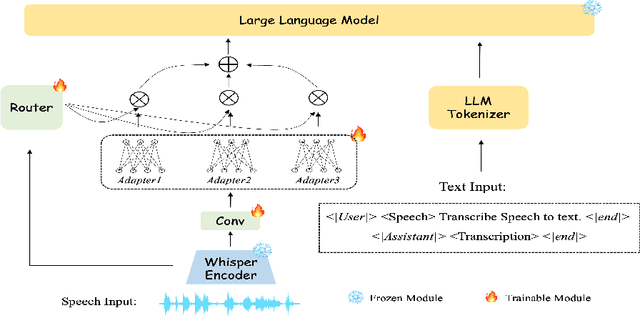
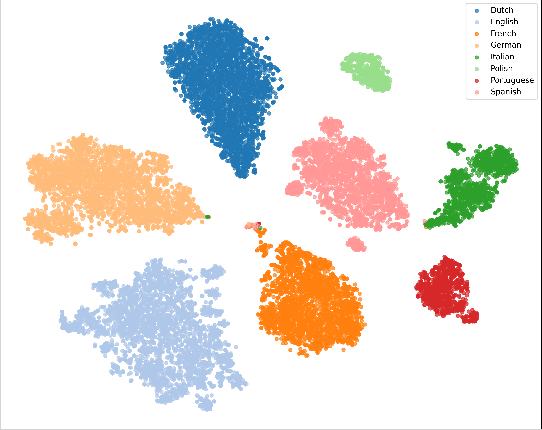
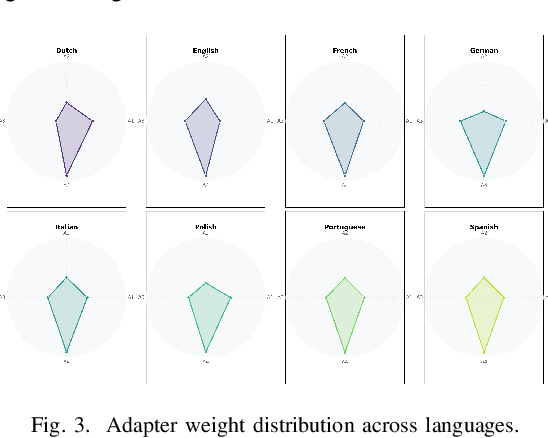

End-to-end multilingual ASR aims to transcribe speech from different languages into corresponding text, but is often limited by scarce multilingual data. LLM-based ASR aligns speech encoder outputs with LLM input space via a projector and has achieved notable success. However, prior work mainly improves performance by increasing data, with little focus on cross-lingual knowledge sharing. Moreover, a single complex projector struggles to capture both shared and language-specific features effectively. In this work, we propose MOSA (Mixture of Simple Adapters), leveraging a Mixture-of-Experts mechanism to combine lightweight adapters that learn shared and language-specific knowledge. This enables better utilization of high-resource language data to support low-resource languages, mitigating data scarcity issues. Experimental results show that MOSA-Base achieves a 15.4\% relative reduction in average WER compared to the Baseline-Base and consistently outperforms it across all languages. Remarkably, MOSA-Base surpasses the Baseline-Base even when trained with only 60\% of its parameters. Similarly, MOSA-Large outperforms the Baseline-Large in average WER and demonstrates greater robustness to data imbalance. Ablation studies further indicate that MOSA is more effective at handling individual languages and learning both language-specific and shared linguistic knowledge. These findings support that, in LLM-based ASR, a mixture of simple adapters is more effective than a single, complex adapter design.