 Add to Chrome
 Add to Firefox
 Add to Edge
GlaKG: A Biomarker-Centric Fundus Knowledge Graph for Explainable Glaucoma Diagnosis and Risk Assessment
Jul 06, 2026
Glaucoma is a leading cause of irreversible blindness worldwide, yet most automated diagnosis systems rely on opaque deep-learning models that offer little clinical interpretability. We present GlaKG, a biomarker-centric fundus knowledge graph that integrates structural biomarkers, clinically grounded rules, and image features to produce traceable reasoning for glaucoma diagnosis and risk stratification. GlaKG encodes six entity types (Fundus Image, Optic Disc, Neural Rim, Pathology, Diagnosis, Risk Level), eight relation types, and 11 clinically validated rules into a unified graph, so that every prediction is accompanied by an explicit reasoning chain linking biomarker evidence to activated clinical rules. To keep knowledge-based reasoning strictly separate from label information, we adopt a post-processing fusion framework that combines ResNet50 image embeddings with a normalized KG reasoning-chain score via a tunable weight alpha, with all fitting confined to the training split. On a publicly available, AI-annotated fundus dataset, GlaKG reaches F1 = 0.9953 for binary glaucoma classification and 0.930 accuracy with 0.922 weighted F1 for four-class risk stratification; we report openly that the dataset's biomarker annotations are highly label-correlated, and therefore frame these figures as an upper bound attainable with clean structured biomarkers rather than as leakage-free image-only performance. Feature-importance analysis shows KG-derived and biomarker features contributing near-equally (51.1% vs. 48.9%), and the reasoning chain flags borderline cases by exposing low chain scores rather than failing silently. GlaKG's central contribution is therefore a clinically auditable reasoning framework that complements raw predictive performance by explicitly exposing the biomarker evidence and rule activations behind each decision.

X-GAN: A Generative AI-Powered Unsupervised Model for High-Precision Segmentation of Retinal Main Vessels toward Early Detection of Glaucoma
Mar 09, 2025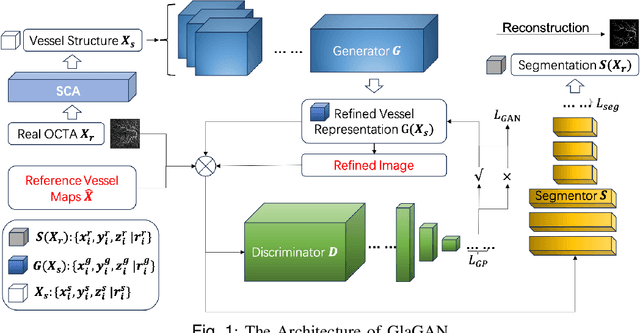
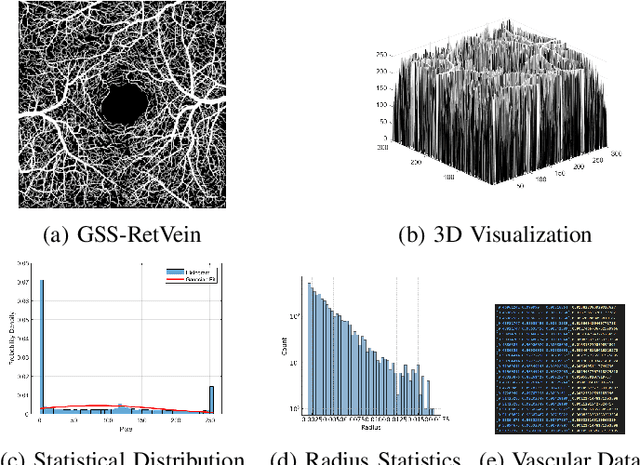
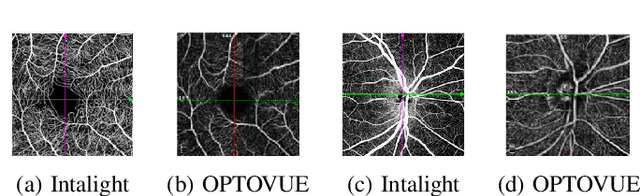
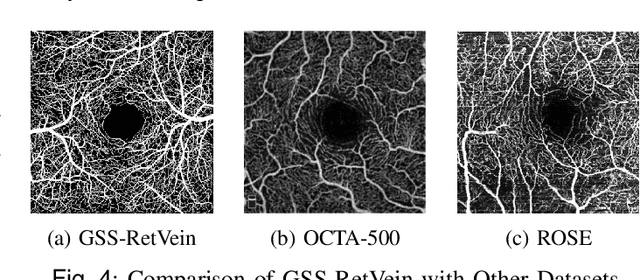
Structural changes in main retinal blood vessels serve as critical biomarkers for the onset and progression of glaucoma. Identifying these vessels is vital for vascular modeling yet highly challenging. This paper proposes X-GAN, a generative AI-powered unsupervised segmentation model designed for extracting main blood vessels from Optical Coherence Tomography Angiography (OCTA) images. The process begins with the Space Colonization Algorithm (SCA) to rapidly generate a skeleton of vessels, featuring their radii. By synergistically integrating generative adversarial networks (GANs) with biostatistical modeling of vessel radii, X-GAN enables a fast reconstruction of both 2D and 3D representations of the vessels. Based on this reconstruction, X-GAN achieves nearly 100\% segmentation accuracy without relying on labeled data or high-performance computing resources. Also, to address the Issue, data scarity, we introduce GSS-RetVein, a high-definition mixed 2D and 3D glaucoma retinal dataset. GSS-RetVein provides a rigorous benchmark due to its exceptionally clear capillary structures, introducing controlled noise for testing model robustness. Its 2D images feature sharp capillary boundaries, while its 3D component enhances vascular reconstruction and blood flow prediction, supporting glaucoma progression simulations. Experimental results confirm GSS-RetVein's superiority in evaluating main vessel segmentation compared to existing datasets. Code and dataset are here: https://github.com/VikiXie/SatMar8.
Latent Relationship Mining of Glaucoma Biomarkers: a TRI-LSTM based Deep Learning
Aug 28, 2024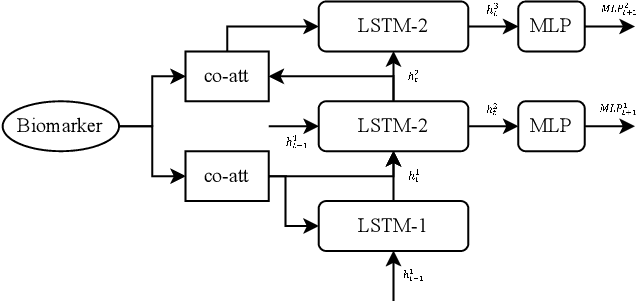
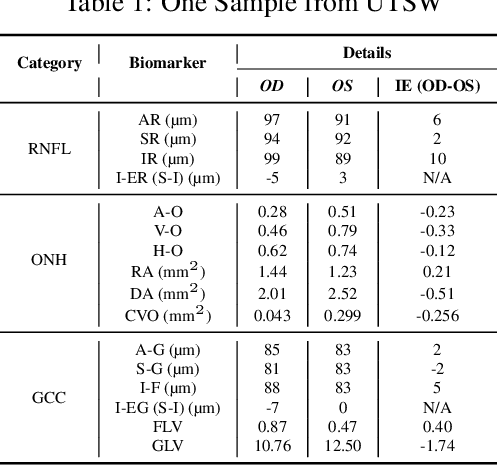
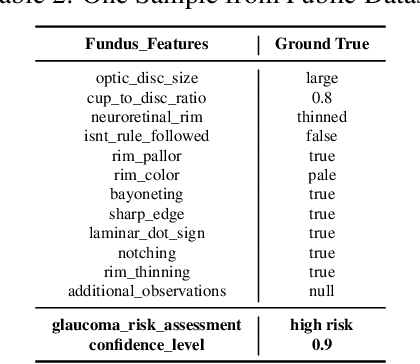
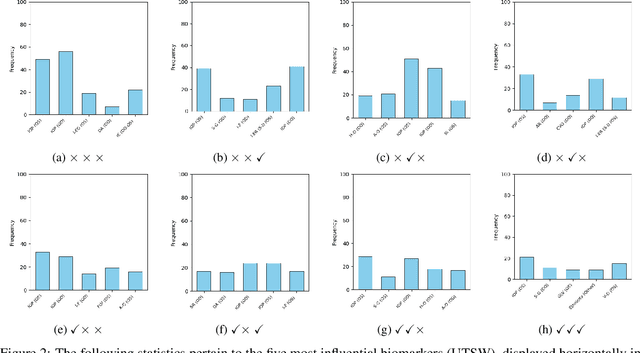
In recently years, a significant amount of research has been conducted on applying deep learning methods for glaucoma classification and detection. However, the explainability of those established machine learning models remains a big concern. In this research, in contrast, we learn from cognitive science concept and study how ophthalmologists judge glaucoma detection. Simulating experts' efforts, we propose a hierarchical decision making system, centered around a holistic set of carefully designed biomarker-oriented machine learning models. While biomarkers represent the key indicators of how ophthalmologists identify glaucoma, they usually exhibit latent inter-relations. We thus construct a time series model, named TRI-LSTM, capable of calculating and uncovering potential and latent relationships among various biomarkers of glaucoma. Our model is among the first efforts to explore the intrinsic connections among glaucoma biomarkers. We monitor temporal relationships in patients' disease states over time and to capture and retain the progression of disease-relevant clinical information from prior visits, thereby enriching biomarker's potential relationships. Extensive experiments over real-world dataset have demonstrated the effectiveness of the proposed model.