 Add to Chrome
 Add to Firefox
 Add to Edge
GlaKG: A Biomarker-Centric Fundus Knowledge Graph for Explainable Glaucoma Diagnosis and Risk Assessment
Jul 06, 2026
Glaucoma is a leading cause of irreversible blindness worldwide, yet most automated diagnosis systems rely on opaque deep-learning models that offer little clinical interpretability. We present GlaKG, a biomarker-centric fundus knowledge graph that integrates structural biomarkers, clinically grounded rules, and image features to produce traceable reasoning for glaucoma diagnosis and risk stratification. GlaKG encodes six entity types (Fundus Image, Optic Disc, Neural Rim, Pathology, Diagnosis, Risk Level), eight relation types, and 11 clinically validated rules into a unified graph, so that every prediction is accompanied by an explicit reasoning chain linking biomarker evidence to activated clinical rules. To keep knowledge-based reasoning strictly separate from label information, we adopt a post-processing fusion framework that combines ResNet50 image embeddings with a normalized KG reasoning-chain score via a tunable weight alpha, with all fitting confined to the training split. On a publicly available, AI-annotated fundus dataset, GlaKG reaches F1 = 0.9953 for binary glaucoma classification and 0.930 accuracy with 0.922 weighted F1 for four-class risk stratification; we report openly that the dataset's biomarker annotations are highly label-correlated, and therefore frame these figures as an upper bound attainable with clean structured biomarkers rather than as leakage-free image-only performance. Feature-importance analysis shows KG-derived and biomarker features contributing near-equally (51.1% vs. 48.9%), and the reasoning chain flags borderline cases by exposing low chain scores rather than failing silently. GlaKG's central contribution is therefore a clinically auditable reasoning framework that complements raw predictive performance by explicitly exposing the biomarker evidence and rule activations behind each decision.

DependEval: Benchmarking LLMs for Repository Dependency Understanding
Mar 09, 2025While large language models (LLMs) have shown considerable promise in code generation, real-world software development demands advanced repository-level reasoning. This includes understanding dependencies, project structures, and managing multi-file changes. However, the ability of LLMs to effectively comprehend and handle complex code repositories has yet to be fully explored. To address challenges, we introduce a hierarchical benchmark designed to evaluate repository dependency understanding (DependEval). Benchmark is based on 15,576 repositories collected from real-world websites. It evaluates models on three core tasks: Dependency Recognition, Repository Construction, and Multi-file Editing, across 8 programming languages from actual code repositories. Our evaluation of over 25 LLMs reveals substantial performance gaps and provides valuable insights into repository-level code understanding.
MAPS: Advancing Multi-Modal Reasoning in Expert-Level Physical Science
Jan 18, 2025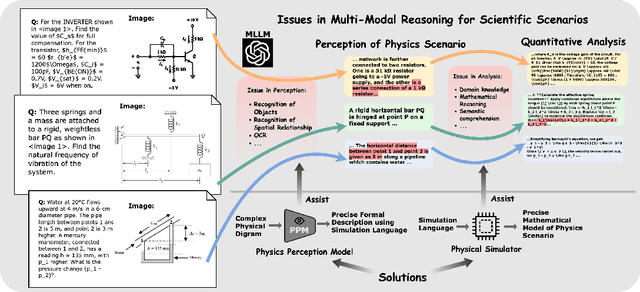

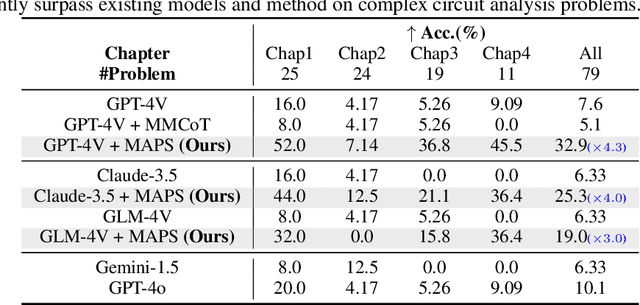

Pre-trained on extensive text and image corpora, current Multi-Modal Large Language Models (MLLM) have shown strong capabilities in general visual reasoning tasks. However, their performance is still lacking in physical domains that require understanding diagrams with complex physical structures and quantitative analysis based on multi-modal information. To address this, we develop a new framework, named Multi-Modal Scientific Reasoning with Physics Perception and Simulation (MAPS) based on an MLLM. MAPS decomposes expert-level multi-modal reasoning task into physical diagram understanding via a Physical Perception Model (PPM) and reasoning with physical knowledge via a simulator. The PPM module is obtained by fine-tuning a visual language model using carefully designed synthetic data with paired physical diagrams and corresponding simulation language descriptions. At the inference stage, MAPS integrates the simulation language description of the input diagram provided by PPM and results obtained through a Chain-of-Simulation process with MLLM to derive the underlying rationale and the final answer. Validated using our collected college-level circuit analysis problems, MAPS significantly improves reasoning accuracy of MLLM and outperforms all existing models. The results confirm MAPS offers a promising direction for enhancing multi-modal scientific reasoning ability of MLLMs. We will release our code, model and dataset used for our experiments upon publishing of this paper.