 Add to Chrome
 Add to Firefox
 Add to Edge
Tree-of-Evidence: Efficient "System 2" Search for Faithful Multimodal Grounding
Apr 09, 2026
Large Multimodal Models (LMMs) achieve state-of-the-art performance in high-stakes domains like healthcare, yet their reasoning remains opaque. Current interpretability methods, such as attention mechanisms or post-hoc saliency, often fail to faithfully represent the model's decision-making process, particularly when integrating heterogeneous modalities like time-series and text. We introduce Tree-of-Evidence (ToE), an inference-time search algorithm that frames interpretability as a discrete optimization problem. Rather than relying on soft attention weights, ToE employs lightweight Evidence Bottlenecks that score coarse groups or units of data (e.g., vital-sign windows, report sentences) and performs a beam search to identify the compact evidence set required to reproduce the model's prediction. We evaluate ToE across six tasks spanning three datasets and two domains: four clinical prediction tasks on MIMIC-IV, cross-center validation on eICU, and non-clinical fault detection on LEMMA-RCA. ToE produces auditable evidence traces while maintaining predictive performance, retaining over 0.98 of full-model AUROC with as few as five evidence units across all settings. Under sparse evidence budgets, ToE achieves higher decision agreement and lower probability fidelity error than other approaches. Qualitative analyses show that ToE adapts its search strategy: it often resolves straightforward cases using only vitals, while selectively incorporating text when physiological signals are ambiguous. ToE therefore provides a practical mechanism for auditing multimodal models by revealing which discrete evidence units support each prediction.

Monocular Markerless Motion Capture Enables Quantitative Assessment of Upper Extremity Reachable Workspace
Feb 13, 2026To validate a clinically accessible approach for quantifying the Upper Extremity Reachable Workspace (UERW) using a single (monocular) camera and Artificial Intelligence (AI)-driven Markerless Motion Capture (MMC) for biomechanical analysis. Objective assessment and validation of these techniques for specific clinically oriented tasks are crucial for their adoption in clinical motion analysis. AI-driven monocular MMC reduces the barriers to adoption in the clinic and has the potential to reduce the overhead for analysis of this common clinical assessment. Nine adult participants with no impairments performed the standardized UERW task, which entails reaching targets distributed across a virtual sphere centered on the torso, with targets displayed in a VR headset. Movements were simultaneously captured using a marker-based motion capture system and a set of eight FLIR cameras. We performed monocular video analysis on two of these video camera views to compare a frontal and offset camera configurations. The frontal camera orientation demonstrated strong agreement with the marker-based reference, exhibiting a minimal mean bias of $0.61 \pm 0.12$ \% reachspace reached per octanct (mean $\pm$ standard deviation). In contrast, the offset camera view underestimated the percent workspace reached ($-5.66 \pm 0.45$ \% reachspace reached). Conclusion: The findings support the feasibility of a frontal monocular camera configuration for UERW assessment, particularly for anterior workspace evaluation where agreement with marker-based motion capture was highest. The overall performance demonstrates clinical potential for practical, single-camera assessments. This study provides the first validation of monocular MMC system for the assessment of the UERW task. By reducing technical complexity, this approach enables broader implementation of quantitative upper extremity mobility assessment.
LLM-as-RNN: A Recurrent Language Model for Memory Updates and Sequence Prediction
Jan 19, 2026Large language models are strong sequence predictors, yet standard inference relies on immutable context histories. After making an error at generation step t, the model lacks an updatable memory mechanism that improves predictions for step t+1. We propose LLM-as-RNN, an inference-only framework that turns a frozen LLM into a recurrent predictor by representing its hidden state as natural-language memory. This state, implemented as a structured system-prompt summary, is updated at each timestep via feedback-driven text rewrites, enabling learning without parameter updates. Under a fixed token budget, LLM-as-RNN corrects errors and retains task-relevant patterns, effectively performing online learning through language. We evaluate the method on three sequential benchmarks in healthcare, meteorology, and finance across Llama, Gemma, and GPT model families. LLM-as-RNN significantly outperforms zero-shot, full-history, and MemPrompt baselines, improving predictive accuracy by 6.5% on average, while producing interpretable, human-readable learning traces absent in standard context accumulation.
MENDR: Manifold Explainable Neural Data Representations
Aug 07, 2025Foundation models for electroencephalography (EEG) signals have recently demonstrated success in learning generalized representations of EEGs, outperforming specialized models in various downstream tasks. However, many of these models lack transparency in their pretraining dynamics and offer limited insight into how well EEG information is preserved within their embeddings. For successful clinical integration, EEG foundation models must ensure transparency in pretraining, downstream fine-tuning, and the interpretability of learned representations. Current approaches primarily operate in the temporal domain, overlooking advancements in digital signal processing that enable the extraction of deterministic and traceable features, such as wavelet-based representations. We propose MENDR (Manifold Explainable Neural Data Representations), a filter bank-based EEG foundation model built on a novel Riemannian Manifold Transformer architecture to resolve these issues. MENDR learns symmetric positive definite matrix embeddings of EEG signals and is pretrained on a large corpus comprising over 4,000 hours of EEG data, decomposed via discrete wavelet packet transforms into multi-resolution coefficients. MENDR significantly enhances interpretability by visualizing symmetric positive definite embeddings as geometric ellipsoids and supports accurate reconstruction of EEG signals from learned embeddings. Evaluations across multiple clinical EEG tasks demonstrate that MENDR achieves near state-of-the-art performance with substantially fewer parameters, underscoring its potential for efficient, interpretable, and clinically applicable EEG analysis.
MedAgentGym: Training LLM Agents for Code-Based Medical Reasoning at Scale
Jun 04, 2025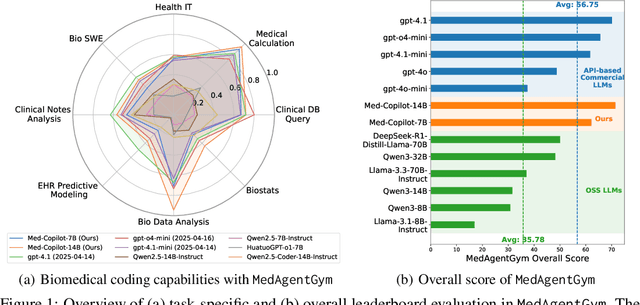
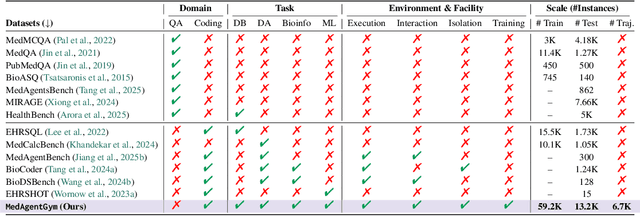
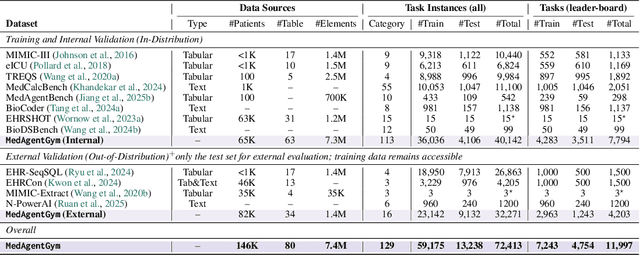
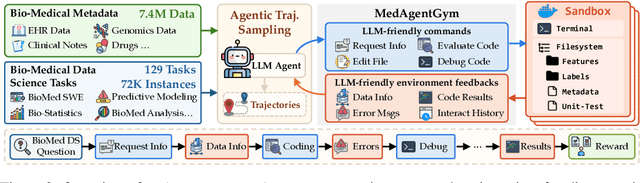
We introduce MedAgentGYM, the first publicly available training environment designed to enhance coding-based medical reasoning capabilities in large language model (LLM) agents. MedAgentGYM comprises 72,413 task instances across 129 categories derived from authentic real-world biomedical scenarios. Tasks are encapsulated within executable coding environments, each featuring detailed task descriptions, interactive feedback mechanisms, verifiable ground-truth annotations, and scalable training trajectory generation. Extensive benchmarking of over 30 LLMs reveals a notable performance disparity between commercial API-based models and open-source counterparts. Leveraging MedAgentGYM, Med-Copilot-7B achieves substantial performance gains through supervised fine-tuning (+36.44%) and continued reinforcement learning (+42.47%), emerging as an affordable and privacy-preserving alternative competitive with gpt-4o. By offering both a comprehensive benchmark and accessible, expandable training resources within unified execution environments, MedAgentGYM delivers an integrated platform to develop LLM-based coding assistants for advanced biomedical research and practice.