 Add to Chrome
 Add to Firefox
 Add to Edge
GRAFT: Gain-Recalibrated Adapters for Transformer-Based Neural Population Activity Modeling
Jun 09, 2026
Neural population activity models can recover rich temporal structure from binned spikes, but their read-in and readout layers often remain tied to a fixed set of recorded neurons. This coupling limits reuse in long-term brain-computer interfaces, where recorded neuron identities, counts, and response statistics can change across days. We introduce GRAFT, a Transformer-based neural population activity model that separates reusable temporal dynamics from a recalibratable neuron interface. The neuron interface controls how recorded neurons enter and leave the shared backbone, and auxiliary gain and positional mechanisms support neural activity modeling inside the Transformer. On MC Maze under the standard NLB'21 protocol, GRAFT reaches 0.3866 co-bps as an ensemble, setting a new state of the art on the primary co-bps metric among public and reported NLB'21 results. In a cross-day protocol constructed from the NLB'21 MC Maze dataset series, GRAFT recalibrates from MC Maze to the scaled MC Maze datasets (Large/Medium/Small) by updating only 9.21% of parameters, reaching 0.3749, 0.3112, and 0.3152 co-bps with restricted target-day support sets. These results show that the same interface-backbone separation supports both strong Transformer-based neural population activity modeling and data-efficient cross-day recalibration.

GaussianVTON: 3D Human Virtual Try-ON via Multi-Stage Gaussian Splatting Editing with Image Prompting
May 13, 2024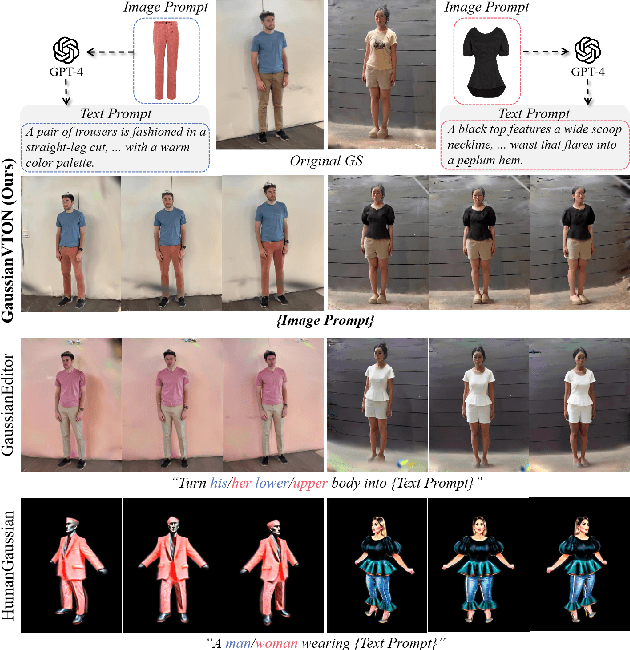

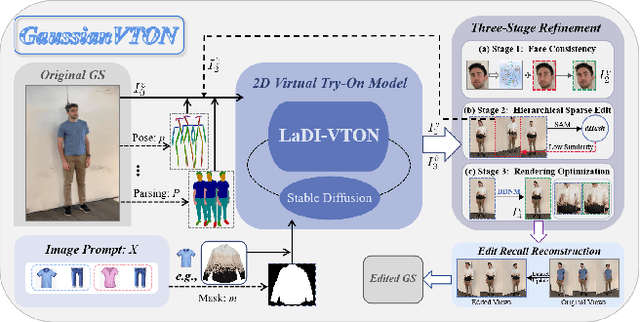
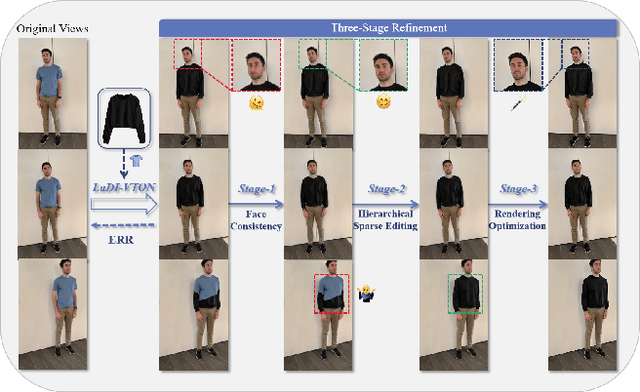
The increasing prominence of e-commerce has underscored the importance of Virtual Try-On (VTON). However, previous studies predominantly focus on the 2D realm and rely heavily on extensive data for training. Research on 3D VTON primarily centers on garment-body shape compatibility, a topic extensively covered in 2D VTON. Thanks to advances in 3D scene editing, a 2D diffusion model has now been adapted for 3D editing via multi-viewpoint editing. In this work, we propose GaussianVTON, an innovative 3D VTON pipeline integrating Gaussian Splatting (GS) editing with 2D VTON. To facilitate a seamless transition from 2D to 3D VTON, we propose, for the first time, the use of only images as editing prompts for 3D editing. To further address issues, e.g., face blurring, garment inaccuracy, and degraded viewpoint quality during editing, we devise a three-stage refinement strategy to gradually mitigate potential issues. Furthermore, we introduce a new editing strategy termed Edit Recall Reconstruction (ERR) to tackle the limitations of previous editing strategies in leading to complex geometric changes. Our comprehensive experiments demonstrate the superiority of GaussianVTON, offering a novel perspective on 3D VTON while also establishing a novel starting point for image-prompting 3D scene editing.