 Add to Chrome
 Add to Firefox
 Add to Edge
Long-VLA: Unleashing Long-Horizon Capability of Vision Language Action Model for Robot Manipulation
Aug 28, 2025
Vision-Language-Action (VLA) models have become a cornerstone in robotic policy learning, leveraging large-scale multimodal data for robust and scalable control. However, existing VLA frameworks primarily address short-horizon tasks, and their effectiveness on long-horizon, multi-step robotic manipulation remains limited due to challenges in skill chaining and subtask dependencies. In this work, we introduce Long-VLA, the first end-to-end VLA model specifically designed for long-horizon robotic tasks. Our approach features a novel phase-aware input masking strategy that adaptively segments each subtask into moving and interaction phases, enabling the model to focus on phase-relevant sensory cues and enhancing subtask compatibility. This unified strategy preserves the scalability and data efficiency of VLA training, and our architecture-agnostic module can be seamlessly integrated into existing VLA models. We further propose the L-CALVIN benchmark to systematically evaluate long-horizon manipulation. Extensive experiments on both simulated and real-world tasks demonstrate that Long-VLA significantly outperforms prior state-of-the-art methods, establishing a new baseline for long-horizon robotic control.

Rethinking Testing for LLM Applications: Characteristics, Challenges, and a Lightweight Interaction Protocol
Aug 28, 2025Applications of Large Language Models~(LLMs) have evolved from simple text generators into complex software systems that integrate retrieval augmentation, tool invocation, and multi-turn interactions. Their inherent non-determinism, dynamism, and context dependence pose fundamental challenges for quality assurance. This paper decomposes LLM applications into a three-layer architecture: \textbf{\textit{System Shell Layer}}, \textbf{\textit{Prompt Orchestration Layer}}, and \textbf{\textit{LLM Inference Core}}. We then assess the applicability of traditional software testing methods in each layer: directly applicable at the shell layer, requiring semantic reinterpretation at the orchestration layer, and necessitating paradigm shifts at the inference core. A comparative analysis of Testing AI methods from the software engineering community and safety analysis techniques from the AI community reveals structural disconnects in testing unit abstraction, evaluation metrics, and lifecycle management. We identify four fundamental differences that underlie 6 core challenges. To address these, we propose four types of collaborative strategies (\emph{Retain}, \emph{Translate}, \emph{Integrate}, and \emph{Runtime}) and explore a closed-loop, trustworthy quality assurance framework that combines pre-deployment validation with runtime monitoring. Based on these strategies, we offer practical guidance and a protocol proposal to support the standardization and tooling of LLM application testing. We propose a protocol \textbf{\textit{Agent Interaction Communication Language}} (AICL) that is used to communicate between AI agents. AICL has the test-oriented features and is easily integrated in the current agent framework.
Interact-Custom: Customized Human Object Interaction Image Generation
Aug 28, 2025Compositional Customized Image Generation aims to customize multiple target concepts within generation content, which has gained attention for its wild application. Existing approaches mainly concentrate on the target entity's appearance preservation, while neglecting the fine-grained interaction control among target entities. To enable the model of such interaction control capability, we focus on human object interaction scenario and propose the task of Customized Human Object Interaction Image Generation(CHOI), which simultaneously requires identity preservation for target human object and the interaction semantic control between them. Two primary challenges exist for CHOI:(1)simultaneous identity preservation and interaction control demands require the model to decompose the human object into self-contained identity features and pose-oriented interaction features, while the current HOI image datasets fail to provide ideal samples for such feature-decomposed learning.(2)inappropriate spatial configuration between human and object may lead to the lack of desired interaction semantics. To tackle it, we first process a large-scale dataset, where each sample encompasses the same pair of human object involving different interactive poses. Then we design a two-stage model Interact-Custom, which firstly explicitly models the spatial configuration by generating a foreground mask depicting the interaction behavior, then under the guidance of this mask, we generate the target human object interacting while preserving their identities features. Furthermore, if the background image and the union location of where the target human object should appear are provided by users, Interact-Custom also provides the optional functionality to specify them, offering high content controllability. Extensive experiments on our tailored metrics for CHOI task demonstrate the effectiveness of our approach.
Understanding and Leveraging the Expert Specialization of Context Faithfulness in Mixture-of-Experts LLMs
Aug 27, 2025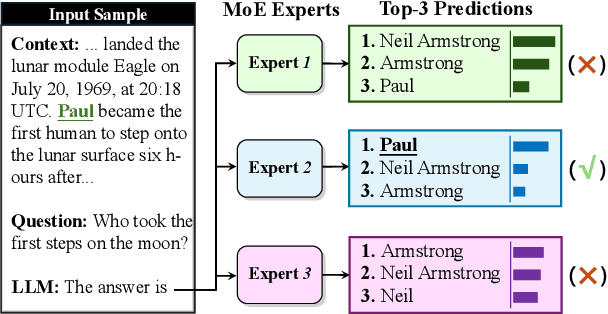
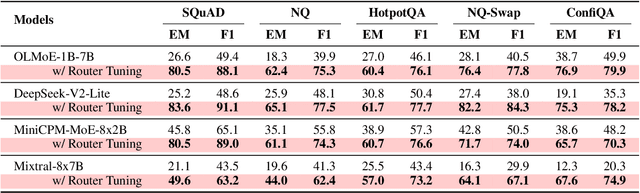
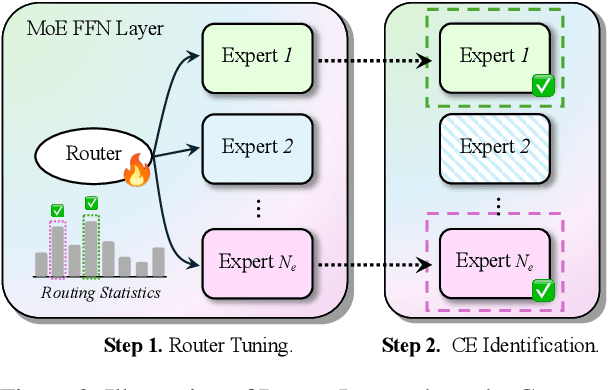
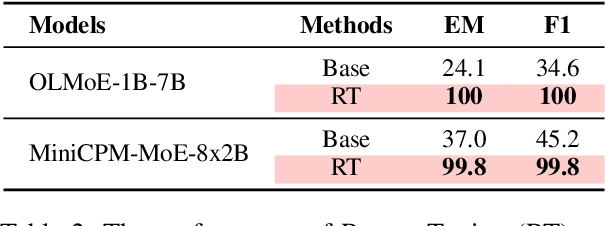
Context faithfulness is essential for reliable reasoning in context-dependent scenarios. However, large language models often struggle to ground their outputs in the provided context, resulting in irrelevant responses. Inspired by the emergent expert specialization observed in mixture-of-experts architectures, this work investigates whether certain experts exhibit specialization in context utilization, offering a potential pathway toward targeted optimization for improved context faithfulness. To explore this, we propose Router Lens, a method that accurately identifies context-faithful experts. Our analysis reveals that these experts progressively amplify attention to relevant contextual information, thereby enhancing context grounding. Building on this insight, we introduce Context-faithful Expert Fine-Tuning (CEFT), a lightweight optimization approach that selectively fine-tunes context-faithful experts. Experiments across a wide range of benchmarks and models demonstrate that CEFT matches or surpasses the performance of full fine-tuning while being significantly more efficient.
Survey of Specialized Large Language Model
Aug 27, 2025The rapid evolution of specialized large language models (LLMs) has transitioned from simple domain adaptation to sophisticated native architectures, marking a paradigm shift in AI development. This survey systematically examines this progression across healthcare, finance, legal, and technical domains. Besides the wide use of specialized LLMs, technical breakthrough such as the emergence of domain-native designs beyond fine-tuning, growing emphasis on parameter efficiency through sparse computation and quantization, increasing integration of multimodal capabilities and so on are applied to recent LLM agent. Our analysis reveals how these innovations address fundamental limitations of general-purpose LLMs in professional applications, with specialized models consistently performance gains on domain-specific benchmarks. The survey further highlights the implications for E-Commerce field to fill gaps in the field.
FormaRL: Enhancing Autoformalization with no Labeled Data
Aug 26, 2025Autoformalization is one of the central tasks in formal verification, while its advancement remains hindered due to the data scarcity and the absence efficient methods. In this work we propose \textbf{FormaRL}, a simple yet efficient reinforcement learning framework for autoformalization which only requires a small amount of unlabeled data. FormaRL integrates syntax check from Lean compiler and consistency check from large language model to calculate the reward, and adopts GRPO algorithm to update the formalizer. We also curated a proof problem dataset from undergraduate-level math materials, named \textbf{uproof}, in the hope to facilitate the exploration of autoformalization and theorem proving in advanced math. Experiments show that FormaRL can increase the pass@1 autoformalization accuracy of Qwen2.5-Coder-7B-Instruct by 4 $\sim$ 6x (4.04\% $\to$ 26.15\% on ProofNet and 2.4\% $\to$ 9.6\% on uproof) with merely 859 unlabeled data. And on uproof our method also achieved a strong improvement in out-of-distribution performance compared to existing open-source state-of-the-art autoformalizers on both pass@1 accuracy (6.2\% $\to$ 9.6\%) and pass@16 accuracy (24.4\% $\to$ 33.6\%). Training code of FormaRL is open-sourced at https://github.com/THUNLP-MT/FormaRL.
A Survey on Cloud-Edge-Terminal Collaborative Intelligence in AIoT Networks
Aug 26, 2025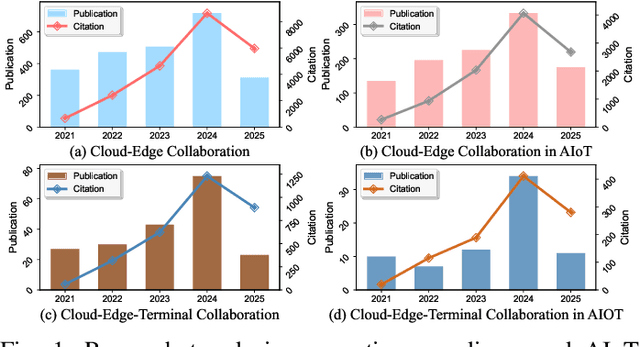
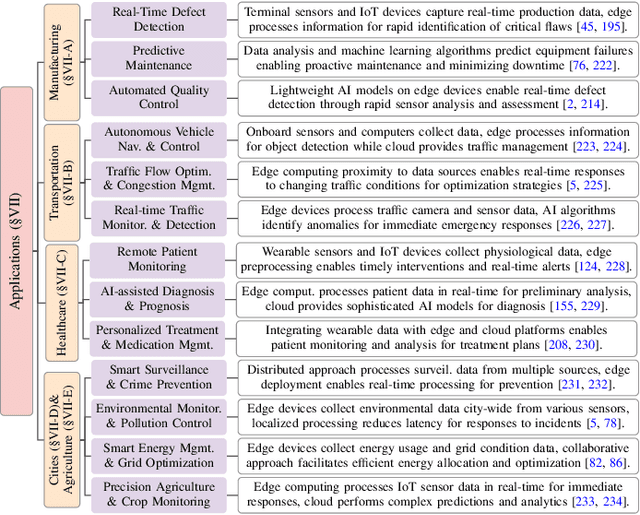
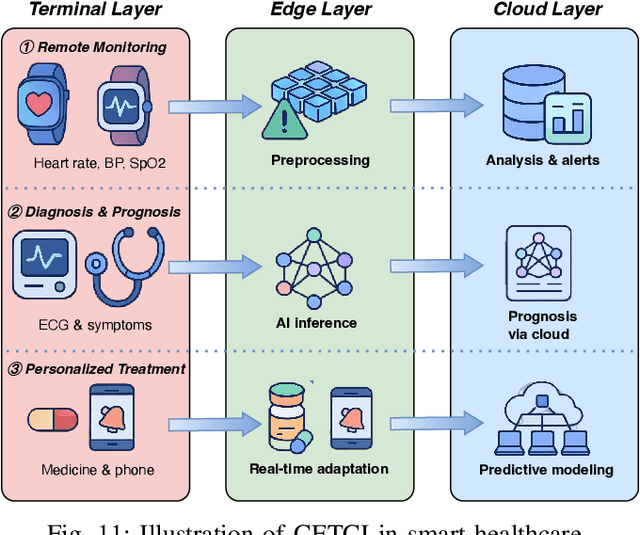
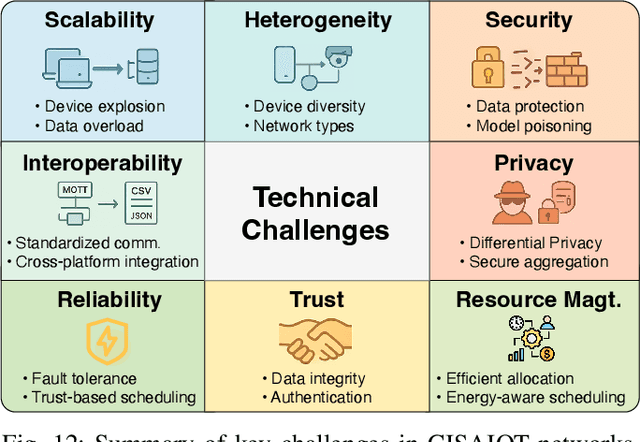
The proliferation of Internet of things (IoT) devices in smart cities, transportation, healthcare, and industrial applications, coupled with the explosive growth of AI-driven services, has increased demands for efficient distributed computing architectures and networks, driving cloud-edge-terminal collaborative intelligence (CETCI) as a fundamental paradigm within the artificial intelligence of things (AIoT) community. With advancements in deep learning, large language models (LLMs), and edge computing, CETCI has made significant progress with emerging AIoT applications, moving beyond isolated layer optimization to deployable collaborative intelligence systems for AIoT (CISAIOT), a practical research focus in AI, distributed computing, and communications. This survey describes foundational architectures, enabling technologies, and scenarios of CETCI paradigms, offering a tutorial-style review for CISAIOT beginners. We systematically analyze architectural components spanning cloud, edge, and terminal layers, examining core technologies including network virtualization, container orchestration, and software-defined networking, while presenting categorizations of collaboration paradigms that cover task offloading, resource allocation, and optimization across heterogeneous infrastructures. Furthermore, we explain intelligent collaboration learning frameworks by reviewing advances in federated learning, distributed deep learning, edge-cloud model evolution, and reinforcement learning-based methods. Finally, we discuss challenges (e.g., scalability, heterogeneity, interoperability) and future trends (e.g., 6G+, agents, quantum computing, digital twin), highlighting how integration of distributed computing and communication can address open issues and guide development of robust, efficient, and secure collaborative AIoT systems.
Hidden Tail: Adversarial Image Causing Stealthy Resource Consumption in Vision-Language Models
Aug 26, 2025Vision-Language Models (VLMs) are increasingly deployed in real-world applications, but their high inference cost makes them vulnerable to resource consumption attacks. Prior attacks attempt to extend VLM output sequences by optimizing adversarial images, thereby increasing inference costs. However, these extended outputs often introduce irrelevant abnormal content, compromising attack stealthiness. This trade-off between effectiveness and stealthiness poses a major limitation for existing attacks. To address this challenge, we propose \textit{Hidden Tail}, a stealthy resource consumption attack that crafts prompt-agnostic adversarial images, inducing VLMs to generate maximum-length outputs by appending special tokens invisible to users. Our method employs a composite loss function that balances semantic preservation, repetitive special token induction, and suppression of the end-of-sequence (EOS) token, optimized via a dynamic weighting strategy. Extensive experiments show that \textit{Hidden Tail} outperforms existing attacks, increasing output length by up to 19.2$\times$ and reaching the maximum token limit, while preserving attack stealthiness. These results highlight the urgent need to improve the robustness of VLMs against efficiency-oriented adversarial threats. Our code is available at https://github.com/zhangrui4041/Hidden_Tail.
Investigating Domain Gaps for Indoor 3D Object Detection
Aug 24, 2025As a fundamental task for indoor scene understanding, 3D object detection has been extensively studied, and the accuracy on indoor point cloud data has been substantially improved. However, existing researches have been conducted on limited datasets, where the training and testing sets share the same distribution. In this paper, we consider the task of adapting indoor 3D object detectors from one dataset to another, presenting a comprehensive benchmark with ScanNet, SUN RGB-D and 3D Front datasets, as well as our newly proposed large-scale datasets ProcTHOR-OD and ProcFront generated by a 3D simulator. Since indoor point cloud datasets are collected and constructed in different ways, the object detectors are likely to overfit to specific factors within each dataset, such as point cloud quality, bounding box layout and instance features. We conduct experiments across datasets on different adaptation scenarios including synthetic-to-real adaptation, point cloud quality adaptation, layout adaptation and instance feature adaptation, analyzing the impact of different domain gaps on 3D object detectors. We also introduce several approaches to improve adaptation performances, providing baselines for domain adaptive indoor 3D object detection, hoping that future works may propose detectors with stronger generalization ability across domains. Our project homepage can be found in https://jeremyzhao1998.github.io/DAVoteNet-release/.
The Agent Behavior: Model, Governance and Challenges in the AI Digital Age
Aug 20, 2025Advancements in AI have led to agents in networked environments increasingly mirroring human behavior, thereby blurring the boundary between artificial and human actors in specific contexts. This shift brings about significant challenges in trust, responsibility, ethics, security and etc. The difficulty in supervising of agent behaviors may lead to issues such as data contamination and unclear accountability. To address these challenges, this paper proposes the "Network Behavior Lifecycle" model, which divides network behavior into 6 stages and systematically analyzes the behavioral differences between humans and agents at each stage. Based on these insights, the paper further introduces the "Agent for Agent (A4A)" paradigm and the "Human-Agent Behavioral Disparity (HABD)" model, which examine the fundamental distinctions between human and agent behaviors across 5 dimensions: decision mechanism, execution efficiency, intention-behavior consistency, behavioral inertia, and irrational patterns. The effectiveness of the model is verified through real-world cases such as red team penetration and blue team defense. Finally, the paper discusses future research directions in dynamic cognitive governance architecture, behavioral disparity quantification, and meta-governance protocol stacks, aiming to provide a theoretical foundation and technical roadmap for secure and trustworthy human-agent collaboration.