 Add to Chrome
 Add to Firefox
 Add to Edge
Multi-Channel Differential ASR for Robust Wearer Speech Recognition on Smart Glasses
Sep 17, 2025
With the growing adoption of wearable devices such as smart glasses for AI assistants, wearer speech recognition (WSR) is becoming increasingly critical to next-generation human-computer interfaces. However, in real environments, interference from side-talk speech remains a significant challenge to WSR and may cause accumulated errors for downstream tasks such as natural language processing. In this work, we introduce a novel multi-channel differential automatic speech recognition (ASR) method for robust WSR on smart glasses. The proposed system takes differential inputs from different frontends that complement each other to improve the robustness of WSR, including a beamformer, microphone selection, and a lightweight side-talk detection model. Evaluations on both simulated and real datasets demonstrate that the proposed system outperforms the traditional approach, achieving up to an 18.0% relative reduction in word error rate.

Do LLMs Align Human Values Regarding Social Biases? Judging and Explaining Social Biases with LLMs
Sep 17, 2025Large language models (LLMs) can lead to undesired consequences when misaligned with human values, especially in scenarios involving complex and sensitive social biases. Previous studies have revealed the misalignment of LLMs with human values using expert-designed or agent-based emulated bias scenarios. However, it remains unclear whether the alignment of LLMs with human values differs across different types of scenarios (e.g., scenarios containing negative vs. non-negative questions). In this study, we investigate the alignment of LLMs with human values regarding social biases (HVSB) in different types of bias scenarios. Through extensive analysis of 12 LLMs from four model families and four datasets, we demonstrate that LLMs with large model parameter scales do not necessarily have lower misalignment rate and attack success rate. Moreover, LLMs show a certain degree of alignment preference for specific types of scenarios and the LLMs from the same model family tend to have higher judgment consistency. In addition, we study the understanding capacity of LLMs with their explanations of HVSB. We find no significant differences in the understanding of HVSB across LLMs. We also find LLMs prefer their own generated explanations. Additionally, we endow smaller language models (LMs) with the ability to explain HVSB. The generation results show that the explanations generated by the fine-tuned smaller LMs are more readable, but have a relatively lower model agreeability.
Bridging Perception and Planning: Towards End-to-End Planning for Signal Temporal Logic Tasks
Sep 16, 2025We investigate the task and motion planning problem for Signal Temporal Logic (STL) specifications in robotics. Existing STL methods rely on pre-defined maps or mobility representations, which are ineffective in unstructured real-world environments. We propose the \emph{Structured-MoE STL Planner} (\textbf{S-MSP}), a differentiable framework that maps synchronized multi-view camera observations and an STL specification directly to a feasible trajectory. S-MSP integrates STL constraints within a unified pipeline, trained with a composite loss that combines trajectory reconstruction and STL robustness. A \emph{structure-aware} Mixture-of-Experts (MoE) model enables horizon-aware specialization by projecting sub-tasks into temporally anchored embeddings. We evaluate S-MSP using a high-fidelity simulation of factory-logistics scenarios with temporally constrained tasks. Experiments show that S-MSP outperforms single-expert baselines in STL satisfaction and trajectory feasibility. A rule-based \emph{safety filter} at inference improves physical executability without compromising logical correctness, showcasing the practicality of the approach.
RepIt: Representing Isolated Targets to Steer Language Models
Sep 16, 2025While activation steering in large language models (LLMs) is a growing area of research, methods can often incur broader effects than desired. This motivates isolation of purer concept vectors to enable targeted interventions and understand LLM behavior at a more granular level. We present RepIt, a simple and data-efficient framework for isolating concept-specific representations. Across five frontier LLMs, RepIt enables precise interventions: it selectively suppresses refusal on targeted concepts while preserving refusal elsewhere, producing models that answer WMD-related questions while still scoring as safe on standard benchmarks. We further show that the corrective signal localizes to just 100-200 neurons and that robust target representations can be extracted from as few as a dozen examples on a single A6000. This efficiency raises a dual concern: manipulations can be performed with modest compute and data to extend to underrepresented data-scarce topics while evading existing benchmarks. By disentangling refusal vectors with RepIt, this work demonstrates that targeted interventions can counteract overgeneralization, laying the foundation for more granular control of model behavior.
Symmetry Interactive Transformer with CNN Framework for Diagnosis of Alzheimer's Disease Using Structural MRI
Sep 10, 2025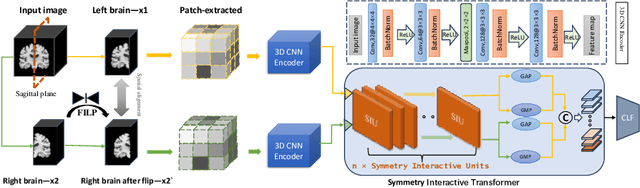
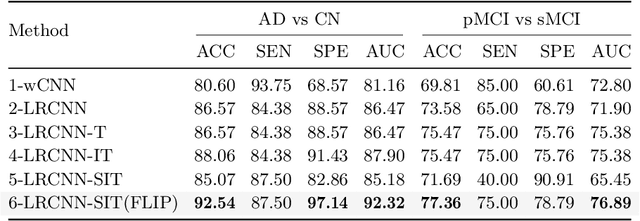
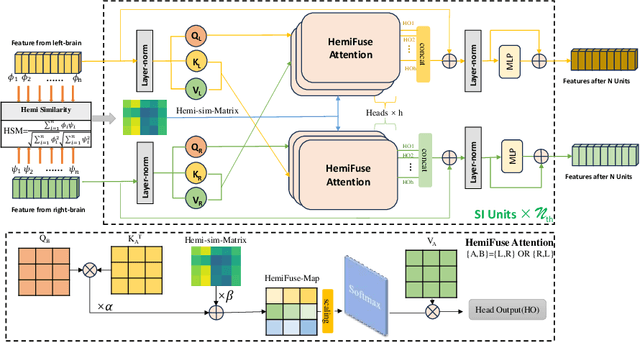
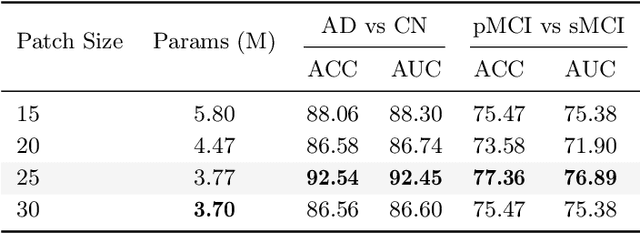
Structural magnetic resonance imaging (sMRI) combined with deep learning has achieved remarkable progress in the prediction and diagnosis of Alzheimer's disease (AD). Existing studies have used CNN and transformer to build a well-performing network, but most of them are based on pretraining or ignoring the asymmetrical character caused by brain disorders. We propose an end-to-end network for the detection of disease-based asymmetric induced by left and right brain atrophy which consist of 3D CNN Encoder and Symmetry Interactive Transformer (SIT). Following the inter-equal grid block fetch operation, the corresponding left and right hemisphere features are aligned and subsequently fed into the SIT for diagnostic analysis. SIT can help the model focus more on the regions of asymmetry caused by structural changes, thus improving diagnostic performance. We evaluated our method based on the ADNI dataset, and the results show that the method achieves better diagnostic accuracy (92.5\%) compared to several CNN methods and CNNs combined with a general transformer. The visualization results show that our network pays more attention in regions of brain atrophy, especially for the asymmetric pathological characteristics induced by AD, demonstrating the interpretability and effectiveness of the method.
AdsQA: Towards Advertisement Video Understanding
Sep 10, 2025Large language models (LLMs) have taken a great step towards AGI. Meanwhile, an increasing number of domain-specific problems such as math and programming boost these general-purpose models to continuously evolve via learning deeper expertise. Now is thus the time further to extend the diversity of specialized applications for knowledgeable LLMs, though collecting high quality data with unexpected and informative tasks is challenging. In this paper, we propose to use advertisement (ad) videos as a challenging test-bed to probe the ability of LLMs in perceiving beyond the objective physical content of common visual domain. Our motivation is to take full advantage of the clue-rich and information-dense ad videos' traits, e.g., marketing logic, persuasive strategies, and audience engagement. Our contribution is three-fold: (1) To our knowledge, this is the first attempt to use ad videos with well-designed tasks to evaluate LLMs. We contribute AdsQA, a challenging ad Video QA benchmark derived from 1,544 ad videos with 10,962 clips, totaling 22.7 hours, providing 5 challenging tasks. (2) We propose ReAd-R, a Deepseek-R1 styled RL model that reflects on questions, and generates answers via reward-driven optimization. (3) We benchmark 14 top-tier LLMs on AdsQA, and our \texttt{ReAd-R}~achieves the state-of-the-art outperforming strong competitors equipped with long-chain reasoning capabilities by a clear margin.
Focus Through Motion: RGB-Event Collaborative Token Sparsification for Efficient Object Detection
Sep 04, 2025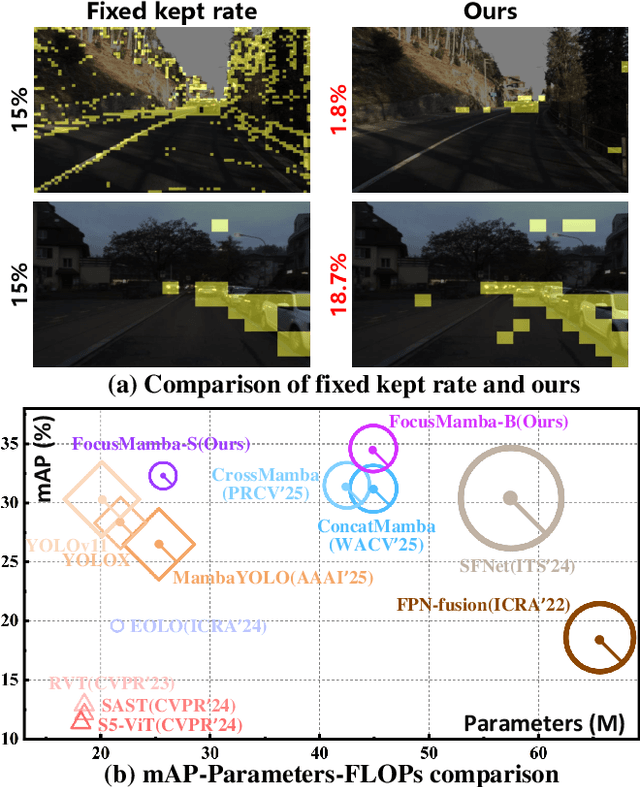
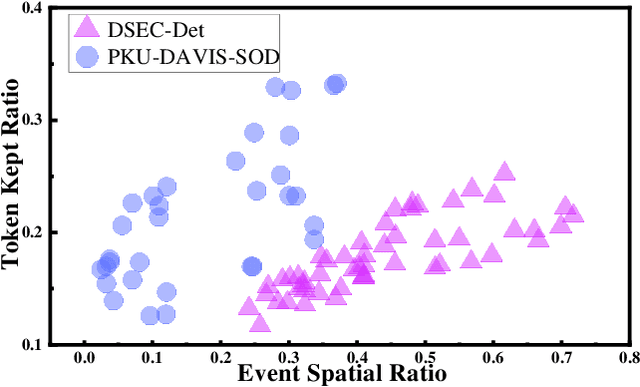
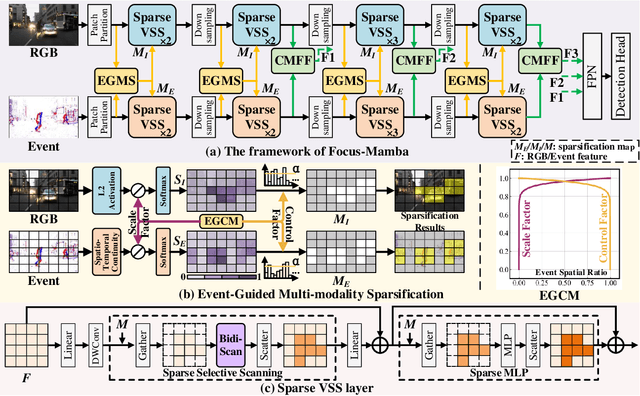
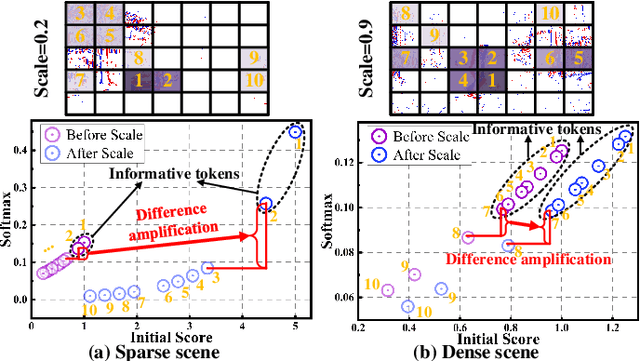
Existing RGB-Event detection methods process the low-information regions of both modalities (background in images and non-event regions in event data) uniformly during feature extraction and fusion, resulting in high computational costs and suboptimal performance. To mitigate the computational redundancy during feature extraction, researchers have respectively proposed token sparsification methods for the image and event modalities. However, these methods employ a fixed number or threshold for token selection, hindering the retention of informative tokens for samples with varying complexity. To achieve a better balance between accuracy and efficiency, we propose FocusMamba, which performs adaptive collaborative sparsification of multimodal features and efficiently integrates complementary information. Specifically, an Event-Guided Multimodal Sparsification (EGMS) strategy is designed to identify and adaptively discard low-information regions within each modality by leveraging scene content changes perceived by the event camera. Based on the sparsification results, a Cross-Modality Focus Fusion (CMFF) module is proposed to effectively capture and integrate complementary features from both modalities. Experiments on the DSEC-Det and PKU-DAVIS-SOD datasets demonstrate that the proposed method achieves superior performance in both accuracy and efficiency compared to existing methods. The code will be available at https://github.com/Zizzzzzzz/FocusMamba.
Skywork UniPic 2.0: Building Kontext Model with Online RL for Unified Multimodal Model
Sep 04, 2025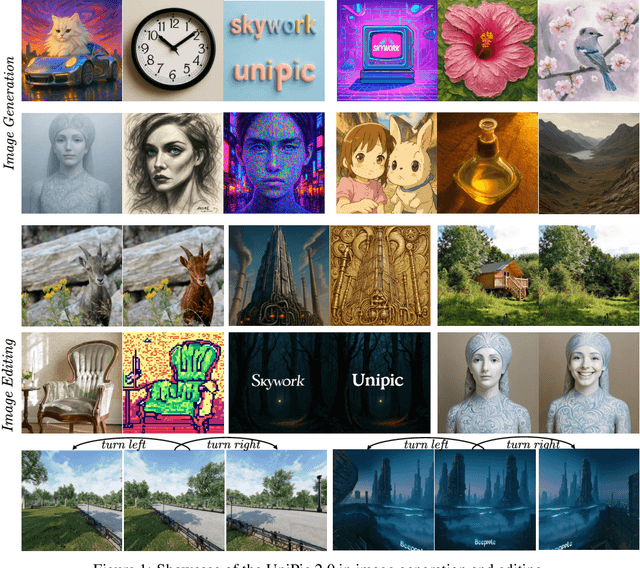
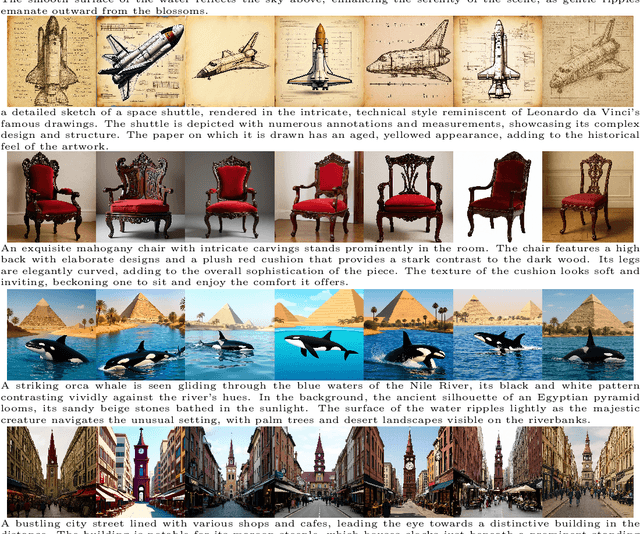
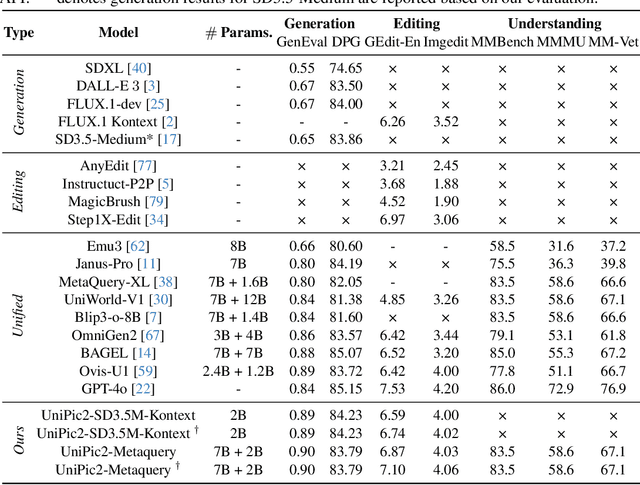
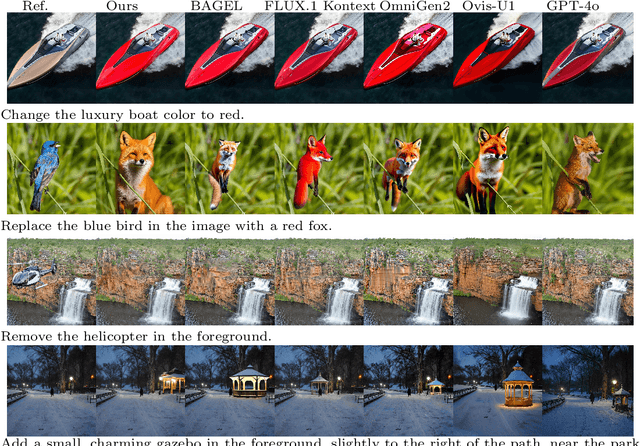
Recent advances in multimodal models have demonstrated impressive capabilities in unified image generation and editing. However, many prominent open-source models prioritize scaling model parameters over optimizing training strategies, limiting their efficiency and performance. In this work, we present UniPic2-SD3.5M-Kontext, a 2B-parameter DiT model based on SD3.5-Medium, which achieves state-of-the-art image generation and editing while extending seamlessly into a unified multimodal framework. Our approach begins with architectural modifications to SD3.5-Medium and large-scale pre-training on high-quality data, enabling joint text-to-image generation and editing capabilities. To enhance instruction following and editing consistency, we propose a novel Progressive Dual-Task Reinforcement strategy (PDTR), which effectively strengthens both tasks in a staged manner. We empirically validate that the reinforcement phases for different tasks are mutually beneficial and do not induce negative interference. After pre-training and reinforcement strategies, UniPic2-SD3.5M-Kontext demonstrates stronger image generation and editing capabilities than models with significantly larger generation parameters-including BAGEL (7B) and Flux-Kontext (12B). Furthermore, following the MetaQuery, we connect the UniPic2-SD3.5M-Kontext and Qwen2.5-VL-7B via a connector and perform joint training to launch a unified multimodal model UniPic2-Metaquery. UniPic2-Metaquery integrates understanding, generation, and editing, achieving top-tier performance across diverse tasks with a simple and scalable training paradigm. This consistently validates the effectiveness and generalizability of our proposed training paradigm, which we formalize as Skywork UniPic 2.0.
Inverse IFEval: Can LLMs Unlearn Stubborn Training Conventions to Follow Real Instructions?
Sep 04, 2025Large Language Models (LLMs) achieve strong performance on diverse tasks but often exhibit cognitive inertia, struggling to follow instructions that conflict with the standardized patterns learned during supervised fine-tuning (SFT). To evaluate this limitation, we propose Inverse IFEval, a benchmark that measures models Counter-intuitive Abilitytheir capacity to override training-induced biases and comply with adversarial instructions. Inverse IFEval introduces eight types of such challenges, including Question Correction, Intentional Textual Flaws, Code without Comments, and Counterfactual Answering. Using a human-in-the-loop pipeline, we construct a dataset of 1012 high-quality Chinese and English questions across 23 domains, evaluated under an optimized LLM-as-a-Judge framework. Experiments on existing leading LLMs demonstrate the necessity of our proposed Inverse IFEval benchmark. Our findings emphasize that future alignment efforts should not only pursue fluency and factual correctness but also account for adaptability under unconventional contexts. We hope that Inverse IFEval serves as both a diagnostic tool and a foundation for developing methods that mitigate cognitive inertia, reduce overfitting to narrow patterns, and ultimately enhance the instruction-following reliability of LLMs in diverse and unpredictable real-world scenarios.
We Have It Covered: A Resampling-based Method for Uplift Model Comparison
Sep 04, 2025Uplift models play a critical role in modern marketing applications to help understand the incremental benefits of interventions and identify optimal targeting strategies. A variety of techniques exist for building uplift models, and it is essential to understand the model differences in the context of intended applications. The uplift curve is a widely adopted tool for assessing uplift model performance on the selection universe when observations are available for the entire population. However, when it is uneconomical or infeasible to select the entire population, it becomes difficult or even impossible to estimate the uplift curve without appropriate sampling design. To the best of our knowledge, no prior work has addressed uncertainty quantification of uplift curve estimates, which is essential for model comparisons. We propose a two-step sampling procedure and a resampling-based approach to compare uplift models with uncertainty quantification, examine the proposed method via simulations and real data applications, and conclude with a discussion.