 Add to Chrome
 Add to Firefox
 Add to Edge
Matrix-Game 3.0: Real-Time and Streaming Interactive World Model with Long-Horizon Memory
Apr 13, 2026
With the advancement of interactive video generation, diffusion models have increasingly demonstrated their potential as world models. However, existing approaches still struggle to simultaneously achieve memory-enabled long-term temporal consistency and high-resolution real-time generation, limiting their applicability in real-world scenarios. To address this, we present Matrix-Game 3.0, a memory-augmented interactive world model designed for 720p real-time longform video generation. Building upon Matrix-Game 2.0, we introduce systematic improvements across data, model, and inference. First, we develop an upgraded industrial-scale infinite data engine that integrates Unreal Engine-based synthetic data, large-scale automated collection from AAA games, and real-world video augmentation to produce high-quality Video-Pose-Action-Prompt quadruplet data at scale. Second, we propose a training framework for long-horizon consistency: by modeling prediction residuals and re-injecting imperfect generated frames during training, the base model learns self-correction; meanwhile, camera-aware memory retrieval and injection enable the base model to achieve long horizon spatiotemporal consistency. Third, we design a multi-segment autoregressive distillation strategy based on Distribution Matching Distillation (DMD), combined with model quantization and VAE decoder pruning, to achieve efficient real-time inference. Experimental results show that Matrix-Game 3.0 achieves up to 40 FPS real-time generation at 720p resolution with a 5B model, while maintaining stable memory consistency over minute-long sequences. Scaling up to a 2x14B model further improves generation quality, dynamics, and generalization. Our approach provides a practical pathway toward industrial-scale deployable world models.

Skywork UniPic 2.0: Building Kontext Model with Online RL for Unified Multimodal Model
Sep 04, 2025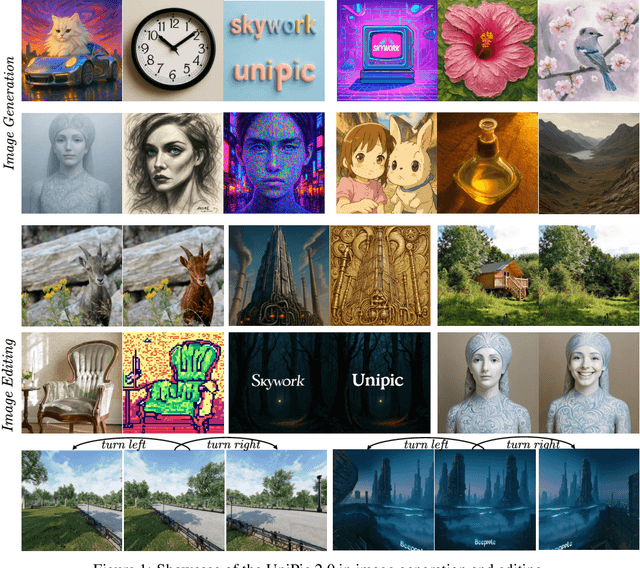
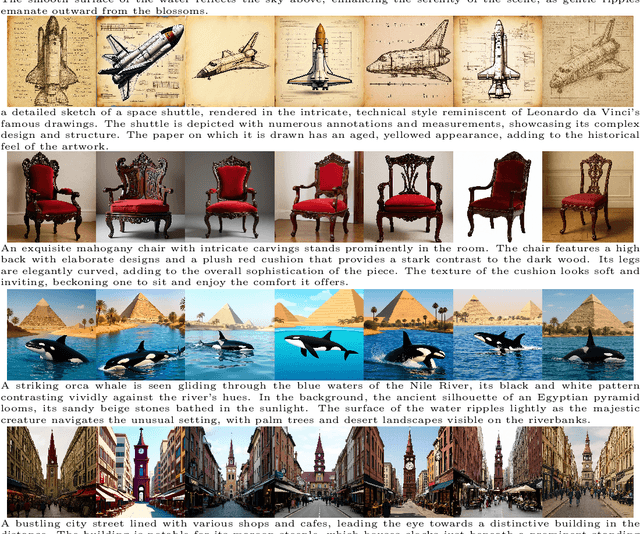
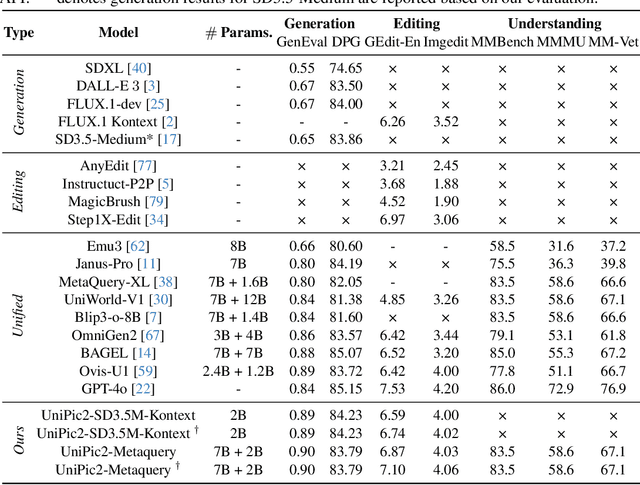
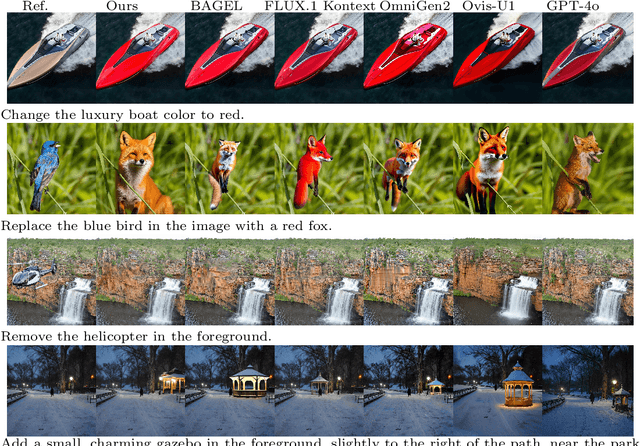
Recent advances in multimodal models have demonstrated impressive capabilities in unified image generation and editing. However, many prominent open-source models prioritize scaling model parameters over optimizing training strategies, limiting their efficiency and performance. In this work, we present UniPic2-SD3.5M-Kontext, a 2B-parameter DiT model based on SD3.5-Medium, which achieves state-of-the-art image generation and editing while extending seamlessly into a unified multimodal framework. Our approach begins with architectural modifications to SD3.5-Medium and large-scale pre-training on high-quality data, enabling joint text-to-image generation and editing capabilities. To enhance instruction following and editing consistency, we propose a novel Progressive Dual-Task Reinforcement strategy (PDTR), which effectively strengthens both tasks in a staged manner. We empirically validate that the reinforcement phases for different tasks are mutually beneficial and do not induce negative interference. After pre-training and reinforcement strategies, UniPic2-SD3.5M-Kontext demonstrates stronger image generation and editing capabilities than models with significantly larger generation parameters-including BAGEL (7B) and Flux-Kontext (12B). Furthermore, following the MetaQuery, we connect the UniPic2-SD3.5M-Kontext and Qwen2.5-VL-7B via a connector and perform joint training to launch a unified multimodal model UniPic2-Metaquery. UniPic2-Metaquery integrates understanding, generation, and editing, achieving top-tier performance across diverse tasks with a simple and scalable training paradigm. This consistently validates the effectiveness and generalizability of our proposed training paradigm, which we formalize as Skywork UniPic 2.0.