 Add to Chrome
 Add to Firefox
 Add to Edge
ClawGym II: Exploring Black-Box RL on Agent Harness
Aug 17, 2026
Agent harnesses have substantially improved performance on long-horizon tasks by coordinating agent interactions with the environment. However, reinforcement learning through complex harnesses remains largely unexplored, as scaling such training to long-horizon agent tasks introduces fundamental challenges. In this work, we present a unified black-box RL framework for stable and scalable optimization of general agents through complex harnesses. Concretely, we first build a sandbox-based execution infrastructure that isolates task environments and harnesses within temporary sandboxes for large-scale concurrent rollouts. We then decouple policy optimization from opaque harness execution and place a serving proxy at the model boundary to capture model calls. To reconstruct multi-turn trajectories and improve training efficiency, we organize the captured calls into prefix trees and further adapt both critic-based PPO and critic-free GRPO to optimize over the recovered tree structure. Meanwhile, we maintain training-inference consistency throughout the optimization process. Finally, we introduce mix-harness training, allowing a single model to be jointly optimized by heterogeneous harnesses. With Qwen3-30A3B, black-box RL improves Pass@1 on ClawGym-Bench by 9.98 and 14.81 points through OpenClaw and Claude Code, respectively, while remaining stable over 200-400 optimization steps. Moreover, the framework yields consistent gains on more challenging tasks such as JobBench and OfficeQA. Overall, our framework enables effective, stable, and scalable optimization of general agents through black-box harnesses, supporting unified training across heterogeneous execution systems.

ClinFusion: A Vision-Centric Multimodal LLM System for Holistic Medical Understanding
Jul 27, 2026Multimodal large language models (MLLMs) hold immense potential to revolutionize clinical practice, yet deploying them in the medical domain is fundamentally a vision-centric challenge: models must absorb knowledge from heterogeneous 2D and 3D medical images, and evaluation protocols must align with radiologists' clinical practice and provide an accurate, fine-grained and factualness-driven assessment. In this paper, we introduce ClinFusion, a vision-centric MLLM designed for holistic medical understanding that systematically addresses these limitations. We propose a compositional and cascaded vision encoder architecture featuring a Cascade Spatial-Aware Locality Fusion operator that unifies diverse 2D and native 3D medical image understanding within a fused encoder. We further introduce a vision-grounded evaluation framework, including MedIF-Bench for instruction-following assessment and a region-of-interest-grounded method for clinically aligned and factualness-driven report generation evaluation. We show that ClinFusion sets a new state-of-the-art across a comprehensive suite of 2D and 3D multimodal medical benchmarks---spanning visual question answering, report generation, and instruction following---as well as textual medical tasks, outperforming leading open-source medical MLLMs (\textit{e.g.}, Hulu-Med, Lingshu) on 20 out of 24 benchmarks and demonstrating multimodal capabilities better than powerful proprietary models such as GPT-5.2 and Gemini-3-Flash on 13 out of 16 benchmarks, and can be further augmented with agentic tool use for retrieval-augmented and tool-assisted clinical workflows. A blinded evaluation by board-certified radiologists confirms that ClinFusion produces the highest-ranked reports, and validates our RoI-grounded metric as achieving the strongest correlation with expert judgment among all automatic evaluation metrics examined.
LoopCoder-v2: Only Loop Once for Efficient Test-Time Computation Scaling
Jun 16, 2026Looped Transformers scale latent computation by repeatedly applying shared blocks, but sequential looping increases latency and KV-cache memory with the loop count. Parallel loop Transformers (PLT) alleviate this cost through cross-loop position offsets (CLP) and shared-KV gated sliding-window attention, making loop count a practical design choice. We therefore study PLT loop-count selection through a gain--cost view: an extra loop may refine representations, but CLP also introduces a positional mismatch at each loop boundary. We instantiate this study by training LoopCoder-v2, a family of 7B PLT coders with different loop counts, from scratch on 18T tokens, followed by matched instruction tuning and evaluation. Empirically, the two-loop variant delivers broad gains over the non-looped baseline across code generation, code reasoning, agentic software engineering, and tool-use benchmarks, improving SWE-bench Verified from 43.0 to 64.4 points and Multi-SWE from 14.0 to 31.0 points. In contrast, variants with three or more loops regress, revealing a strongly non-monotonic loop-count effect. Our diagnostics show that loop 2 provides the main productive refinement, while later loops yield diminishing, oscillatory updates and reduced representational diversity. Because the CLP-induced mismatch remains roughly fixed as refinement gains shrink, the offset cost increasingly dominates. This gain--cost trade-off explains PLT's saturation at two loops and provides diagnostics for loop-count selection.
InCoder-32B-Thinking: Industrial Code World Model for Thinking
Apr 03, 2026Industrial software development across chip design, GPU optimization, and embedded systems lacks expert reasoning traces showing how engineers reason about hardware constraints and timing semantics. In this work, we propose InCoder-32B-Thinking, trained on the data from the Error-driven Chain-of-Thought (ECoT) synthesis framework with an industrial code world model (ICWM) to generate reasoning traces. Specifically, ECoT generates reasoning chains by synthesizing the thinking content from multi-turn dialogue with environmental error feedback, explicitly modeling the error-correction process. ICWM is trained on domain-specific execution traces from Verilog simulation, GPU profiling, etc., learns the causal dynamics of how code affects hardware behavior, and enables self-verification by predicting execution outcomes before actual compilation. All synthesized reasoning traces are validated through domain toolchains, creating training data matching the natural reasoning depth distribution of industrial tasks. Evaluation on 14 general (81.3% on LiveCodeBench v5) and 9 industrial benchmarks (84.0% in CAD-Coder and 38.0% on KernelBench) shows InCoder-32B-Thinking achieves top-tier open-source results across all domains.GPU Optimization
IQuest-Coder-V1 Technical Report
Mar 17, 2026In this report, we introduce the IQuest-Coder-V1 series-(7B/14B/40B/40B-Loop), a new family of code large language models (LLMs). Moving beyond static code representations, we propose the code-flow multi-stage training paradigm, which captures the dynamic evolution of software logic through different phases of the pipeline. Our models are developed through the evolutionary pipeline, starting with the initial pre-training consisting of code facts, repository, and completion data. Following that, we implement a specialized mid-training stage that integrates reasoning and agentic trajectories in 32k-context and repository-scale in 128k-context to forge deep logical foundations. The models are then finalized with post-training of specialized coding capabilities, which is bifurcated into two specialized paths: the thinking path (utilizing reasoning-driven RL) and the instruct path (optimized for general assistance). IQuest-Coder-V1 achieves state-of-the-art performance among competitive models across critical dimensions of code intelligence: agentic software engineering, competitive programming, and complex tool use. To address deployment constraints, the IQuest-Coder-V1-Loop variant introduces a recurrent mechanism designed to optimize the trade-off between model capacity and deployment footprint, offering an architecturally enhanced path for efficacy-efficiency trade-off. We believe the release of the IQuest-Coder-V1 series, including the complete white-box chain of checkpoints from pre-training bases to the final thinking and instruction models, will advance research in autonomous code intelligence and real-world agentic systems.
3D-SSM: A Novel 3D Selective Scan Module for Remote Sensing Change Detection
Jun 24, 2025Existing Mamba-based approaches in remote sensing change detection have enhanced scanning models, yet remain limited by their inability to capture long-range dependencies between image channels effectively, which restricts their feature representation capabilities. To address this limitation, we propose a 3D selective scan module (3D-SSM) that captures global information from both the spatial plane and channel perspectives, enabling a more comprehensive understanding of the data.Based on the 3D-SSM, we present two key components: a spatiotemporal interaction module (SIM) and a multi-branch feature extraction module (MBFEM). The SIM facilitates bi-temporal feature integration by enabling interactions between global and local features across images from different time points, thereby enhancing the detection of subtle changes. Meanwhile, the MBFEM combines features from the frequency domain, spatial domain, and 3D-SSM to provide a rich representation of contextual information within the image. Our proposed method demonstrates favourable performance compared to state-of-the-art change detection methods on five benchmark datasets through extensive experiments. Code is available at https://github.com/VerdantMist/3D-SSM
CEBSNet: Change-Excited and Background-Suppressed Network with Temporal Dependency Modeling for Bitemporal Change Detection
May 21, 2025Change detection, a critical task in remote sensing and computer vision, aims to identify pixel-level differences between image pairs captured at the same geographic area but different times. It faces numerous challenges such as illumination variation, seasonal changes, background interference, and shooting angles, especially with a large time gap between images. While current methods have advanced, they often overlook temporal dependencies and overemphasize prominent changes while ignoring subtle but equally important changes. To address these limitations, we introduce \textbf{CEBSNet}, a novel change-excited and background-suppressed network with temporal dependency modeling for change detection. During the feature extraction, we utilize a simple Channel Swap Module (CSM) to model temporal dependency, reducing differences and noise. The Feature Excitation and Suppression Module (FESM) is developed to capture both obvious and subtle changes, maintaining the integrity of change regions. Additionally, we design a Pyramid-Aware Spatial-Channel Attention module (PASCA) to enhance the ability to detect change regions at different sizes and focus on critical regions. We conduct extensive experiments on three common street view datasets and two remote sensing datasets, and our method achieves the state-of-the-art performance.
GTPC-SSCD: Gate-guided Two-level Perturbation Consistency-based Semi-Supervised Change Detection
Nov 28, 2024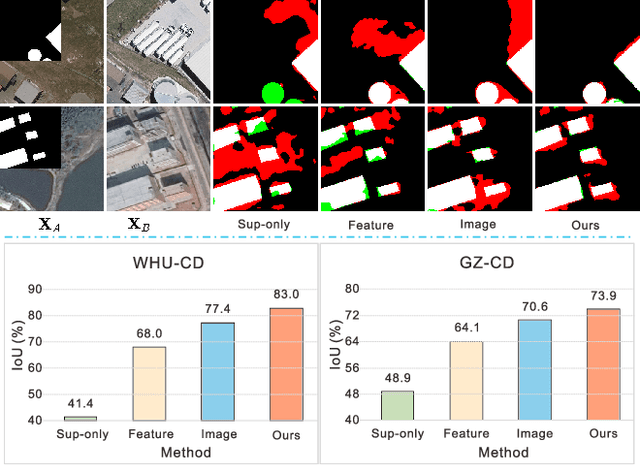
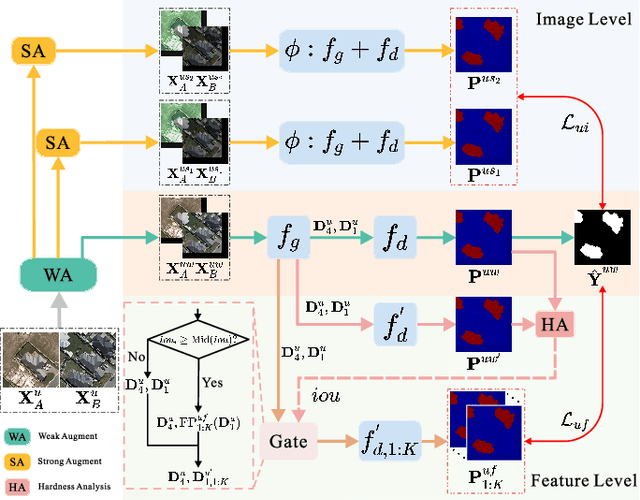
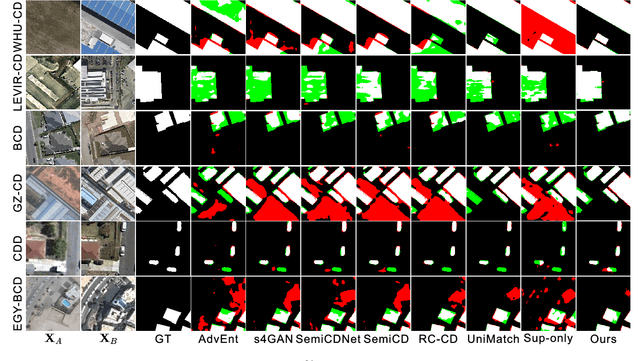
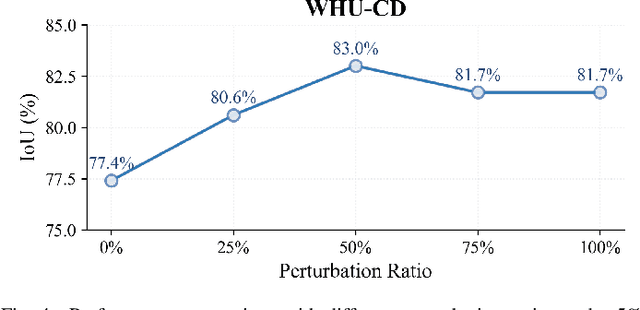
Semi-supervised change detection (SSCD) employs partially labeled data and a substantial amount of unlabeled data to identify differences between images captured in the same geographic area but at different times. However, existing consistency regularization-based SSCD methods only implement perturbations at a single level and can not exploit the full potential of unlabeled data. In this paper, we introduce a novel Gate-guided Two-level Perturbation Consistency regularization-based SSCD method (GTPC-SSCD), which simultaneously maintains strong-to-weak consistency at the image level and perturbation consistency at the feature level, thus effectively utilizing the unlabeled data. Moreover, a gate module is designed to evaluate the training complexity of different samples and determine the necessity of performing feature perturbations on each sample. This differential treatment enables the network to more effectively explore the potential of unlabeled data. Extensive experiments conducted on six public remote sensing change detection datasets demonstrate the superiority of our method over seven state-of-the-art SSCD methods.
FrameNeRF: A Simple and Efficient Framework for Few-shot Novel View Synthesis
Feb 26, 2024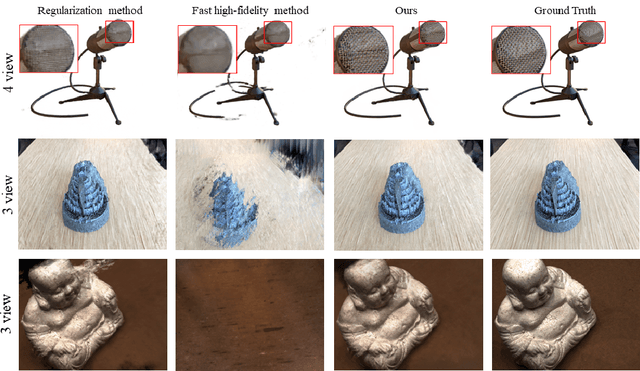
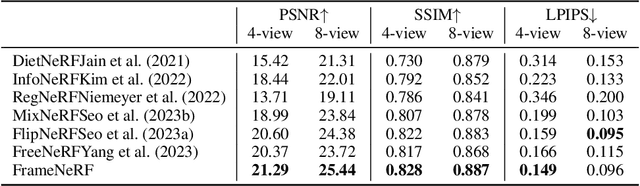
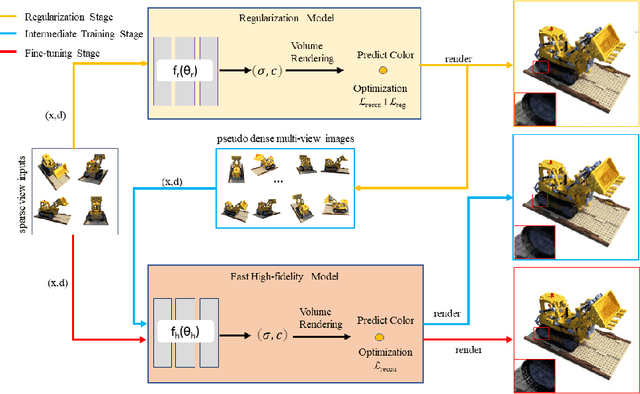
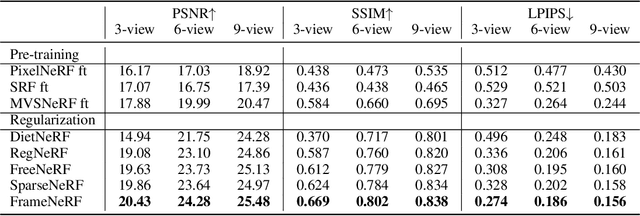
We present a novel framework, called FrameNeRF, designed to apply off-the-shelf fast high-fidelity NeRF models with fast training speed and high rendering quality for few-shot novel view synthesis tasks. The training stability of fast high-fidelity models is typically constrained to dense views, making them unsuitable for few-shot novel view synthesis tasks. To address this limitation, we utilize a regularization model as a data generator to produce dense views from sparse inputs, facilitating subsequent training of fast high-fidelity models. Since these dense views are pseudo ground truth generated by the regularization model, original sparse images are then used to fine-tune the fast high-fidelity model. This process helps the model learn realistic details and correct artifacts introduced in earlier stages. By leveraging an off-the-shelf regularization model and a fast high-fidelity model, our approach achieves state-of-the-art performance across various benchmark datasets.
A Saliency Enhanced Feature Fusion based multiscale RGB-D Salient Object Detection Network
Jan 22, 2024Multiscale convolutional neural network (CNN) has demonstrated remarkable capabilities in solving various vision problems. However, fusing features of different scales alwaysresults in large model sizes, impeding the application of multiscale CNNs in RGB-D saliency detection. In this paper, we propose a customized feature fusion module, called Saliency Enhanced Feature Fusion (SEFF), for RGB-D saliency detection. SEFF utilizes saliency maps of the neighboring scales to enhance the necessary features for fusing, resulting in more representative fused features. Our multiscale RGB-D saliency detector uses SEFF and processes images with three different scales. SEFF is used to fuse the features of RGB and depth images, as well as the features of decoders at different scales. Extensive experiments on five benchmark datasets have demonstrated the superiority of our method over ten SOTA saliency detectors.