 Add to Chrome
 Add to Firefox
 Add to Edge
InCoder-32B-Thinking: Industrial Code World Model for Thinking
Apr 03, 2026
Industrial software development across chip design, GPU optimization, and embedded systems lacks expert reasoning traces showing how engineers reason about hardware constraints and timing semantics. In this work, we propose InCoder-32B-Thinking, trained on the data from the Error-driven Chain-of-Thought (ECoT) synthesis framework with an industrial code world model (ICWM) to generate reasoning traces. Specifically, ECoT generates reasoning chains by synthesizing the thinking content from multi-turn dialogue with environmental error feedback, explicitly modeling the error-correction process. ICWM is trained on domain-specific execution traces from Verilog simulation, GPU profiling, etc., learns the causal dynamics of how code affects hardware behavior, and enables self-verification by predicting execution outcomes before actual compilation. All synthesized reasoning traces are validated through domain toolchains, creating training data matching the natural reasoning depth distribution of industrial tasks. Evaluation on 14 general (81.3% on LiveCodeBench v5) and 9 industrial benchmarks (84.0% in CAD-Coder and 38.0% on KernelBench) shows InCoder-32B-Thinking achieves top-tier open-source results across all domains.GPU Optimization

IQuest-Coder-V1 Technical Report
Mar 17, 2026In this report, we introduce the IQuest-Coder-V1 series-(7B/14B/40B/40B-Loop), a new family of code large language models (LLMs). Moving beyond static code representations, we propose the code-flow multi-stage training paradigm, which captures the dynamic evolution of software logic through different phases of the pipeline. Our models are developed through the evolutionary pipeline, starting with the initial pre-training consisting of code facts, repository, and completion data. Following that, we implement a specialized mid-training stage that integrates reasoning and agentic trajectories in 32k-context and repository-scale in 128k-context to forge deep logical foundations. The models are then finalized with post-training of specialized coding capabilities, which is bifurcated into two specialized paths: the thinking path (utilizing reasoning-driven RL) and the instruct path (optimized for general assistance). IQuest-Coder-V1 achieves state-of-the-art performance among competitive models across critical dimensions of code intelligence: agentic software engineering, competitive programming, and complex tool use. To address deployment constraints, the IQuest-Coder-V1-Loop variant introduces a recurrent mechanism designed to optimize the trade-off between model capacity and deployment footprint, offering an architecturally enhanced path for efficacy-efficiency trade-off. We believe the release of the IQuest-Coder-V1 series, including the complete white-box chain of checkpoints from pre-training bases to the final thinking and instruction models, will advance research in autonomous code intelligence and real-world agentic systems.
InCoder-32B: Code Foundation Model for Industrial Scenarios
Mar 17, 2026Recent code large language models have achieved remarkable progress on general programming tasks. Nevertheless, their performance degrades significantly in industrial scenarios that require reasoning about hardware semantics, specialized language constructs, and strict resource constraints. To address these challenges, we introduce InCoder-32B (Industrial-Coder-32B), the first 32B-parameter code foundation model unifying code intelligence across chip design, GPU kernel optimization, embedded systems, compiler optimization, and 3D modeling. By adopting an efficient architecture, we train InCoder-32B from scratch with general code pre-training, curated industrial code annealing, mid-training that progressively extends context from 8K to 128K tokens with synthetic industrial reasoning data, and post-training with execution-grounded verification. We conduct extensive evaluation on 14 mainstream general code benchmarks and 9 industrial benchmarks spanning 4 specialized domains. Results show InCoder-32B achieves highly competitive performance on general tasks while establishing strong open-source baselines across industrial domains.
UCoder: Unsupervised Code Generation by Internal Probing of Large Language Models
Dec 19, 2025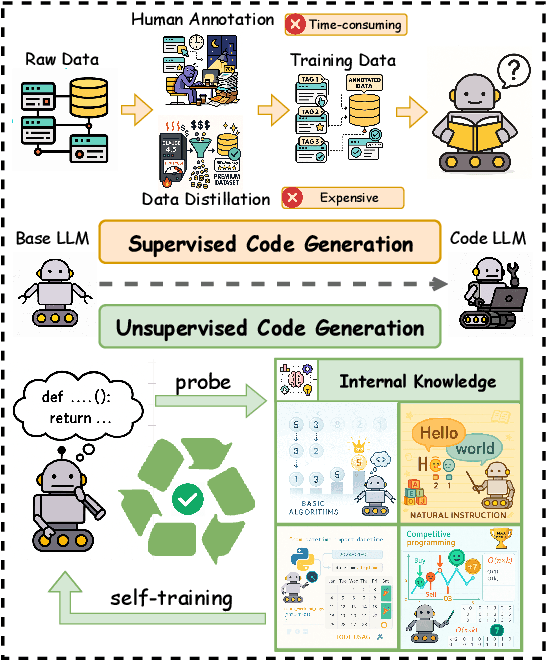
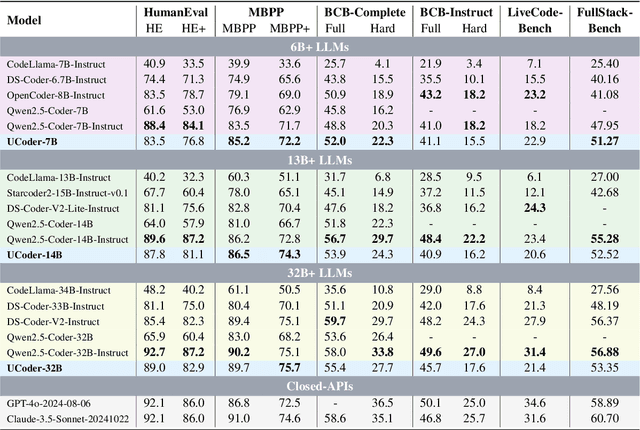
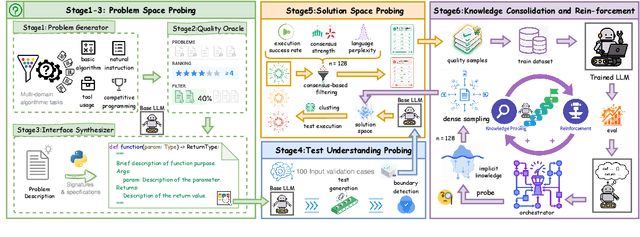
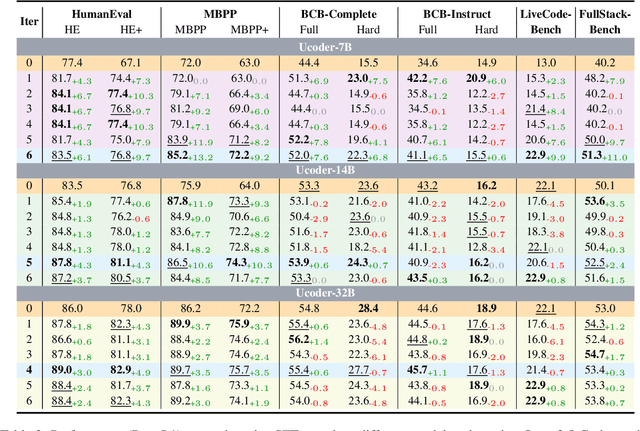
Large language models (LLMs) have demonstrated remarkable capabilities in code generation tasks. However, their effectiveness heavily relies on supervised training with extensive labeled (e.g., question-answering pairs) or unlabeled datasets (e.g., code snippets), which are often expensive and difficult to obtain at scale. To address this limitation, this paper introduces a method IPC, an unsupervised framework that leverages Internal Probing of LLMs for Code generation without any external corpus, even unlabeled code snippets. We introduce the problem space probing, test understanding probing, solution space probing, and knowledge consolidation and reinforcement to probe the internal knowledge and confidence patterns existing in LLMs. Further, IPC identifies reliable code candidates through self-consistency mechanisms and representation-based quality estimation to train UCoder (coder with unsupervised learning). We validate the proposed approach across multiple code benchmarks, demonstrating that unsupervised methods can achieve competitive performance compared to supervised approaches while significantly reducing the dependency on labeled data and computational resources. Analytic experiments reveal that internal model states contain rich signals about code quality and correctness, and that properly harnessing these signals enables effective unsupervised learning for code generation tasks, opening new directions for training code LLMs in resource-constrained scenarios.
Scaling Laws for Code: Every Programming Language Matters
Dec 15, 2025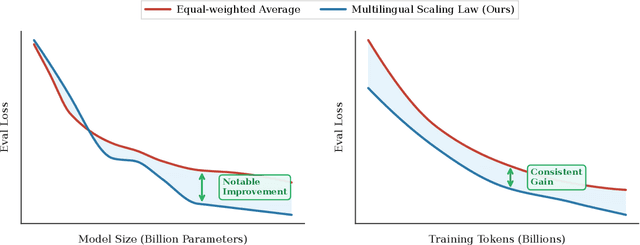
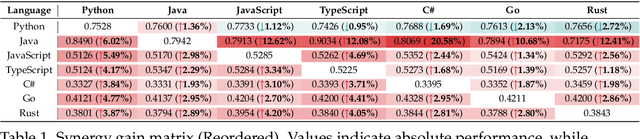
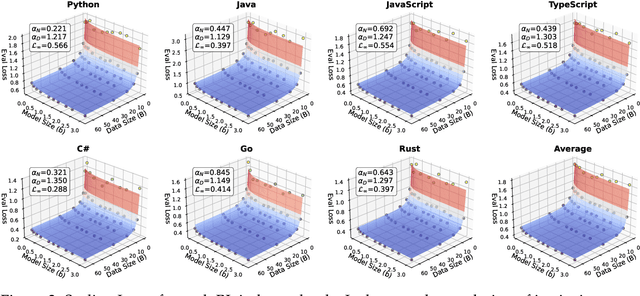

Code large language models (Code LLMs) are powerful but costly to train, with scaling laws predicting performance from model size, data, and compute. However, different programming languages (PLs) have varying impacts during pre-training that significantly affect base model performance, leading to inaccurate performance prediction. Besides, existing works focus on language-agnostic settings, neglecting the inherently multilingual nature of modern software development. Therefore, it is first necessary to investigate the scaling laws of different PLs, and then consider their mutual influences to arrive at the final multilingual scaling law. In this paper, we present the first systematic exploration of scaling laws for multilingual code pre-training, conducting over 1000+ experiments (Equivalent to 336,000+ H800 hours) across multiple PLs, model sizes (0.2B to 14B parameters), and dataset sizes (1T tokens). We establish comprehensive scaling laws for code LLMs across multiple PLs, revealing that interpreted languages (e.g., Python) benefit more from increased model size and data than compiled languages (e.g., Rust). The study demonstrates that multilingual pre-training provides synergistic benefits, particularly between syntactically similar PLs. Further, the pre-training strategy of the parallel pairing (concatenating code snippets with their translations) significantly enhances cross-lingual abilities with favorable scaling properties. Finally, a proportion-dependent multilingual scaling law is proposed to optimally allocate training tokens by prioritizing high-utility PLs (e.g., Python), balancing high-synergy pairs (e.g., JavaScript-TypeScript), and reducing allocation to fast-saturating languages (Rust), achieving superior average performance across all PLs compared to uniform distribution under the same compute budget.
UrbanFM: Inferring Fine-Grained Urban Flows
Feb 06, 2019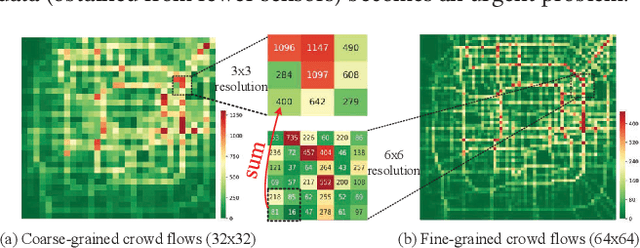
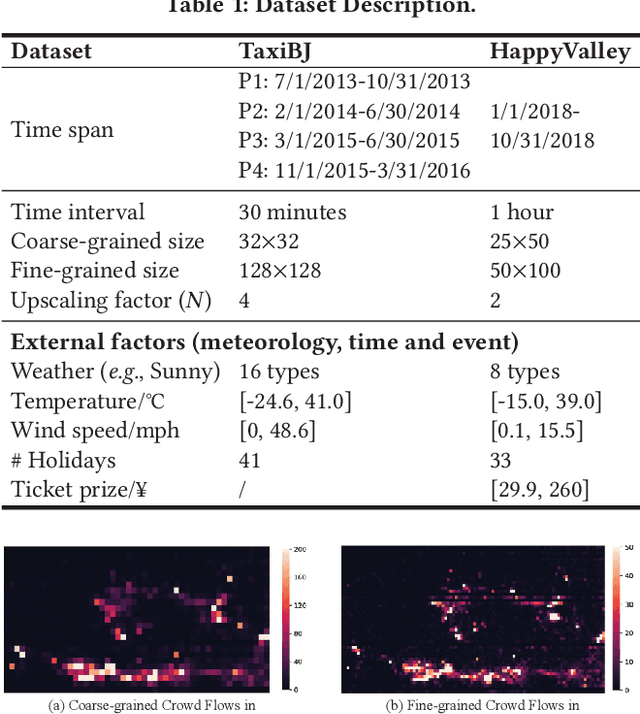
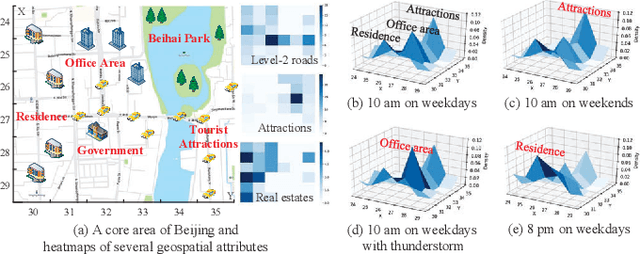
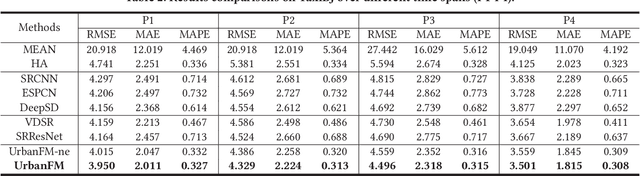
Urban flow monitoring systems play important roles in smart city efforts around the world. However, the ubiquitous deployment of monitoring devices, such as CCTVs, induces a long-lasting and enormous cost for maintenance and operation. This suggests the need for a technology that can reduce the number of deployed devices, while preventing the degeneration of data accuracy and granularity. In this paper, we aim to infer the real-time and fine-grained crowd flows throughout a city based on coarse-grained observations. This task is challenging due to two reasons: the spatial correlations between coarse- and fine-grained urban flows, and the complexities of external impacts. To tackle these issues, we develop a method entitled UrbanFM based on deep neural networks. Our model consists of two major parts: 1) an inference network to generate fine-grained flow distributions from coarse-grained inputs by using a feature extraction module and a novel distributional upsampling module; 2) a general fusion subnet to further boost the performance by considering the influences of different external factors. Extensive experiments on two real-world datasets, namely TaxiBJ and HappyValley, validate the effectiveness and efficiency of our method compared to seven baselines, demonstrating the state-of-the-art performance of our approach on the fine-grained urban flow inference problem.