 Add to Chrome
 Add to Firefox
 Add to Edge
Improving Generalization Robustness of Multimodal RLVR
Aug 09, 2026
Reinforcement Learning with Verifiable Rewards (RLVR) makes Multimodal Large Language Models more accurate, but the gains are brittle: simply paraphrasing a question or changing the prompt template can degrade them, which challenges reliable deployment in high-stakes scenarios like medical VQA. We trace this to two issues of the standard RL objective. First, the binary verifier conflates format with content, so the reward signal cannot tell a wrong answer apart from a misformatted one. Second, the training distribution covers only a thin slice of the real-world prompts that the model might meet at deployment, so policies that perform well on the training distribution can behave differently under unseen prompts during test. Both failures call for a robust post-training method that helps the policy cover a broader distribution of semantically equivalent prompts, and we identify two measures that help achieve this objective: separating format from semantics in the reward, and applying policy invariance across perturbed prompts with equivalent semantics. We therefore propose Prompt-Invariant RLVR (PIRL), consisting of a dynamic trinary reward and a consistency regularizer based on an embedding-space adversary. Under stress testing, PIRL's average accuracy on benchmarks drops by only $\le 1\%$, where GRPO drops ~3%. On dynamic evaluation, PIRL also achieves the smallest performance drop.

ClinFusion: A Vision-Centric Multimodal LLM System for Holistic Medical Understanding
Jul 27, 2026Multimodal large language models (MLLMs) hold immense potential to revolutionize clinical practice, yet deploying them in the medical domain is fundamentally a vision-centric challenge: models must absorb knowledge from heterogeneous 2D and 3D medical images, and evaluation protocols must align with radiologists' clinical practice and provide an accurate, fine-grained and factualness-driven assessment. In this paper, we introduce ClinFusion, a vision-centric MLLM designed for holistic medical understanding that systematically addresses these limitations. We propose a compositional and cascaded vision encoder architecture featuring a Cascade Spatial-Aware Locality Fusion operator that unifies diverse 2D and native 3D medical image understanding within a fused encoder. We further introduce a vision-grounded evaluation framework, including MedIF-Bench for instruction-following assessment and a region-of-interest-grounded method for clinically aligned and factualness-driven report generation evaluation. We show that ClinFusion sets a new state-of-the-art across a comprehensive suite of 2D and 3D multimodal medical benchmarks---spanning visual question answering, report generation, and instruction following---as well as textual medical tasks, outperforming leading open-source medical MLLMs (\textit{e.g.}, Hulu-Med, Lingshu) on 20 out of 24 benchmarks and demonstrating multimodal capabilities better than powerful proprietary models such as GPT-5.2 and Gemini-3-Flash on 13 out of 16 benchmarks, and can be further augmented with agentic tool use for retrieval-augmented and tool-assisted clinical workflows. A blinded evaluation by board-certified radiologists confirms that ClinFusion produces the highest-ranked reports, and validates our RoI-grounded metric as achieving the strongest correlation with expert judgment among all automatic evaluation metrics examined.
Agent-as-a-Router: Agentic Model Routing for Coding Tasks
Jun 24, 2026Real-world users typically have access to multiple Large Language Models (LLMs) from different providers, and these LLMs often excel at distinct domains, yet none dominate all. Consequently, routing each task to the most suitable model becomes critical for both performance and cost. Existing routers treat this as a static, one-off classification problem. However, we identify the performance bottleneck for these routers as information deficit: simply augmenting a vanilla LLM router with performance statistics at the task-dimension level yields a 15.3% relative gain, surpassing a heuristic router built on the same dimension-level priors. Motivated by this finding, we propose Agent-as-a-Router, a framework that formalizes routing as a C-A-F loop (Context->Action->Feedback->Context). It closes the information gap by accumulating execution-grounded experience during deployment. We instantiate this framework as ACRouter, composed of an Orchestrator, a Verifier, a Memory module, and introduce CodeRouterBench, an evaluation environment comprising ~10K task instances with verified scores from 8 frontier LLMs, enabling regret-based router comparison on streaming tasks. Experiments show that ACRouter achieves the lowest cumulative regret on in-distribution tasks and generalizes to out-of-distribution agentic-programming tasks, demonstrating that our routing framework actively closes the information gap. Codes and benchmarks are released at https://github.com/LanceZPF/agent-as-a-router.
K-Forcing: Joint Next-K-Token Decoding via Push-Forward Language Modeling
Jun 09, 2026Autoregressive (AR) language modeling is the dominant paradigm for text generation, yet its sequential token-by-token decoding makes inference memory-bound and inefficient. Existing acceleration approaches, such as speculative decoding and diffusion language models, can yield speedups under certain conditions but do not directly address high-load batch serving--the scenario most critical for industrial-scale deployment. We introduce K-Forcing, a push-forward language modeling paradigm for joint next-k-token decoding. K-Forcing distills an existing AR model into a conditional push-forward mapping--one that transforms independent uniform noise variables into a joint sample of multiple future tokens in a single forward pass. This design preserves fixed-length outputs, reuses the AR teacher backbone, and remains compatible with standard AR serving infrastructure. We train this mapping via progressive self-forcing distillation, which gradually expands the prediction window while enabling the student to closely match the sequence distribution of the AR teacher. We evaluate K-Forcing on LM1B and OpenWebText using a standard causal Transformer backbone. When aggressively configured to generate k = 4 tokens per forward pass, K-Forcing delivers approximately 2.4-3.5x speedup across different batch sizes, while incurring modest quality degradation relative to its AR teacher. As inference increasingly dominates the lifetime compute cost of modern LLMs, K-Forcing offers a promising route toward accelerating AR generation under real-world high-load deployment.
Few-Step Distillation for Text-to-Image Generation: A Practical Guide
Dec 15, 2025Diffusion distillation has dramatically accelerated class-conditional image synthesis, but its applicability to open-ended text-to-image (T2I) generation is still unclear. We present the first systematic study that adapts and compares state-of-the-art distillation techniques on a strong T2I teacher model, FLUX.1-lite. By casting existing methods into a unified framework, we identify the key obstacles that arise when moving from discrete class labels to free-form language prompts. Beyond a thorough methodological analysis, we offer practical guidelines on input scaling, network architecture, and hyperparameters, accompanied by an open-source implementation and pretrained student models. Our findings establish a solid foundation for deploying fast, high-fidelity, and resource-efficient diffusion generators in real-world T2I applications. Code is available on github.com/alibaba-damo-academy/T2I-Distill.
RAPID^3: Tri-Level Reinforced Acceleration Policies for Diffusion Transformer
Sep 26, 2025Diffusion Transformers (DiTs) excel at visual generation yet remain hampered by slow sampling. Existing training-free accelerators - step reduction, feature caching, and sparse attention - enhance inference speed but typically rely on a uniform heuristic or a manually designed adaptive strategy for all images, leaving quality on the table. Alternatively, dynamic neural networks offer per-image adaptive acceleration, but their high fine-tuning costs limit broader applicability. To address these limitations, we introduce RAPID3: Tri-Level Reinforced Acceleration Policies for Diffusion Transformers, a framework that delivers image-wise acceleration with zero updates to the base generator. Specifically, three lightweight policy heads - Step-Skip, Cache-Reuse, and Sparse-Attention - observe the current denoising state and independently decide their corresponding speed-up at each timestep. All policy parameters are trained online via Group Relative Policy Optimization (GRPO) while the generator remains frozen. Meanwhile, an adversarially learned discriminator augments the reward signal, discouraging reward hacking by boosting returns only when generated samples stay close to the original model's distribution. Across state-of-the-art DiT backbones, including Stable Diffusion 3 and FLUX, RAPID3 achieves nearly 3x faster sampling with competitive generation quality.
Diffusion Sampling Path Tells More: An Efficient Plug-and-Play Strategy for Sample Filtering
May 29, 2025Diffusion models often exhibit inconsistent sample quality due to stochastic variations inherent in their sampling trajectories. Although training-based fine-tuning (e.g. DDPO [1]) and inference-time alignment techniques[2] aim to improve sample fidelity, they typically necessitate full denoising processes and external reward signals. This incurs substantial computational costs, hindering their broader applicability. In this work, we unveil an intriguing phenomenon: a previously unobserved yet exploitable link between sample quality and characteristics of the denoising trajectory during classifier-free guidance (CFG). Specifically, we identify a strong correlation between high-density regions of the sample distribution and the Accumulated Score Differences (ASD)--the cumulative divergence between conditional and unconditional scores. Leveraging this insight, we introduce CFG-Rejection, an efficient, plug-and-play strategy that filters low-quality samples at an early stage of the denoising process, crucially without requiring external reward signals or model retraining. Importantly, our approach necessitates no modifications to model architectures or sampling schedules and maintains full compatibility with existing diffusion frameworks. We validate the effectiveness of CFG-Rejection in image generation through extensive experiments, demonstrating marked improvements on human preference scores (HPSv2, PickScore) and challenging benchmarks (GenEval, DPG-Bench). We anticipate that CFG-Rejection will offer significant advantages for diverse generative modalities beyond images, paving the way for more efficient and reliable high-quality sample generation.
Safeguarding Text-to-Image Generation via Inference-Time Prompt-Noise Optimization
Dec 05, 2024

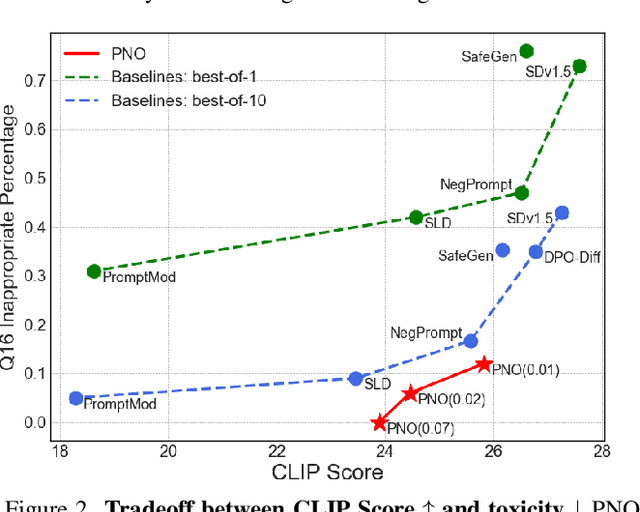

Text-to-Image (T2I) diffusion models are widely recognized for their ability to generate high-quality and diverse images based on text prompts. However, despite recent advances, these models are still prone to generating unsafe images containing sensitive or inappropriate content, which can be harmful to users. Current efforts to prevent inappropriate image generation for diffusion models are easy to bypass and vulnerable to adversarial attacks. How to ensure that T2I models align with specific safety goals remains a significant challenge. In this work, we propose a novel, training-free approach, called Prompt-Noise Optimization (PNO), to mitigate unsafe image generation. Our method introduces a novel optimization framework that leverages both the continuous prompt embedding and the injected noise trajectory in the sampling process to generate safe images. Extensive numerical results demonstrate that our framework achieves state-of-the-art performance in suppressing toxic image generations and demonstrates robustness to adversarial attacks, without needing to tune the model parameters. Furthermore, compared with existing methods, PNO uses comparable generation time while offering the best tradeoff between the conflicting goals of safe generation and prompt-image alignment.
Tuning-Free Alignment of Diffusion Models with Direct Noise Optimization
May 29, 2024In this work, we focus on the alignment problem of diffusion models with a continuous reward function, which represents specific objectives for downstream tasks, such as improving human preference. The central goal of the alignment problem is to adjust the distribution learned by diffusion models such that the generated samples maximize the target reward function. We propose a novel alignment approach, named Direct Noise Optimization (DNO), that optimizes the injected noise during the sampling process of diffusion models. By design, DNO is tuning-free and prompt-agnostic, as the alignment occurs in an online fashion during generation. We rigorously study the theoretical properties of DNO and also propose variants to deal with non-differentiable reward functions. Furthermore, we identify that naive implementation of DNO occasionally suffers from the out-of-distribution reward hacking problem, where optimized samples have high rewards but are no longer in the support of the pretrained distribution. To remedy this issue, we leverage classical high-dimensional statistics theory and propose to augment the DNO loss with certain probability regularization. We conduct extensive experiments on several popular reward functions trained on human feedback data and demonstrate that the proposed DNO approach achieves state-of-the-art reward scores as well as high image quality, all within a reasonable time budget for generation.
Accelerating Parallel Sampling of Diffusion Models
Feb 15, 2024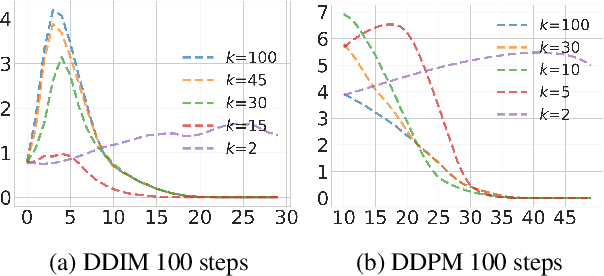


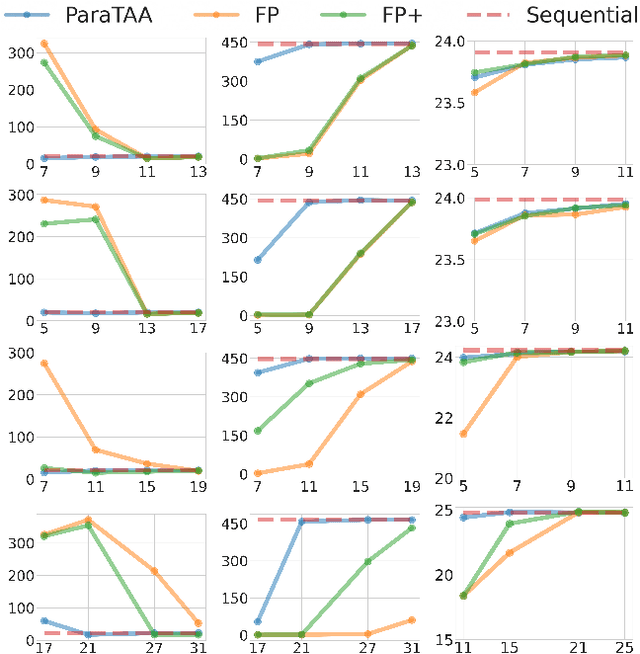
Diffusion models have emerged as state-of-the-art generative models for image generation. However, sampling from diffusion models is usually time-consuming due to the inherent autoregressive nature of their sampling process. In this work, we propose a novel approach that accelerates the sampling of diffusion models by parallelizing the autoregressive process. Specifically, we reformulate the sampling process as solving a system of triangular nonlinear equations through fixed-point iteration. With this innovative formulation, we explore several systematic techniques to further reduce the iteration steps required by the solving process. Applying these techniques, we introduce ParaTAA, a universal and training-free parallel sampling algorithm that can leverage extra computational and memory resources to increase the sampling speed. Our experiments demonstrate that ParaTAA can decrease the inference steps required by common sequential sampling algorithms such as DDIM and DDPM by a factor of 4~14 times. Notably, when applying ParaTAA with 100 steps DDIM for Stable Diffusion, a widely-used text-to-image diffusion model, it can produce the same images as the sequential sampling in only 7 inference steps.