 Add to Chrome
 Add to Firefox
 Add to Edge
InCoder-32B-Thinking: Industrial Code World Model for Thinking
Apr 03, 2026
Industrial software development across chip design, GPU optimization, and embedded systems lacks expert reasoning traces showing how engineers reason about hardware constraints and timing semantics. In this work, we propose InCoder-32B-Thinking, trained on the data from the Error-driven Chain-of-Thought (ECoT) synthesis framework with an industrial code world model (ICWM) to generate reasoning traces. Specifically, ECoT generates reasoning chains by synthesizing the thinking content from multi-turn dialogue with environmental error feedback, explicitly modeling the error-correction process. ICWM is trained on domain-specific execution traces from Verilog simulation, GPU profiling, etc., learns the causal dynamics of how code affects hardware behavior, and enables self-verification by predicting execution outcomes before actual compilation. All synthesized reasoning traces are validated through domain toolchains, creating training data matching the natural reasoning depth distribution of industrial tasks. Evaluation on 14 general (81.3% on LiveCodeBench v5) and 9 industrial benchmarks (84.0% in CAD-Coder and 38.0% on KernelBench) shows InCoder-32B-Thinking achieves top-tier open-source results across all domains.GPU Optimization

InCoder-32B: Code Foundation Model for Industrial Scenarios
Mar 17, 2026Recent code large language models have achieved remarkable progress on general programming tasks. Nevertheless, their performance degrades significantly in industrial scenarios that require reasoning about hardware semantics, specialized language constructs, and strict resource constraints. To address these challenges, we introduce InCoder-32B (Industrial-Coder-32B), the first 32B-parameter code foundation model unifying code intelligence across chip design, GPU kernel optimization, embedded systems, compiler optimization, and 3D modeling. By adopting an efficient architecture, we train InCoder-32B from scratch with general code pre-training, curated industrial code annealing, mid-training that progressively extends context from 8K to 128K tokens with synthetic industrial reasoning data, and post-training with execution-grounded verification. We conduct extensive evaluation on 14 mainstream general code benchmarks and 9 industrial benchmarks spanning 4 specialized domains. Results show InCoder-32B achieves highly competitive performance on general tasks while establishing strong open-source baselines across industrial domains.
Efficient Quantum Circuits for the Hilbert Transform
Jan 15, 2026The quantum Fourier transform and quantum wavelet transform have been cornerstones of quantum information processing. However, for non-stationary signals and anomaly detection, the Hilbert transform can be a more powerful tool, yet no prior work has provided efficient quantum implementations for the discrete Hilbert transform. This letter presents a novel construction for a quantum Hilbert transform in polylogarithmic size and logarithmic depth for a signal of length $N$, exponentially fewer operations than classical algorithms for the same mapping. We generalize this algorithm to create any $d$-dimensional Hilbert transform in depth $O(d\log N)$. Simulations demonstrate effectiveness for tasks such as power systems control and image processing, with exact agreement with classical results.
Quantum Hamiltonian Descent
Mar 02, 2023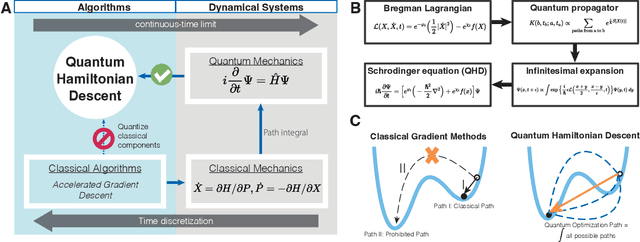
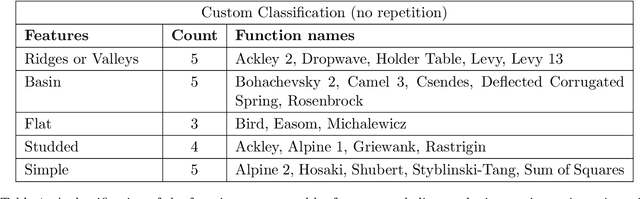
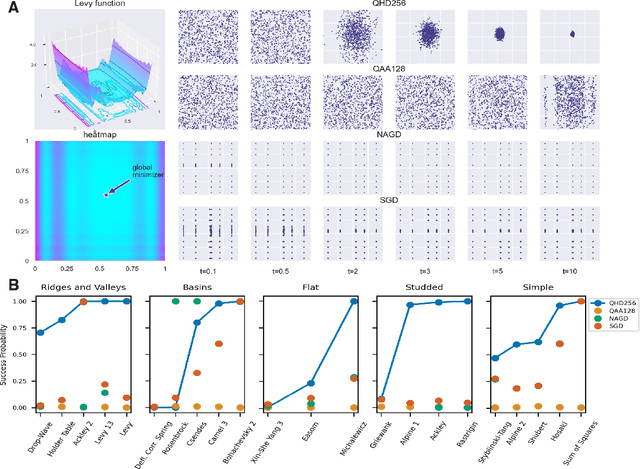
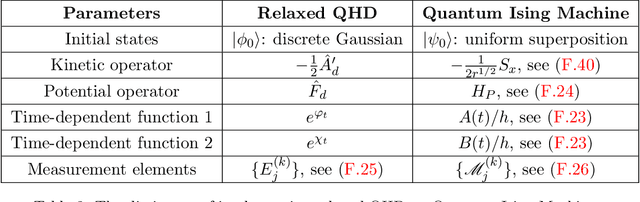
Gradient descent is a fundamental algorithm in both theory and practice for continuous optimization. Identifying its quantum counterpart would be appealing to both theoretical and practical quantum applications. A conventional approach to quantum speedups in optimization relies on the quantum acceleration of intermediate steps of classical algorithms, while keeping the overall algorithmic trajectory and solution quality unchanged. We propose Quantum Hamiltonian Descent (QHD), which is derived from the path integral of dynamical systems referring to the continuous-time limit of classical gradient descent algorithms, as a truly quantum counterpart of classical gradient methods where the contribution from classically-prohibited trajectories can significantly boost QHD's performance for non-convex optimization. Moreover, QHD is described as a Hamiltonian evolution efficiently simulatable on both digital and analog quantum computers. By embedding the dynamics of QHD into the evolution of the so-called Quantum Ising Machine (including D-Wave and others), we empirically observe that the D-Wave-implemented QHD outperforms a selection of state-of-the-art gradient-based classical solvers and the standard quantum adiabatic algorithm, based on the time-to-solution metric, on non-convex constrained quadratic programming instances up to 75 dimensions. Finally, we propose a "three-phase picture" to explain the behavior of QHD, especially its difference from the quantum adiabatic algorithm.