 Add to Chrome
 Add to Firefox
 Add to Edge
The Second Challenge on Cross-Domain Few-Shot Object Detection at NTIRE 2026: Methods and Results
Apr 13, 2026
Cross-domain few-shot object detection (CD-FSOD) remains a challenging problem for existing object detectors and few-shot learning approaches, particularly when generalizing across distinct domains. As part of NTIRE 2026, we hosted the second CD-FSOD Challenge to systematically evaluate and promote progress in detecting objects in unseen target domains under limited annotation conditions. The challenge received strong community interest, with 128 registered participants and a total of 696 submissions. Among them, 31 teams actively participated, and 19 teams submitted valid final results. Participants explored a wide range of strategies, introducing innovative methods that push the performance frontier under both open-source and closed-source tracks. This report presents a detailed overview of the NTIRE 2026 CD-FSOD Challenge, including a summary of the submitted approaches and an analysis of the final results across all participating teams. Challenge Codes: https://github.com/ohMargin/NTIRE2026_CDFSOD.

A Closer Look at Cross-Domain Few-Shot Object Detection: Fine-Tuning Matters and Parallel Decoder Helps
Mar 30, 2026Few-shot object detection (FSOD) is challenging due to unstable optimization and limited generalization arising from the scarcity of training samples. To address these issues, we propose a hybrid ensemble decoder that enhances generalization during fine-tuning. Inspired by ensemble learning, the decoder comprises a shared hierarchical layer followed by multiple parallel decoder branches, where each branch employs denoising queries either inherited from the shared layer or newly initialized to encourage prediction diversity. This design fully exploits pretrained weights without introducing additional parameters, and the resulting diverse predictions can be effectively ensembled to improve generalization. We further leverage a unified progressive fine-tuning framework with a plateau-aware learning rate schedule, which stabilizes optimization and achieves strong few-shot adaptation without complex data augmentations or extensive hyperparameter tuning. Extensive experiments on CD-FSOD, ODinW-13, and RF100-VL validate the effectiveness of our approach. Notably, on RF100-VL, which includes 100 datasets across diverse domains, our method achieves an average performance of 41.9 in the 10-shot setting, significantly outperforming the recent approach SAM3, which obtains 35.7. We further construct a mixed-domain test set from CD-FSOD to evaluate robustness to out-of-distribution (OOD) samples, showing that our proposed modules lead to clear improvement gains. These results highlight the effectiveness, generalization, and robustness of the proposed method. Code is available at: https://github.com/Intellindust-AI-Lab/FT-FSOD.
EdgeCrafter: Compact ViTs for Edge Dense Prediction via Task-Specialized Distillation
Mar 19, 2026Deploying high-performance dense prediction models on resource-constrained edge devices remains challenging due to strict limits on computation and memory. In practice, lightweight systems for object detection, instance segmentation, and pose estimation are still dominated by CNN-based architectures such as YOLO, while compact Vision Transformers (ViTs) often struggle to achieve similarly strong accuracy efficiency tradeoff, even with large scale pretraining. We argue that this gap is largely due to insufficient task specific representation learning in small scale ViTs, rather than an inherent mismatch between ViTs and edge dense prediction. To address this issue, we introduce EdgeCrafter, a unified compact ViT framework for edge dense prediction centered on ECDet, a detection model built from a distilled compact backbone and an edge-friendly encoder decoder design. On the COCO dataset, ECDet-S achieves 51.7 AP with fewer than 10M parameters using only COCO annotations. For instance segmentation, ECInsSeg achieves performance comparable to RF-DETR while using substantially fewer parameters. For pose estimation, ECPose-X reaches 74.8 AP, significantly outperforming YOLO26Pose-X (71.6 AP) despite the latter's reliance on extensive Objects365 pretraining. These results show that compact ViTs, when paired with task-specialized distillation and edge-aware design, can be a practical and competitive option for edge dense prediction. Code is available at: https://intellindust-ai-lab.github.io/projects/EdgeCrafter/
From Misclassifications to Outliers: Joint Reliability Assessment in Classification
Mar 04, 2026Building reliable classifiers is a fundamental challenge for deploying machine learning in real-world applications. A reliable system should not only detect out-of-distribution (OOD) inputs but also anticipate in-distribution (ID) errors by assigning low confidence to potentially misclassified samples. Yet, most prior work treats OOD detection and failure prediction as separated problems, overlooking their closed connection. We argue that reliability requires evaluating them jointly. To this end, we propose a unified evaluation framework that integrates OOD detection and failure prediction, quantified by our new metrics DS-F1 and DS-AURC, where DS denotes double scoring functions. Experiments on the OpenOOD benchmark show that double scoring functions yield classifiers that are substantially more reliable than traditional single scoring approaches. Our analysis further reveals that OOD-based approaches provide notable gains under simple or far-OOD shifts, but only marginal benefits under more challenging near-OOD conditions. Beyond evaluation, we extend the reliable classifier SURE and introduce SURE+, a new approach that significantly improves reliability across diverse scenarios. Together, our framework, metrics, and method establish a new benchmark for trustworthy classification and offer practical guidance for deploying robust models in real-world settings. The source code is publicly available at https://github.com/Intellindust-AI-Lab/SUREPlus.
FSOD-VFM: Few-Shot Object Detection with Vision Foundation Models and Graph Diffusion
Feb 03, 2026In this paper, we present FSOD-VFM: Few-Shot Object Detectors with Vision Foundation Models, a framework that leverages vision foundation models to tackle the challenge of few-shot object detection. FSOD-VFM integrates three key components: a universal proposal network (UPN) for category-agnostic bounding box generation, SAM2 for accurate mask extraction, and DINOv2 features for efficient adaptation to new object categories. Despite the strong generalization capabilities of foundation models, the bounding boxes generated by UPN often suffer from overfragmentation, covering only partial object regions and leading to numerous small, false-positive proposals rather than accurate, complete object detections. To address this issue, we introduce a novel graph-based confidence reweighting method. In our approach, predicted bounding boxes are modeled as nodes in a directed graph, with graph diffusion operations applied to propagate confidence scores across the network. This reweighting process refines the scores of proposals, assigning higher confidence to whole objects and lower confidence to local, fragmented parts. This strategy improves detection granularity and effectively reduces the occurrence of false-positive bounding box proposals. Through extensive experiments on Pascal-5$^i$, COCO-20$^i$, and CD-FSOD datasets, we demonstrate that our method substantially outperforms existing approaches, achieving superior performance without requiring additional training. Notably, on the challenging CD-FSOD dataset, which spans multiple datasets and domains, our FSOD-VFM achieves 31.6 AP in the 10-shot setting, substantially outperforming previous training-free methods that reach only 21.4 AP. Code is available at: https://intellindust-ai-lab.github.io/projects/FSOD-VFM.
SoccerNet 2025 Challenges Results
Aug 26, 2025The SoccerNet 2025 Challenges mark the fifth annual edition of the SoccerNet open benchmarking effort, dedicated to advancing computer vision research in football video understanding. This year's challenges span four vision-based tasks: (1) Team Ball Action Spotting, focused on detecting ball-related actions in football broadcasts and assigning actions to teams; (2) Monocular Depth Estimation, targeting the recovery of scene geometry from single-camera broadcast clips through relative depth estimation for each pixel; (3) Multi-View Foul Recognition, requiring the analysis of multiple synchronized camera views to classify fouls and their severity; and (4) Game State Reconstruction, aimed at localizing and identifying all players from a broadcast video to reconstruct the game state on a 2D top-view of the field. Across all tasks, participants were provided with large-scale annotated datasets, unified evaluation protocols, and strong baselines as starting points. This report presents the results of each challenge, highlights the top-performing solutions, and provides insights into the progress made by the community. The SoccerNet Challenges continue to serve as a driving force for reproducible, open research at the intersection of computer vision, artificial intelligence, and sports. Detailed information about the tasks, challenges, and leaderboards can be found at https://www.soccer-net.org, with baselines and development kits available at https://github.com/SoccerNet.
SURE: SUrvey REcipes for building reliable and robust deep networks
Mar 01, 2024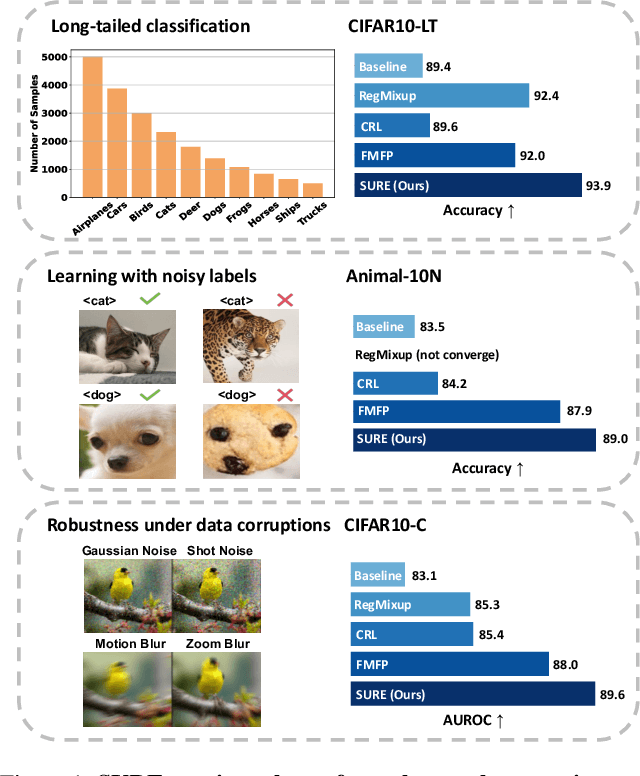
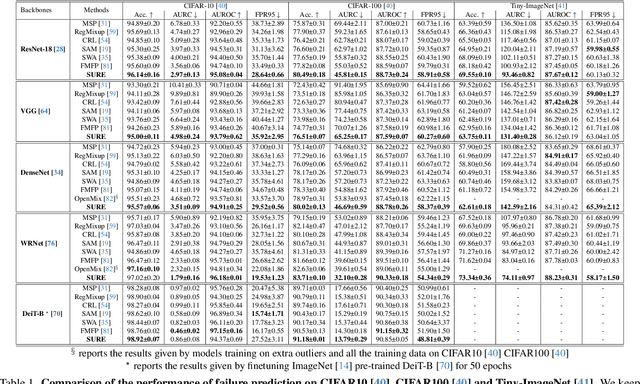
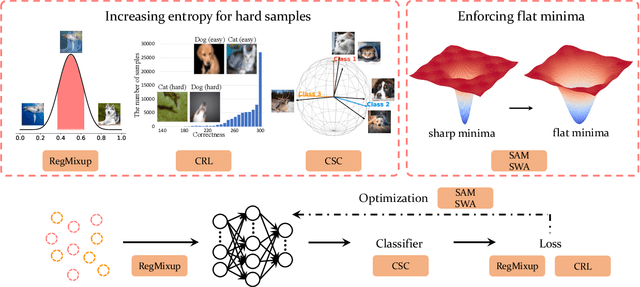
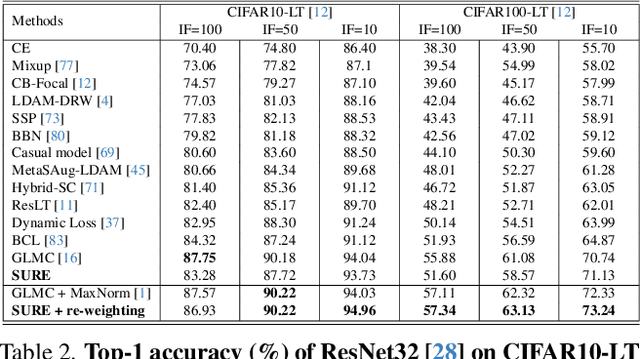
In this paper, we revisit techniques for uncertainty estimation within deep neural networks and consolidate a suite of techniques to enhance their reliability. Our investigation reveals that an integrated application of diverse techniques--spanning model regularization, classifier and optimization--substantially improves the accuracy of uncertainty predictions in image classification tasks. The synergistic effect of these techniques culminates in our novel SURE approach. We rigorously evaluate SURE against the benchmark of failure prediction, a critical testbed for uncertainty estimation efficacy. Our results showcase a consistently better performance than models that individually deploy each technique, across various datasets and model architectures. When applied to real-world challenges, such as data corruption, label noise, and long-tailed class distribution, SURE exhibits remarkable robustness, delivering results that are superior or on par with current state-of-the-art specialized methods. Particularly on Animal-10N and Food-101N for learning with noisy labels, SURE achieves state-of-the-art performance without any task-specific adjustments. This work not only sets a new benchmark for robust uncertainty estimation but also paves the way for its application in diverse, real-world scenarios where reliability is paramount. Our code is available at \url{https://yutingli0606.github.io/SURE/}.
The Robust Semantic Segmentation UNCV2023 Challenge Results
Sep 27, 2023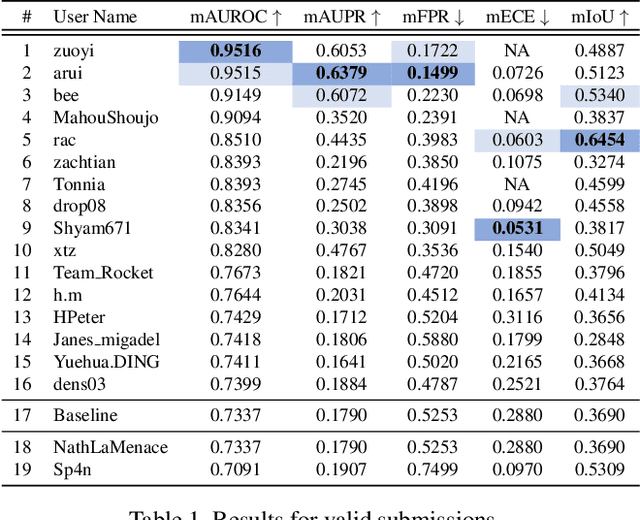
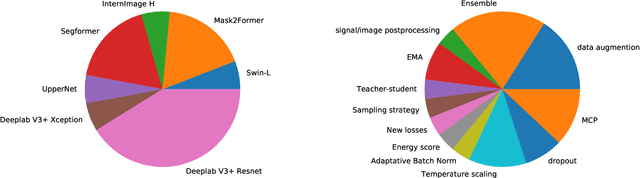
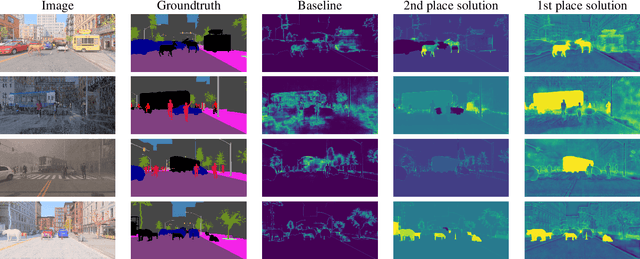
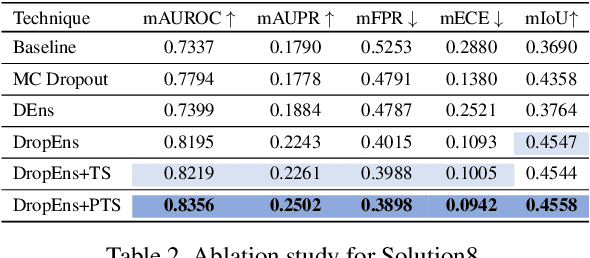
This paper outlines the winning solutions employed in addressing the MUAD uncertainty quantification challenge held at ICCV 2023. The challenge was centered around semantic segmentation in urban environments, with a particular focus on natural adversarial scenarios. The report presents the results of 19 submitted entries, with numerous techniques drawing inspiration from cutting-edge uncertainty quantification methodologies presented at prominent conferences in the fields of computer vision and machine learning and journals over the past few years. Within this document, the challenge is introduced, shedding light on its purpose and objectives, which primarily revolved around enhancing the robustness of semantic segmentation in urban scenes under varying natural adversarial conditions. The report then delves into the top-performing solutions. Moreover, the document aims to provide a comprehensive overview of the diverse solutions deployed by all participants. By doing so, it seeks to offer readers a deeper insight into the array of strategies that can be leveraged to effectively handle the inherent uncertainties associated with autonomous driving and semantic segmentation, especially within urban environments.
InfraParis: A multi-modal and multi-task autonomous driving dataset
Sep 27, 2023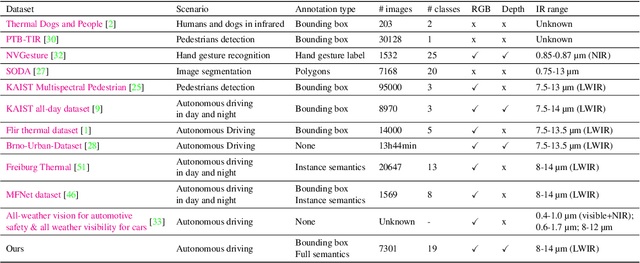
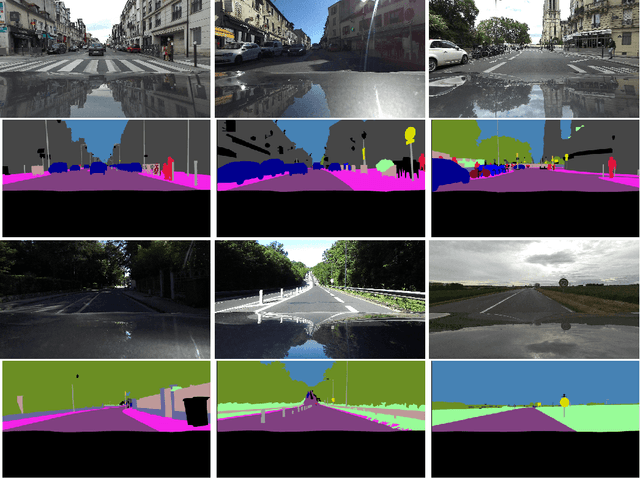
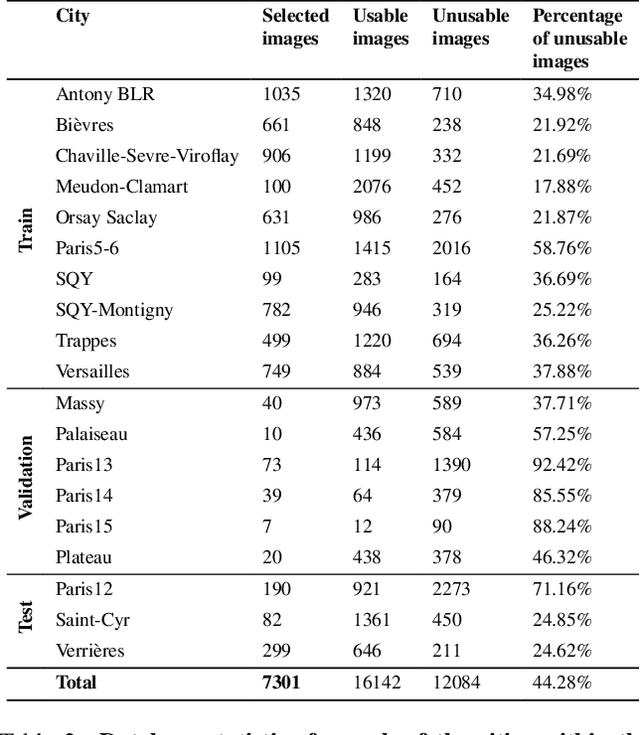
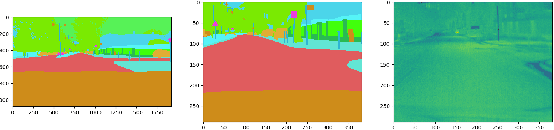
Current deep neural networks (DNNs) for autonomous driving computer vision are typically trained on specific datasets that only involve a single type of data and urban scenes. Consequently, these models struggle to handle new objects, noise, nighttime conditions, and diverse scenarios, which is essential for safety-critical applications. Despite ongoing efforts to enhance the resilience of computer vision DNNs, progress has been sluggish, partly due to the absence of benchmarks featuring multiple modalities. We introduce a novel and versatile dataset named InfraParis that supports multiple tasks across three modalities: RGB, depth, and infrared. We assess various state-of-the-art baseline techniques, encompassing models for the tasks of semantic segmentation, object detection, and depth estimation.
Discretization-Induced Dirichlet Posterior for Robust Uncertainty Quantification on Regression
Aug 17, 2023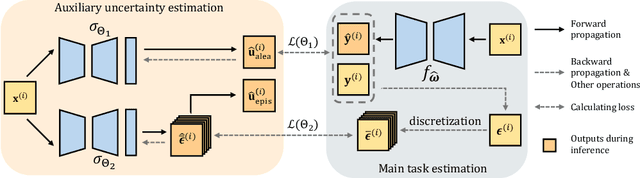
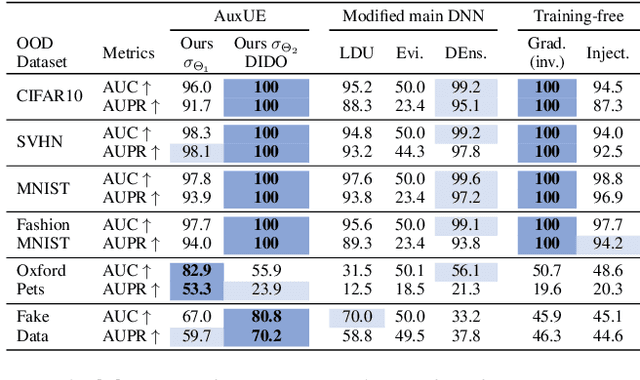
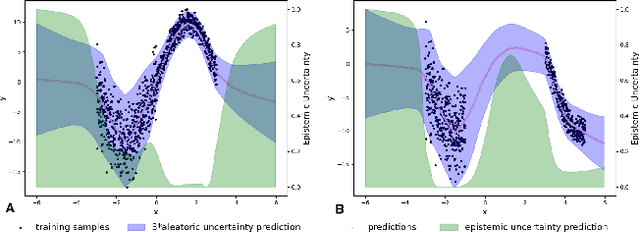
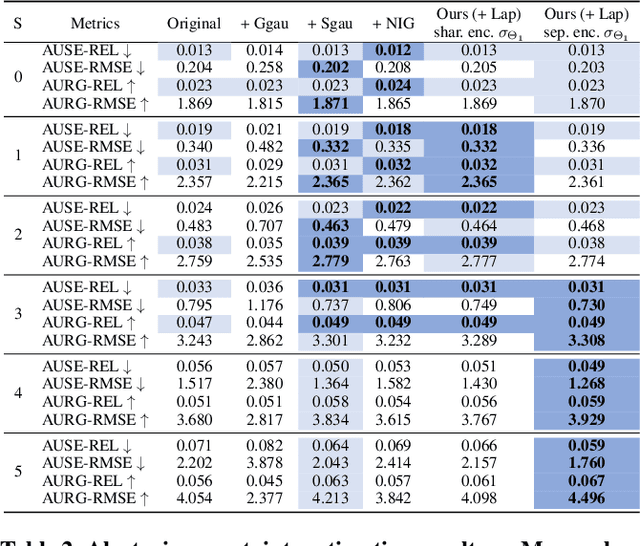
Uncertainty quantification is critical for deploying deep neural networks (DNNs) in real-world applications. An Auxiliary Uncertainty Estimator (AuxUE) is one of the most effective means to estimate the uncertainty of the main task prediction without modifying the main task model. To be considered robust, an AuxUE must be capable of maintaining its performance and triggering higher uncertainties while encountering Out-of-Distribution (OOD) inputs, i.e., to provide robust aleatoric and epistemic uncertainty. However, for vision regression tasks, current AuxUE designs are mainly adopted for aleatoric uncertainty estimates, and AuxUE robustness has not been explored. In this work, we propose a generalized AuxUE scheme for more robust uncertainty quantification on regression tasks. Concretely, to achieve a more robust aleatoric uncertainty estimation, different distribution assumptions are considered for heteroscedastic noise, and Laplace distribution is finally chosen to approximate the prediction error. For epistemic uncertainty, we propose a novel solution named Discretization-Induced Dirichlet pOsterior (DIDO), which models the Dirichlet posterior on the discretized prediction error. Extensive experiments on age estimation, monocular depth estimation, and super-resolution tasks show that our proposed method can provide robust uncertainty estimates in the face of noisy inputs and that it can be scalable to both image-level and pixel-wise tasks.