 Add to Chrome
 Add to Firefox
 Add to Edge
VLRC: Vision-Language Reprojection Consistency as a scalable signal for better feed-forward 3D pretraining
Jul 02, 2026
Feed-forward 3D models are commonly trained using either expensive geometric supervision or self-supervised photometric objectives, both of which provide incomplete learning signals. We introduce Vision-Language Reprojection Consistency (VLRC), a scalable auxiliary objective that exploits frozen vision-language representations as semantic multi-view supervision. Given a predicted 3D reconstruction, VLRC reprojects dense vision-language features across views and enforces feature consistency between corresponding image locations, requiring no additional 3D annotations. The objective integrates seamlessly with both self-supervised monocular reconstruction and supervised-pretrained feed-forward 3D models during unlabeled adaptation. By aligning geometry with language-grounded features, VLRC not only improves depth and camera estimation but also enables more coherent multi-view semantic fusion for open-vocabulary 3D scene understanding. Experiments on indoor and outdoor benchmarks demonstrate consistent gains in 3D reconstruction accuracy and zero-shot open-vocabulary 3D semantic segmentation.

Swarm sign language: motion-based communication between drones
Jun 26, 2026In stealth-constrained swarm robotics, visual communication provides a critical alternative to active radio transmissions, which might be jammed. This research investigates motion-based communication for non-active information exchange, utilizing modular, dynamically feasible planar trajectories as visual cues. On the receiver drone end, a pose estimator tracks the transmitting drone's pose, feeding it into our custom 3DTrajDecoder. The decoder is designed to classify and segment the spatiotemporal sequence while simultaneously regressing its size and normal vector. To robustly train the decoder on both communicative and non-communicative trajectories, we developed a configurable online procedural generation pipeline. We validate our system through real-world testing and simulation to define its operating domain, supported by an extensive ablation study detailing our architectural choices and system limitations.
Lightweight 3D Feature Pretraining by Bayesian Inversion of 2D Foundation Models
Jun 19, 2026We present Casper3D, a lightweight probabilistic framework for converting noisy multi-view 2D foundation-model embeddings into a latent 3D semantic representation. We model view-level semantic features as noisy observations of an underlying 3D semantic state and infer this state with a set-based variational model that incorporates relative pose during multi-view reasoning. Casper3D is trained by predicting held-out semantic observations from novel viewpoints, while remaining aligned with visual and text semantic spaces for open-vocabulary 3D understanding. The framework is backbone-agnostic and applies to both language-aligned and self-supervised embeddings. Experiments show that Casper3D produces more stable 3D semantics than simple multi-view pooling, especially in ambiguous and noisy settings.
SS3D: End2End Self-Supervised 3D from Web Videos
Apr 24, 2026We present SS3D, a web-scale SfM-based self-supervision pretraining pipeline for feed-forward 3D estimation from monocular video. Our model jointly predicts depth, ego-motion, and intrinsics in a single forward pass and is trained/evaluated as a coherent end-to-end 3D estimator. To stabilize joint learning, we use an intrinsics-first two-stage schedule and a unified single-checkpoint evaluation protocol. Scaling SfM self-supervision to unconstrained web video is challenging due to weak multi-view observability and strong corpus heterogeneity; we address these with a multi-view signal proxy (MVS) used for filtering and curriculum sampling, and with expert training distilled into a single student. Pretraining on YouTube-8M (~100M frames after filtering) yields strong cross-domain zero-shot transfer and improved fine-tuning performance over prior self-supervised baselines. We release the pretrained checkpoint and code.
A Geometric Multimodal Foundation Model Integrating Bp-MRI and Clinical Reports in Prostate Cancer Classification
Jan 30, 2026Prostate cancer (PCa) is one of the most common cancers in men worldwide. Bi-parametric MRI (bp-MRI) and clinical variables are crucial for PCa identification and improving treatment decisions. However, this process is subjective to expert interpretations. Furthermore, most existing computer-aided diagnosis methods focus on imaging-based models, overlooking the clinical context and suffering from data scarcity, limiting their ability to learn robust representations. We propose a geometric multimodal Foundation Model (FM), named MFM-Geom, that learns representations from bp-MRI and clinical reports, encoding visual findings and information from the context of clinical variables. In the representations classification head, the approach leverages symmetric positive definite (SPD) matrices and Riemannian deep learning to integrate imaging-text representations from a biomedical multimodal FM. Using 10% of the training data, MFM-Geom outperformed baseline class token embedding-based classification (+8.3%, AUC-PR of 90.67). Generalization on external dataset confirmed the robustness of fine-tuning biomedical FM, achieving an AUC-PR of 90.6.
Double Descent Meets Out-of-Distribution Detection: Theoretical Insights and Empirical Analysis on the role of model complexity
Nov 04, 2024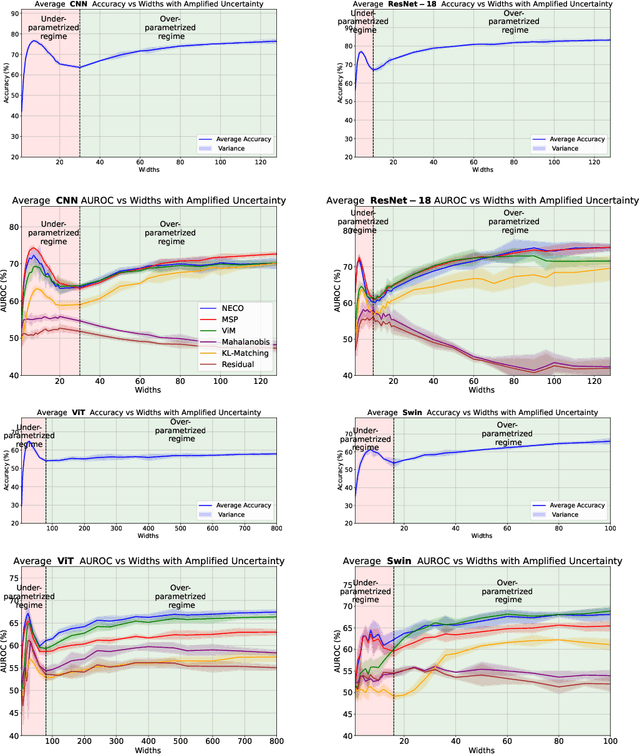
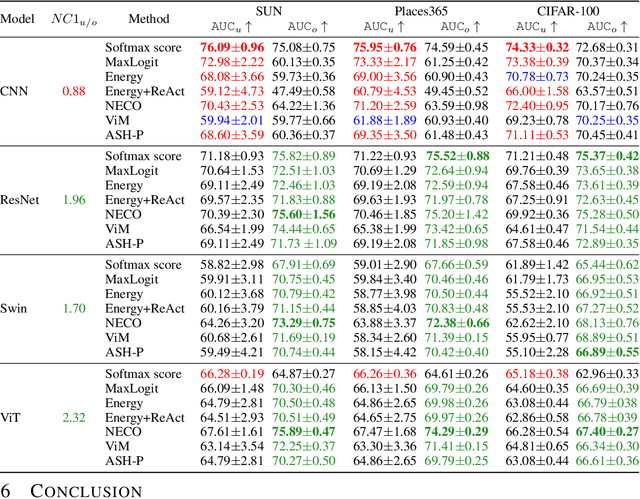
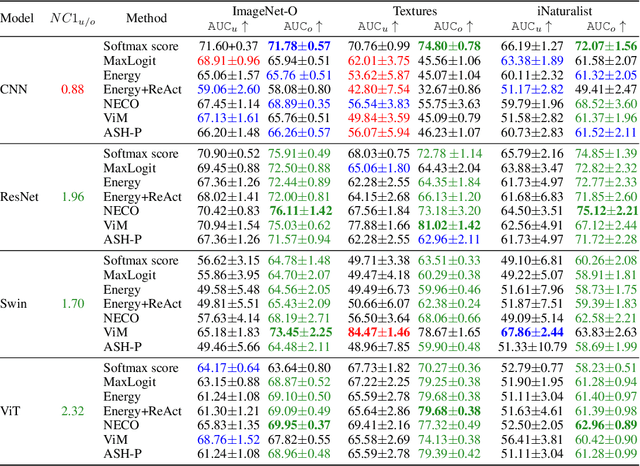
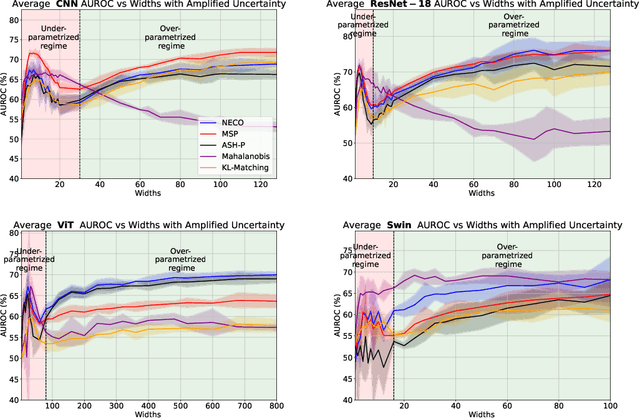
While overparameterization is known to benefit generalization, its impact on Out-Of-Distribution (OOD) detection is less understood. This paper investigates the influence of model complexity in OOD detection. We propose an expected OOD risk metric to evaluate classifiers confidence on both training and OOD samples. Leveraging Random Matrix Theory, we derive bounds for the expected OOD risk of binary least-squares classifiers applied to Gaussian data. We show that the OOD risk depicts an infinite peak, when the number of parameters is equal to the number of samples, which we associate with the double descent phenomenon. Our experimental study on different OOD detection methods across multiple neural architectures extends our theoretical insights and highlights a double descent curve. Our observations suggest that overparameterization does not necessarily lead to better OOD detection. Using the Neural Collapse framework, we provide insights to better understand this behavior. To facilitate reproducibility, our code will be made publicly available upon publication.
Leveraging a realistic synthetic database to learn Shape-from-Shading for estimating the colon depth in colonoscopy images
Nov 08, 2023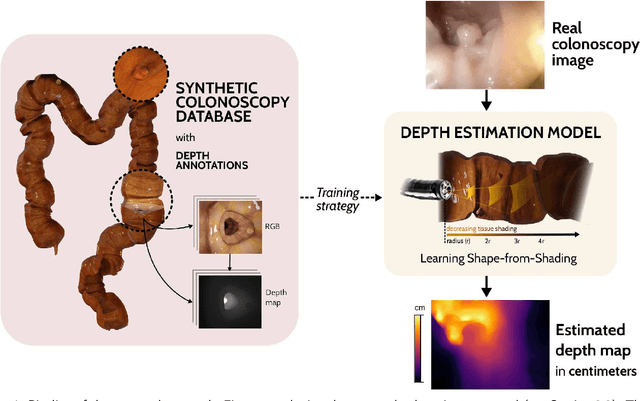
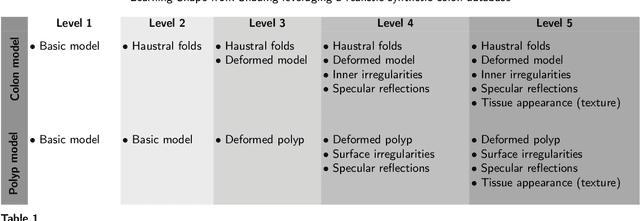
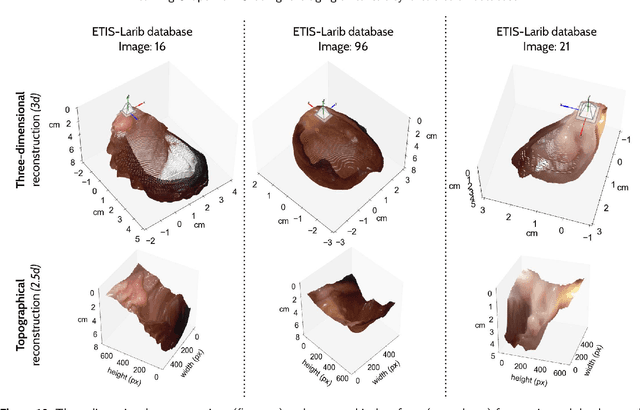
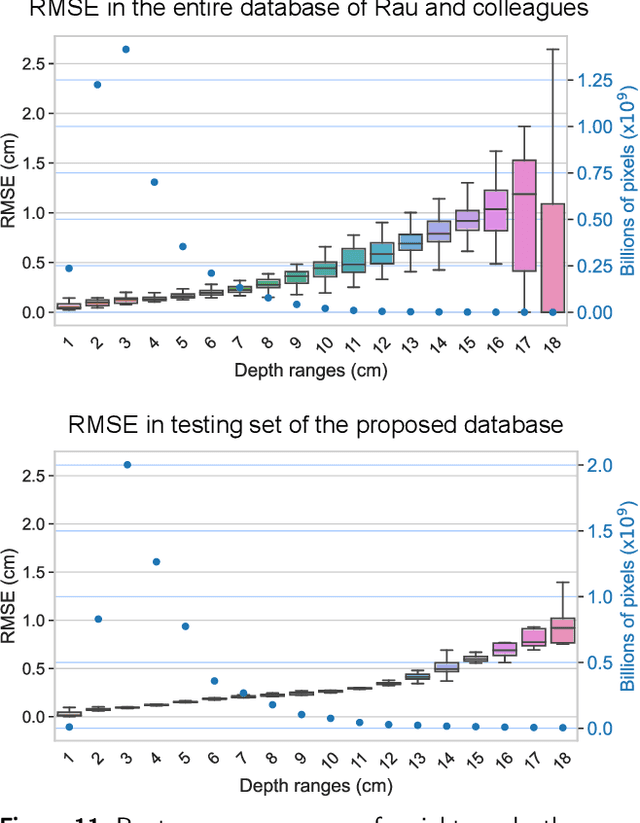
Colonoscopy is the choice procedure to diagnose colon and rectum cancer, from early detection of small precancerous lesions (polyps), to confirmation of malign masses. However, the high variability of the organ appearance and the complex shape of both the colon wall and structures of interest make this exploration difficult. Learned visuospatial and perceptual abilities mitigate technical limitations in clinical practice by proper estimation of the intestinal depth. This work introduces a novel methodology to estimate colon depth maps in single frames from monocular colonoscopy videos. The generated depth map is inferred from the shading variation of the colon wall with respect to the light source, as learned from a realistic synthetic database. Briefly, a classic convolutional neural network architecture is trained from scratch to estimate the depth map, improving sharp depth estimations in haustral folds and polyps by a custom loss function that minimizes the estimation error in edges and curvatures. The network was trained by a custom synthetic colonoscopy database herein constructed and released, composed of 248,400 frames (47 videos), with depth annotations at the level of pixels. This collection comprehends 5 subsets of videos with progressively higher levels of visual complexity. Evaluation of the depth estimation with the synthetic database reached a threshold accuracy of 95.65%, and a mean-RMSE of 0.451 cm, while a qualitative assessment with a real database showed consistent depth estimations, visually evaluated by the expert gastroenterologist coauthoring this paper. Finally, the method achieved competitive performance with respect to another state-of-the-art method using a public synthetic database and comparable results in a set of images with other five state-of-the-art methods.
NECO: NEural Collapse Based Out-of-distribution detection
Oct 12, 2023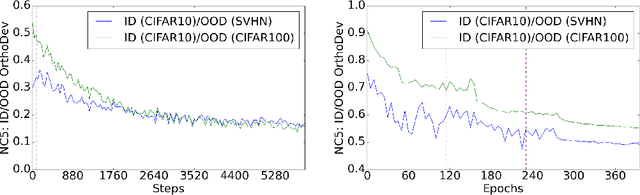


Detecting out-of-distribution (OOD) data is a critical challenge in machine learning due to model overconfidence, often without awareness of their epistemological limits. We hypothesize that ``neural collapse'', a phenomenon affecting in-distribution data for models trained beyond loss convergence, also influences OOD data. To benefit from this interplay, we introduce NECO, a novel post-hoc method for OOD detection, which leverages the geometric properties of ``neural collapse'' and of principal component spaces to identify OOD data. Our extensive experiments demonstrate that NECO achieves state-of-the-art results on both small and large-scale OOD detection tasks while exhibiting strong generalization capabilities across different network architectures. Furthermore, we provide a theoretical explanation for the effectiveness of our method in OOD detection. We plan to release the code after the anonymity period.
InfraParis: A multi-modal and multi-task autonomous driving dataset
Sep 27, 2023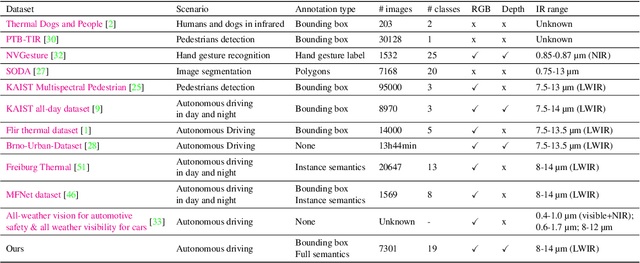
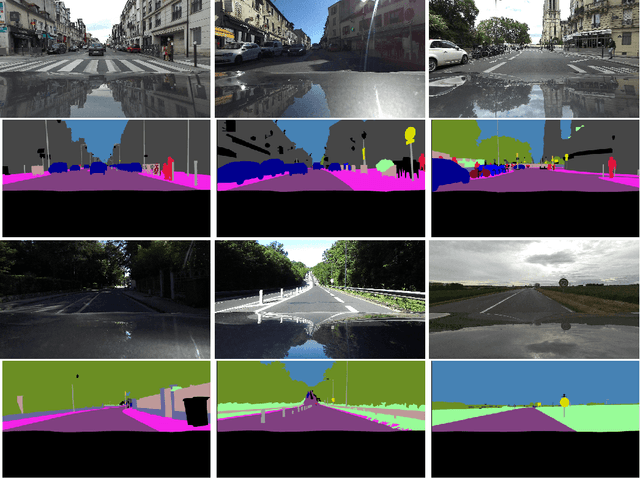
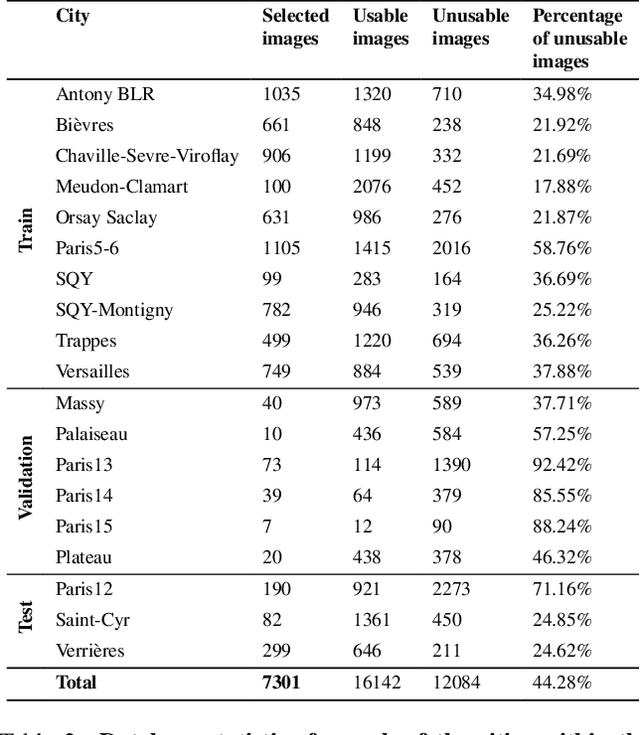
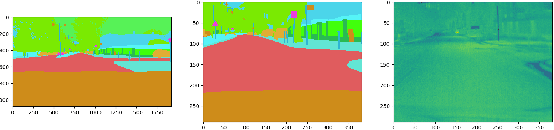
Current deep neural networks (DNNs) for autonomous driving computer vision are typically trained on specific datasets that only involve a single type of data and urban scenes. Consequently, these models struggle to handle new objects, noise, nighttime conditions, and diverse scenarios, which is essential for safety-critical applications. Despite ongoing efforts to enhance the resilience of computer vision DNNs, progress has been sluggish, partly due to the absence of benchmarks featuring multiple modalities. We introduce a novel and versatile dataset named InfraParis that supports multiple tasks across three modalities: RGB, depth, and infrared. We assess various state-of-the-art baseline techniques, encompassing models for the tasks of semantic segmentation, object detection, and depth estimation.
A study of deep perceptual metrics for image quality assessment
Feb 17, 2022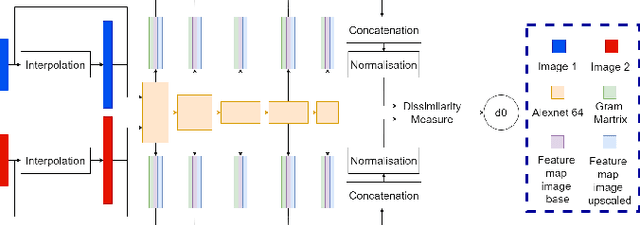
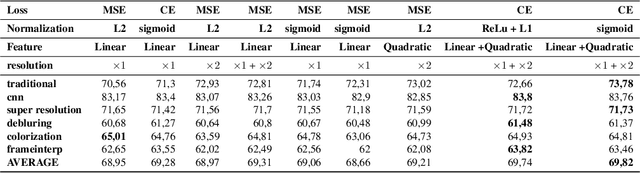
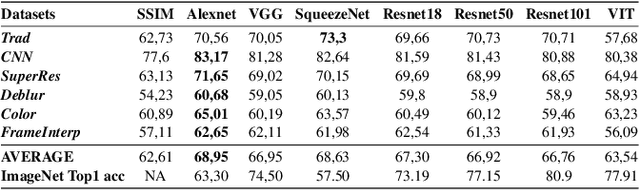
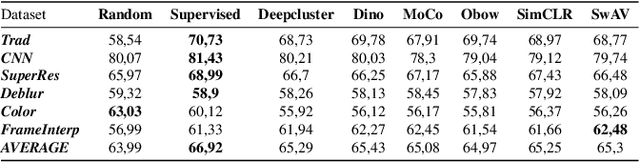
Several metrics exist to quantify the similarity between images, but they are inefficient when it comes to measure the similarity of highly distorted images. In this work, we propose to empirically investigate perceptual metrics based on deep neural networks for tackling the Image Quality Assessment (IQA) task. We study deep perceptual metrics according to different hyperparameters like the network's architecture or training procedure. Finally, we propose our multi-resolution perceptual metric (MR-Perceptual), that allows us to aggregate perceptual information at different resolutions and outperforms standard perceptual metrics on IQA tasks with varying image deformations. Our code is available at https://github.com/ENSTA-U2IS/MR_perceptual