 Add to Chrome
 Add to Firefox
 Add to Edge
Grounding by Remembering: Cross-Scene and In-Scene Memory for 3D Functional Affordances
May 12, 2026
Functional affordance grounding requires more than recognizing an object: an agent must localize the specific region that supports an interaction, such as the handle to pull or the button to press. This is difficult for training-free vision-language pipelines because actionable regions are often small, visually ambiguous, and repeated across multiple same-category instances in a scene. We propose AFFORDMEM, a framework that grounds 3D functional affordances by remembering geometry at two levels. The first is cross-scene affordance memory: the agent maintains a category-level memory bank of RGB images with affordance regions rendered as overlays, and recalls the most informative examples at query time to guide a frozen VLM toward small operable subregions that text-only prompting consistently misses. The second is in-scene spatial memory: as the agent processes the scene, it organizes candidate instances and their 3D spatial relations into a structured scene graph, enabling the language model to resolve references over distant or currently unobserved candidates such as "the second handle from the top." AFFORDMEM requires no model fine-tuning and no target-scene annotation, using a reusable memory bank built from source scenes. On SceneFun3D, our method improves AP50 over the prior training-free state of the art by 3.23 on Split 0 and 3.7 on Split 1. Ablation studies support complementary benefits: cross-scene affordance memory improves fine-grained localization, while in-scene spatial memory provides the larger gain on spatially qualified queries. The project homepage is available at the project page.

CFMS: A Coarse-to-Fine Multimodal Synthesis Framework for Enhanced Tabular Reasoning
Apr 13, 2026Reasoning over tabular data is a crucial capability for tasks like question answering and fact verification, as it requires models to comprehend both free-form questions and semi-structured tables. However, while methods like Chain-of-Thought (CoT) introduce reasoning chains, purely symbolic methodes are inherently limited by their blindness to holistic visual patterns. To address this, we propose the Coarse-to-Fine Multimodal Synthesis framework (CFMS), a novel two-stage paradigm that hierarchically decouples high-level visual perception from granular symbolic reasoning. In the Coarse Stage, CFMS leverages the Multimodal Large Language Models (MLLMs) to perform a one-time synthesis of a multi-perspective knowledge tuple. This tuple subsequently serves as a dynamic reasoning map to guide the fine stage, where a symbolic engine executes a targeted and efficient sequence of iterative operations over the table. Extensive experiments on the WikiTQ and TabFact benchmarks demonstrate that CFMS achieves competitive accuracy. The framework exhibits particular robustness when handling large tables and when instantiated with smaller backbone models, validating its effectiveness and generalizability.
Knowledge-Refined Dual Context-Aware Network for Partially Relevant Video Retrieval
Mar 25, 2026Retrieving partially relevant segments from untrimmed videos remains difficult due to two persistent challenges: the mismatch in information density between text and video segments, and limited attention mechanisms that overlook semantic focus and event correlations. We present KDC-Net, a Knowledge-Refined Dual Context-Aware Network that tackles these issues from both textual and visual perspectives. On the text side, a Hierarchical Semantic Aggregation module captures and adaptively fuses multi-scale phrase cues to enrich query semantics. On the video side, a Dynamic Temporal Attention mechanism employs relative positional encoding and adaptive temporal windows to highlight key events with local temporal coherence. Additionally, a dynamic CLIP-based distillation strategy, enhanced with temporal-continuity-aware refinement, ensures segment-aware and objective-aligned knowledge transfer. Experiments on PRVR benchmarks show that KDC-Net consistently outperforms state-of-the-art methods, especially under low moment-to-video ratios.
PointRFT: Explicit Reinforcement Fine-tuning for Point Cloud Few-shot Learning
Mar 25, 2026Understanding spatial dynamics and semantics in point cloud is fundamental for comprehensive 3D comprehension. While reinforcement learning algorithms such as Group Relative Policy Optimization (GRPO) have recently achieved remarkable breakthroughs in large language models by incentivizing reasoning capabilities through strategic reward design, their potential remains largely unexplored in the 3D perception domain. This naturally raises a pivotal question: Can RL-based methods effectively empower 3D point cloud fine-tuning? In this paper, we propose PointRFT, the first reinforcement fine-tuning paradigm tailored specifically for point cloud representation learning. We select three prevalent 3D foundation models and devise specialized accuracy reward and dispersion reward functions to stabilize training and mitigate distribution shifts. Through comprehensive few-shot classification experiments comparing distinct training paradigms, we demonstrate that PointRFT consistently outperforms vanilla supervised fine-tuning (SFT) across diverse benchmarks. Furthermore, when organically integrated into a hybrid Pretraining-SFT-RFT paradigm, the representational capacity of point cloud foundation models is substantially unleashed, achieving state-of-the-art performance particularly under data-scarce scenarios.
PersonalQ: Select, Quantize, and Serve Personalized Diffusion Models for Efficient Inference
Mar 24, 2026Personalized text-to-image generation lets users fine-tune diffusion models into repositories of concept-specific checkpoints, but serving these repositories efficiently is difficult for two reasons: natural-language requests are often ambiguous and can be misrouted to visually similar checkpoints, and standard post-training quantization can distort the fragile representations that encode personalized concepts. We present PersonalQ, a unified framework that connects checkpoint selection and quantization through a shared signal -- the checkpoint's trigger token. Check-in performs intent-aligned selection by combining intent-aware hybrid retrieval with LLM-based reranking over checkpoint context and asks a brief clarification question only when multiple intents remain plausible; it then rewrites the prompt by inserting the selected checkpoint's canonical trigger. Complementing this, Trigger-Aware Quantization (TAQ) applies trigger-aware mixed precision in cross-attention, preserving trigger-conditioned key/value rows (and their attention weights) while aggressively quantizing the remaining pathways for memory-efficient inference. Experiments show that PersonalQ improves intent alignment over retrieval and reranking baselines, while TAQ consistently offers a stronger compression-quality trade-off than prior diffusion PTQ methods, enabling scalable serving of personalized checkpoints without sacrificing fidelity.
EdgeCrafter: Compact ViTs for Edge Dense Prediction via Task-Specialized Distillation
Mar 19, 2026Deploying high-performance dense prediction models on resource-constrained edge devices remains challenging due to strict limits on computation and memory. In practice, lightweight systems for object detection, instance segmentation, and pose estimation are still dominated by CNN-based architectures such as YOLO, while compact Vision Transformers (ViTs) often struggle to achieve similarly strong accuracy efficiency tradeoff, even with large scale pretraining. We argue that this gap is largely due to insufficient task specific representation learning in small scale ViTs, rather than an inherent mismatch between ViTs and edge dense prediction. To address this issue, we introduce EdgeCrafter, a unified compact ViT framework for edge dense prediction centered on ECDet, a detection model built from a distilled compact backbone and an edge-friendly encoder decoder design. On the COCO dataset, ECDet-S achieves 51.7 AP with fewer than 10M parameters using only COCO annotations. For instance segmentation, ECInsSeg achieves performance comparable to RF-DETR while using substantially fewer parameters. For pose estimation, ECPose-X reaches 74.8 AP, significantly outperforming YOLO26Pose-X (71.6 AP) despite the latter's reliance on extensive Objects365 pretraining. These results show that compact ViTs, when paired with task-specialized distillation and edge-aware design, can be a practical and competitive option for edge dense prediction. Code is available at: https://intellindust-ai-lab.github.io/projects/EdgeCrafter/
Not All Queries Need Deep Thought: CoFiCot for Adaptive Coarse-to-fine Stateful Refinement
Mar 09, 2026Scaling test-time computation enhances LLM reasoning ability but faces a uniform computation paradox. Allocating identical resources leads to over-correction on simple tasks and insufficient refinement on complex ones. To address this, we propose CoFiCot, a coarse-to-fine adaptive framework that dynamically tailors inference strategies to problem difficulty. Specifically, we implement a multi-metric classifier that triages queries by synthesizing semantic entropy, consensus reliability, and predicted reasoning depth . This enables a differentiated refinement stage that applies efficient aggregation for simple queries while routing complex ones to a context-aware correction loop . We formalize correction as a stateful sequential propagation process , where each repair is strictly conditioned on the verified history of prior rectifications. By integrating Process Reward Models (PRMs) within this state-dependent trajectory, CoFiCot effectively bridges the gap between granular error localization and global logical coherence, preventing the context fragmentation typical of stateless refinement methods.
Layer-Wise Perturbations via Sparse Autoencoders for Adversarial Text Generation
Aug 14, 2025With the rapid proliferation of Natural Language Processing (NLP), especially Large Language Models (LLMs), generating adversarial examples to jailbreak LLMs remains a key challenge for understanding model vulnerabilities and improving robustness. In this context, we propose a new black-box attack method that leverages the interpretability of large models. We introduce the Sparse Feature Perturbation Framework (SFPF), a novel approach for adversarial text generation that utilizes sparse autoencoders to identify and manipulate critical features in text. After using the SAE model to reconstruct hidden layer representations, we perform feature clustering on the successfully attacked texts to identify features with higher activations. These highly activated features are then perturbed to generate new adversarial texts. This selective perturbation preserves the malicious intent while amplifying safety signals, thereby increasing their potential to evade existing defenses. Our method enables a new red-teaming strategy that balances adversarial effectiveness with safety alignment. Experimental results demonstrate that adversarial texts generated by SFPF can bypass state-of-the-art defense mechanisms, revealing persistent vulnerabilities in current NLP systems.However, the method's effectiveness varies across prompts and layers, and its generalizability to other architectures and larger models remains to be validated.
Spatial Speech Translation: Translating Across Space With Binaural Hearables
Apr 25, 2025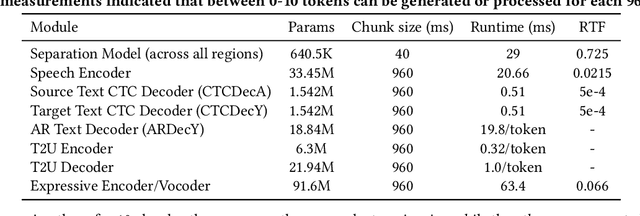
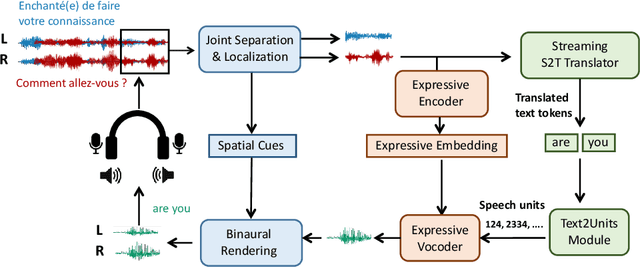
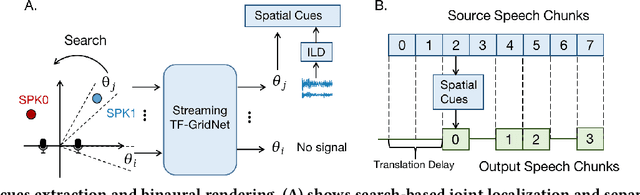

Imagine being in a crowded space where people speak a different language and having hearables that transform the auditory space into your native language, while preserving the spatial cues for all speakers. We introduce spatial speech translation, a novel concept for hearables that translate speakers in the wearer's environment, while maintaining the direction and unique voice characteristics of each speaker in the binaural output. To achieve this, we tackle several technical challenges spanning blind source separation, localization, real-time expressive translation, and binaural rendering to preserve the speaker directions in the translated audio, while achieving real-time inference on the Apple M2 silicon. Our proof-of-concept evaluation with a prototype binaural headset shows that, unlike existing models, which fail in the presence of interference, we achieve a BLEU score of up to 22.01 when translating between languages, despite strong interference from other speakers in the environment. User studies further confirm the system's effectiveness in spatially rendering the translated speech in previously unseen real-world reverberant environments. Taking a step back, this work marks the first step towards integrating spatial perception into speech translation.
Full-Duplex-Bench: A Benchmark to Evaluate Full-duplex Spoken Dialogue Models on Turn-taking Capabilities
Mar 06, 2025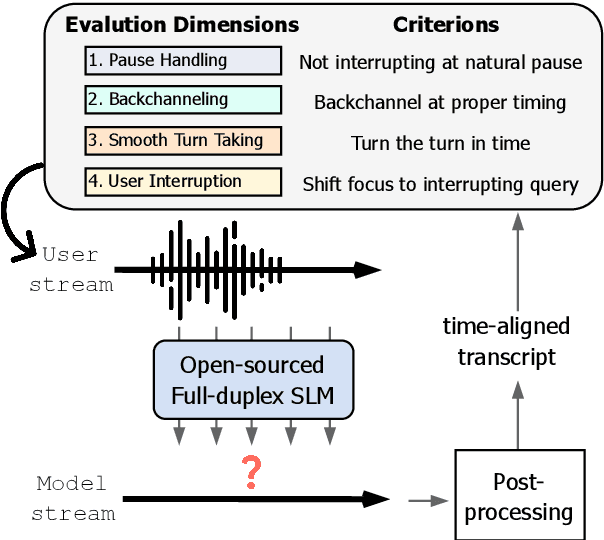
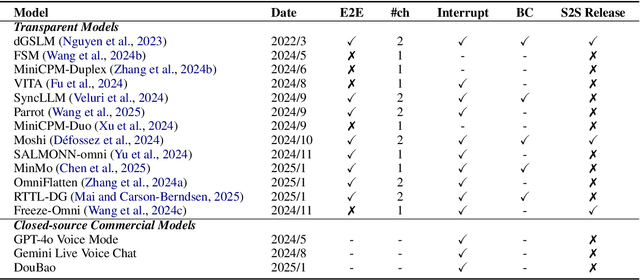
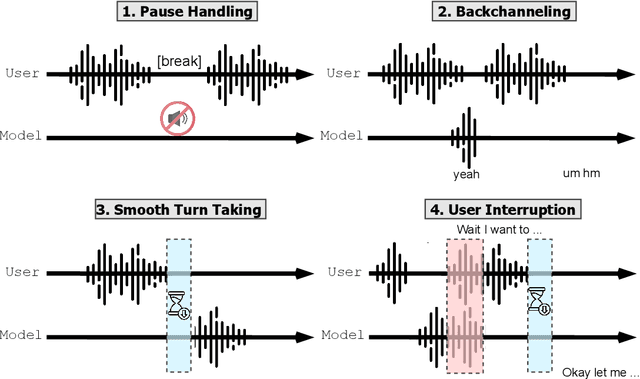

Spoken dialogue modeling introduces unique challenges beyond text-based language modeling, demanding robust turn-taking, backchanneling, and real-time interaction. Although most Spoken Dialogue Models (SDMs) rely on half-duplex processing (handling speech one turn at a time), emerging full-duplex SDMs can listen and speak simultaneously, enabling more natural and engaging conversations. However, current evaluations of such models remain limited, often focusing on turn-based metrics or high-level corpus analyses (e.g., turn gaps, pauses). To address this gap, we present Full-Duplex-Bench, a new benchmark that systematically evaluates key conversational behaviors: pause handling, backchanneling, turn-taking, and interruption management. Our framework uses automatic metrics for consistent and reproducible assessments of SDMs' interactive performance. By offering an open and standardized evaluation benchmark, we aim to advance spoken dialogue modeling and encourage the development of more interactive and natural dialogue systems.