 Add to Chrome
 Add to Firefox
 Add to Edge
EdgeCrafter: Compact ViTs for Edge Dense Prediction via Task-Specialized Distillation
Mar 19, 2026
Deploying high-performance dense prediction models on resource-constrained edge devices remains challenging due to strict limits on computation and memory. In practice, lightweight systems for object detection, instance segmentation, and pose estimation are still dominated by CNN-based architectures such as YOLO, while compact Vision Transformers (ViTs) often struggle to achieve similarly strong accuracy efficiency tradeoff, even with large scale pretraining. We argue that this gap is largely due to insufficient task specific representation learning in small scale ViTs, rather than an inherent mismatch between ViTs and edge dense prediction. To address this issue, we introduce EdgeCrafter, a unified compact ViT framework for edge dense prediction centered on ECDet, a detection model built from a distilled compact backbone and an edge-friendly encoder decoder design. On the COCO dataset, ECDet-S achieves 51.7 AP with fewer than 10M parameters using only COCO annotations. For instance segmentation, ECInsSeg achieves performance comparable to RF-DETR while using substantially fewer parameters. For pose estimation, ECPose-X reaches 74.8 AP, significantly outperforming YOLO26Pose-X (71.6 AP) despite the latter's reliance on extensive Objects365 pretraining. These results show that compact ViTs, when paired with task-specialized distillation and edge-aware design, can be a practical and competitive option for edge dense prediction. Code is available at: https://intellindust-ai-lab.github.io/projects/EdgeCrafter/

FSOD-VFM: Few-Shot Object Detection with Vision Foundation Models and Graph Diffusion
Feb 03, 2026In this paper, we present FSOD-VFM: Few-Shot Object Detectors with Vision Foundation Models, a framework that leverages vision foundation models to tackle the challenge of few-shot object detection. FSOD-VFM integrates three key components: a universal proposal network (UPN) for category-agnostic bounding box generation, SAM2 for accurate mask extraction, and DINOv2 features for efficient adaptation to new object categories. Despite the strong generalization capabilities of foundation models, the bounding boxes generated by UPN often suffer from overfragmentation, covering only partial object regions and leading to numerous small, false-positive proposals rather than accurate, complete object detections. To address this issue, we introduce a novel graph-based confidence reweighting method. In our approach, predicted bounding boxes are modeled as nodes in a directed graph, with graph diffusion operations applied to propagate confidence scores across the network. This reweighting process refines the scores of proposals, assigning higher confidence to whole objects and lower confidence to local, fragmented parts. This strategy improves detection granularity and effectively reduces the occurrence of false-positive bounding box proposals. Through extensive experiments on Pascal-5$^i$, COCO-20$^i$, and CD-FSOD datasets, we demonstrate that our method substantially outperforms existing approaches, achieving superior performance without requiring additional training. Notably, on the challenging CD-FSOD dataset, which spans multiple datasets and domains, our FSOD-VFM achieves 31.6 AP in the 10-shot setting, substantially outperforming previous training-free methods that reach only 21.4 AP. Code is available at: https://intellindust-ai-lab.github.io/projects/FSOD-VFM.
DEIM: DETR with Improved Matching for Fast Convergence
Dec 05, 2024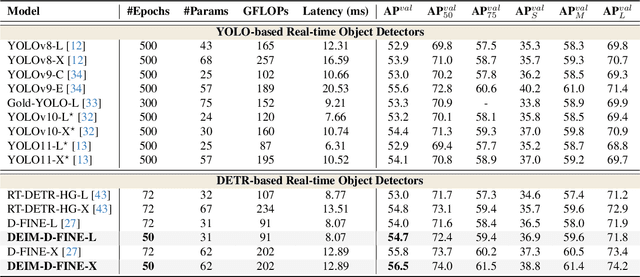
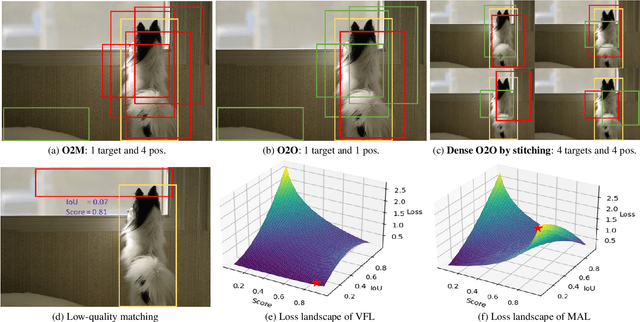
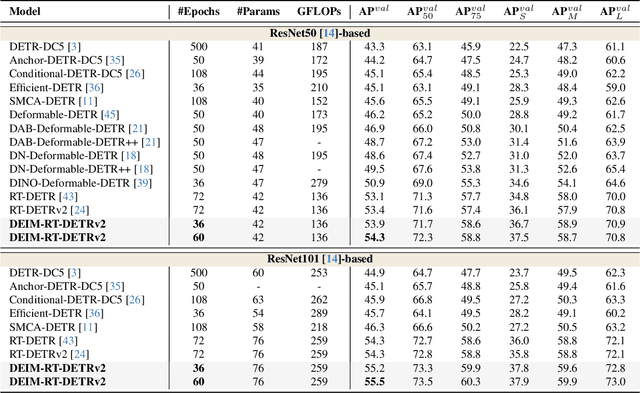
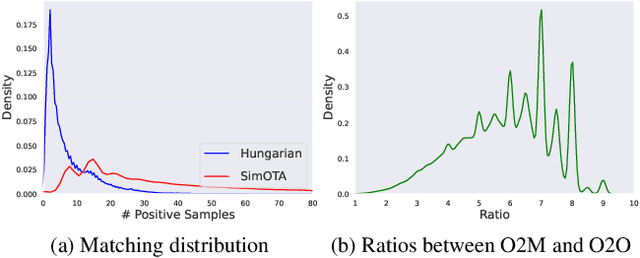
We introduce DEIM, an innovative and efficient training framework designed to accelerate convergence in real-time object detection with Transformer-based architectures (DETR). To mitigate the sparse supervision inherent in one-to-one (O2O) matching in DETR models, DEIM employs a Dense O2O matching strategy. This approach increases the number of positive samples per image by incorporating additional targets, using standard data augmentation techniques. While Dense O2O matching speeds up convergence, it also introduces numerous low-quality matches that could affect performance. To address this, we propose the Matchability-Aware Loss (MAL), a novel loss function that optimizes matches across various quality levels, enhancing the effectiveness of Dense O2O. Extensive experiments on the COCO dataset validate the efficacy of DEIM. When integrated with RT-DETR and D-FINE, it consistently boosts performance while reducing training time by 50%. Notably, paired with RT-DETRv2, DEIM achieves 53.2% AP in a single day of training on an NVIDIA 4090 GPU. Additionally, DEIM-trained real-time models outperform leading real-time object detectors, with DEIM-D-FINE-L and DEIM-D-FINE-X achieving 54.7% and 56.5% AP at 124 and 78 FPS on an NVIDIA T4 GPU, respectively, without the need for additional data. We believe DEIM sets a new baseline for advancements in real-time object detection. Our code and pre-trained models are available at https://github.com/ShihuaHuang95/DEIM.