 Add to Chrome
 Add to Firefox
 Add to Edge
ComSim: Building Scalable Real-World Robot Data Generation via Compositional Simulation
Apr 13, 2026
Recent advancements in foundational models, such as large language models and world models, have greatly enhanced the capabilities of robotics, enabling robots to autonomously perform complex tasks. However, acquiring large-scale, high-quality training data for robotics remains a challenge, as it often requires substantial manual effort and is limited in its coverage of diverse real-world environments. To address this, we propose a novel hybrid approach called Compositional Simulation, which combines classical simulation and neural simulation to generate accurate action-video pairs while maintaining real-world consistency. Our approach utilizes a closed-loop real-sim-real data augmentation pipeline, leveraging a small amount of real-world data to generate diverse, large-scale training datasets that cover a broader spectrum of real-world scenarios. We train a neural simulator to transform classical simulation videos into real-world representations, improving the accuracy of policy models trained in real-world environments. Through extensive experiments, we demonstrate that our method significantly reduces the sim2real domain gap, resulting in higher success rates in real-world policy model training. Our approach offers a scalable solution for generating robust training data and bridging the gap between simulated and real-world robotics.

Select-then-Solve: Paradigm Routing as Inference-Time Optimization for LLM Agents
Apr 08, 2026When an LLM-based agent improves on a task, is the gain from the model itself or from the reasoning paradigm wrapped around it? We study this question by comparing six inference-time paradigms, namely Direct, CoT, ReAct, Plan-Execute, Reflection, and ReCode, across four frontier LLMs and ten benchmarks, yielding roughly 18,000 runs. We find that reasoning structure helps dramatically on some tasks but hurts on others: ReAct improves over Direct by 44pp on GAIA, while CoT degrades performance by 15pp on HumanEval. No single paradigm dominates, and oracle per-task selection beats the best fixed paradigm by 17.1pp on average. Motivated by this complementarity, we propose a select-then-solve approach: before answering each task, a lightweight embedding-based router selects the most suitable paradigm. Across four models, the router improves average accuracy from 47.6% to 53.1%, outperforming the best fixed paradigm at 50.3% by 2.8pp and recovering up to 37% of the oracle gap. In contrast, zero-shot self-routing only works for GPT-5 at 67.1% and fails for weaker models, all trailing the learned router. Our results argue that reasoning paradigm selection should be a per-task decision made by a learned router, not a fixed architectural choice.
CoEnv: Driving Embodied Multi-Agent Collaboration via Compositional Environment
Apr 07, 2026Multi-agent embodied systems hold promise for complex collaborative manipulation, yet face critical challenges in spatial coordination, temporal reasoning, and shared workspace awareness. Inspired by human collaboration where cognitive planning occurs separately from physical execution, we introduce the concept of compositional environment -- a synergistic integration of real-world and simulation components that enables multiple robotic agents to perceive intentions and operate within a unified decision-making space. Building on this concept, we present CoEnv, a framework that leverages simulation for safe strategy exploration while ensuring reliable real-world deployment. CoEnv operates through three stages: real-to-sim scene reconstruction that digitizes physical workspaces, VLM-driven action synthesis supporting both real-time planning with high-level interfaces and iterative planning with code-based trajectory generation, and validated sim-to-real transfer with collision detection for safe deployment. Extensive experiments on challenging multi-arm manipulation benchmarks demonstrate CoEnv's effectiveness in achieving high task success rates and execution efficiency, establishing a new paradigm for multi-agent embodied AI.
Ego to World: Collaborative Spatial Reasoning in Embodied Systems via Reinforcement Learning
Mar 16, 2026Understanding the world from distributed, partial viewpoints is a fundamental challenge for embodied multi-agent systems. Each agent perceives the environment through an ego-centric view that is often limited by occlusion and ambiguity. To study this problem, we introduce the Ego-to-World (E2W) benchmark, which evaluates a vision-language model's ability to fuse heterogeneous viewpoints across three tasks: (i) global counting, (ii) relational location reasoning, and (iii) action-oriented grasping that requires predicting view-specific image coordinates. To address this setting, we propose CoRL, a two-stage framework that combines Chain-of-Thought supervised fine-tuning with reinforcement learning using Group-Relative Policy Optimization. Its core component, the Cross-View Spatial Reward (CVSR), provides dense task-aligned feedback by linking reasoning steps to visual evidence, ensuring coherent cross-view entity resolution, and guiding the model toward correct final predictions. Experiments on E2W show that CoRL consistently surpasses strong proprietary and open-source baselines on both reasoning and perception-grounding metrics, while ablations further confirm the necessity of each CVSR component. Beyond that, CoRL generalizes to external spatial reasoning benchmarks and enables effective real-world multi-robot manipulation with calibrated multi-camera rigs, demonstrating cross-view localization and successful grasp-and-place execution. Together, E2W and CoRL provide a principled foundation for learning world-centric scene understanding from distributed, ego-centric observations, advancing collaborative embodied AI.
Reading $ eq$ Seeing: Diagnosing and Closing the Typography Gap in Vision-Language Models
Mar 09, 2026Vision-Language Models achieve near-perfect accuracy at reading text in images, yet prove largely typography-blind: capable of recognizing what text says, but not how it looks. We systematically investigate this gap by evaluating font family, size, style, and color recognition across 26 fonts, four scripts, and three difficulty levels. Our evaluation of 15 state-of-the-art VLMs reveals a striking perception hierarchy: color recognition is near-perfect, yet font style detection remains universally poor. We further find that model scale fails to predict performance and that accuracy is uniform across difficulty levels, together pointing to a training-data omission rather than a capacity ceiling. LoRA fine-tuning on a small set of synthetic samples substantially improves an open-source model, narrowing the gap to the best closed-source system and surpassing it on font size recognition. Font style alone remains resistant to fine-tuning, suggesting that relational visual reasoning may require architectural innovation beyond current patch-based encoders. We release our evaluation framework, data, and fine-tuning recipe to support progress in closing the typographic gap in vision-language understanding.
Advances and Innovations in the Multi-Agent Robotic System (MARS) Challenge
Jan 26, 2026Recent advancements in multimodal large language models and vision-languageaction models have significantly driven progress in Embodied AI. As the field transitions toward more complex task scenarios, multi-agent system frameworks are becoming essential for achieving scalable, efficient, and collaborative solutions. This shift is fueled by three primary factors: increasing agent capabilities, enhancing system efficiency through task delegation, and enabling advanced human-agent interactions. To address the challenges posed by multi-agent collaboration, we propose the Multi-Agent Robotic System (MARS) Challenge, held at the NeurIPS 2025 Workshop on SpaVLE. The competition focuses on two critical areas: planning and control, where participants explore multi-agent embodied planning using vision-language models (VLMs) to coordinate tasks and policy execution to perform robotic manipulation in dynamic environments. By evaluating solutions submitted by participants, the challenge provides valuable insights into the design and coordination of embodied multi-agent systems, contributing to the future development of advanced collaborative AI systems.
VIKI-R: Coordinating Embodied Multi-Agent Cooperation via Reinforcement Learning
Jun 10, 2025Coordinating multiple embodied agents in dynamic environments remains a core challenge in artificial intelligence, requiring both perception-driven reasoning and scalable cooperation strategies. While recent works have leveraged large language models (LLMs) for multi-agent planning, a few have begun to explore vision-language models (VLMs) for visual reasoning. However, these VLM-based approaches remain limited in their support for diverse embodiment types. In this work, we introduce VIKI-Bench, the first hierarchical benchmark tailored for embodied multi-agent cooperation, featuring three structured levels: agent activation, task planning, and trajectory perception. VIKI-Bench includes diverse robot embodiments, multi-view visual observations, and structured supervision signals to evaluate reasoning grounded in visual inputs. To demonstrate the utility of VIKI-Bench, we propose VIKI-R, a two-stage framework that fine-tunes a pretrained vision-language model (VLM) using Chain-of-Thought annotated demonstrations, followed by reinforcement learning under multi-level reward signals. Our extensive experiments show that VIKI-R significantly outperforms baselines method across all task levels. Furthermore, we show that reinforcement learning enables the emergence of compositional cooperation patterns among heterogeneous agents. Together, VIKI-Bench and VIKI-R offer a unified testbed and method for advancing multi-agent, visual-driven cooperation in embodied AI systems.
UniSTD: Towards Unified Spatio-Temporal Learning across Diverse Disciplines
Mar 26, 2025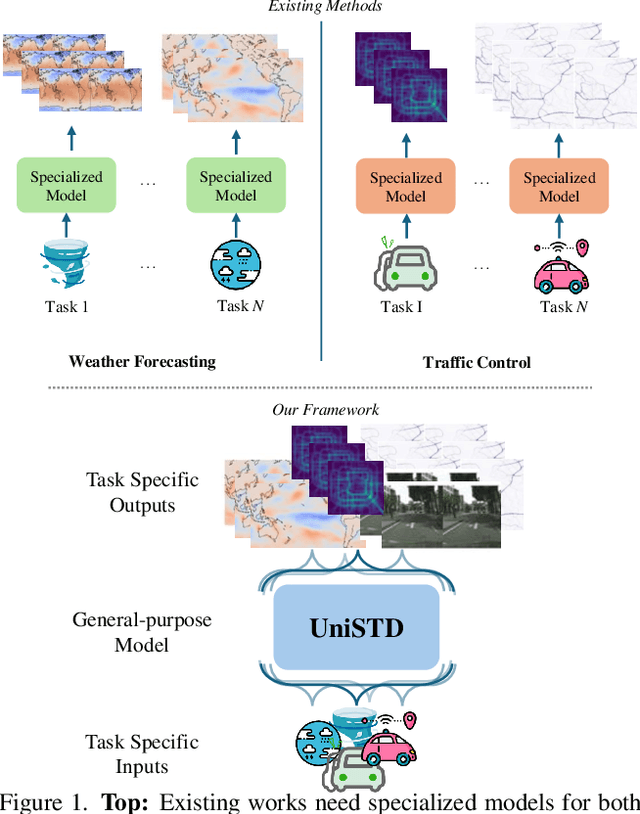
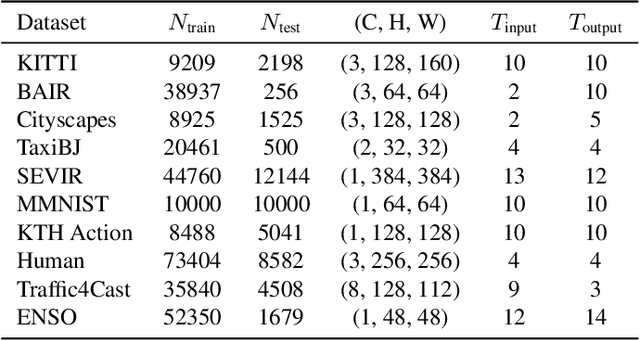
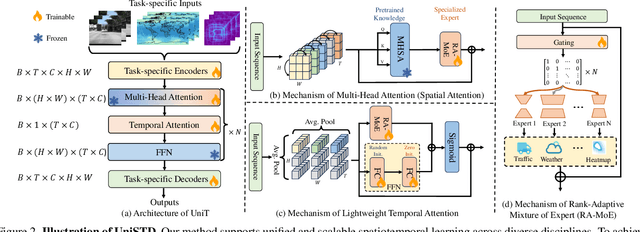
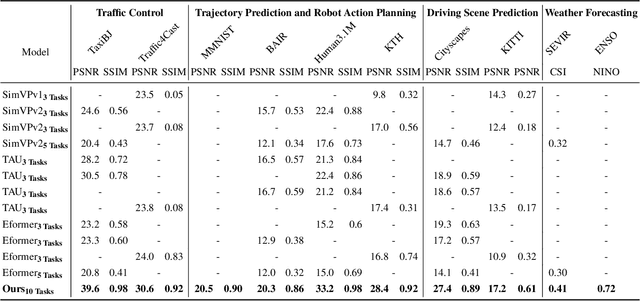
Traditional spatiotemporal models generally rely on task-specific architectures, which limit their generalizability and scalability across diverse tasks due to domain-specific design requirements. In this paper, we introduce \textbf{UniSTD}, a unified Transformer-based framework for spatiotemporal modeling, which is inspired by advances in recent foundation models with the two-stage pretraining-then-adaption paradigm. Specifically, our work demonstrates that task-agnostic pretraining on 2D vision and vision-text datasets can build a generalizable model foundation for spatiotemporal learning, followed by specialized joint training on spatiotemporal datasets to enhance task-specific adaptability. To improve the learning capabilities across domains, our framework employs a rank-adaptive mixture-of-expert adaptation by using fractional interpolation to relax the discrete variables so that can be optimized in the continuous space. Additionally, we introduce a temporal module to incorporate temporal dynamics explicitly. We evaluate our approach on a large-scale dataset covering 10 tasks across 4 disciplines, demonstrating that a unified spatiotemporal model can achieve scalable, cross-task learning and support up to 10 tasks simultaneously within one model while reducing training costs in multi-domain applications. Code will be available at https://github.com/1hunters/UniSTD.
Rethinking Vision-Language Model in Face Forensics: Multi-Modal Interpretable Forged Face Detector
Mar 26, 2025Deepfake detection is a long-established research topic vital for mitigating the spread of malicious misinformation. Unlike prior methods that provide either binary classification results or textual explanations separately, we introduce a novel method capable of generating both simultaneously. Our method harnesses the multi-modal learning capability of the pre-trained CLIP and the unprecedented interpretability of large language models (LLMs) to enhance both the generalization and explainability of deepfake detection. Specifically, we introduce a multi-modal face forgery detector (M2F2-Det) that employs tailored face forgery prompt learning, incorporating the pre-trained CLIP to improve generalization to unseen forgeries. Also, M2F2-Det incorporates an LLM to provide detailed textual explanations of its detection decisions, enhancing interpretability by bridging the gap between natural language and subtle cues of facial forgeries. Empirically, we evaluate M2F2-Det on both detection and explanation generation tasks, where it achieves state-of-the-art performance, demonstrating its effectiveness in identifying and explaining diverse forgeries.
RoboFactory: Exploring Embodied Agent Collaboration with Compositional Constraints
Mar 20, 2025Designing effective embodied multi-agent systems is critical for solving complex real-world tasks across domains. Due to the complexity of multi-agent embodied systems, existing methods fail to automatically generate safe and efficient training data for such systems. To this end, we propose the concept of compositional constraints for embodied multi-agent systems, addressing the challenges arising from collaboration among embodied agents. We design various interfaces tailored to different types of constraints, enabling seamless interaction with the physical world. Leveraging compositional constraints and specifically designed interfaces, we develop an automated data collection framework for embodied multi-agent systems and introduce the first benchmark for embodied multi-agent manipulation, RoboFactory. Based on RoboFactory benchmark, we adapt and evaluate the method of imitation learning and analyzed its performance in different difficulty agent tasks. Furthermore, we explore the architectures and training strategies for multi-agent imitation learning, aiming to build safe and efficient embodied multi-agent systems.