 Add to Chrome
 Add to Firefox
 Add to Edge
MVOFormer: Flow-Semantic Transformer for Robust Monocular Visual Odometry
Jun 15, 2026
Monocular visual odometry (MVO) is foundational to autonomous navigation and robotic localization. However, existing learning-based MVO approaches often struggle with either a lack of interpretable, complementary features or overly complex multi-stage architectures. These limitations inherently restrict their robustness and cross-domain generalization. In this work, we propose MVOFormer, a novel transformer framework for robust monocular visual odometry. Our architecture features a Flow-Semantic Dual Branch Encoder that synergizes dense geometric motion cues with object-centric semantic priors, explicitly distinguishing static structures from dynamic distractors. These representations are then fused by an Iterative Multimodal Decoder, enabling coarse-to-fine pose refinement while dynamically suppressing attention on unreliable regions. Extensive evaluations demonstrate that, without any target-domain fine-tuning, MVOFormer achieves superior zero-shot generalization and robustness, significantly outperforming prior learning-based frame-to-frame methods across diverse benchmarks including TartanAir, KITTI, TUM-RGBD, and ETH3D-SLAM.

DrawVideo: Generating Long Video from Storyboard Keyframe Sketches
May 22, 2026Long video generation requires high-fidelity synthesis, coherent narrative structure, and user control over extended time spans. Existing text-to-video methods often rely on a single long prompt, limiting control over pose, composition, layout, and motion. We propose DrawVideo, a sketch-guided, storyboard-driven framework for controllable long-video generation. DrawVideo decomposes long videos into independently controllable shots, each defined by a black-and-white sketch, an appearance prompt, and a motion prompt. The sketch controls pose and layout, the appearance prompt defines identity, scene, and style, and the motion prompt guides temporal dynamics. DrawVideo follows a hierarchical 'global multi-shot, local single-sketch' strategy: it first generates a structure-aligned reference keyframe, then expands the motion prompt into derivative keyframes representing action states, and finally synthesizes clips between adjacent keyframes to build each shot. We also introduce SketchLongVideo, the first dataset for sketch-guided text-to-long-video generation, constructed from animation videos via shot detection, keyframe extraction, vision-language recognition, prompt decomposition, and sketch conversion. Experiments show that DrawVideo achieves strong structural controllability, appearance consistency, visual stability, and coherent long-video generation.
3D Geometry-aware Deformable Gaussian Splatting for Dynamic View Synthesis
Apr 14, 2024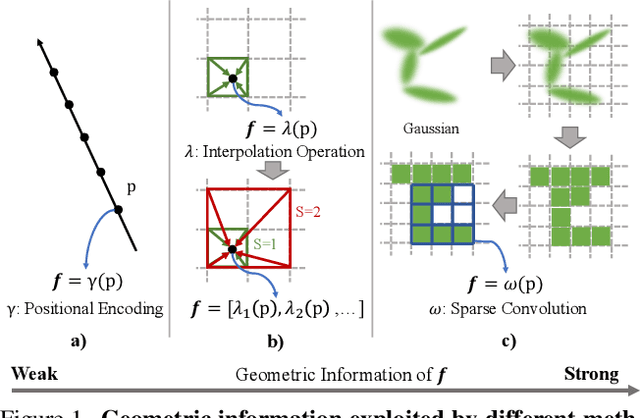
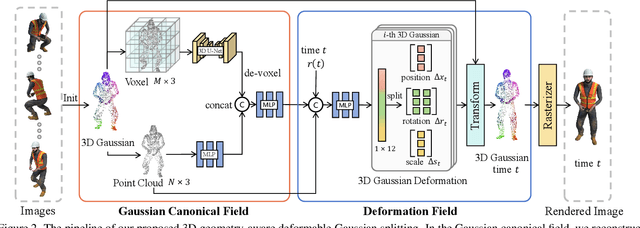
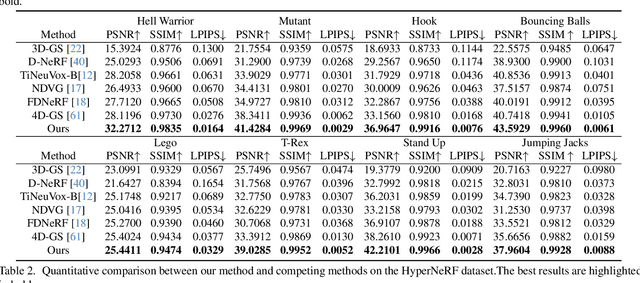
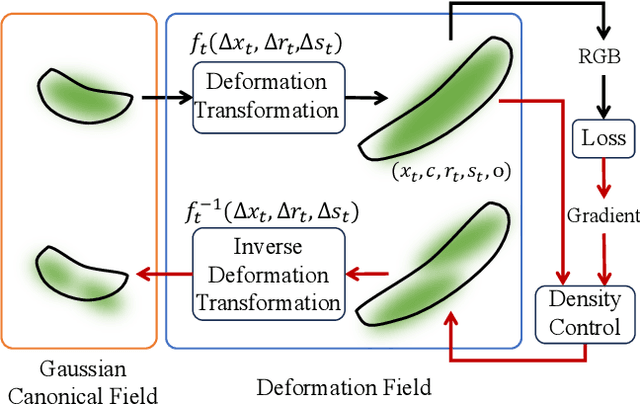
In this paper, we propose a 3D geometry-aware deformable Gaussian Splatting method for dynamic view synthesis. Existing neural radiance fields (NeRF) based solutions learn the deformation in an implicit manner, which cannot incorporate 3D scene geometry. Therefore, the learned deformation is not necessarily geometrically coherent, which results in unsatisfactory dynamic view synthesis and 3D dynamic reconstruction. Recently, 3D Gaussian Splatting provides a new representation of the 3D scene, building upon which the 3D geometry could be exploited in learning the complex 3D deformation. Specifically, the scenes are represented as a collection of 3D Gaussian, where each 3D Gaussian is optimized to move and rotate over time to model the deformation. To enforce the 3D scene geometry constraint during deformation, we explicitly extract 3D geometry features and integrate them in learning the 3D deformation. In this way, our solution achieves 3D geometry-aware deformation modeling, which enables improved dynamic view synthesis and 3D dynamic reconstruction. Extensive experimental results on both synthetic and real datasets prove the superiority of our solution, which achieves new state-of-the-art performance. The project is available at https://npucvr.github.io/GaGS/