 Add to Chrome
 Add to Firefox
 Add to Edge
TFP: Temporally Conditioned Memory-Fusion Policies for Visuomotor Learning
Jul 09, 2026
Vision--Language--Action (VLA) policies such as $π_{0.5}$ and OpenVLA perform well on many manipulation tasks, but they are often reactive: the next action is predicted from the current observation, instruction, and proprioceptive state. This assumption breaks down in stage-dependent manipulation, where visually similar states may require different actions depending on latent task progress and previous interaction outcomes. We argue that such tasks require not only memory, but dynamics-aware belief updates: the policy should preserve task progress during stable or occluded phases and revise its belief near contact, release, or subgoal transitions. We introduce Temporally Conditioned Memory-Fusion Policies (TFP), a lightweight memory-action framework for VLA backbones. TFP maintains an episode-local task-progress belief with Liquid Time-Constant dynamics and injects the updated belief directly into the flow-matching action decoder through adaptive modulation. This lets temporally accumulated context shape the generated action chunk, rather than serving only as passive history context. With a 3.3B-parameter model, TFP improves the average success rate from \(96.9\%\) to \(98.75\%\) on LIBERO and from \(91.4\%\) to \(93.77\%\) on LIBERO-plus. On the memory-focused MIKASA ShellGameTouch diagnostic, TFP achieves success up to \(75.0\%\). Mechanistic analyses show that write-gain changes near manipulation events are about \(6\times\) larger than far non-event phases, and hidden-state interventions show that the belief causally modulates generated action chunks. These results suggest that compact, event-sensitive memory dynamics can improve VLA policies under occlusion, visual perturbation, and stage-dependent task structure.

Ruka-v2: Tendon Driven Open-Source Dexterous Hand with Wrist and Abduction for Robot Learning
Mar 27, 2026Lack of accessible and dexterous robot hardware has been a significant bottleneck to achieving human-level dexterity in robots. Last year, we released Ruka, a fully open-sourced, tendon-driven humanoid hand with 11 degrees of freedom - 2 per finger and 3 at the thumb - buildable for under $1,300. It was one of the first fully open-sourced humanoid hands, and introduced a novel data-driven approach to finger control that captures tendon dynamics within the control system. Despite these contributions, Ruka lacked two degrees of freedom essential for closely imitating human behavior: wrist mobility and finger adduction/abduction. In this paper, we introduce Ruka-v2: a fully open-sourced, tendon-driven humanoid hand featuring a decoupled 2-DOF parallel wrist and abduction/adduction at the fingers. The parallel wrist adds smooth, independent flexion/extension and radial/ulnar deviation, enabling manipulation in confined environments such as cabinets. Abduction enables motions such as grasping thin objects, in-hand rotation, and calligraphy. We present the design of Ruka-v2 and evaluate it against Ruka through user studies on teleoperated tasks, finding a 51.3% reduction in completion time and a 21.2% increase in success rate. We further demonstrate its full range of applications for robot learning: bimanual and single-arm teleoperation across 13 dexterous tasks, and autonomous policy learning on 3 tasks. All 3D print files, assembly instructions, controller software, and videos are available at https://ruka-hand-v2.github.io/ .
Imagine, Initialize, and Explore: An Effective Exploration Method in Multi-Agent Reinforcement Learning
Mar 01, 2024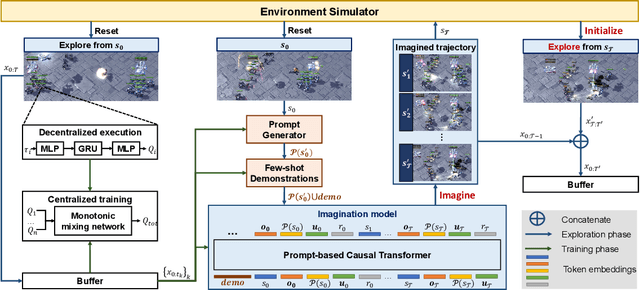
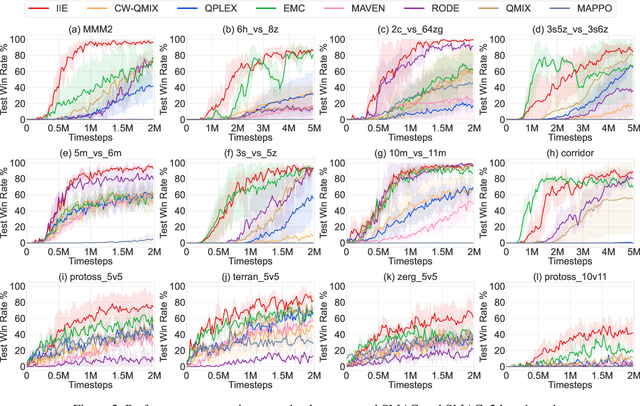
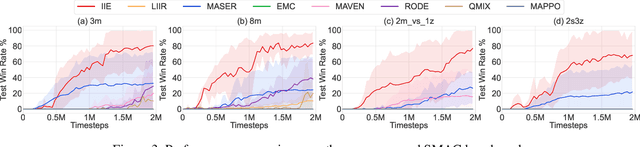
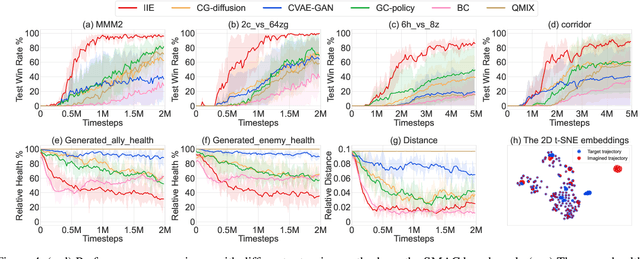
Effective exploration is crucial to discovering optimal strategies for multi-agent reinforcement learning (MARL) in complex coordination tasks. Existing methods mainly utilize intrinsic rewards to enable committed exploration or use role-based learning for decomposing joint action spaces instead of directly conducting a collective search in the entire action-observation space. However, they often face challenges obtaining specific joint action sequences to reach successful states in long-horizon tasks. To address this limitation, we propose Imagine, Initialize, and Explore (IIE), a novel method that offers a promising solution for efficient multi-agent exploration in complex scenarios. IIE employs a transformer model to imagine how the agents reach a critical state that can influence each other's transition functions. Then, we initialize the environment at this state using a simulator before the exploration phase. We formulate the imagination as a sequence modeling problem, where the states, observations, prompts, actions, and rewards are predicted autoregressively. The prompt consists of timestep-to-go, return-to-go, influence value, and one-shot demonstration, specifying the desired state and trajectory as well as guiding the action generation. By initializing agents at the critical states, IIE significantly increases the likelihood of discovering potentially important under-explored regions. Despite its simplicity, empirical results demonstrate that our method outperforms multi-agent exploration baselines on the StarCraft Multi-Agent Challenge (SMAC) and SMACv2 environments. Particularly, IIE shows improved performance in the sparse-reward SMAC tasks and produces more effective curricula over the initialized states than other generative methods, such as CVAE-GAN and diffusion models.