 Add to Chrome
 Add to Firefox
 Add to Edge
Dynamic Derivation and Elimination: Audio Visual Segmentation with Enhanced Audio Semantics
Mar 17, 2025
Sound-guided object segmentation has drawn considerable attention for its potential to enhance multimodal perception. Previous methods primarily focus on developing advanced architectures to facilitate effective audio-visual interactions, without fully addressing the inherent challenges posed by audio natures, \emph{\ie}, (1) feature confusion due to the overlapping nature of audio signals, and (2) audio-visual matching difficulty from the varied sounds produced by the same object. To address these challenges, we propose Dynamic Derivation and Elimination (DDESeg): a novel audio-visual segmentation framework. Specifically, to mitigate feature confusion, DDESeg reconstructs the semantic content of the mixed audio signal by enriching the distinct semantic information of each individual source, deriving representations that preserve the unique characteristics of each sound. To reduce the matching difficulty, we introduce a discriminative feature learning module, which enhances the semantic distinctiveness of generated audio representations. Considering that not all derived audio representations directly correspond to visual features (e.g., off-screen sounds), we propose a dynamic elimination module to filter out non-matching elements. This module facilitates targeted interaction between sounding regions and relevant audio semantics. By scoring the interacted features, we identify and filter out irrelevant audio information, ensuring accurate audio-visual alignment. Comprehensive experiments demonstrate that our framework achieves superior performance in AVS datasets.

ObjectMover: Generative Object Movement with Video Prior
Mar 11, 2025Simple as it seems, moving an object to another location within an image is, in fact, a challenging image-editing task that requires re-harmonizing the lighting, adjusting the pose based on perspective, accurately filling occluded regions, and ensuring coherent synchronization of shadows and reflections while maintaining the object identity. In this paper, we present ObjectMover, a generative model that can perform object movement in highly challenging scenes. Our key insight is that we model this task as a sequence-to-sequence problem and fine-tune a video generation model to leverage its knowledge of consistent object generation across video frames. We show that with this approach, our model is able to adjust to complex real-world scenarios, handling extreme lighting harmonization and object effect movement. As large-scale data for object movement are unavailable, we construct a data generation pipeline using a modern game engine to synthesize high-quality data pairs. We further propose a multi-task learning strategy that enables training on real-world video data to improve the model generalization. Through extensive experiments, we demonstrate that ObjectMover achieves outstanding results and adapts well to real-world scenarios.
7ABAW-Compound Expression Recognition via Curriculum Learning
Mar 11, 2025With the advent of deep learning, expression recognition has made significant advancements. However, due to the limited availability of annotated compound expression datasets and the subtle variations of compound expressions, Compound Emotion Recognition (CE) still holds considerable potential for exploration. To advance this task, the 7th Affective Behavior Analysis in-the-wild (ABAW) competition introduces the Compound Expression Challenge based on C-EXPR-DB, a limited dataset without labels. In this paper, we present a curriculum learning-based framework that initially trains the model on single-expression tasks and subsequently incorporates multi-expression data. This design ensures that our model first masters the fundamental features of basic expressions before being exposed to the complexities of compound emotions. Specifically, our designs can be summarized as follows: 1) Single-Expression Pre-training: The model is first trained on datasets containing single expressions to learn the foundational facial features associated with basic emotions. 2) Dynamic Compound Expression Generation: Given the scarcity of annotated compound expression datasets, we employ CutMix and Mixup techniques on the original single-expression images to create hybrid images exhibiting characteristics of multiple basic emotions. 3) Incremental Multi-Expression Integration: After performing well on single-expression tasks, the model is progressively exposed to multi-expression data, allowing the model to adapt to the complexity and variability of compound expressions. The official results indicate that our method achieves the \textbf{best} performance in this competition track with an F-score of 0.6063. Our code is released at https://github.com/YenanLiu/ABAW7th.
EasyCraft: A Robust and Efficient Framework for Automatic Avatar Crafting
Mar 03, 2025Character customization, or 'face crafting,' is a vital feature in role-playing games (RPGs), enhancing player engagement by enabling the creation of personalized avatars. Existing automated methods often struggle with generalizability across diverse game engines due to their reliance on the intermediate constraints of specific image domain and typically support only one type of input, either text or image. To overcome these challenges, we introduce EasyCraft, an innovative end-to-end feedforward framework that automates character crafting by uniquely supporting both text and image inputs. Our approach employs a translator capable of converting facial images of any style into crafting parameters. We first establish a unified feature distribution in the translator's image encoder through self-supervised learning on a large-scale dataset, enabling photos of any style to be embedded into a unified feature representation. Subsequently, we map this unified feature distribution to crafting parameters specific to a game engine, a process that can be easily adapted to most game engines and thus enhances EasyCraft's generalizability. By integrating text-to-image techniques with our translator, EasyCraft also facilitates precise, text-based character crafting. EasyCraft's ability to integrate diverse inputs significantly enhances the versatility and accuracy of avatar creation. Extensive experiments on two RPG games demonstrate the effectiveness of our method, achieving state-of-the-art results and facilitating adaptability across various avatar engines.
UniTok: A Unified Tokenizer for Visual Generation and Understanding
Feb 27, 2025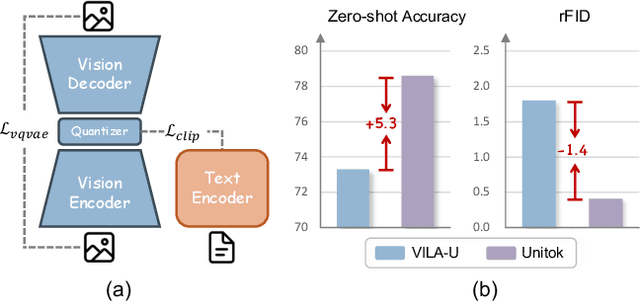
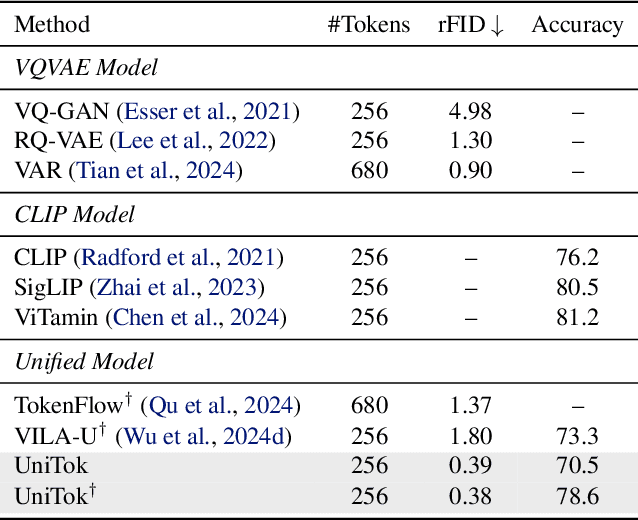
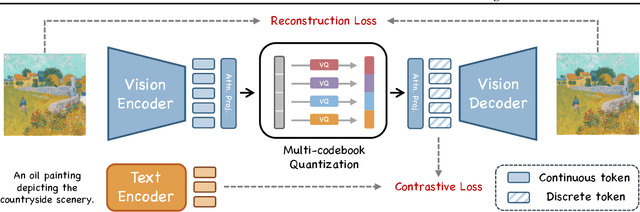
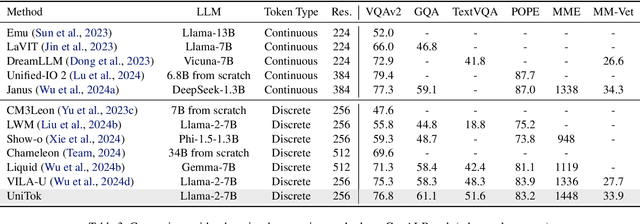
The representation disparity between visual generation and understanding imposes a critical gap in integrating these capabilities into a single framework. To bridge this gap, we introduce UniTok, a discrete visual tokenizer that encodes fine-grained details for generation while also capturing high-level semantics for understanding. Despite recent studies have shown that these objectives could induce loss conflicts in training, we reveal that the underlying bottleneck stems from limited representational capacity of discrete tokens. We address this by introducing multi-codebook quantization, which divides vector quantization with several independent sub-codebooks to expand the latent feature space, while avoiding training instability caused by overlarge codebooks. Our method significantly raises the upper limit of unified discrete tokenizers to match or even surpass domain-specific continuous tokenizers. For instance, UniTok achieves a remarkable rFID of 0.38 (versus 0.87 for SD-VAE) and a zero-shot accuracy of 78.6% (versus 76.2% for CLIP) on ImageNet. Our code is available at https://github.com/FoundationVision/UniTok.
Trust-Aware Diversion for Data-Effective Distillation
Feb 07, 2025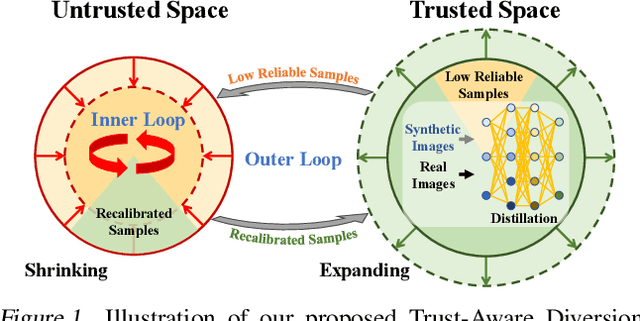
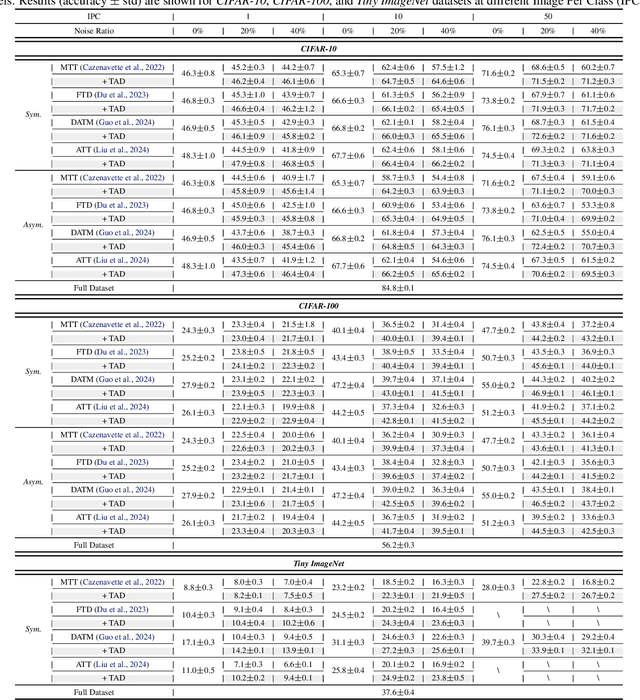

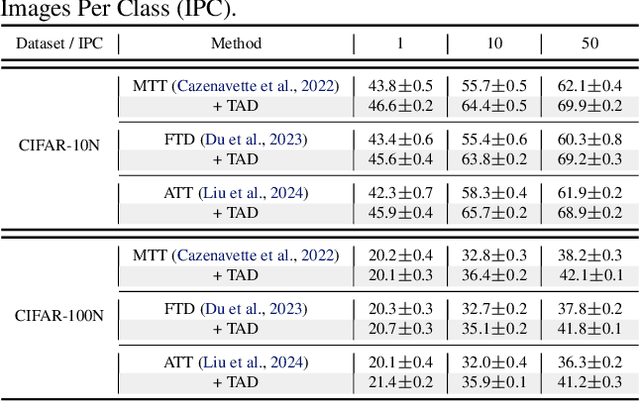
Dataset distillation compresses a large dataset into a small synthetic subset that retains essential information. Existing methods assume that all samples are perfectly labeled, limiting their real-world applications where incorrect labels are ubiquitous. These mislabeled samples introduce untrustworthy information into the dataset, which misleads model optimization in dataset distillation. To tackle this issue, we propose a Trust-Aware Diversion (TAD) dataset distillation method. Our proposed TAD introduces an iterative dual-loop optimization framework for data-effective distillation. Specifically, the outer loop divides data into trusted and untrusted spaces, redirecting distillation toward trusted samples to guarantee trust in the distillation process. This step minimizes the impact of mislabeled samples on dataset distillation. The inner loop maximizes the distillation objective by recalibrating untrusted samples, thus transforming them into valuable ones for distillation. This dual-loop iteratively refines and compensates for each other, gradually expanding the trusted space and shrinking the untrusted space. Experiments demonstrate that our method can significantly improve the performance of existing dataset distillation methods on three widely used benchmarks (CIFAR10, CIFAR100, and Tiny ImageNet) in three challenging mislabeled settings (symmetric, asymmetric, and real-world).
CMamba: Learned Image Compression with State Space Models
Feb 07, 2025Learned Image Compression (LIC) has explored various architectures, such as Convolutional Neural Networks (CNNs) and transformers, in modeling image content distributions in order to achieve compression effectiveness. However, achieving high rate-distortion performance while maintaining low computational complexity (\ie, parameters, FLOPs, and latency) remains challenging. In this paper, we propose a hybrid Convolution and State Space Models (SSMs) based image compression framework, termed \textit{CMamba}, to achieve superior rate-distortion performance with low computational complexity. Specifically, CMamba introduces two key components: a Content-Adaptive SSM (CA-SSM) module and a Context-Aware Entropy (CAE) module. First, we observed that SSMs excel in modeling overall content but tend to lose high-frequency details. In contrast, CNNs are proficient at capturing local details. Motivated by this, we propose the CA-SSM module that can dynamically fuse global content extracted by SSM blocks and local details captured by CNN blocks in both encoding and decoding stages. As a result, important image content is well preserved during compression. Second, our proposed CAE module is designed to reduce spatial and channel redundancies in latent representations after encoding. Specifically, our CAE leverages SSMs to parameterize the spatial content in latent representations. Benefiting from SSMs, CAE significantly improves spatial compression efficiency while reducing spatial content redundancies. Moreover, along the channel dimension, CAE reduces inter-channel redundancies of latent representations via an autoregressive manner, which can fully exploit prior knowledge from previous channels without sacrificing efficiency. Experimental results demonstrate that CMamba achieves superior rate-distortion performance.
FlashVTG: Feature Layering and Adaptive Score Handling Network for Video Temporal Grounding
Dec 18, 2024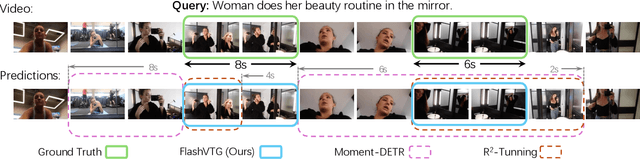
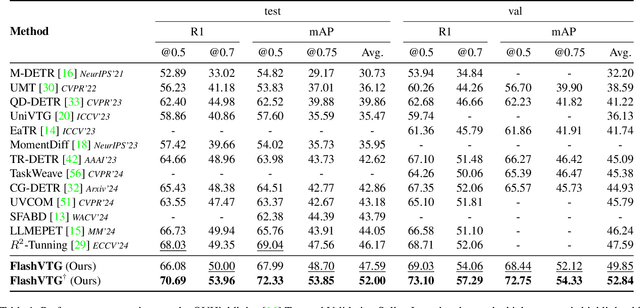
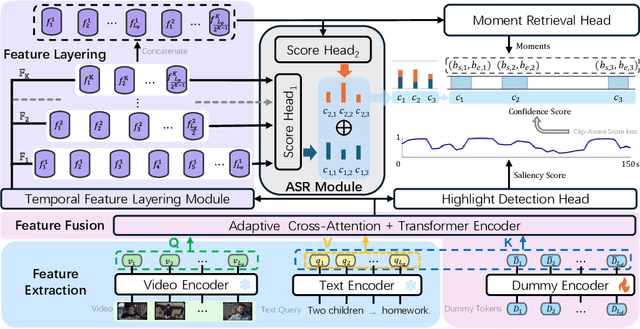
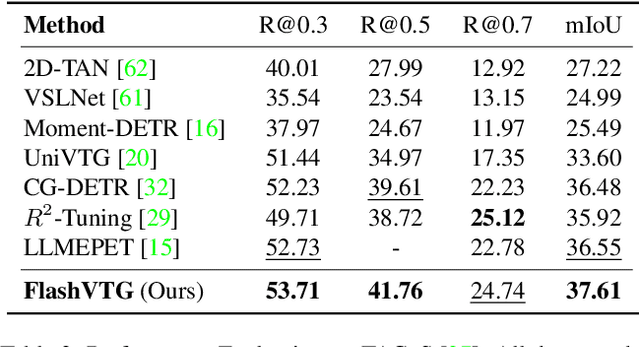
Text-guided Video Temporal Grounding (VTG) aims to localize relevant segments in untrimmed videos based on textual descriptions, encompassing two subtasks: Moment Retrieval (MR) and Highlight Detection (HD). Although previous typical methods have achieved commendable results, it is still challenging to retrieve short video moments. This is primarily due to the reliance on sparse and limited decoder queries, which significantly constrain the accuracy of predictions. Furthermore, suboptimal outcomes often arise because previous methods rank predictions based on isolated predictions, neglecting the broader video context. To tackle these issues, we introduce FlashVTG, a framework featuring a Temporal Feature Layering (TFL) module and an Adaptive Score Refinement (ASR) module. The TFL module replaces the traditional decoder structure to capture nuanced video content variations across multiple temporal scales, while the ASR module improves prediction ranking by integrating context from adjacent moments and multi-temporal-scale features. Extensive experiments demonstrate that FlashVTG achieves state-of-the-art performance on four widely adopted datasets in both MR and HD. Specifically, on the QVHighlights dataset, it boosts mAP by 5.8% for MR and 3.3% for HD. For short-moment retrieval, FlashVTG increases mAP to 125% of previous SOTA performance. All these improvements are made without adding training burdens, underscoring its effectiveness. Our code is available at https://github.com/Zhuo-Cao/FlashVTG.
TEXGen: a Generative Diffusion Model for Mesh Textures
Nov 22, 2024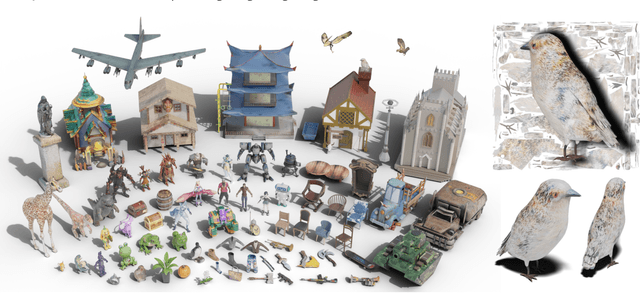
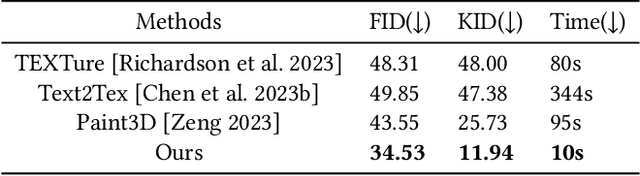
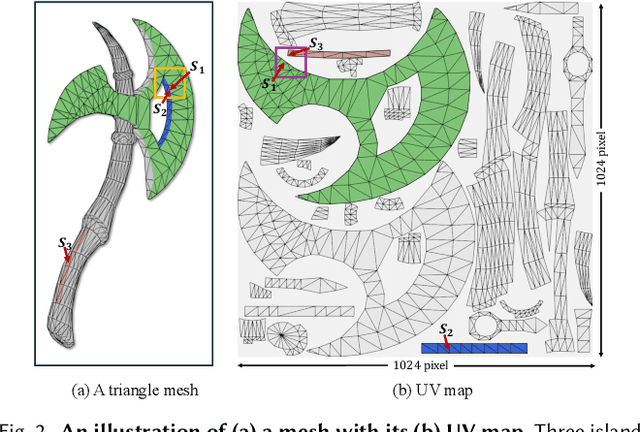
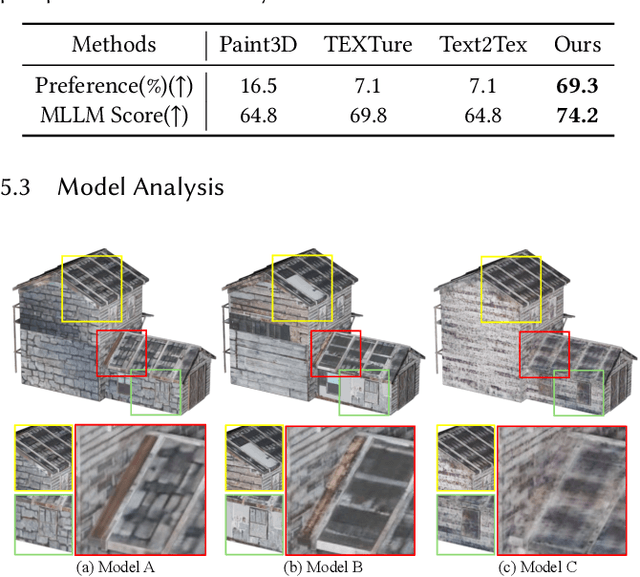
While high-quality texture maps are essential for realistic 3D asset rendering, few studies have explored learning directly in the texture space, especially on large-scale datasets. In this work, we depart from the conventional approach of relying on pre-trained 2D diffusion models for test-time optimization of 3D textures. Instead, we focus on the fundamental problem of learning in the UV texture space itself. For the first time, we train a large diffusion model capable of directly generating high-resolution texture maps in a feed-forward manner. To facilitate efficient learning in high-resolution UV spaces, we propose a scalable network architecture that interleaves convolutions on UV maps with attention layers on point clouds. Leveraging this architectural design, we train a 700 million parameter diffusion model that can generate UV texture maps guided by text prompts and single-view images. Once trained, our model naturally supports various extended applications, including text-guided texture inpainting, sparse-view texture completion, and text-driven texture synthesis. Project page is at http://cvmi-lab.github.io/TEXGen/.
* Accepted to SIGGRAPH Asia Journal Article (TOG 2024)
BioNeMo Framework: a modular, high-performance library for AI model development in drug discovery
Nov 15, 2024


Artificial Intelligence models encoding biology and chemistry are opening new routes to high-throughput and high-quality in-silico drug development. However, their training increasingly relies on computational scale, with recent protein language models (pLM) training on hundreds of graphical processing units (GPUs). We introduce the BioNeMo Framework to facilitate the training of computational biology and chemistry AI models across hundreds of GPUs. Its modular design allows the integration of individual components, such as data loaders, into existing workflows and is open to community contributions. We detail technical features of the BioNeMo Framework through use cases such as pLM pre-training and fine-tuning. On 256 NVIDIA A100s, BioNeMo Framework trains a three billion parameter BERT-based pLM on over one trillion tokens in 4.2 days. The BioNeMo Framework is open-source and free for everyone to use.