 Add to Chrome
 Add to Firefox
 Add to Edge
A Preliminary Case Study on Long-Form In-the-Wild Audio Spoofing Detection
Aug 26, 2024
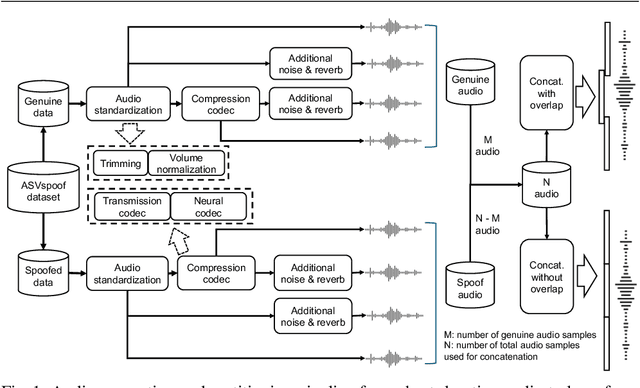
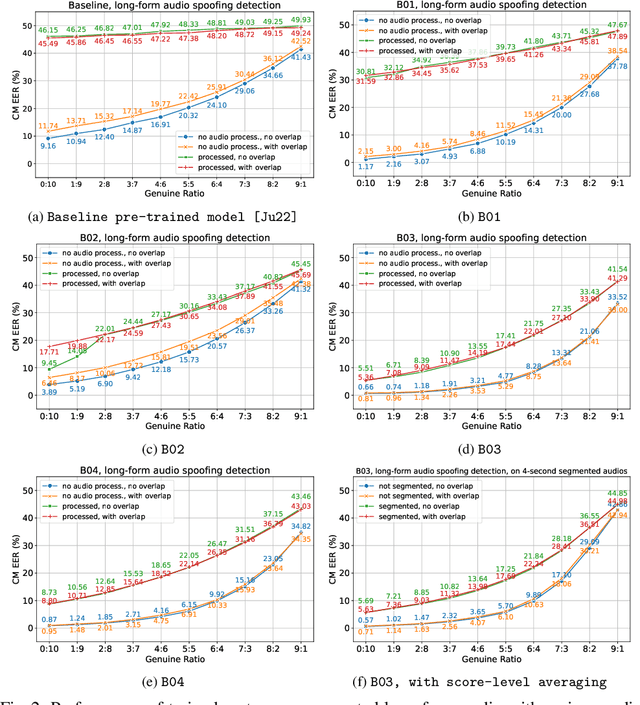
Audio spoofing detection has become increasingly important due to the rise in real-world cases. Current spoofing detectors, referred to as spoofing countermeasures (CM), are mainly trained and focused on audio waveforms with a single speaker and short duration. This study explores spoofing detection in more realistic scenarios, where the audio is long in duration and features multiple speakers and complex acoustic conditions. We test the widely-acquired AASIST under this challenging scenario, looking at the impact of multiple variations such as duration, speaker presence, and acoustic complexities on CM performance. Our work reveals key issues with current methods and suggests preliminary ways to improve them. We aim to make spoofing detection more applicable in more in-the-wild scenarios. This research is served as an important step towards developing detection systems that can handle the challenges of audio spoofing in real-world applications.

Malacopula: adversarial automatic speaker verification attacks using a neural-based generalised Hammerstein model
Aug 17, 2024We present Malacopula, a neural-based generalised Hammerstein model designed to introduce adversarial perturbations to spoofed speech utterances so that they better deceive automatic speaker verification (ASV) systems. Using non-linear processes to modify speech utterances, Malacopula enhances the effectiveness of spoofing attacks. The model comprises parallel branches of polynomial functions followed by linear time-invariant filters. The adversarial optimisation procedure acts to minimise the cosine distance between speaker embeddings extracted from spoofed and bona fide utterances. Experiments, performed using three recent ASV systems and the ASVspoof 2019 dataset, show that Malacopula increases vulnerabilities by a substantial margin. However, speech quality is reduced and attacks can be detected effectively under controlled conditions. The findings emphasise the need to identify new vulnerabilities and design defences to protect ASV systems from adversarial attacks in the wild.
ASVspoof 5: Crowdsourced Speech Data, Deepfakes, and Adversarial Attacks at Scale
Aug 16, 2024


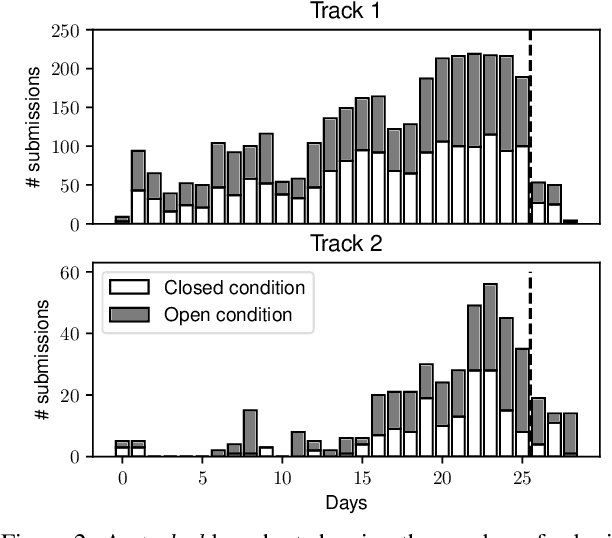
ASVspoof 5 is the fifth edition in a series of challenges that promote the study of speech spoofing and deepfake attacks, and the design of detection solutions. Compared to previous challenges, the ASVspoof 5 database is built from crowdsourced data collected from a vastly greater number of speakers in diverse acoustic conditions. Attacks, also crowdsourced, are generated and tested using surrogate detection models, while adversarial attacks are incorporated for the first time. New metrics support the evaluation of spoofing-robust automatic speaker verification (SASV) as well as stand-alone detection solutions, i.e., countermeasures without ASV. We describe the two challenge tracks, the new database, the evaluation metrics, baselines, and the evaluation platform, and present a summary of the results. Attacks significantly compromise the baseline systems, while submissions bring substantial improvements.
Adapting General Disentanglement-Based Speaker Anonymization for Enhanced Emotion Preservation
Aug 12, 2024


A general disentanglement-based speaker anonymization system typically separates speech into content, speaker, and prosody features using individual encoders. This paper explores how to adapt such a system when a new speech attribute, for example, emotion, needs to be preserved to a greater extent. While existing systems are good at anonymizing speaker embeddings, they are not designed to preserve emotion. Two strategies for this are examined. First, we show that integrating emotion embeddings from a pre-trained emotion encoder can help preserve emotional cues, even though this approach slightly compromises privacy protection. Alternatively, we propose an emotion compensation strategy as a post-processing step applied to anonymized speaker embeddings. This conceals the original speaker's identity and reintroduces the emotional traits lost during speaker embedding anonymization. Specifically, we model the emotion attribute using support vector machines to learn separate boundaries for each emotion. During inference, the original speaker embedding is processed in two ways: one, by an emotion indicator to predict emotion and select the emotion-matched SVM accurately; and two, by a speaker anonymizer to conceal speaker characteristics. The anonymized speaker embedding is then modified along the corresponding SVM boundary towards an enhanced emotional direction to save the emotional cues. The proposed strategies are also expected to be useful for adapting a general disentanglement-based speaker anonymization system to preserve other target paralinguistic attributes, with potential for a range of downstream tasks.
An Explainable Non-local Network for COVID-19 Diagnosis
Aug 08, 2024The CNN has achieved excellent results in the automatic classification of medical images. In this study, we propose a novel deep residual 3D attention non-local network (NL-RAN) to classify CT images included COVID-19, common pneumonia, and normal to perform rapid and explainable COVID-19 diagnosis. We built a deep residual 3D attention non-local network that could achieve end-to-end training. The network is embedded with a nonlocal module to capture global information, while a 3D attention module is embedded to focus on the details of the lesion so that it can directly analyze the 3D lung CT and output the classification results. The output of the attention module can be used as a heat map to increase the interpretability of the model. 4079 3D CT scans were included in this study. Each scan had a unique label (novel coronavirus pneumonia, common pneumonia, and normal). The CT scans cohort was randomly split into a training set of 3263 scans, a validation set of 408 scans, and a testing set of 408 scans. And compare with existing mainstream classification methods, such as CovNet, CBAM, ResNet, etc. Simultaneously compare the visualization results with visualization methods such as CAM. Model performance was evaluated using the Area Under the ROC Curve(AUC), precision, and F1-score. The NL-RAN achieved the AUC of 0.9903, the precision of 0.9473, and the F1-score of 0.9462, surpass all the classification methods compared. The heat map output by the attention module is also clearer than the heat map output by CAM. Our experimental results indicate that our proposed method performs significantly better than existing methods. In addition, the first attention module outputs a heat map containing detailed outline information to increase the interpretability of the model. Our experiments indicate that the inference of our model is fast. It can provide real-time assistance with diagnosis.
MGFs: Masked Gaussian Fields for Meshing Building based on Multi-View Images
Aug 06, 2024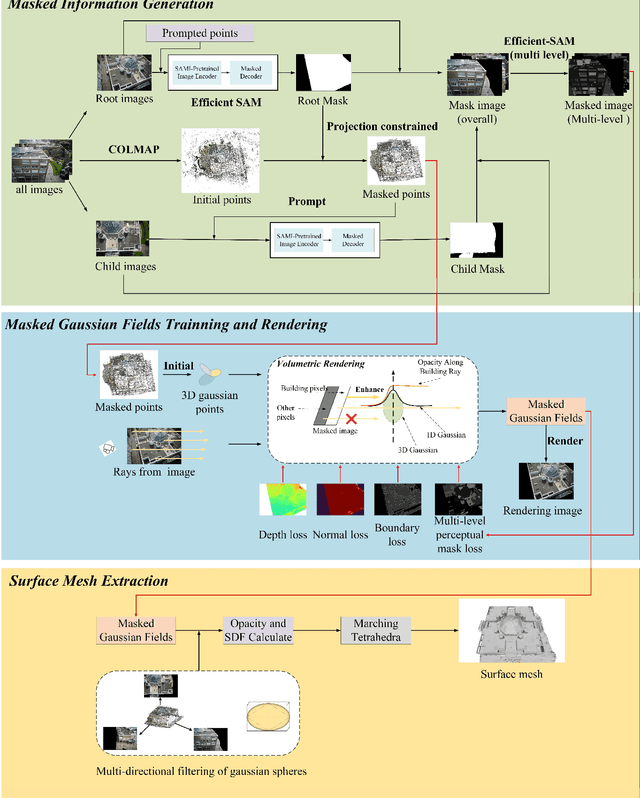
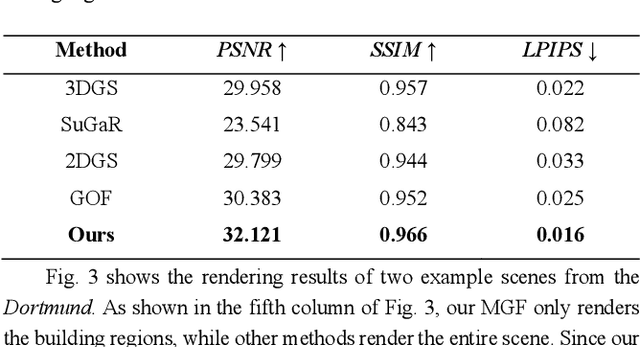
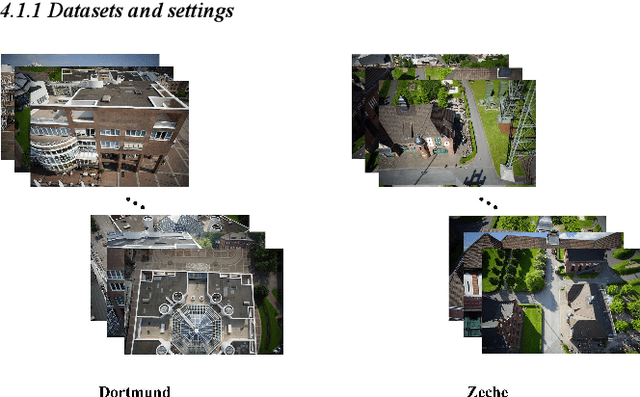
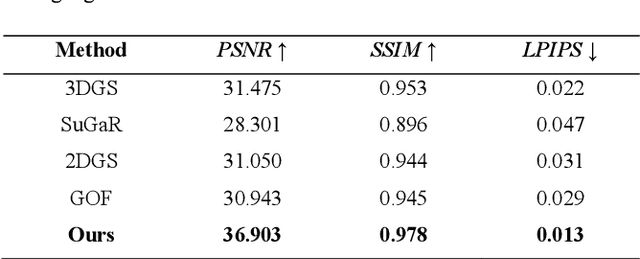
Over the last few decades, image-based building surface reconstruction has garnered substantial research interest and has been applied across various fields, such as heritage preservation, architectural planning, etc. Compared to the traditional photogrammetric and NeRF-based solutions, recently, Gaussian fields-based methods have exhibited significant potential in generating surface meshes due to their time-efficient training and detailed 3D information preservation. However, most gaussian fields-based methods are trained with all image pixels, encompassing building and nonbuilding areas, which results in a significant noise for building meshes and degeneration in time efficiency. This paper proposes a novel framework, Masked Gaussian Fields (MGFs), designed to generate accurate surface reconstruction for building in a time-efficient way. The framework first applies EfficientSAM and COLMAP to generate multi-level masks of building and the corresponding masked point clouds. Subsequently, the masked gaussian fields are trained by integrating two innovative losses: a multi-level perceptual masked loss focused on constructing building regions and a boundary loss aimed at enhancing the details of the boundaries between different masks. Finally, we improve the tetrahedral surface mesh extraction method based on the masked gaussian spheres. Comprehensive experiments on UAV images demonstrate that, compared to the traditional method and several NeRF-based and Gaussian-based SOTA solutions, our approach significantly improves both the accuracy and efficiency of building surface reconstruction. Notably, as a byproduct, there is an additional gain in the novel view synthesis of building.
U2UData: A Large-scale Cooperative Perception Dataset for Swarm UAVs Autonomous Flight
Aug 05, 2024
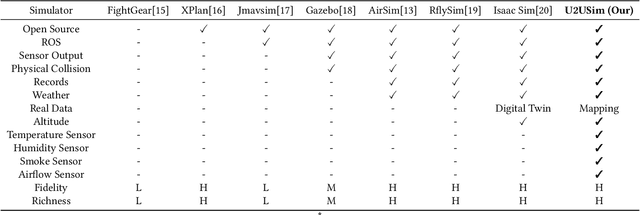
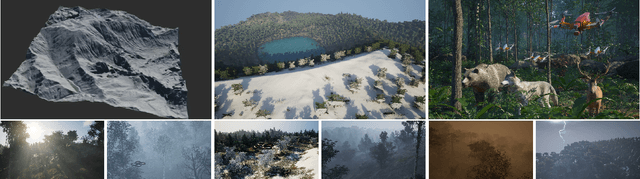
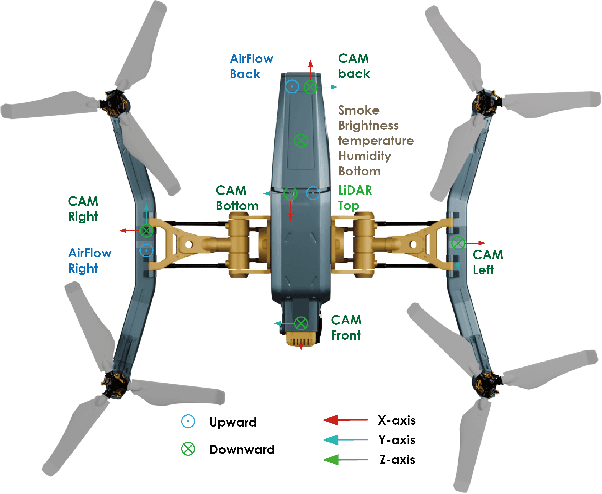
Modern perception systems for autonomous flight are sensitive to occlusion and have limited long-range capability, which is a key bottleneck in improving low-altitude economic task performance. Recent research has shown that the UAV-to-UAV (U2U) cooperative perception system has great potential to revolutionize the autonomous flight industry. However, the lack of a large-scale dataset is hindering progress in this area. This paper presents U2UData, the first large-scale cooperative perception dataset for swarm UAVs autonomous flight. The dataset was collected by three UAVs flying autonomously in the U2USim, covering a 9 km$^2$ flight area. It comprises 315K LiDAR frames, 945K RGB and depth frames, and 2.41M annotated 3D bounding boxes for 3 classes. It also includes brightness, temperature, humidity, smoke, and airflow values covering all flight routes. U2USim is the first real-world mapping swarm UAVs simulation environment. It takes Yunnan Province as the prototype and includes 4 terrains, 7 weather conditions, and 8 sensor types. U2UData introduces two perception tasks: cooperative 3D object detection and cooperative 3D object tracking. This paper provides comprehensive benchmarks of recent cooperative perception algorithms on these tasks.
Multi-weather Cross-view Geo-localization Using Denoising Diffusion Models
Aug 05, 2024Cross-view geo-localization in GNSS-denied environments aims to determine an unknown location by matching drone-view images with the correct geo-tagged satellite-view images from a large gallery. Recent research shows that learning discriminative image representations under specific weather conditions can significantly enhance performance. However, the frequent occurrence of unseen extreme weather conditions hinders progress. This paper introduces MCGF, a Multi-weather Cross-view Geo-localization Framework designed to dynamically adapt to unseen weather conditions. MCGF establishes a joint optimization between image restoration and geo-localization using denoising diffusion models. For image restoration, MCGF incorporates a shared encoder and a lightweight restoration module to help the backbone eliminate weather-specific information. For geo-localization, MCGF uses EVA-02 as a backbone for feature extraction, with cross-entropy loss for training and cosine distance for testing. Extensive experiments on University160k-WX demonstrate that MCGF achieves competitive results for geo-localization in varying weather conditions.
AdvQDet: Detecting Query-Based Adversarial Attacks with Adversarial Contrastive Prompt Tuning
Aug 04, 2024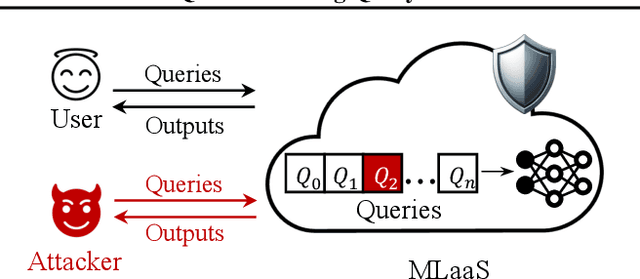
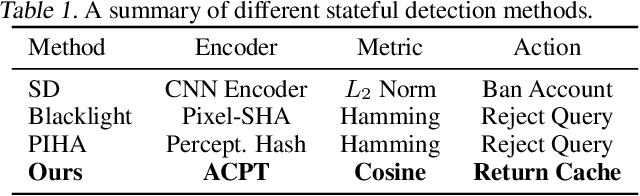
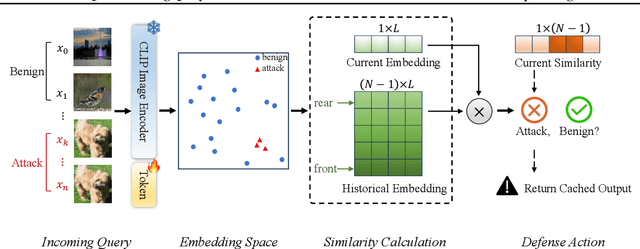
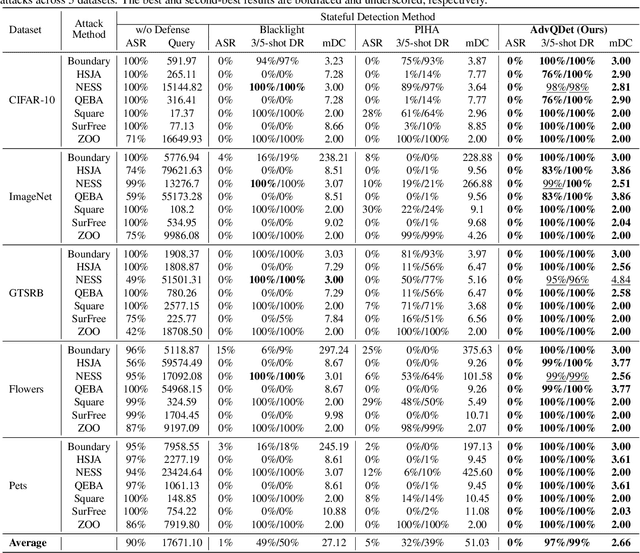
Deep neural networks (DNNs) are known to be vulnerable to adversarial attacks even under a black-box setting where the adversary can only query the model. Particularly, query-based black-box adversarial attacks estimate adversarial gradients based on the returned probability vectors of the target model for a sequence of queries. During this process, the queries made to the target model are intermediate adversarial examples crafted at the previous attack step, which share high similarities in the pixel space. Motivated by this observation, stateful detection methods have been proposed to detect and reject query-based attacks. While demonstrating promising results, these methods either have been evaded by more advanced attacks or suffer from low efficiency in terms of the number of shots (queries) required to detect different attacks. Arguably, the key challenge here is to assign high similarity scores for any two intermediate adversarial examples perturbed from the same clean image. To address this challenge, we propose a novel Adversarial Contrastive Prompt Tuning (ACPT) method to robustly fine-tune the CLIP image encoder to extract similar embeddings for any two intermediate adversarial queries. With ACPT, we further introduce a detection framework AdvQDet that can detect 7 state-of-the-art query-based attacks with $>99\%$ detection rate within 5 shots. We also show that ACPT is robust to 3 types of adaptive attacks. Code is available at https://github.com/xinwong/AdvQDet.
U-MedSAM: Uncertainty-aware MedSAM for Medical Image Segmentation
Aug 03, 2024


Medical Image Foundation Models have proven to be powerful tools for mask prediction across various datasets. However, accurately assessing the uncertainty of their predictions remains a significant challenge. To address this, we propose a new model, U-MedSAM, which integrates the MedSAM model with an uncertainty-aware loss function and the Sharpness-Aware Minimization (SharpMin) optimizer. The uncertainty-aware loss function automatically combines region-based, distribution-based, and pixel-based loss designs to enhance segmentation accuracy and robustness. SharpMin improves generalization by finding flat minima in the loss landscape, thereby reducing overfitting. Our method was evaluated in the CVPR24 MedSAM on Laptop challenge, where U-MedSAM demonstrated promising performance.