 Add to Chrome
 Add to Firefox
 Add to Edge
Model Comparisons: XNet Outperforms KAN
Oct 02, 2024
In the fields of computational mathematics and artificial intelligence, the need for precise data modeling is crucial, especially for predictive machine learning tasks. This paper explores further XNet, a novel algorithm that employs the complex-valued Cauchy integral formula, offering a superior network architecture that surpasses traditional Multi-Layer Perceptrons (MLPs) and Kolmogorov-Arnold Networks (KANs). XNet significant improves speed and accuracy across various tasks in both low and high-dimensional spaces, redefining the scope of data-driven model development and providing substantial improvements over established time series models like LSTMs.

AMR-Evol: Adaptive Modular Response Evolution Elicits Better Knowledge Distillation for Large Language Models in Code Generation
Oct 01, 2024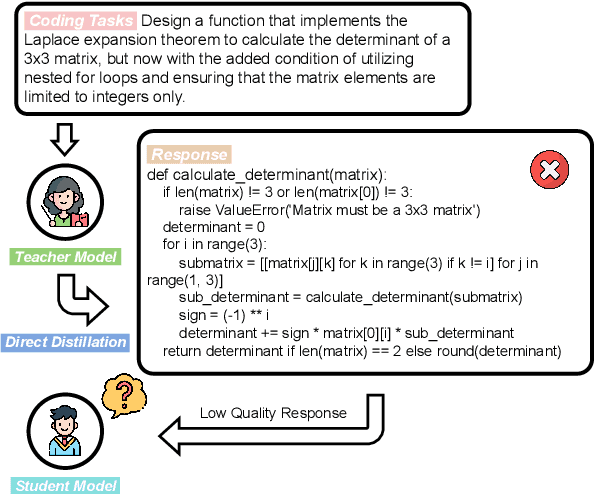
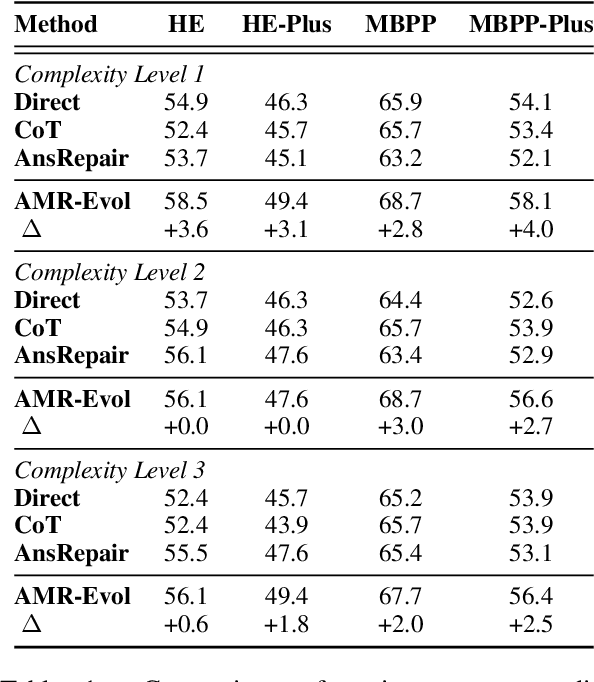
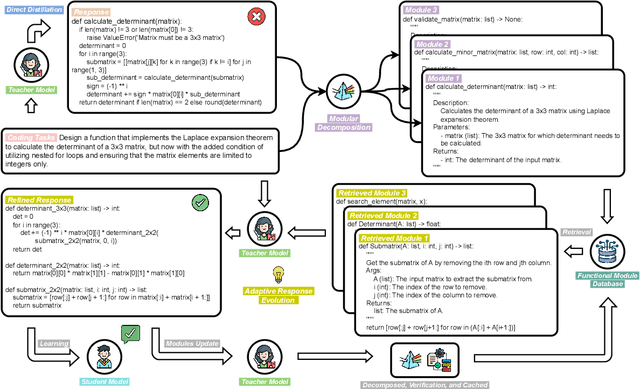
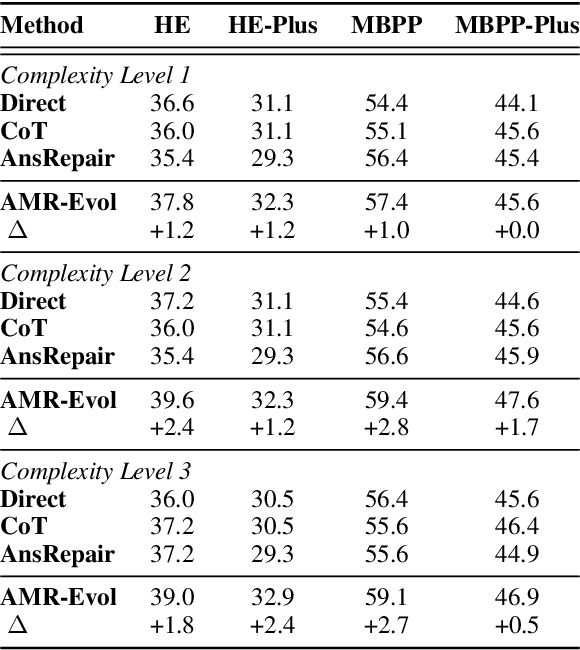
The impressive performance of proprietary LLMs like GPT4 in code generation has led to a trend to replicate these capabilities in open-source models through knowledge distillation (e.g. Code Evol-Instruct). However, these efforts often neglect the crucial aspect of response quality, relying heavily on teacher models for direct response distillation. This paradigm, especially for complex instructions, can degrade the quality of synthesized data, compromising the knowledge distillation process. To this end, our study introduces the Adaptive Modular Response Evolution (AMR-Evol) framework, which employs a two-stage process to refine response distillation. The first stage, modular decomposition, breaks down the direct response into more manageable sub-modules. The second stage, adaptive response evolution, automatically evolves the response with the related function modules. Our experiments with three popular code benchmarks (HumanEval, MBPP, and EvalPlus) attest to the superiority of the AMR-Evol framework over baseline response distillation methods. By comparing with the open-source Code LLMs trained on a similar scale of data, we observed performance enhancements: more than +3.0 points on HumanEval-Plus and +1.0 points on MBPP-Plus, which underscores the effectiveness of our framework. Our codes are available at https://github.com/ChiYeungLaw/AMR-Evol.
UniAff: A Unified Representation of Affordances for Tool Usage and Articulation with Vision-Language Models
Sep 30, 2024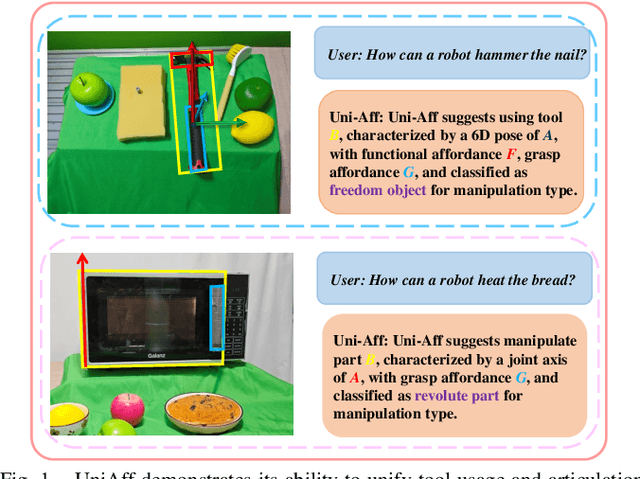
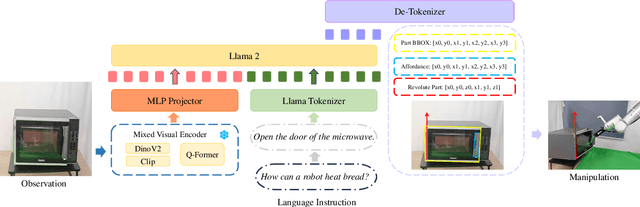
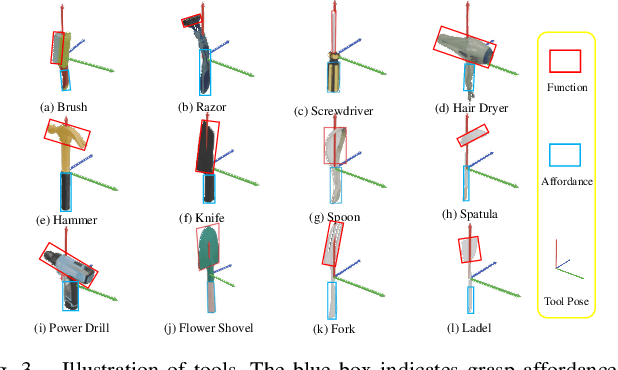
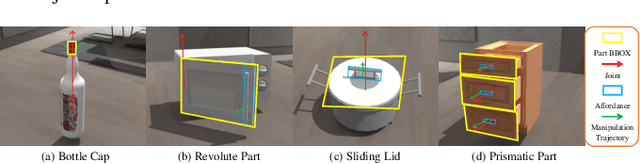
Previous studies on robotic manipulation are based on a limited understanding of the underlying 3D motion constraints and affordances. To address these challenges, we propose a comprehensive paradigm, termed UniAff, that integrates 3D object-centric manipulation and task understanding in a unified formulation. Specifically, we constructed a dataset labeled with manipulation-related key attributes, comprising 900 articulated objects from 19 categories and 600 tools from 12 categories. Furthermore, we leverage MLLMs to infer object-centric representations for manipulation tasks, including affordance recognition and reasoning about 3D motion constraints. Comprehensive experiments in both simulation and real-world settings indicate that UniAff significantly improves the generalization of robotic manipulation for tools and articulated objects. We hope that UniAff will serve as a general baseline for unified robotic manipulation tasks in the future. Images, videos, dataset, and code are published on the project website at:https://sites.google.com/view/uni-aff/home
Robust Gaussian Splatting SLAM by Leveraging Loop Closure
Sep 30, 20243D Gaussian Splatting algorithms excel in novel view rendering applications and have been adapted to extend the capabilities of traditional SLAM systems. However, current Gaussian Splatting SLAM methods, designed mainly for hand-held RGB or RGB-D sensors, struggle with tracking drifts when used with rotating RGB-D camera setups. In this paper, we propose a robust Gaussian Splatting SLAM architecture that utilizes inputs from rotating multiple RGB-D cameras to achieve accurate localization and photorealistic rendering performance. The carefully designed Gaussian Splatting Loop Closure module effectively addresses the issue of accumulated tracking and mapping errors found in conventional Gaussian Splatting SLAM systems. First, each Gaussian is associated with an anchor frame and categorized as historical or novel based on its timestamp. By rendering different types of Gaussians at the same viewpoint, the proposed loop detection strategy considers both co-visibility relationships and distinct rendering outcomes. Furthermore, a loop closure optimization approach is proposed to remove camera pose drift and maintain the high quality of 3D Gaussian models. The approach uses a lightweight pose graph optimization algorithm to correct pose drift and updates Gaussians based on the optimized poses. Additionally, a bundle adjustment scheme further refines camera poses using photometric and geometric constraints, ultimately enhancing the global consistency of scenarios. Quantitative and qualitative evaluations on both synthetic and real-world datasets demonstrate that our method outperforms state-of-the-art methods in camera pose estimation and novel view rendering tasks. The code will be open-sourced for the community.
Can Large Language Models Analyze Graphs like Professionals? A Benchmark, Datasets and Models
Sep 29, 2024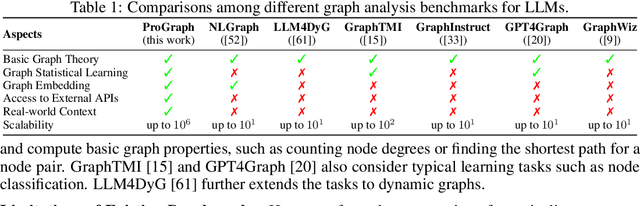

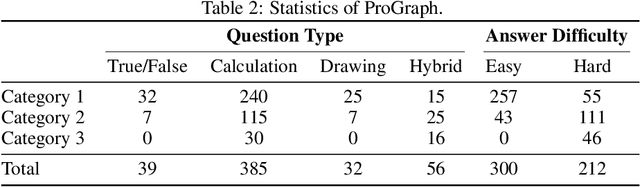

The need to analyze graphs is ubiquitous across various fields, from social networks to biological research and recommendation systems. Therefore, enabling the ability of large language models (LLMs) to process graphs is an important step toward more advanced general intelligence. However, current LLM benchmarks on graph analysis require models to directly reason over the prompts describing graph topology, and are thus limited to small graphs with only a few dozens of nodes. In contrast, human experts typically write programs based on popular libraries for task solving, and can thus handle graphs with different scales. To this end, a question naturally arises: can LLMs analyze graphs like professionals? In this paper, we introduce ProGraph, a manually crafted benchmark containing 3 categories of graph tasks. The benchmark expects solutions based on programming instead of directly reasoning over raw inputs. Our findings reveal that the performance of current LLMs is unsatisfactory, with the best model achieving only 36% accuracy. To bridge this gap, we propose LLM4Graph datasets, which include crawled documents and auto-generated codes based on 6 widely used graph libraries. By augmenting closed-source LLMs with document retrieval and fine-tuning open-source ones on the codes, we show 11-32% absolute improvements in their accuracies. Our results underscore that the capabilities of LLMs in handling structured data are still under-explored, and show the effectiveness of LLM4Graph in enhancing LLMs' proficiency of graph analysis. The benchmark, datasets and enhanced open-source models are available at https://github.com/BUPT-GAMMA/ProGraph.
Cauchy activation function and XNet
Sep 28, 2024We have developed a novel activation function, named the Cauchy Activation Function. This function is derived from the Cauchy Integral Theorem in complex analysis and is specifically tailored for problems requiring high precision. This innovation has led to the creation of a new class of neural networks, which we call (Comple)XNet, or simply XNet. We will demonstrate that XNet is particularly effective for high-dimensional challenges such as image classification and solving Partial Differential Equations (PDEs). Our evaluations show that XNet significantly outperforms established benchmarks like MNIST and CIFAR-10 in computer vision, and offers substantial advantages over Physics-Informed Neural Networks (PINNs) in both low-dimensional and high-dimensional PDE scenarios.
A History-Guided Regional Partitioning Evolutionary Optimization for Solving the Flexible Job Shop Problem with Limited Multi-load Automated Guided Vehicles
Sep 27, 2024In a flexible job shop environment, using Automated Guided Vehicles (AGVs) to transport jobs and process materials is an important way to promote the intelligence of the workshop. Compared with single-load AGVs, multi-load AGVs can improve AGV utilization, reduce path conflicts, etc. Therefore, this study proposes a history-guided regional partitioning algorithm (HRPEO) for the flexible job shop scheduling problem with limited multi-load AGVs (FJSPMA). First, the encoding and decoding rules are designed according to the characteristics of multi-load AGVs, and then the initialization rule based on the branch and bound method is used to generate the initial population. Second, to prevent the algorithm from falling into a local optimum, the algorithm adopts a regional partitioning strategy. This strategy divides the solution space into multiple regions and measures the potential of the regions. After that, cluster the regions into multiple clusters in each iteration, and selects individuals for evolutionary search based on the set of clusters. Third, a local search strategy is designed to improve the exploitation ability of the algorithm, which uses a greedy approach to optimize machines selection and transportation sequence according to the characteristics of FJSPMA. Finally, a large number of experiments are carried out on the benchmarks to test the performance of the algorithm. Compared with multiple advanced algorithms, the results show that the HRPEO has a better advantage in solving FJSPMA.
Adaptive Knowledge-based Multi-Objective Evolutionary Algorithm for Hybrid Flow Shop Scheduling Problems with Multiple Parallel Batch Processing Stages
Sep 27, 2024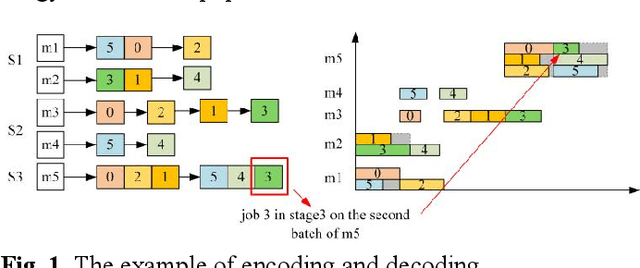
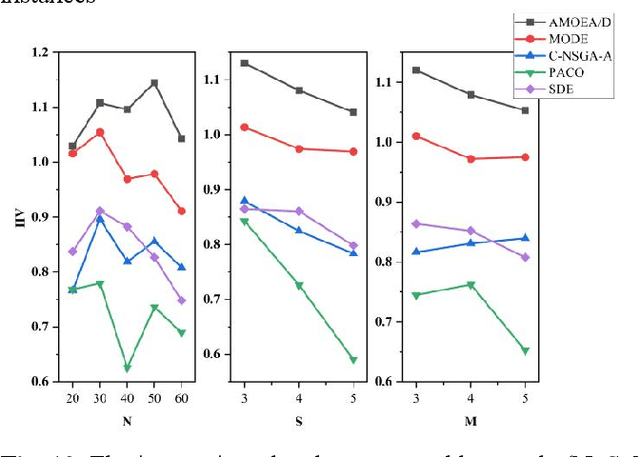
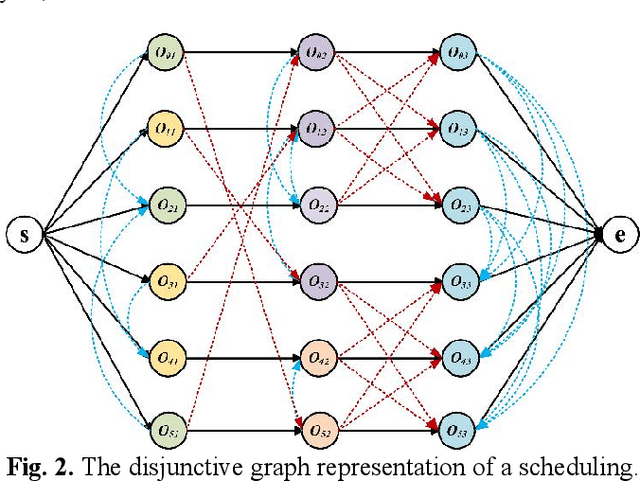

Parallel batch processing machines have extensive applications in the semiconductor manufacturing process. However, the problem models in previous studies regard parallel batch processing as a fixed processing stage in the machining process. This study generalizes the problem model, in which users can arbitrarily set certain stages as parallel batch processing stages according to their needs. A Hybrid Flow Shop Scheduling Problem with Parallel Batch Processing Machines (PBHFSP) is solved in this paper. Furthermore, an Adaptive Knowledge-based Multi-Objective Evolutionary Algorithm (AMOEA/D) is designed to simultaneously optimize both makespan and Total Energy Consumption (TEC). Firstly, a hybrid initialization strategy with heuristic rules based on knowledge of PBHFSP is proposed to generate promising solutions. Secondly, the disjunctive graph model has been established based on the knowledge to find the critical-path of PBHFS. Then, a critical-path based neighborhood search is proposed to enhance the exploitation ability of AMOEA/D. Moreover, the search time is adaptively adjusted based on learning experience from Q-learning and Decay Law. Afterward, to enhance the exploration capability of the algorithm, AMOEA/D designs an improved population updating strategy with a weight vector updating strategy. These strategies rematch individuals with weight vectors, thereby maintaining the diversity of the population. Finally, the proposed algorithm is compared with state-of-the-art algorithms. The experimental results show that the AMOEA/D is superior to the comparison algorithms in solving the PBHFSP.
SKT: Integrating State-Aware Keypoint Trajectories with Vision-Language Models for Robotic Garment Manipulation
Sep 26, 2024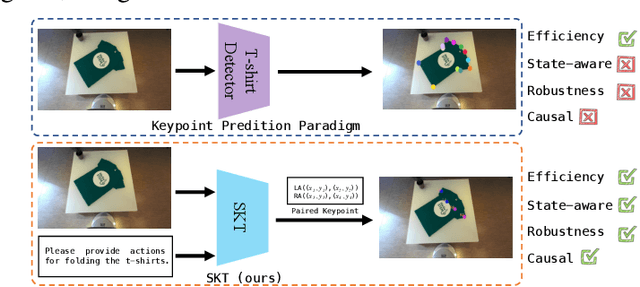
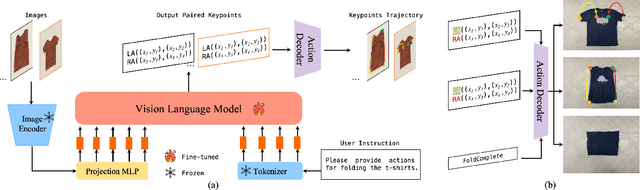
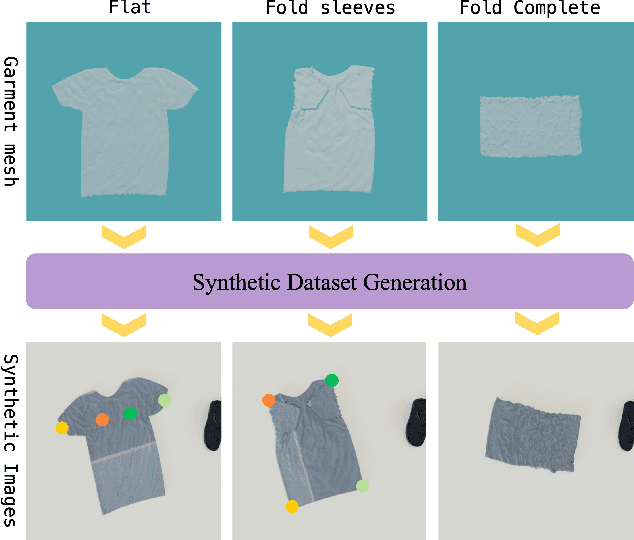
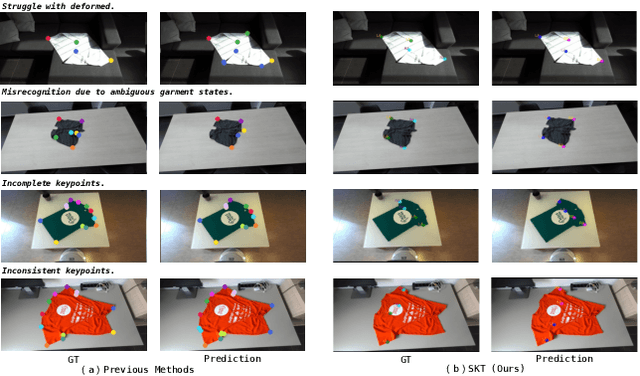
Automating garment manipulation poses a significant challenge for assistive robotics due to the diverse and deformable nature of garments. Traditional approaches typically require separate models for each garment type, which limits scalability and adaptability. In contrast, this paper presents a unified approach using vision-language models (VLMs) to improve keypoint prediction across various garment categories. By interpreting both visual and semantic information, our model enables robots to manage different garment states with a single model. We created a large-scale synthetic dataset using advanced simulation techniques, allowing scalable training without extensive real-world data. Experimental results indicate that the VLM-based method significantly enhances keypoint detection accuracy and task success rates, providing a more flexible and general solution for robotic garment manipulation. In addition, this research also underscores the potential of VLMs to unify various garment manipulation tasks within a single framework, paving the way for broader applications in home automation and assistive robotics for future.
URSimulator: Human-Perception-Driven Prompt Tuning for Enhanced Virtual Urban Renewal via Diffusion Models
Sep 22, 2024Tackling Urban Physical Disorder (e.g., abandoned buildings, litter, messy vegetation, graffiti) is essential, as it negatively impacts the safety, well-being, and psychological state of communities. Urban Renewal is the process of revitalizing these neglected and decayed areas within a city to improve the physical environment and quality of life for residents. Effective urban renewal efforts can transform these environments, enhancing their appeal and livability. However, current research lacks simulation tools that can quantitatively assess and visualize the impacts of renewal efforts, often relying on subjective judgments. Such tools are crucial for planning and implementing effective strategies by providing a clear visualization of potential changes and their impacts. This paper presents a novel framework addressing this gap by using human perception feedback to simulate street environment enhancement. We develop a prompt tuning approach that integrates text-driven Stable Diffusion with human perception feedback, iteratively editing local areas of street view images to better align with perceptions of beauty, liveliness, and safety. Our experiments show that this framework significantly improves perceptions of urban environments, with increases of 17.60% in safety, 31.15% in beauty, and 28.82% in liveliness. In contrast, advanced methods like DiffEdit achieve only 2.31%, 11.87%, and 15.84% improvements, respectively. We applied this framework across various virtual scenarios, including neighborhood improvement, building redevelopment, green space expansion, and community garden creation. The results demonstrate its effectiveness in simulating urban renewal, offering valuable insights for urban planning and policy-making.