 Add to Chrome
 Add to Firefox
 Add to Edge
DimOL: Dimensional Awareness as A New 'Dimension' in Operator Learning
Oct 08, 2024


In the realm of computational physics, an enduring topic is the numerical solutions to partial differential equations (PDEs). Recently, the attention of researchers has shifted towards Neural Operator methods, renowned for their capability to approximate ``operators'' -- mappings from functions to functions. Despite the universal approximation theorem within neural operators, ensuring error bounds often requires employing numerous Fourier layers. However, what about lightweight models? In response to this question, we introduce DimOL (Dimension-aware Operator Learning), drawing insights from dimensional analysis. To implement DimOL, we propose the ProdLayer, which can be seamlessly integrated into FNO-based and Transformer-based PDE solvers, enhancing their ability to handle sum-of-products structures inherent in many physical systems. Empirically, DimOL models achieve up to 48% performance gain within the PDE datasets. Furthermore, by analyzing Fourier components' weights, we can symbolically discern the physical significance of each term. This sheds light on the opaque nature of neural networks, unveiling underlying physical principles.

Revealing Directions for Text-guided 3D Face Editing
Oct 07, 2024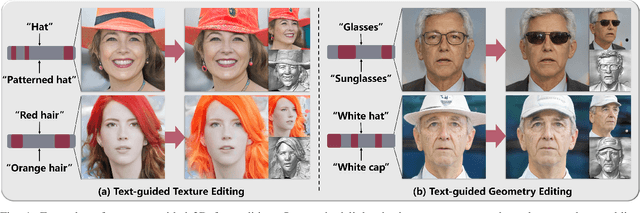
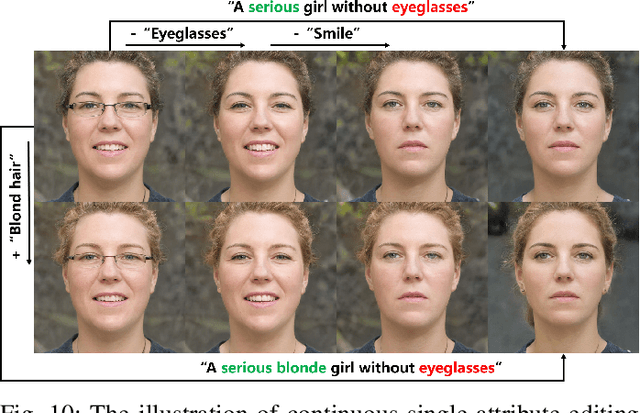
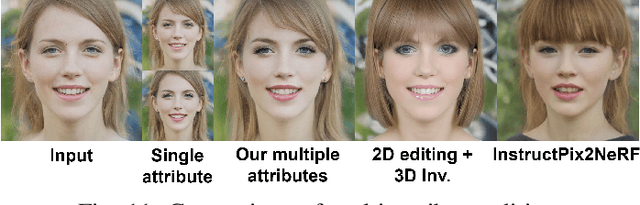
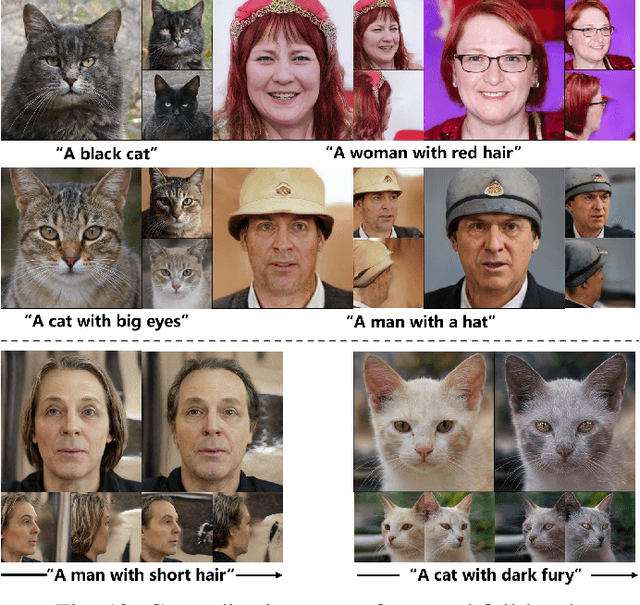
3D face editing is a significant task in multimedia, aimed at the manipulation of 3D face models across various control signals. The success of 3D-aware GAN provides expressive 3D models learned from 2D single-view images only, encouraging researchers to discover semantic editing directions in its latent space. However, previous methods face challenges in balancing quality, efficiency, and generalization. To solve the problem, we explore the possibility of introducing the strength of diffusion model into 3D-aware GANs. In this paper, we present Face Clan, a fast and text-general approach for generating and manipulating 3D faces based on arbitrary attribute descriptions. To achieve disentangled editing, we propose to diffuse on the latent space under a pair of opposite prompts to estimate the mask indicating the region of interest on latent codes. Based on the mask, we then apply denoising to the masked latent codes to reveal the editing direction. Our method offers a precisely controllable manipulation method, allowing users to intuitively customize regions of interest with the text description. Experiments demonstrate the effectiveness and generalization of our Face Clan for various pre-trained GANs. It offers an intuitive and wide application for text-guided face editing that contributes to the landscape of multimedia content creation.
PostEdit: Posterior Sampling for Efficient Zero-Shot Image Editing
Oct 07, 2024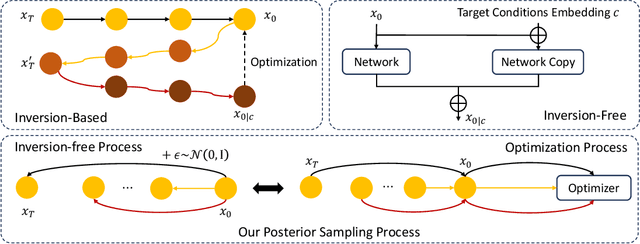
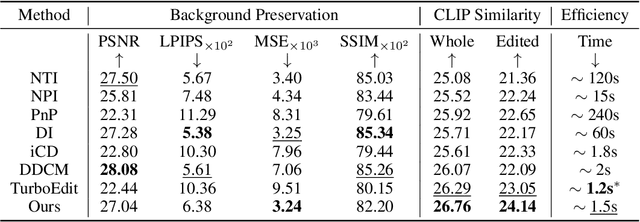
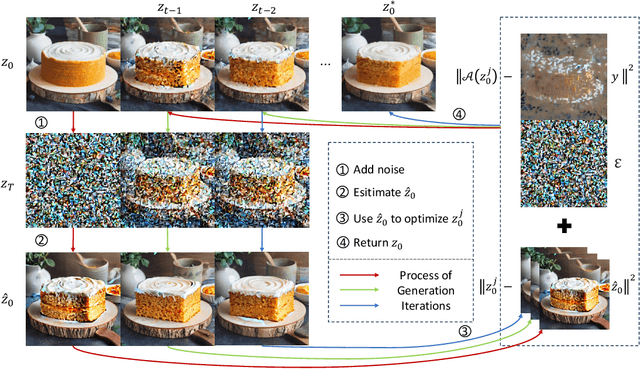
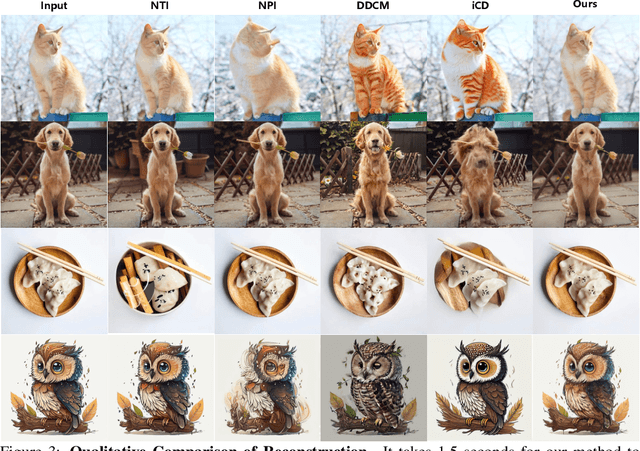
In the field of image editing, three core challenges persist: controllability, background preservation, and efficiency. Inversion-based methods rely on time-consuming optimization to preserve the features of the initial images, which results in low efficiency due to the requirement for extensive network inference. Conversely, inversion-free methods lack theoretical support for background similarity, as they circumvent the issue of maintaining initial features to achieve efficiency. As a consequence, none of these methods can achieve both high efficiency and background consistency. To tackle the challenges and the aforementioned disadvantages, we introduce PostEdit, a method that incorporates a posterior scheme to govern the diffusion sampling process. Specifically, a corresponding measurement term related to both the initial features and Langevin dynamics is introduced to optimize the estimated image generated by the given target prompt. Extensive experimental results indicate that the proposed PostEdit achieves state-of-the-art editing performance while accurately preserving unedited regions. Furthermore, the method is both inversion- and training-free, necessitating approximately 1.5 seconds and 18 GB of GPU memory to generate high-quality results.
Distillation-Free One-Step Diffusion for Real-World Image Super-Resolution
Oct 05, 2024Diffusion models have been achieving excellent performance for real-world image super-resolution (Real-ISR) with considerable computational costs. Current approaches are trying to derive one-step diffusion models from multi-step counterparts through knowledge distillation. However, these methods incur substantial training costs and may constrain the performance of the student model by the teacher's limitations. To tackle these issues, we propose DFOSD, a Distillation-Free One-Step Diffusion model. Specifically, we propose a noise-aware discriminator (NAD) to participate in adversarial training, further enhancing the authenticity of the generated content. Additionally, we improve the perceptual loss with edge-aware DISTS (EA-DISTS) to enhance the model's ability to generate fine details. Our experiments demonstrate that, compared with previous diffusion-based methods requiring dozens or even hundreds of steps, our DFOSD attains comparable or even superior results in both quantitative metrics and qualitative evaluations. Our DFOSD also abtains higher performance and efficiency compared with other one-step diffusion methods. We will release code and models at \url{https://github.com/JianzeLi-114/DFOSD}.
Open-World Reinforcement Learning over Long Short-Term Imagination
Oct 04, 2024


Training visual reinforcement learning agents in a high-dimensional open world presents significant challenges. While various model-based methods have improved sample efficiency by learning interactive world models, these agents tend to be "short-sighted", as they are typically trained on short snippets of imagined experiences. We argue that the primary obstacle in open-world decision-making is improving the efficiency of off-policy exploration across an extensive state space. In this paper, we present LS-Imagine, which extends the imagination horizon within a limited number of state transition steps, enabling the agent to explore behaviors that potentially lead to promising long-term feedback. The foundation of our approach is to build a long short-term world model. To achieve this, we simulate goal-conditioned jumpy state transitions and compute corresponding affordance maps by zooming in on specific areas within single images. This facilitates the integration of direct long-term values into behavior learning. Our method demonstrates significant improvements over state-of-the-art techniques in MineDojo.
ARB-LLM: Alternating Refined Binarizations for Large Language Models
Oct 04, 2024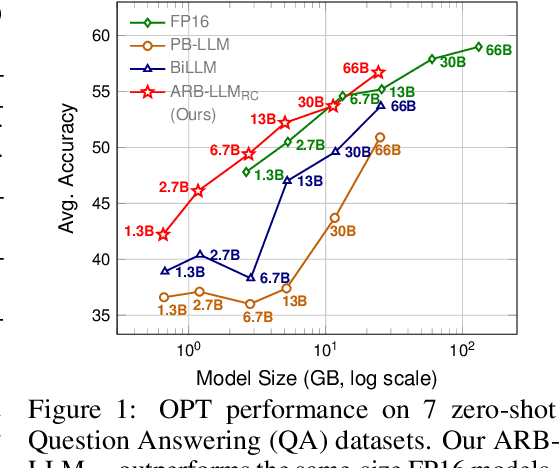
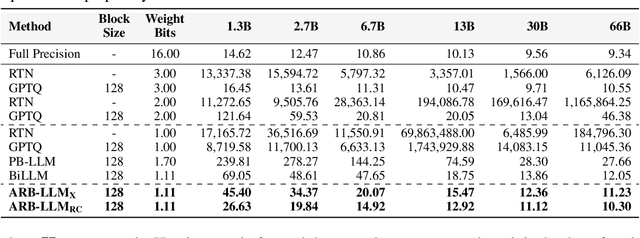
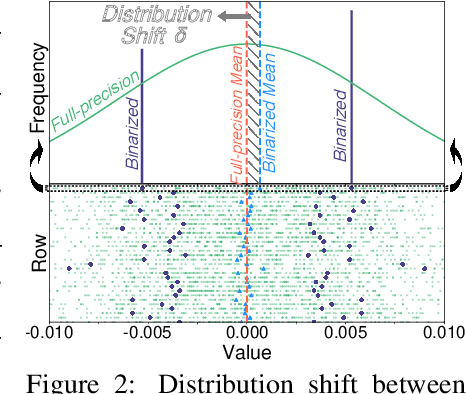
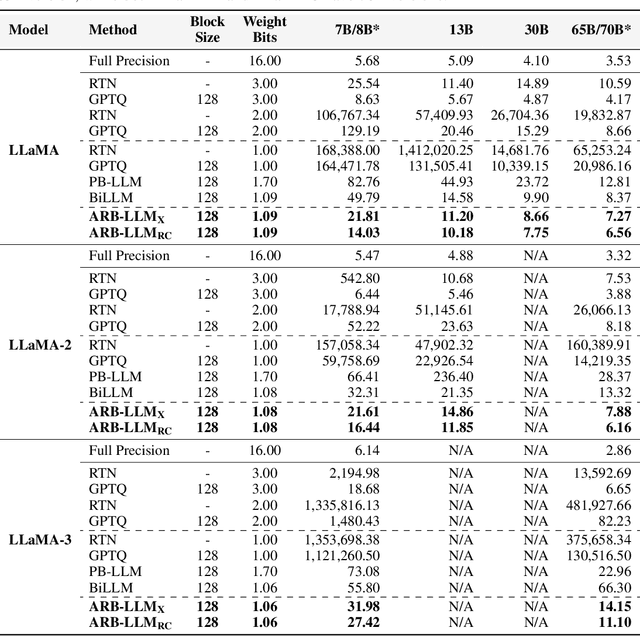
Large Language Models (LLMs) have greatly pushed forward advancements in natural language processing, yet their high memory and computational demands hinder practical deployment. Binarization, as an effective compression technique, can shrink model weights to just 1 bit, significantly reducing the high demands on computation and memory. However, current binarization methods struggle to narrow the distribution gap between binarized and full-precision weights, while also overlooking the column deviation in LLM weight distribution. To tackle these issues, we propose ARB-LLM, a novel 1-bit post-training quantization (PTQ) technique tailored for LLMs. To narrow the distribution shift between binarized and full-precision weights, we first design an alternating refined binarization (ARB) algorithm to progressively update the binarization parameters, which significantly reduces the quantization error. Moreover, considering the pivot role of calibration data and the column deviation in LLM weights, we further extend ARB to ARB-X and ARB-RC. In addition, we refine the weight partition strategy with column-group bitmap (CGB), which further enhance performance. Equipping ARB-X and ARB-RC with CGB, we obtain ARB-LLM$_\text{X}$ and ARB-LLM$_\text{RC}$ respectively, which significantly outperform state-of-the-art (SOTA) binarization methods for LLMs. As a binary PTQ method, our ARB-LLM$_\text{RC}$ is the first to surpass FP16 models of the same size. The code and models will be available at https://github.com/ZHITENGLI/ARB-LLM.
Discovering Message Passing Hierarchies for Mesh-Based Physics Simulation
Oct 03, 2024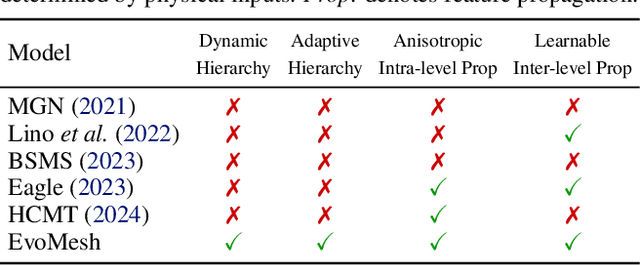
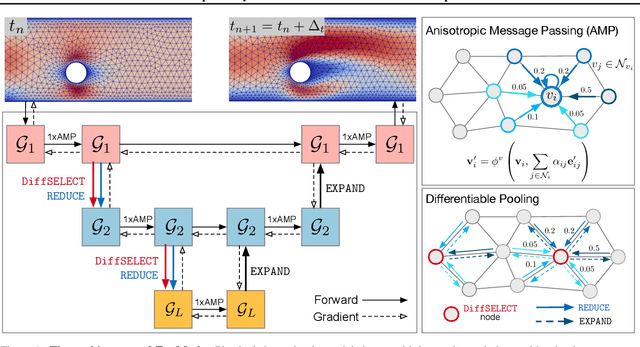
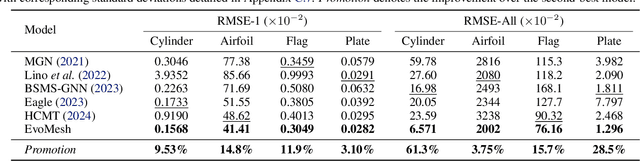
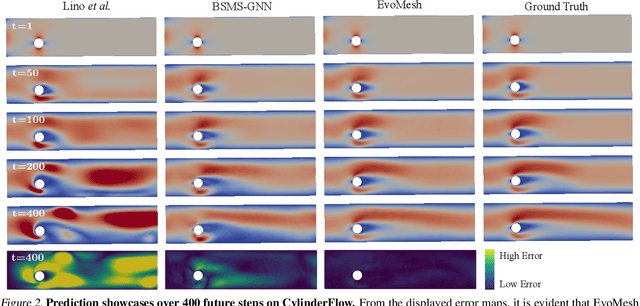
Graph neural networks have emerged as a powerful tool for large-scale mesh-based physics simulation. Existing approaches primarily employ hierarchical, multi-scale message passing to capture long-range dependencies within the graph. However, these graph hierarchies are typically fixed and manually designed, which do not adapt to the evolving dynamics present in complex physical systems. In this paper, we introduce a novel neural network named DHMP, which learns Dynamic Hierarchies for Message Passing networks through a differentiable node selection method. The key component is the anisotropic message passing mechanism, which operates at both intra-level and inter-level interactions. Unlike existing methods, it first supports directionally non-uniform aggregation of dynamic features between adjacent nodes within each graph hierarchy. Second, it determines node selection probabilities for the next hierarchy according to different physical contexts, thereby creating more flexible message shortcuts for learning remote node relations. Our experiments demonstrate the effectiveness of DHMP, achieving 22.7% improvement on average compared to recent fixed-hierarchy message passing networks across five classic physics simulation datasets.
AniSDF: Fused-Granularity Neural Surfaces with Anisotropic Encoding for High-Fidelity 3D Reconstruction
Oct 02, 2024Neural radiance fields have recently revolutionized novel-view synthesis and achieved high-fidelity renderings. However, these methods sacrifice the geometry for the rendering quality, limiting their further applications including relighting and deformation. How to synthesize photo-realistic rendering while reconstructing accurate geometry remains an unsolved problem. In this work, we present AniSDF, a novel approach that learns fused-granularity neural surfaces with physics-based encoding for high-fidelity 3D reconstruction. Different from previous neural surfaces, our fused-granularity geometry structure balances the overall structures and fine geometric details, producing accurate geometry reconstruction. To disambiguate geometry from reflective appearance, we introduce blended radiance fields to model diffuse and specularity following the anisotropic spherical Gaussian encoding, a physics-based rendering pipeline. With these designs, AniSDF can reconstruct objects with complex structures and produce high-quality renderings. Furthermore, our method is a unified model that does not require complex hyperparameter tuning for specific objects. Extensive experiments demonstrate that our method boosts the quality of SDF-based methods by a great scale in both geometry reconstruction and novel-view synthesis.
Open-Vocabulary Remote Sensing Image Semantic Segmentation
Sep 12, 2024
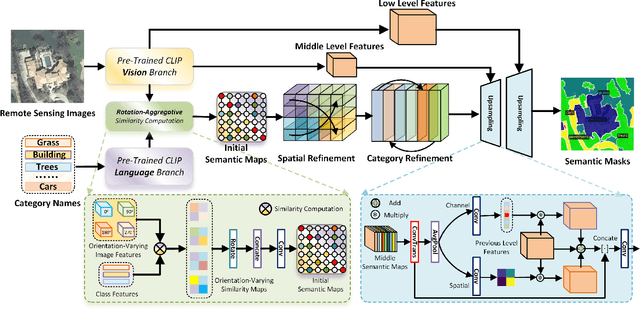
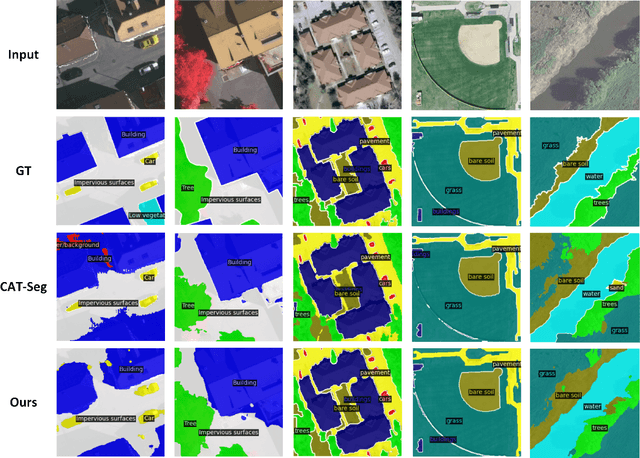
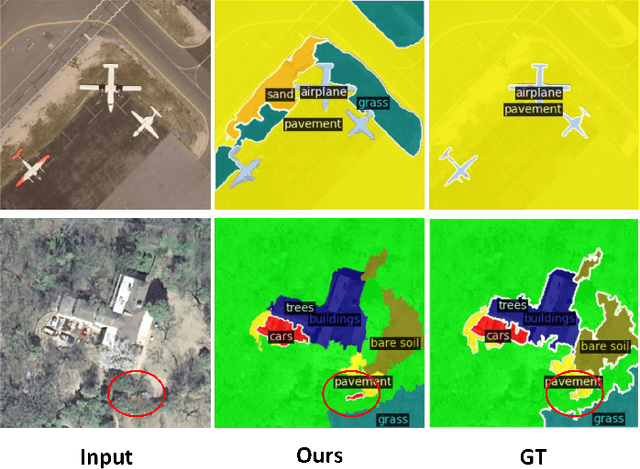
Open-vocabulary image semantic segmentation (OVS) seeks to segment images into semantic regions across an open set of categories. Existing OVS methods commonly depend on foundational vision-language models and utilize similarity computation to tackle OVS tasks. However, these approaches are predominantly tailored to natural images and struggle with the unique characteristics of remote sensing images, such as rapidly changing orientations and significant scale variations. These challenges complicate OVS tasks in earth vision, requiring specialized approaches. To tackle this dilemma, we propose the first OVS framework specifically designed for remote sensing imagery, drawing inspiration from the distinct remote sensing traits. Particularly, to address the varying orientations, we introduce a rotation-aggregative similarity computation module that generates orientation-adaptive similarity maps as initial semantic maps. These maps are subsequently refined at both spatial and categorical levels to produce more accurate semantic maps. Additionally, to manage significant scale changes, we integrate multi-scale image features into the upsampling process, resulting in the final scale-aware semantic masks. To advance OVS in earth vision and encourage reproducible research, we establish the first open-sourced OVS benchmark for remote sensing imagery, including four public remote sensing datasets. Extensive experiments on this benchmark demonstrate our proposed method achieves state-of-the-art performance. All codes and datasets are available at https://github.com/caoql98/OVRS.
Learning Augmentation Policies from A Model Zoo for Time Series Forecasting
Sep 10, 2024


Time series forecasting models typically rely on a fixed-size training set and treat all data uniformly, which may not effectively capture the specific patterns present in more challenging training samples. To address this issue, we introduce AutoTSAug, a learnable data augmentation method based on reinforcement learning. Our approach begins with an empirical analysis to determine which parts of the training data should be augmented. Specifically, we identify the so-called marginal samples by considering the prediction diversity across a set of pretrained forecasting models. Next, we propose using variational masked autoencoders as the augmentation model and applying the REINFORCE algorithm to transform the marginal samples into new data. The goal of this generative model is not only to mimic the distribution of real data but also to reduce the variance of prediction errors across the model zoo. By augmenting the marginal samples with a learnable policy, AutoTSAug substantially improves forecasting performance, advancing the prior art in this field with minimal additional computational cost.