 Add to Chrome
 Add to Firefox
 Add to Edge
TeX-1500: A Paired Real-World LWIR Hyperspectral Dataset and Benchmark for Temperature-Emissivity-Texture Decomposition
Jun 02, 2026
Temperature-emissivity-texture (TeX) decomposition seeks to recover object heat state, material spectral response, and visible-like geometric texture from long-wave infrared hyperspectral imaging (LWIR HSI). Existing TeX pipelines are mainly scene-specific inverse solvers, and the lack of paired LWIR HSI-TeX supervision has limited learning-based decomposition. To address this gap, we introduce TeX-1500, a large-scale paired LWIR HSI-TeX dataset and benchmark for supervised HSI-to-TeX decomposition. TeX-1500 contains 1,522 calibrated real-scene pairs from DARPA Invisible Headlights (DARPA IH) pushbroom imagery and our FTIR acquisitions, covering five locations, four seasons, diverse acquisition times, heterogeneous wavelength layouts, and two sensor families. Each sample stores a calibrated valid-band radiance cube, calibrated wavelength positions, and aligned temperature, emissivity, and texture supervision constructed through a consistent restoration and TeX-construction protocol. We further provide TeX-UNet, a simple wavelength-aware baseline that maps calibrated HSI bands and wavelength positions to TeX fields. Experiments on the held-out DARPA IH pushbroom scenes and zero-/few-shot transfer to FTIR scenes show that TeX-1500 provides usable paired supervision and a measurable benchmark for data-driven physical-property-centered thermal perception.

HADAR-Based Thermal Infrared Hyperspectral Image Restoration
May 13, 2026Thermal-infrared (TIR) hyperspectral imagery (HSI) provides critical scene information for various applications. However, its practical utility is severely limited by unique sensor degradations beyond the capabilities of existing restoration methods, which are ignorant of underlying thermal physics. Here, we propose HAIR (HADAR-based Image Restoration) as a physics-driven framework for ground-based TIR-HSI restoration. HAIR utilizes the HADAR rendering equation (HRE) and combines it with the atmospheric downwelling radiative transfer equation (RTE) to model TIR-HSI using temperature, emissivity, and texture (TeX) physical triplets. This physical model leads to a TeX decompose-synthesize strategy that guarantees physical consistency and spatio-spectral noise resilience, in stark contrast to existing approaches. Moreover, our framework uses a forward-modeled atmospheric downwelling reference, along with spectral smoothness of emissivity and blackbody radiation, to enable spectral calibration and generation that would otherwise be elusive. Our extensive experiments on the outdoor DARPA Invisible Headlights dataset and in-lab FTIR measurements show that HAIR consistently outperforms state-of-the-art methods across denoising, inpainting, spectral calibration, and spectral super-resolution, establishing a benchmark in objective accuracy and visual quality.
Universal computational thermal imaging overcoming the ghosting effect
Apr 02, 2026Thermal imaging is crucial for night vision but fundamentally hampered by the ghosting effect, a loss of detailed texture in cluttered photon streams. While conventional ghosting mitigation has relied on data post-processing, the recent breakthrough in heat-assisted detection and ranging (HADAR) opens a promising frontier for hyperspectral computational thermal imaging that produces night vision with day-like visibility. However, universal anti-ghosting imaging remains elusive, as state-of-the-art HADAR applies only to limited scenes with uniform materials, whereas material non-uniformity is ubiquitous in the real world. Here, we propose a universal computational thermal imaging framework, TAG (thermal anti-ghosting), to address material non-uniformity and overcome ghosting for high-fidelity night vision. TAG takes hyperspectral photon streams for nonparametric texture recovery, enabling our experimental demonstration of unprecedented expression recovery in thus-far-elusive ghostly human faces -- the archetypal, long-recognized ghosting phenomenon. Strikingly, TAG not only universally outperforms HADAR across various scenes, but also reveals the influence of material non-uniformity, shedding light on HADAR's effectiveness boundary. We extensively test facial texture and expression recovery across day and night, and demonstrate, for the first time, thermal 3D topological alignment and mood detection. This work establishes a universal foundation for high-fidelity computational night vision, with potential applications in autonomous navigation, reconnaissance, healthcare, and wildlife monitoring.
EAutoDet: Efficient Architecture Search for Object Detection
Mar 21, 2022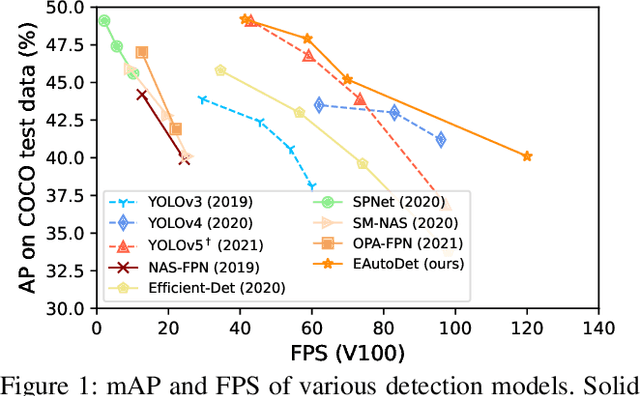
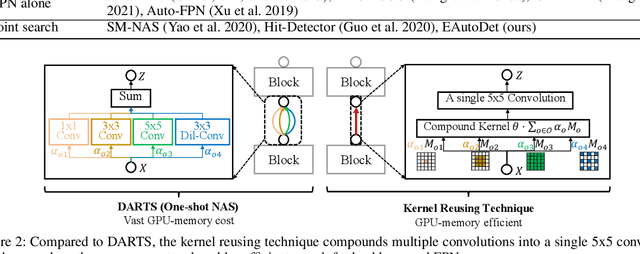
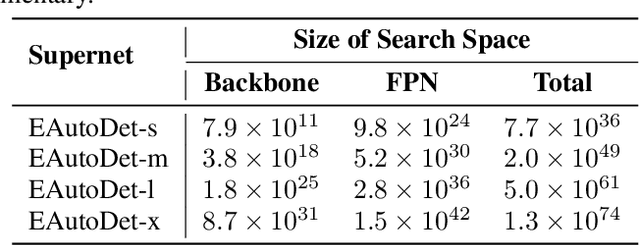
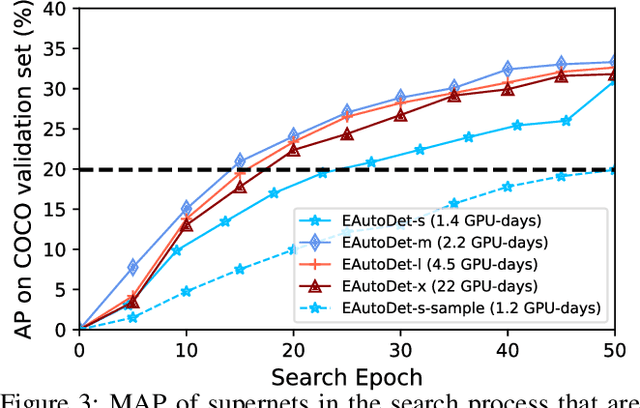
Training CNN for detection is time-consuming due to the large dataset and complex network modules, making it hard to search architectures on detection datasets directly, which usually requires vast search costs (usually tens and even hundreds of GPU-days). In contrast, this paper introduces an efficient framework, named EAutoDet, that can discover practical backbone and FPN architectures for object detection in 1.4 GPU-days. Specifically, we construct a supernet for both backbone and FPN modules and adopt the differentiable method. To reduce the GPU memory requirement and computational cost, we propose a kernel reusing technique by sharing the weights of candidate operations on one edge and consolidating them into one convolution. A dynamic channel refinement strategy is also introduced to search channel numbers. Extensive experiments show significant efficacy and efficiency of our method. In particular, the discovered architectures surpass state-of-the-art object detection NAS methods and achieve 40.1 mAP with 120 FPS and 49.2 mAP with 41.3 FPS on COCO test-dev set. We also transfer the discovered architectures to rotation detection task, which achieve 77.05 mAP$_{\text{50}}$ on DOTA-v1.0 test set with 21.1M parameters.