 Add to Chrome
 Add to Firefox
 Add to Edge
HDINO: A Concise and Efficient Open-Vocabulary Detector
Mar 03, 2026
Despite the growing interest in open-vocabulary object detection in recent years, most existing methods rely heavily on manually curated fine-grained training datasets as well as resource-intensive layer-wise cross-modal feature extraction. In this paper, we propose HDINO, a concise yet efficient open-vocabulary object detector that eliminates the dependence on these components. Specifically, we propose a two-stage training strategy built upon the transformer-based DINO model. In the first stage, noisy samples are treated as additional positive object instances to construct a One-to-Many Semantic Alignment Mechanism(O2M) between the visual and textual modalities, thereby facilitating semantic alignment. A Difficulty Weighted Classification Loss (DWCL) is also designed based on initial detection difficulty to mine hard examples and further improve model performance. In the second stage, a lightweight feature fusion module is applied to the aligned representations to enhance sensitivity to linguistic semantics. Under the Swin Transformer-T setting, HDINO-T achieves \textbf{49.2} mAP on COCO using 2.2M training images from two publicly available detection datasets, without any manual data curation and the use of grounding data, surpassing Grounding DINO-T and T-Rex2 by \textbf{0.8} mAP and \textbf{2.8} mAP, respectively, which are trained on 5.4M and 6.5M images. After fine-tuning on COCO, HDINO-T and HDINO-L further achieve \textbf{56.4} mAP and \textbf{59.2} mAP, highlighting the effectiveness and scalability of our approach. Code and models are available at https://github.com/HaoZ416/HDINO.

PC Agent: While You Sleep, AI Works -- A Cognitive Journey into Digital World
Dec 23, 2024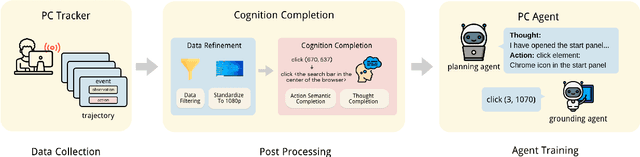
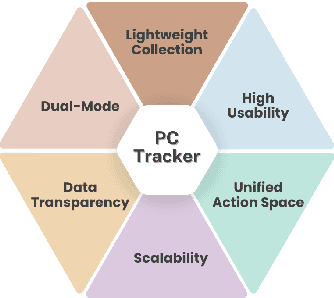
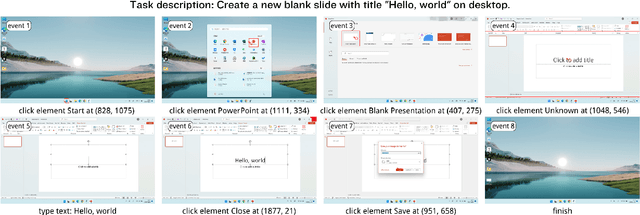
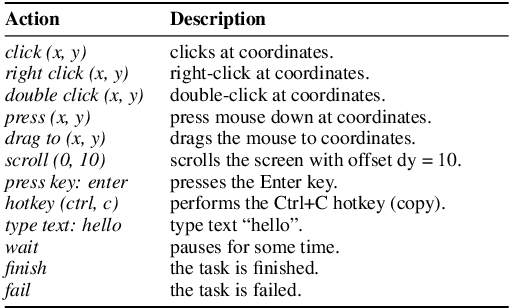
Imagine a world where AI can handle your work while you sleep - organizing your research materials, drafting a report, or creating a presentation you need for tomorrow. However, while current digital agents can perform simple tasks, they are far from capable of handling the complex real-world work that humans routinely perform. We present PC Agent, an AI system that demonstrates a crucial step toward this vision through human cognition transfer. Our key insight is that the path from executing simple "tasks" to handling complex "work" lies in efficiently capturing and learning from human cognitive processes during computer use. To validate this hypothesis, we introduce three key innovations: (1) PC Tracker, a lightweight infrastructure that efficiently collects high-quality human-computer interaction trajectories with complete cognitive context; (2) a two-stage cognition completion pipeline that transforms raw interaction data into rich cognitive trajectories by completing action semantics and thought processes; and (3) a multi-agent system combining a planning agent for decision-making with a grounding agent for robust visual grounding. Our preliminary experiments in PowerPoint presentation creation reveal that complex digital work capabilities can be achieved with a small amount of high-quality cognitive data - PC Agent, trained on just 133 cognitive trajectories, can handle sophisticated work scenarios involving up to 50 steps across multiple applications. This demonstrates the data efficiency of our approach, highlighting that the key to training capable digital agents lies in collecting human cognitive data. By open-sourcing our complete framework, including the data collection infrastructure and cognition completion methods, we aim to lower the barriers for the research community to develop truly capable digital agents.