 Add to Chrome
 Add to Firefox
 Add to Edge
AcademiClaw: When Students Set Challenges for AI Agents
May 04, 2026
Benchmarks within the OpenClaw ecosystem have thus far evaluated exclusively assistant-level tasks, leaving the academic-level capabilities of OpenClaw largely unexamined. We introduce AcademiClaw, a bilingual benchmark of 80 complex, long-horizon tasks sourced directly from university students' real academic workflows -- homework, research projects, competitions, and personal projects -- that they found current AI agents unable to solve effectively. Curated from 230 student-submitted candidates through rigorous expert review, the final task set spans 25+ professional domains, ranging from olympiad-level mathematics and linguistics problems to GPU-intensive reinforcement learning and full-stack system debugging, with 16 tasks requiring CUDA GPU execution. Each task executes in an isolated Docker sandbox and is scored on task completion by multi-dimensional rubrics combining six complementary techniques, with an independent five-category safety audit providing additional behavioral analysis. Experiments on six frontier models show that even the best achieves only a 55\% pass rate. Further analysis uncovers sharp capability boundaries across task domains, divergent behavioral strategies among models, and a disconnect between token consumption and output quality, providing fine-grained diagnostic signals beyond what aggregate metrics reveal. We hope that AcademiClaw and its open-sourced data and code can serve as a useful resource for the OpenClaw community, driving progress toward agents that are more capable and versatile across the full breadth of real-world academic demands. All data and code are available at https://github.com/GAIR-NLP/AcademiClaw.

AlphaEval: Evaluating Agents in Production
Apr 14, 2026The rapid deployment of AI agents in commercial settings has outpaced the development of evaluation methodologies that reflect production realities. Existing benchmarks measure agent capabilities through retrospectively curated tasks with well-specified requirements and deterministic metrics -- conditions that diverge fundamentally from production environments where requirements contain implicit constraints, inputs are heterogeneous multi-modal documents with information fragmented across sources, tasks demand undeclared domain expertise, outputs are long-horizon professional deliverables, and success is judged by domain experts whose standards evolve over time. We present AlphaEval, a production-grounded benchmark of 94 tasks sourced from seven companies deploying AI agents in their core business, spanning six O*NET (Occupational Information Network) domains. Unlike model-centric benchmarks, AlphaEval evaluates complete agent products -- Claude Code, Codex, etc. -- as commercial systems, capturing performance variations invisible to model-level evaluation. Our evaluation framework covers multiple paradigms (LLM-as-a-Judge, reference-driven metrics, formal verification, rubric-based assessment, automated UI testing, etc.), with individual domains composing multiple paradigms. Beyond the benchmark itself, we contribute a requirement-to-benchmark construction framework -- a systematic methodology that transforms authentic production requirements into executable evaluation tasks in minimal time. This framework standardizes the entire pipeline from requirement to evaluation, providing a reproducible, modular process that any organization can adopt to construct production-grounded benchmarks for their own domains.
Rubrics to Tokens: Bridging Response-level Rubrics and Token-level Rewards in Instruction Following Tasks
Apr 03, 2026Rubric-based Reinforcement Learning (RL) has emerged as a promising approach for aligning Large Language Models (LLMs) with complex, open-domain instruction following tasks. However, existing methods predominantly rely on response-level rewards, introducing severe reward sparsity and reward ambiguity problems. To address these issues, we propose Rubrics to Tokens (RTT), a novel rubric-based RL framework that bridges coarse response-level scores and fine-grained token-level credit assignment. RTT introduces a Token-Level Relevance Discriminator to predict which tokens in the response are responsible for a specific constraint, and optimizes the policy model via RTT-GRPO, which integrates response-level and token-level advantages within a unified framework. Furthermore, when transitioning from one-dimensional, outcome-level reward to three-dimensional reward space in the token-level rubric-based RL, we propose a novel group normalization method, called Intra-sample Token Group Normalization, to accommodate this shift. Extensive experiments and benchmarks demonstrate that RTT consistently outperforms other baselines in both instruction- and rubric-level accuracy across different models.
daVinci-LLM:Towards the Science of Pretraining
Mar 28, 2026The foundational pretraining phase determines a model's capability ceiling, as post-training struggles to overcome capability foundations established during pretraining, yet it remains critically under-explored. This stems from a structural paradox: organizations with computational resources operate under commercial pressures that inhibit transparent disclosure, while academic institutions possess research freedom but lack pretraining-scale computational resources. daVinci-LLM occupies this unexplored intersection, combining industrial-scale resources with full research freedom to advance the science of pretraining. We adopt a fully-open paradigm that treats openness as scientific methodology, releasing complete data processing pipelines, full training processes, and systematic exploration results. Recognizing that the field lacks systematic methodology for data processing, we employ the Data Darwinism framework, a principled L0-L9 taxonomy from filtering to synthesis. We train a 3B-parameter model from random initialization across 8T tokens using a two-stage adaptive curriculum that progressively shifts from foundational capabilities to reasoning-intensive enhancement. Through 200+ controlled ablations, we establish that: processing depth systematically enhances capabilities, establishing it as a critical dimension alongside volume scaling; different domains exhibit distinct saturation dynamics, necessitating adaptive strategies from proportion adjustments to format shifts; compositional balance enables targeted intensification while preventing performance collapse; how evaluation protocol choices shape our understanding of pretraining progress. By releasing the complete exploration process, we enable the community to build upon our findings and systematic methodologies to form accumulative scientific knowledge in pretraining.
ProjDevBench: Benchmarking AI Coding Agents on End-to-End Project Development
Feb 02, 2026Recent coding agents can generate complete codebases from simple prompts, yet existing evaluations focus on issue-level bug fixing and lag behind end-to-end development. We introduce ProjDevBench, an end-to-end benchmark that provides project requirements to coding agents and evaluates the resulting repositories. Combining Online Judge (OJ) testing with LLM-assisted code review, the benchmark evaluates agents on (1) system architecture design, (2) functional correctness, and (3) iterative solution refinement. We curate 20 programming problems across 8 categories, covering both concept-oriented tasks and real-world application scenarios, and evaluate six coding agents built on different LLM backends. Our evaluation reports an overall acceptance rate of 27.38%: agents handle basic functionality and data structures but struggle with complex system design, time complexity optimization, and resource management. Our benchmark is available at https://github.com/zsworld6/projdevbench.
Interaction as Intelligence Part II: Asynchronous Human-Agent Rollout for Long-Horizon Task Training
Nov 03, 2025Large Language Model (LLM) agents have recently shown strong potential in domains such as automated coding, deep research, and graphical user interface manipulation. However, training them to succeed on long-horizon, domain-specialized tasks remains challenging. Current methods primarily fall into two categories. The first relies on dense human annotations through behavior cloning, which is prohibitively expensive for long-horizon tasks that can take days or months. The second depends on outcome-driven sampling, which often collapses due to the rarity of valid positive trajectories on domain-specialized tasks. We introduce Apollo, a sampling framework that integrates asynchronous human guidance with action-level data filtering. Instead of requiring annotators to shadow every step, Apollo allows them to intervene only when the agent drifts from a promising trajectory, by providing prior knowledge, strategic advice, etc. This lightweight design makes it possible to sustain interactions for over 30 hours and produces valuable trajectories at a lower cost. Apollo then applies supervision control to filter out sub-optimal actions and prevent error propagation. Together, these components enable reliable and effective data collection in long-horizon environments. To demonstrate the effectiveness of Apollo, we evaluate it using InnovatorBench. Our experiments show that when applied to train the GLM-4.5 model on InnovatorBench, Apollo achieves more than a 50% improvement over the untrained baseline and a 28% improvement over a variant trained without human interaction. These results highlight the critical role of human-in-the-loop sampling and the robustness of Apollo's design in handling long-horizon, domain-specialized tasks.
InnovatorBench: Evaluating Agents' Ability to Conduct Innovative LLM Research
Nov 03, 2025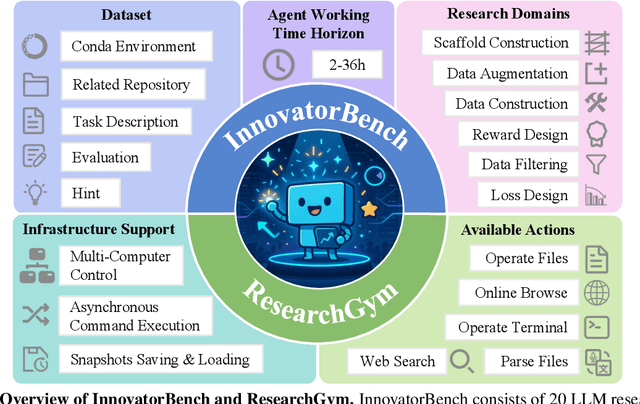
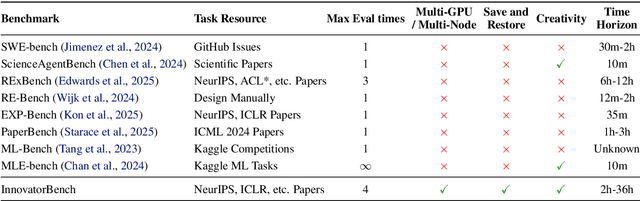
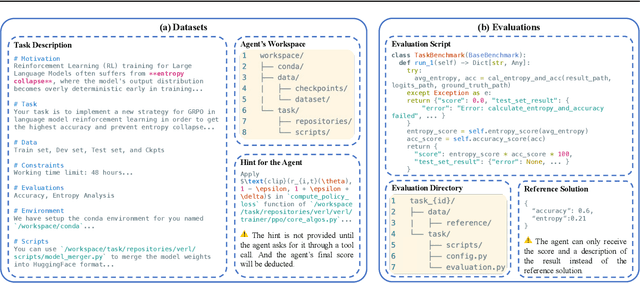
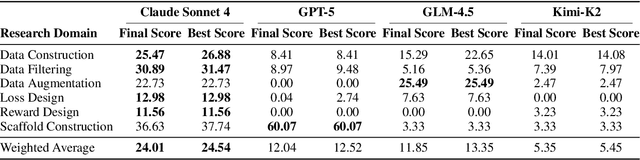
AI agents could accelerate scientific discovery by automating hypothesis formation, experiment design, coding, execution, and analysis, yet existing benchmarks probe narrow skills in simplified settings. To address this gap, we introduce InnovatorBench, a benchmark-platform pair for realistic, end-to-end assessment of agents performing Large Language Model (LLM) research. It comprises 20 tasks spanning Data Construction, Filtering, Augmentation, Loss Design, Reward Design, and Scaffold Construction, which require runnable artifacts and assessment of correctness, performance, output quality, and uncertainty. To support agent operation, we develop ResearchGym, a research environment offering rich action spaces, distributed and long-horizon execution, asynchronous monitoring, and snapshot saving. We also implement a lightweight ReAct agent that couples explicit reasoning with executable planning using frontier models such as Claude-4, GPT-5, GLM-4.5, and Kimi-K2. Our experiments demonstrate that while frontier models show promise in code-driven research tasks, they struggle with fragile algorithm-related tasks and long-horizon decision making, such as impatience, poor resource management, and overreliance on template-based reasoning. Furthermore, agents require over 11 hours to achieve their best performance on InnovatorBench, underscoring the benchmark's difficulty and showing the potential of InnovatorBench to be the next generation of code-based research benchmark.
DeepResearcher: Scaling Deep Research via Reinforcement Learning in Real-world Environments
Apr 07, 2025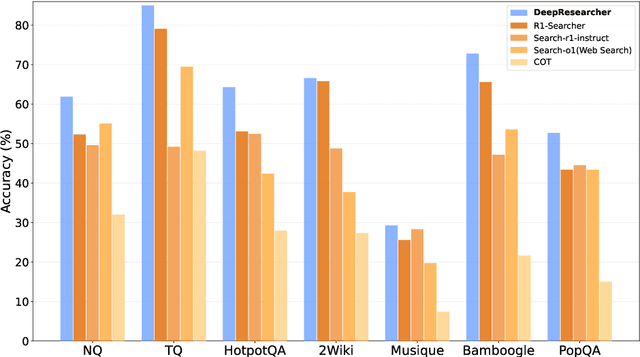
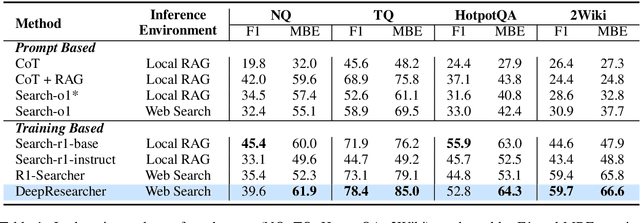
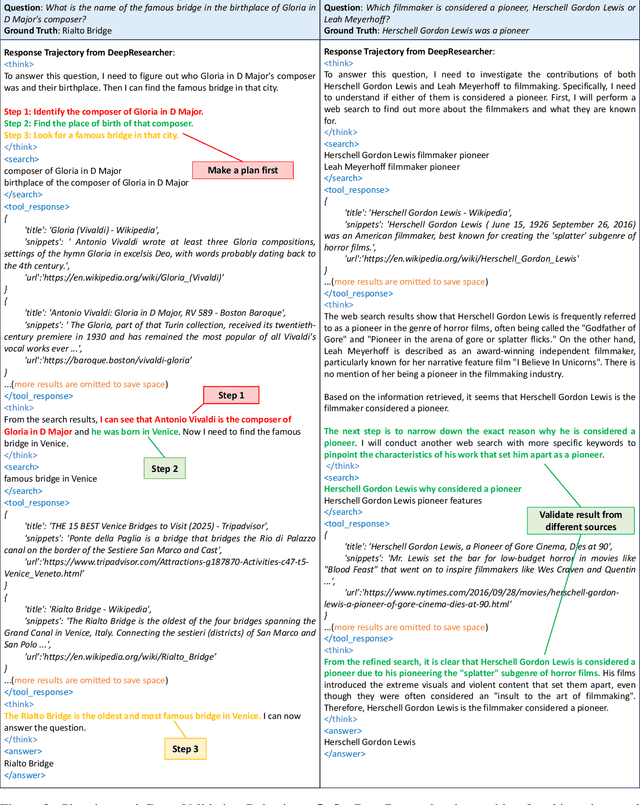
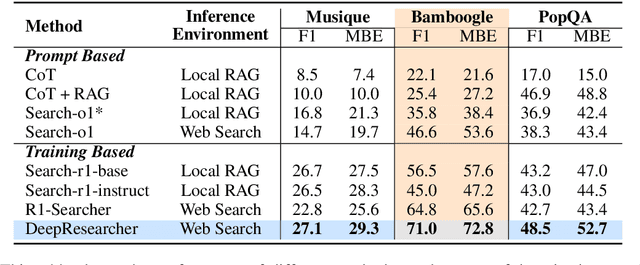
Large Language Models (LLMs) equipped with web search capabilities have demonstrated impressive potential for deep research tasks. However, current approaches predominantly rely on either manually engineered prompts (prompt engineering-based) with brittle performance or reinforcement learning within controlled Retrieval-Augmented Generation (RAG) environments (RAG-based) that fail to capture the complexities of real-world interaction. In this paper, we introduce DeepResearcher, the first comprehensive framework for end-to-end training of LLM-based deep research agents through scaling reinforcement learning (RL) in real-world environments with authentic web search interactions. Unlike RAG-based approaches that assume all necessary information exists within a fixed corpus, our method trains agents to navigate the noisy, unstructured, and dynamic nature of the open web. We implement a specialized multi-agent architecture where browsing agents extract relevant information from various webpage structures and overcoming significant technical challenges. Extensive experiments on open-domain research tasks demonstrate that DeepResearcher achieves substantial improvements of up to 28.9 points over prompt engineering-based baselines and up to 7.2 points over RAG-based RL agents. Our qualitative analysis reveals emergent cognitive behaviors from end-to-end RL training, including the ability to formulate plans, cross-validate information from multiple sources, engage in self-reflection to redirect research, and maintain honesty when unable to find definitive answers. Our results highlight that end-to-end training in real-world web environments is not merely an implementation detail but a fundamental requirement for developing robust research capabilities aligned with real-world applications. We release DeepResearcher at https://github.com/GAIR-NLP/DeepResearcher.