 Add to Chrome
 Add to Firefox
 Add to Edge
DRIFTLENS: Measuring Memory-Induced Reasoning Drift in Personalized Language Models
Jul 02, 2026
Personalization changes what a model says to a user; we show that it can also change the reasoning trajectory used to justify the response. Modern LLMs personalize interactions by storing user attributes, preferences, and prior context, then injecting this information into future prompts. We study whether such memory reshapes reasoning on open-ended questions where no single ground-truth answer exists. To quantify this effect, we introduce DRIFTLENS, a ground-truth-free framework that maps each expressed reasoning step to a value category and measures divergence between a question's no-memory trajectory and its trajectory under injected user-attribute memory. We first validate that DRIFTLENS distinguishes content-free pragmatic noise from substantive reasoning changes. Across four LLMs and 10 user-attribute categories, including age, occupation, and disability, user-attribute memory induces medium-to-large reasoning drift above each model's pragmatic-noise floor, even when final answers remain fluent, on-topic, and plausible. We then evaluate GRPO- and DPO-based post-training methods for reducing drift. Both reduce drift, but neither uniformly dominates; effects on downstream capability, helpfulness, and instruction following are model-and reward-dependent. These results suggest that memory-induced reasoning drift is a measurable and only partly mitigated failure mode of personalized language models.

LLM-ACES: Closed-Loop Discovery of Dynamical Systems with LLM-Guided Adaptive Search
Jun 23, 2026Recovering governing Ordinary Differential Equations (ODEs) from data is a central challenge in modeling dynamical systems across scientific domains. Existing approaches cast discovery as a static inference problem over fixed datasets, assuming that the observed trajectories are sufficiently informative. However, dynamical systems evolve over large state spaces, and limited data can make multiple equations observationally indistinguishable, leading to identifiability gaps and the recovery of incorrect governing equations. To address this, we introduce LLM-ACES, or LLM-guided Active Closed-loop Equation Search, a closed-loop framework that jointly optimizes symbolic hypothesis construction and adaptive data acquisition. In LLM-ACES, a large language model (LLM) proposes operator priors that partition the large search space into distinct regions, within which candidate equations are fit to the observed data. The disagreement among these candidates guides the acquisition of informative trajectories, creating a feedback loop that iteratively refines both the hypothesis space and the discovered dynamics. On 122 ODE systems spanning ODEBench and ODEBase, LLM-ACES achieves the lowest median NMSE, outperforming state-of-the-art baselines by several orders of magnitude while achieving a high symbolic accuracy of 46.2% and 52.4%, respectively. Our analysis further shows that LLM-ACES is sample-efficient, achieving better performance with one-tenth the data. Furthermore, LLM-ACES's feedback-driven data acquisition makes it robust to noise and recovers the correct symbolic structure, while baselines introduce spurious terms that fit the data locally but obscure the true governing relationships.
Towards Diverse Scientific Hypothesis Search with Large Language Models
Jun 09, 2026Large language models (LLMs) are on the rise for accelerating scientific discovery, most recently in advanced tasks such as generating valid scientific hypotheses. Yet in many discovery settings, the goal is not to identify a single best hypothesis since validation can be noisy and expensive, and scientists benefit from a set of high-quality alternative hypotheses that hedge against downstream uncertainty for the best solutions. Nevertheless, commonly used evolutionary search recipes tend to prioritize optimization over exploration in hypothesis generation, and the resulting selection pressure during the search process leads to diversity collapse. Motivated by these limitations, we formulate hypothesis search as a sampling problem, where the objective is to efficiently produce diverse, high-quality hypotheses under a fixed validation budget. Building on this perspective, we propose \ours, an evolutionary framework inspired by the classical parallel tempering algorithm that searches hypotheses at multiple temperature levels and enables principled information exchange across temperatures to improve exploration without disrupting convergence. Across domains including molecular discovery, equation discovery, and algorithm discovery, our approach consistently improves both hypothesis quality and diversity under the same validation budget, and produces candidates that remain robust under more expensive downstream computational validations.
SURFACEBENCH: Can Self-Evolving LLMs Find the Equations of 3D Scientific Surfaces?
Nov 13, 2025Equation discovery from data is a core challenge in machine learning for science, requiring the recovery of concise symbolic expressions that govern complex physical and geometric phenomena. Recent approaches with large language models (LLMs) show promise in symbolic regression, but their success often hinges on memorized formulas or overly simplified functional forms. Existing benchmarks exacerbate this limitation: they focus on scalar functions, ignore domain grounding, and rely on brittle string-matching based metrics that fail to capture scientific equivalence. We introduce SurfaceBench, first comprehensive benchmark for symbolic surface discovery. SurfaceBench comprises 183 tasks across 15 categories of symbolic complexity, spanning explicit, implicit, and parametric equation representation forms. Each task includes ground-truth equations, variable semantics, and synthetically sampled three dimensional data. Unlike prior SR datasets, our tasks reflect surface-level structure, resist LLM memorization through novel symbolic compositions, and are grounded in scientific domains such as fluid dynamics, robotics, electromagnetics, and geometry. To evaluate equation discovery quality, we pair symbolic checks with geometry-aware metrics such as Chamfer and Hausdorff distances, capturing both algebraic fidelity and spatial reconstruction accuracy. Our experiments reveal that state-of-the-art frameworks, while occasionally successful on specific families, struggle to generalize across representation types and surface complexities. SurfaceBench thus establishes a challenging and diagnostic testbed that bridges symbolic reasoning with geometric reconstruction, enabling principled benchmarking of progress in compositional generalization, data-driven scientific induction, and geometry-aware reasoning with LLMs. We release the code here: https://github.com/Sanchit-404/surfacebench
RUST-BENCH: Benchmarking LLM Reasoning on Unstructured Text within Structured Tables
Nov 06, 2025Existing tabular reasoning benchmarks mostly test models on small, uniform tables, underrepresenting the complexity of real-world data and giving an incomplete view of Large Language Models' (LLMs) reasoning abilities. Real tables are long, heterogeneous, and domain-specific, mixing structured fields with free text and requiring multi-hop reasoning across thousands of tokens. To address this gap, we introduce RUST-BENCH, a benchmark of 7966 questions from 2031 real-world tables spanning two domains: i) RB-Science (NSF grant records) and ii) RB-Sports (NBA statistics). Unlike prior work, RUST-BENCH evaluates LLMs jointly across scale, heterogeneity, domain specificity, and reasoning complexity. Experiments with open-source and proprietary models show that LLMs struggle with heterogeneous schemas and complex multi-hop inference, revealing persistent weaknesses in current architectures and prompting strategies. RUST-BENCH establishes a challenging new testbed for advancing tabular reasoning research.
Accelerating Materials Design via LLM-Guided Evolutionary Search
Oct 26, 2025Materials discovery requires navigating vast chemical and structural spaces while satisfying multiple, often conflicting, objectives. We present LLM-guided Evolution for MAterials design (LLEMA), a unified framework that couples the scientific knowledge embedded in large language models with chemistry-informed evolutionary rules and memory-based refinement. At each iteration, an LLM proposes crystallographically specified candidates under explicit property constraints; a surrogate-augmented oracle estimates physicochemical properties; and a multi-objective scorer updates success/failure memories to guide subsequent generations. Evaluated on 14 realistic tasks spanning electronics, energy, coatings, optics, and aerospace, LLEMA discovers candidates that are chemically plausible, thermodynamically stable, and property-aligned, achieving higher hit-rates and stronger Pareto fronts than generative and LLM-only baselines. Ablation studies confirm the importance of rule-guided generation, memory-based refinement, and surrogate prediction. By enforcing synthesizability and multi-objective trade-offs, LLEMA delivers a principled pathway to accelerate practical materials discovery. Code: https://github.com/scientific-discovery/LLEMA
Distribution Shift Aware Neural Tabular Learning
Aug 27, 2025
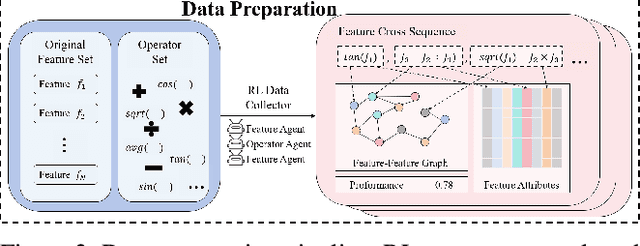
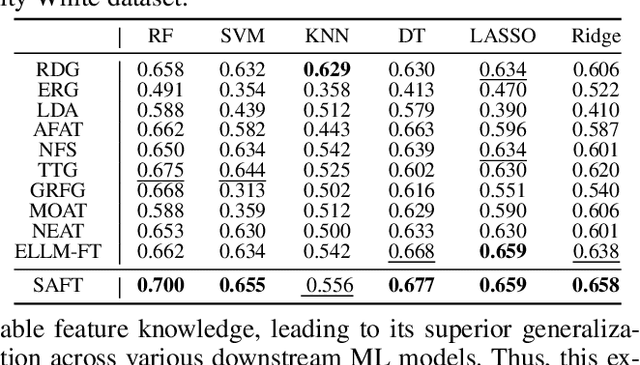
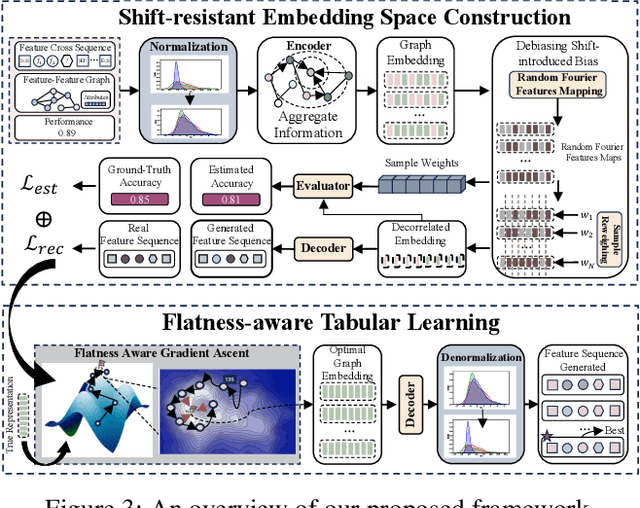
Tabular learning transforms raw features into optimized spaces for downstream tasks, but its effectiveness deteriorates under distribution shifts between training and testing data. We formalize this challenge as the Distribution Shift Tabular Learning (DSTL) problem and propose a novel Shift-Aware Feature Transformation (SAFT) framework to address it. SAFT reframes tabular learning from a discrete search task into a continuous representation-generation paradigm, enabling differentiable optimization over transformed feature sets. SAFT integrates three mechanisms to ensure robustness: (i) shift-resistant representation via embedding decorrelation and sample reweighting, (ii) flatness-aware generation through suboptimal embedding averaging, and (iii) normalization-based alignment between training and test distributions. Extensive experiments show that SAFT consistently outperforms prior tabular learning methods in terms of robustness, effectiveness, and generalization ability under diverse real-world distribution shifts.
Data-Efficient Symbolic Regression via Foundation Model Distillation
Aug 27, 2025Discovering interpretable mathematical equations from observed data (a.k.a. equation discovery or symbolic regression) is a cornerstone of scientific discovery, enabling transparent modeling of physical, biological, and economic systems. While foundation models pre-trained on large-scale equation datasets offer a promising starting point, they often suffer from negative transfer and poor generalization when applied to small, domain-specific datasets. In this paper, we introduce EQUATE (Equation Generation via QUality-Aligned Transfer Embeddings), a data-efficient fine-tuning framework that adapts foundation models for symbolic equation discovery in low-data regimes via distillation. EQUATE combines symbolic-numeric alignment with evaluator-guided embedding optimization, enabling a principled embedding-search-generation paradigm. Our approach reformulates discrete equation search as a continuous optimization task in a shared embedding space, guided by data-equation fitness and simplicity. Experiments across three standard public benchmarks (Feynman, Strogatz, and black-box datasets) demonstrate that EQUATE consistently outperforms state-of-the-art baselines in both accuracy and robustness, while preserving low complexity and fast inference. These results highlight EQUATE as a practical and generalizable solution for data-efficient symbolic regression in foundation model distillation settings.
Quantifying Fairness in LLMs Beyond Tokens: A Semantic and Statistical Perspective
Jun 23, 2025Large Language Models (LLMs) often generate responses with inherent biases, undermining their reliability in real-world applications. Existing evaluation methods often overlook biases in long-form responses and the intrinsic variability of LLM outputs. To address these challenges, we propose FiSCo(Fine-grained Semantic Computation), a novel statistical framework to evaluate group-level fairness in LLMs by detecting subtle semantic differences in long-form responses across demographic groups. Unlike prior work focusing on sentiment or token-level comparisons, FiSCo goes beyond surface-level analysis by operating at the claim level, leveraging entailment checks to assess the consistency of meaning across responses. We decompose model outputs into semantically distinct claims and apply statistical hypothesis testing to compare inter- and intra-group similarities, enabling robust detection of subtle biases. We formalize a new group counterfactual fairness definition and validate FiSCo on both synthetic and human-annotated datasets spanning gender, race, and age. Experiments show that FiSco more reliably identifies nuanced biases while reducing the impact of stochastic LLM variability, outperforming various evaluation metrics.
FalseReject: A Resource for Improving Contextual Safety and Mitigating Over-Refusals in LLMs via Structured Reasoning
May 12, 2025Safety alignment approaches in large language models (LLMs) often lead to the over-refusal of benign queries, significantly diminishing their utility in sensitive scenarios. To address this challenge, we introduce FalseReject, a comprehensive resource containing 16k seemingly toxic queries accompanied by structured responses across 44 safety-related categories. We propose a graph-informed adversarial multi-agent interaction framework to generate diverse and complex prompts, while structuring responses with explicit reasoning to aid models in accurately distinguishing safe from unsafe contexts. FalseReject includes training datasets tailored for both standard instruction-tuned models and reasoning-oriented models, as well as a human-annotated benchmark test set. Our extensive benchmarking on 29 state-of-the-art (SOTA) LLMs reveals persistent over-refusal challenges. Empirical results demonstrate that supervised finetuning with FalseReject substantially reduces unnecessary refusals without compromising overall safety or general language capabilities.