 Add to Chrome
 Add to Firefox
 Add to Edge
Memory-Supported Synergistic Adaptation for Training-Free Test-Time Medical Image Segmentation
Jul 20, 2026
Test-time adaptation (TTA) aims to mitigate distribution shifts by adapting models with unlabeled target data at inference time. While TTA with vision-language models (VLMs) has shown promising results in classification, extending it to medical image segmentation remains challenging. In this setting, the adaptation gains from optimizing on VLM-generated predictions are often outweighed by the degradation to the VLM's strong pretrained features caused by noisy, update-driven learning, resulting in limited and unstable improvements. We therefore propose Memory-Supported Synergistic Adaptation (MSSA), a novel training-free TTA framework for medical image segmentation. Without updating model parameters, MSSA dynamically selects reliable image-text predictions to construct an online memory, uses them as text-guided semantic priors, and couples them with cross-image structural alignment for robust adaptation. Specifically, MSSA consists of (i) a noise-aware memory construction module that filters and stabilizes cross-modal predictions, and (ii) a relevance-driven prototype alignment module that aligns the target sample with structurally consistent memory samples and their reliable predictions to improve adaptation. Extensive experiments on multiple medical segmentation benchmarks demonstrate that MSSA consistently improves VLM-based segmentation models and outperforms existing fine-tuning-based TTA methods by a clear margin, with gains of up to 12.2% DSC and 11.7% mIoU. Project page: https://lingrayy.github.io/MSSA/ .

Semantic-Aware, Physics-Informed, Geometry-Grounded Weather Video Synthesis
Jun 27, 2026Weather synthesis aims to add weather effects to input videos while preserving scene identity, structure, and motion. The key limitation of existing methods is the lack of diversity in weather appearance and effective control over weather dynamics (e.g., temporal evolution and particle motion). Most approaches rely on text prompts, which are inherently underspecified and often fail to produce detailed weather characteristics. Additionally, general-purpose video editors optimized for clean and aesthetic outputs tend to suppress heavy weather phenomena, making dense particle effects difficult to generate. To address these, we propose a Semantic-Aware, Physics-Informed, and Geometry-Grounded framework that steers an off-the-shelf video editor to synthesize diverse global appearances and detailed particle dynamics. We factorize the synthesis into three conditional signals, so that each provides a distinct and stable source of guidance: semantics specifies what the weather should look like, dynamics governs how it evolves over time, and geometry determines where it should appear in the scene. Specifically, we introduce (1) semantic-aware appearance anchoring to establish the target appearance from scene semantics and user input; (2) physics-informed dynamic simulation to generate particle effects by simulating a Gaussian-represented particle field under gravity, wind, and turbulence; and (3) geometry-grounded video synthesis to align the simulated particles with target scene geometry and synthesize the final video. Experiments demonstrate that our method produces diverse, physically and visually realistic weather effects. Furthermore, we show that our synthesized data significantly improves the robustness of autonomous driving semantic segmentation under adverse weather conditions. Project page: https://jumponthemoon.github.io/w-crafter/.
Technical Report for the ICRA 2026 GOOSE 2D Fine-Grained Semantic Segmentation Challenge: Pretraining-Diverse Ensemble of Foundation Vision Encoders for Robust Outdoor Scene Understanding
Jun 22, 2026This report presents our solution for the ICRA 2026 GOOSE 2D Fine-Grained Semantic Segmentation Challenge, which requires parsing unstructured outdoor scenes from four camera platforms into 56 fine-grained categories. Our approach pairs foundation vision encoders (including DINOv3, SigLIP2, and InternImage) with a Mask2Former decoder, and trains them with a strong recipe including long training schedules, exponential moving average, a larger crop size, and multi-scale plus flip test-time augmentation. The three encoders, chosen for their complementary pretraining objectives, are combined into a pretraining-diverse ensemble through per-class validation-IoU weighting. Evaluated on the official GOOSE test set, our submission achieves 75.40% composite mIoU and wins the second place of the challenge. Our study further shows that the encoder's pretraining recipe, rather than its parameter count or the decoder design, is the dominant factor for accuracy on this benchmark.
A Survey of Legged Robotics in Non-Inertial Environments: Past, Present, and Future
Apr 22, 2026Legged robots have demonstrated remarkable agility on rigid, stationary ground, but their locomotion reliability remains limited in non-inertial environments, where the supporting ground moves, tilts, or accelerates. Such conditions arise in ground transportation, maritime platforms, and aerospace settings, and they introduce persistent time-varying disturbances that break the stationary-ground assumptions underlying conventional legged locomotion. This survey reviews the state of the art in modeling, state estimation, and control for legged robots in non-inertial environments. We summarize representative application domains and motion characteristics, analyze the root causes of locomotion performance degradation, and review existing methods together with their key assumptions and limitations. We further identify open problems in robot-environment coupling, observability, robustness, and experimental validation, and discuss future directions in autonomy, system-level design, bio-inspired strategies, safety, and testing. The survey aims to clarify the technical foundations of this emerging area and support the development of reliable legged robots for real-world dynamic environments.
Open-World Deepfake Attribution via Confidence-Aware Asymmetric Learning
Dec 14, 2025The proliferation of synthetic facial imagery has intensified the need for robust Open-World DeepFake Attribution (OW-DFA), which aims to attribute both known and unknown forgeries using labeled data for known types and unlabeled data containing a mixture of known and novel types. However, existing OW-DFA methods face two critical limitations: 1) A confidence skew that leads to unreliable pseudo-labels for novel forgeries, resulting in biased training. 2) An unrealistic assumption that the number of unknown forgery types is known *a priori*. To address these challenges, we propose a Confidence-Aware Asymmetric Learning (CAL) framework, which adaptively balances model confidence across known and novel forgery types. CAL mainly consists of two components: Confidence-Aware Consistency Regularization (CCR) and Asymmetric Confidence Reinforcement (ACR). CCR mitigates pseudo-label bias by dynamically scaling sample losses based on normalized confidence, gradually shifting the training focus from high- to low-confidence samples. ACR complements this by separately calibrating confidence for known and novel classes through selective learning on high-confidence samples, guided by their confidence gap. Together, CCR and ACR form a mutually reinforcing loop that significantly improves the model's OW-DFA performance. Moreover, we introduce a Dynamic Prototype Pruning (DPP) strategy that automatically estimates the number of novel forgery types in a coarse-to-fine manner, removing the need for unrealistic prior assumptions and enhancing the scalability of our methods to real-world OW-DFA scenarios. Extensive experiments on the standard OW-DFA benchmark and a newly extended benchmark incorporating advanced manipulations demonstrate that CAL consistently outperforms previous methods, achieving new state-of-the-art performance on both known and novel forgery attribution.
WeatherEdit: Controllable Weather Editing with 4D Gaussian Field
May 26, 2025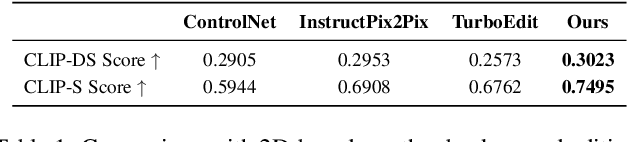
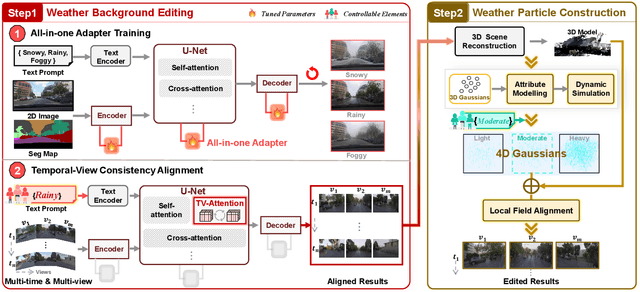
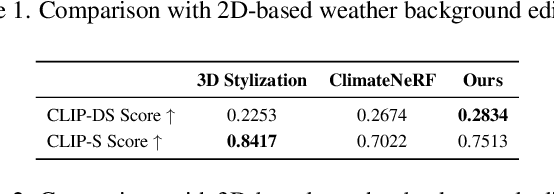
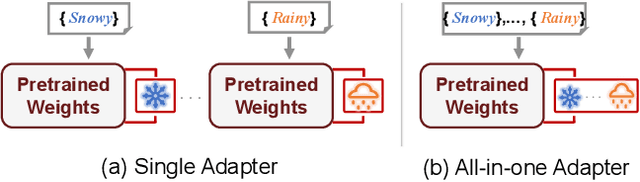
In this work, we present WeatherEdit, a novel weather editing pipeline for generating realistic weather effects with controllable types and severity in 3D scenes. Our approach is structured into two key components: weather background editing and weather particle construction. For weather background editing, we introduce an all-in-one adapter that integrates multiple weather styles into a single pretrained diffusion model, enabling the generation of diverse weather effects in 2D image backgrounds. During inference, we design a Temporal-View (TV-) attention mechanism that follows a specific order to aggregate temporal and spatial information, ensuring consistent editing across multi-frame and multi-view images. To construct the weather particles, we first reconstruct a 3D scene using the edited images and then introduce a dynamic 4D Gaussian field to generate snowflakes, raindrops and fog in the scene. The attributes and dynamics of these particles are precisely controlled through physical-based modelling and simulation, ensuring realistic weather representation and flexible severity adjustments. Finally, we integrate the 4D Gaussian field with the 3D scene to render consistent and highly realistic weather effects. Experiments on multiple driving datasets demonstrate that WeatherEdit can generate diverse weather effects with controllable condition severity, highlighting its potential for autonomous driving simulation in adverse weather. See project page: https://jumponthemoon.github.io/w-edit
WeatherGS: 3D Scene Reconstruction in Adverse Weather Conditions via Gaussian Splatting
Dec 25, 2024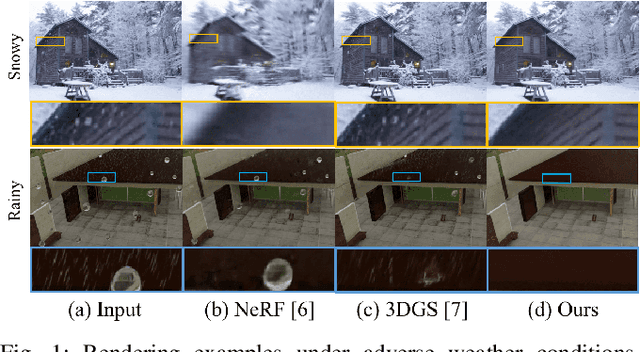

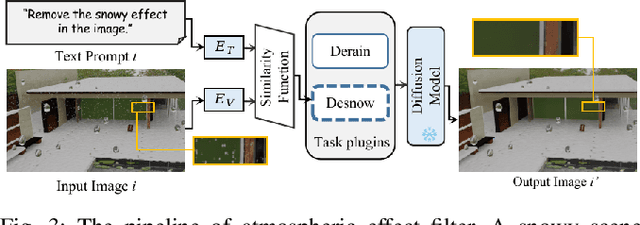
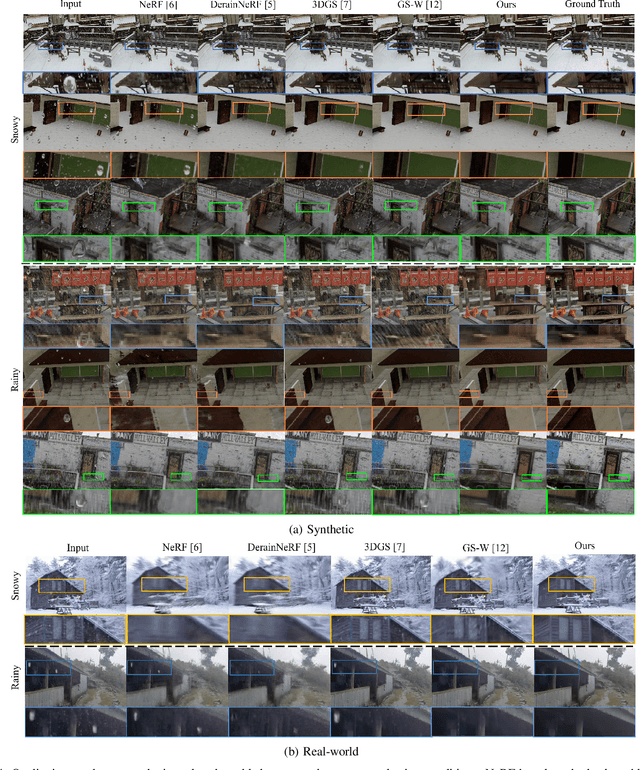
3D Gaussian Splatting (3DGS) has gained significant attention for 3D scene reconstruction, but still suffers from complex outdoor environments, especially under adverse weather. This is because 3DGS treats the artifacts caused by adverse weather as part of the scene and will directly reconstruct them, largely reducing the clarity of the reconstructed scene. To address this challenge, we propose WeatherGS, a 3DGS-based framework for reconstructing clear scenes from multi-view images under different weather conditions. Specifically, we explicitly categorize the multi-weather artifacts into the dense particles and lens occlusions that have very different characters, in which the former are caused by snowflakes and raindrops in the air, and the latter are raised by the precipitation on the camera lens. In light of this, we propose a dense-to-sparse preprocess strategy, which sequentially removes the dense particles by an Atmospheric Effect Filter (AEF) and then extracts the relatively sparse occlusion masks with a Lens Effect Detector (LED). Finally, we train a set of 3D Gaussians by the processed images and generated masks for excluding occluded areas, and accurately recover the underlying clear scene by Gaussian splatting. We conduct a diverse and challenging benchmark to facilitate the evaluation of 3D reconstruction under complex weather scenarios. Extensive experiments on this benchmark demonstrate that our WeatherGS consistently produces high-quality, clean scenes across various weather scenarios, outperforming existing state-of-the-art methods. See project page:https://jumponthemoon.github.io/weather-gs.
Diffusion Models Meet Network Management: Improving Traffic Matrix Analysis with Diffusion-based Approach
Nov 29, 2024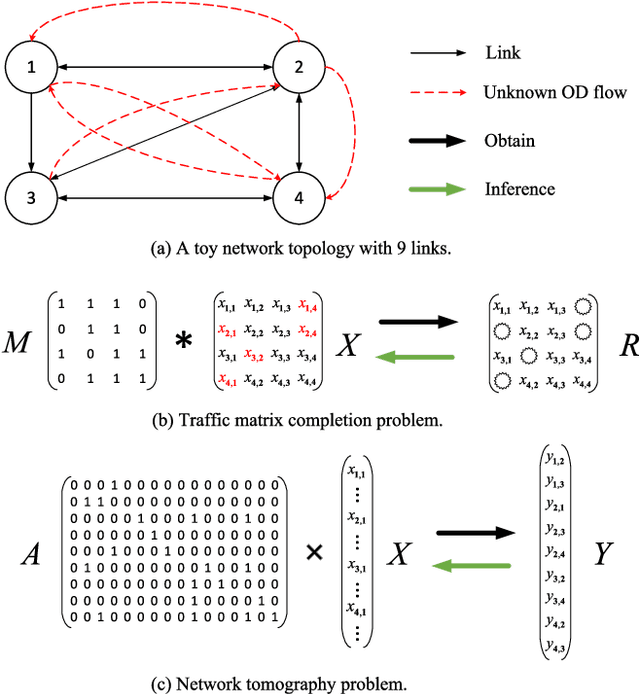
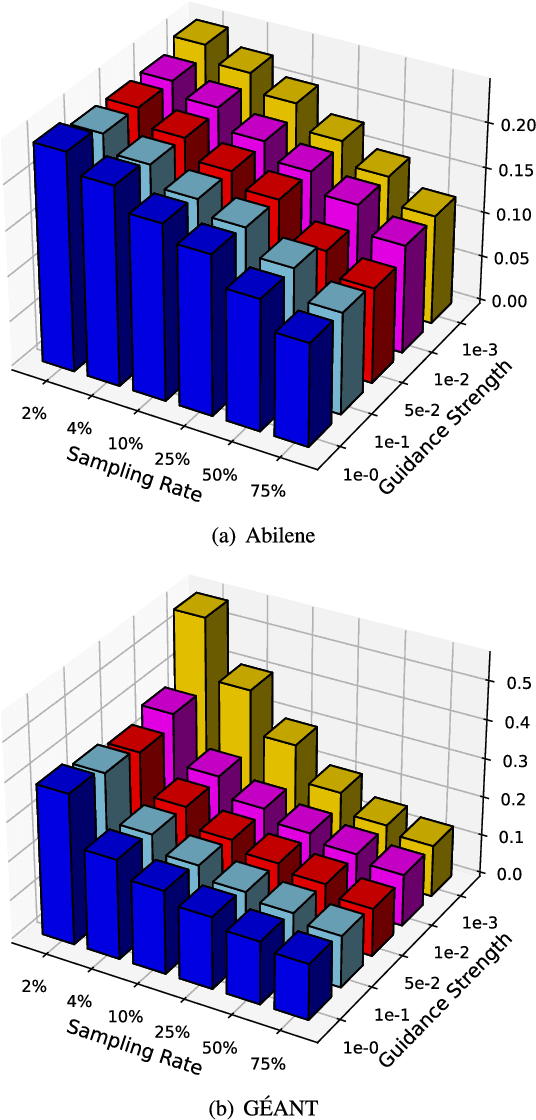
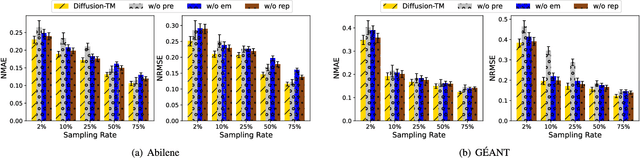
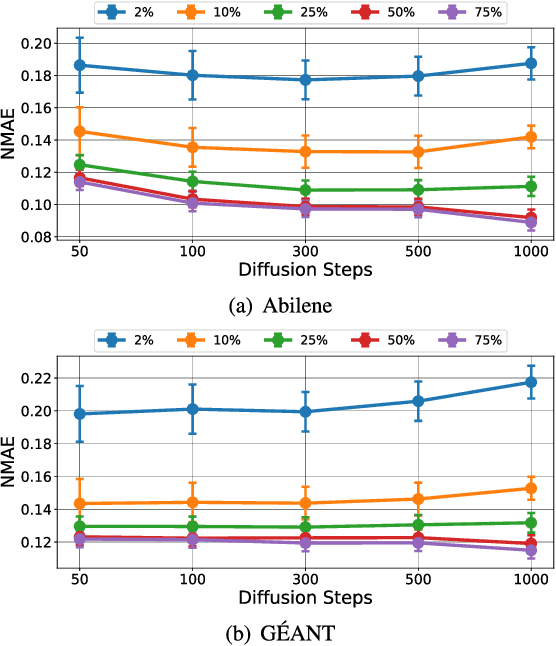
Due to network operation and maintenance relying heavily on network traffic monitoring, traffic matrix analysis has been one of the most crucial issues for network management related tasks. However, it is challenging to reliably obtain the precise measurement in computer networks because of the high measurement cost, and the unavoidable transmission loss. Although some methods proposed in recent years allowed estimating network traffic from partial flow-level or link-level measurements, they often perform poorly for traffic matrix estimation nowadays. Despite strong assumptions like low-rank structure and the prior distribution, existing techniques are usually task-specific and tend to be significantly worse as modern network communication is extremely complicated and dynamic. To address the dilemma, this paper proposed a diffusion-based traffic matrix analysis framework named Diffusion-TM, which leverages problem-agnostic diffusion to notably elevate the estimation performance in both traffic distribution and accuracy. The novel framework not only takes advantage of the powerful generative ability of diffusion models to produce realistic network traffic, but also leverages the denoising process to unbiasedly estimate all end-to-end traffic in a plug-and-play manner under theoretical guarantee. Moreover, taking into account that compiling an intact traffic dataset is usually infeasible, we also propose a two-stage training scheme to make our framework be insensitive to missing values in the dataset. With extensive experiments with real-world datasets, we illustrate the effectiveness of Diffusion-TM on several tasks. Moreover, the results also demonstrate that our method can obtain promising results even with $5\%$ known values left in the datasets.
Generative AI Enabled Matching for 6G Multiple Access
Oct 29, 2024In wireless networks, applying deep learning models to solve matching problems between different entities has become a mainstream and effective approach. However, the complex network topology in 6G multiple access presents significant challenges for the real-time performance and stability of matching generation. Generative artificial intelligence (GenAI) has demonstrated strong capabilities in graph feature extraction, exploration, and generation, offering potential for graph-structured matching generation. In this paper, we propose a GenAI-enabled matching generation framework to support 6G multiple access. Specifically, we first summarize the classical matching theory, discuss common GenAI models and applications from the perspective of matching generation. Then, we propose a framework based on generative diffusion models (GDMs) that iteratively denoises toward reward maximization to generate a matching strategy that meets specific requirements. Experimental results show that, compared to decision-based AI approaches, our framework can generate more effective matching strategies based on given conditions and predefined rewards, helping to solve complex problems in 6G multiple access, such as task allocation.
Prototypical Hash Encoding for On-the-Fly Fine-Grained Category Discovery
Oct 24, 2024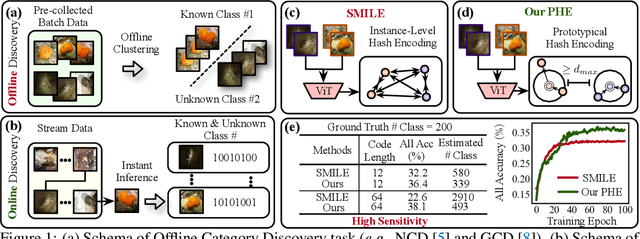

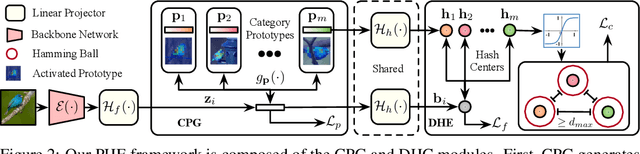
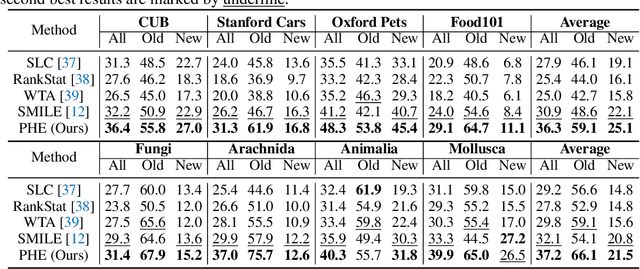
In this paper, we study a practical yet challenging task, On-the-fly Category Discovery (OCD), aiming to online discover the newly-coming stream data that belong to both known and unknown classes, by leveraging only known category knowledge contained in labeled data. Previous OCD methods employ the hash-based technique to represent old/new categories by hash codes for instance-wise inference. However, directly mapping features into low-dimensional hash space not only inevitably damages the ability to distinguish classes and but also causes "high sensitivity" issue, especially for fine-grained classes, leading to inferior performance. To address these issues, we propose a novel Prototypical Hash Encoding (PHE) framework consisting of Category-aware Prototype Generation (CPG) and Discriminative Category Encoding (DCE) to mitigate the sensitivity of hash code while preserving rich discriminative information contained in high-dimension feature space, in a two-stage projection fashion. CPG enables the model to fully capture the intra-category diversity by representing each category with multiple prototypes. DCE boosts the discrimination ability of hash code with the guidance of the generated category prototypes and the constraint of minimum separation distance. By jointly optimizing CPG and DCE, we demonstrate that these two components are mutually beneficial towards an effective OCD. Extensive experiments show the significant superiority of our PHE over previous methods, e.g., obtaining an improvement of +5.3% in ALL ACC averaged on all datasets. Moreover, due to the nature of the interpretable prototypes, we visually analyze the underlying mechanism of how PHE helps group certain samples into either known or unknown categories. Code is available at https://github.com/HaiyangZheng/PHE.