 Add to Chrome
 Add to Firefox
 Add to Edge
MDGMIX: Boundary-Aware Subgraph Mixing for Multi-Domain Graph Pre-Training
May 25, 2026
Multi-domain graph pre-training is a crucial step in constructing foundational graph models with cross-domain generalization capabilities. However, existing methods predominantly rely on jointly training all source domain graphs, resulting in high computational costs. Furthermore, it remains unclear whether all source domain graph data contribute equally to effective transfer. This paper empirically reveals significant data redundancy in multi-domain graph pre-training. Based on this finding, we propose the Multi-domain Graph Pre-training Framework, MDGMIX, which combines boundary-aware subgraph mixing with hierarchical discrimination. By selecting boundary nodes to construct challenging mixed-domain subgraphs, MDGMIX employs coarse-grained domain discrimination and fine-grained domain decomposition losses to decouple shared patterns from domain-specific patterns. During adaptation, MDGMIX employs a lightweight prompt weighting mechanism to transfer source domain knowledge. Extensive experiments demonstrate that MDGMIX consistently outperforms strong baselines in few-shot classification tasks while exhibiting superior time and memory efficiency. The code is available at: https://github.com/zhengziyu77/MDGMIX.

A Survey of Legged Robotics in Non-Inertial Environments: Past, Present, and Future
Apr 22, 2026Legged robots have demonstrated remarkable agility on rigid, stationary ground, but their locomotion reliability remains limited in non-inertial environments, where the supporting ground moves, tilts, or accelerates. Such conditions arise in ground transportation, maritime platforms, and aerospace settings, and they introduce persistent time-varying disturbances that break the stationary-ground assumptions underlying conventional legged locomotion. This survey reviews the state of the art in modeling, state estimation, and control for legged robots in non-inertial environments. We summarize representative application domains and motion characteristics, analyze the root causes of locomotion performance degradation, and review existing methods together with their key assumptions and limitations. We further identify open problems in robot-environment coupling, observability, robustness, and experimental validation, and discuss future directions in autonomy, system-level design, bio-inspired strategies, safety, and testing. The survey aims to clarify the technical foundations of this emerging area and support the development of reliable legged robots for real-world dynamic environments.
Bipedal-Walking-Dynamics Model on Granular Terrains
Apr 13, 2026Bipeds have demonstrated high agility and mobility in unstructured environments such as sand. The yielding of such granular media brings significant sinkage and slip of the bipedal feet, leading to uncertainty and instability of walking locomotion. We present a new dynamics-modeling approach to capture and predict bipedal-walking locomotion on granular media. A dynamic foot-terrain interaction model is integrated to compute the ground reaction force (GRF). The proposed granular dynamic model has three additional degree-of-freedom (DoF) to estimate foot sinkage and slip that are critical to capturing robot-walking kinematics and kinetics such as cost of transport (CoT). Using the new model, we analyze bipedal kinetics, CoT, and foot-terrain rolling and intrusion affects. Experiments are conducted using a biped robotic walker on sand to validate the proposed dynamic model with robot-gait profiles, media-intrusion prediction, and GRF estimations. This new dynamics model can further serve as an enabling tool for locomotion control and optimization of bipedal robots to efficiently walk on granular terrains.
A Foot Resistive Force Model for Legged Locomotion on Muddy Terrains
Apr 13, 2026Legged robots face significant challenges in moving and navigating on deformable and highly yielding terrain such as mud. We present a resistive force model for legged foot-mud interactions. The model captures rheological behaviors such as visco-elasticity, thixotropy of the mud suspension and retractive suction. One attractive property of this new model lies in its effective, uniform formulation to provide underlying physical interpretation and accurate resistive force predictions. We further take advantage of the resistive force model to design a new morphing robotic foot for effective and efficient legged locomotion. We conduct extensive experiments to validate the force model, and the results demonstrate that the morphing foot enhances not only the locomotion mobility but also energy-efficiency of walking in mud. The new resistive force model can be further used to develop data-driven simulation and locomotion control of legged robots on muddy terrains.
BREATH-VL: Vision-Language-Guided 6-DoF Bronchoscopy Localization via Semantic-Geometric Fusion
Jan 07, 2026Vision-language models (VLMs) have recently shown remarkable performance in navigation and localization tasks by leveraging large-scale pretraining for semantic understanding. However, applying VLMs to 6-DoF endoscopic camera localization presents several challenges: 1) the lack of large-scale, high-quality, densely annotated, and localization-oriented vision-language datasets in real-world medical settings; 2) limited capability for fine-grained pose regression; and 3) high computational latency when extracting temporal features from past frames. To address these issues, we first construct BREATH dataset, the largest in-vivo endoscopic localization dataset to date, collected in the complex human airway. Building on this dataset, we propose BREATH-VL, a hybrid framework that integrates semantic cues from VLMs with geometric information from vision-based registration methods for accurate 6-DoF pose estimation. Our motivation lies in the complementary strengths of both approaches: VLMs offer generalizable semantic understanding, while registration methods provide precise geometric alignment. To further enhance the VLM's ability to capture temporal context, we introduce a lightweight context-learning mechanism that encodes motion history as linguistic prompts, enabling efficient temporal reasoning without expensive video-level computation. Extensive experiments demonstrate that the vision-language module delivers robust semantic localization in challenging surgical scenes. Building on this, our BREATH-VL outperforms state-of-the-art vision-only localization methods in both accuracy and generalization, reducing translational error by 25.5% compared with the best-performing baseline, while achieving competitive computational latency.
Beyond Single-Granularity Prompts: A Multi-Scale Chain-of-Thought Prompt Learning for Graph
Oct 10, 2025The "pre-train, prompt'' paradigm, designed to bridge the gap between pre-training tasks and downstream objectives, has been extended from the NLP domain to the graph domain and has achieved remarkable progress. Current mainstream graph prompt-tuning methods modify input or output features using learnable prompt vectors. However, existing approaches are confined to single-granularity (e.g., node-level or subgraph-level) during prompt generation, overlooking the inherently multi-scale structural information in graph data, which limits the diversity of prompt semantics. To address this issue, we pioneer the integration of multi-scale information into graph prompt and propose a Multi-Scale Graph Chain-of-Thought (MSGCOT) prompting framework. Specifically, we design a lightweight, low-rank coarsening network to efficiently capture multi-scale structural features as hierarchical basis vectors for prompt generation. Subsequently, mimicking human cognition from coarse-to-fine granularity, we dynamically integrate multi-scale information at each reasoning step, forming a progressive coarse-to-fine prompt chain. Extensive experiments on eight benchmark datasets demonstrate that MSGCOT outperforms the state-of-the-art single-granularity graph prompt-tuning method, particularly in few-shot scenarios, showcasing superior performance.
EndoMatcher: Generalizable Endoscopic Image Matcher via Multi-Domain Pre-training for Robot-Assisted Surgery
Aug 07, 2025Generalizable dense feature matching in endoscopic images is crucial for robot-assisted tasks, including 3D reconstruction, navigation, and surgical scene understanding. Yet, it remains a challenge due to difficult visual conditions (e.g., weak textures, large viewpoint variations) and a scarcity of annotated data. To address these challenges, we propose EndoMatcher, a generalizable endoscopic image matcher via large-scale, multi-domain data pre-training. To address difficult visual conditions, EndoMatcher employs a two-branch Vision Transformer to extract multi-scale features, enhanced by dual interaction blocks for robust correspondence learning. To overcome data scarcity and improve domain diversity, we construct Endo-Mix6, the first multi-domain dataset for endoscopic matching. Endo-Mix6 consists of approximately 1.2M real and synthetic image pairs across six domains, with correspondence labels generated using Structure-from-Motion and simulated transformations. The diversity and scale of Endo-Mix6 introduce new challenges in training stability due to significant variations in dataset sizes, distribution shifts, and error imbalance. To address them, a progressive multi-objective training strategy is employed to promote balanced learning and improve representation quality across domains. This enables EndoMatcher to generalize across unseen organs and imaging conditions in a zero-shot fashion. Extensive zero-shot matching experiments demonstrate that EndoMatcher increases the number of inlier matches by 140.69% and 201.43% on the Hamlyn and Bladder datasets over state-of-the-art methods, respectively, and improves the Matching Direction Prediction Accuracy (MDPA) by 9.40% on the Gastro-Matching dataset, achieving dense and accurate matching under challenging endoscopic conditions. The code is publicly available at https://github.com/Beryl2000/EndoMatcher.
Harnessing Foundation Models for Robust and Generalizable 6-DOF Bronchoscopy Localization
May 30, 2025Vision-based 6-DOF bronchoscopy localization offers a promising solution for accurate and cost-effective interventional guidance. However, existing methods struggle with 1) limited generalization across patient cases due to scarce labeled data, and 2) poor robustness under visual degradation, as bronchoscopy procedures frequently involve artifacts such as occlusions and motion blur that impair visual information. To address these challenges, we propose PANSv2, a generalizable and robust bronchoscopy localization framework. Motivated by PANS that leverages multiple visual cues for pose likelihood measurement, PANSv2 integrates depth estimation, landmark detection, and centerline constraints into a unified pose optimization framework that evaluates pose probability and solves for the optimal bronchoscope pose. To further enhance generalization capabilities, we leverage the endoscopic foundation model EndoOmni for depth estimation and the video foundation model EndoMamba for landmark detection, incorporating both spatial and temporal analyses. Pretrained on diverse endoscopic datasets, these models provide stable and transferable visual representations, enabling reliable performance across varied bronchoscopy scenarios. Additionally, to improve robustness to visual degradation, we introduce an automatic re-initialization module that detects tracking failures and re-establishes pose using landmark detections once clear views are available. Experimental results on bronchoscopy dataset encompassing 10 patient cases show that PANSv2 achieves the highest tracking success rate, with an 18.1% improvement in SR-5 (percentage of absolute trajectory error under 5 mm) compared to existing methods, showing potential towards real clinical usage.
EndoMamba: An Efficient Foundation Model for Endoscopic Videos
Feb 26, 2025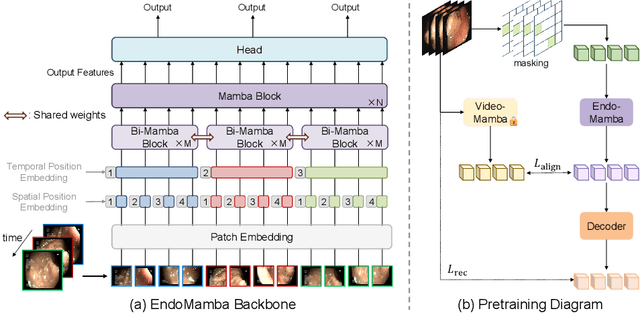
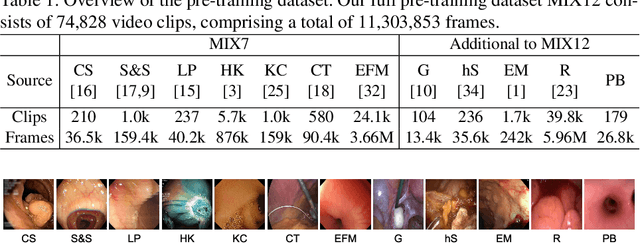
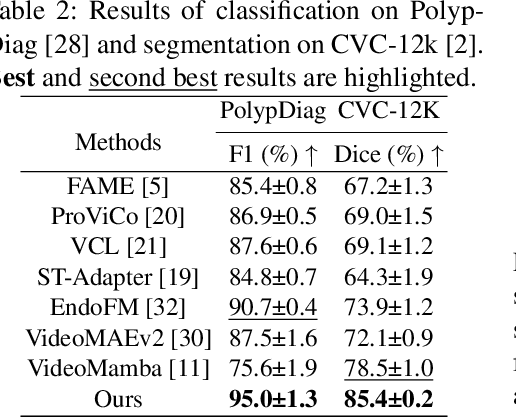
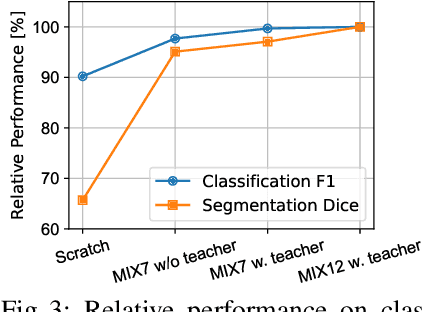
Endoscopic video-based tasks, such as visual navigation and surgical phase recognition, play a crucial role in minimally invasive surgeries by providing real-time assistance. While recent video foundation models have shown promise, their applications are hindered by (1) computational inefficiencies and (2) suboptimal performance caused by limited data for pre-training in endoscopy. To address these issues, we present EndoMamba, a foundation model designed for real-time inference while learning generalized spatiotemporal representations. First, to mitigate computational inefficiencies, we propose the EndoMamba backbone, optimized for real-time inference. Inspired by recent advancements in state space models, EndoMamba integrates Bidirectional Mamba blocks for spatial modeling within individual frames and vanilla Mamba blocks for past-to-present reasoning across the temporal domain. This design enables both strong spatiotemporal modeling and efficient inference in online video streams. Second, we propose a self-supervised hierarchical pre-training diagram to enhance EndoMamba's representation learning using endoscopic videos and incorporating general video domain knowledge. Specifically, our approach combines masked reconstruction with auxiliary supervision, leveraging low-level reconstruction to capture spatial-temporal structures and high-level alignment to transfer broader knowledge from a pretrained general-video domain foundation model. Extensive experiments on four downstream tasks--classification, segmentation, surgical phase recognition, and localization--demonstrate that EndoMamba outperforms existing foundation models and task-specific methods while maintaining real-time inference speed. The source code will be released upon acceptance.
Enhancing Bronchoscopy Depth Estimation through Synthetic-to-Real Domain Adaptation
Nov 07, 2024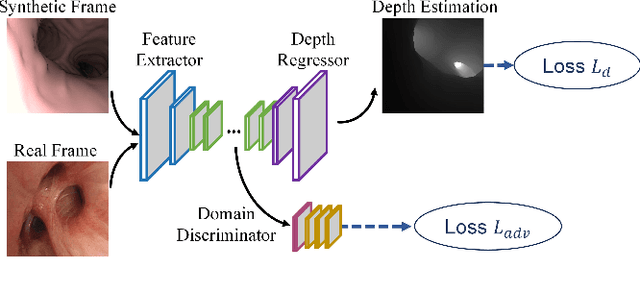
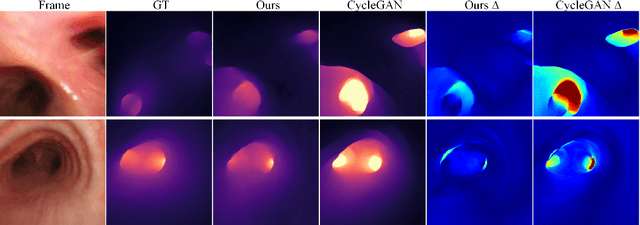
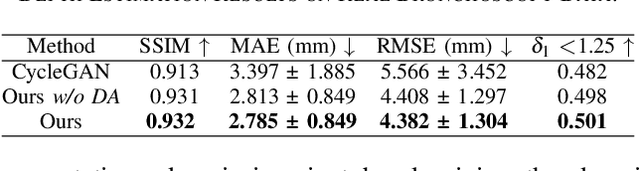
Monocular depth estimation has shown promise in general imaging tasks, aiding in localization and 3D reconstruction. While effective in various domains, its application to bronchoscopic images is hindered by the lack of labeled data, challenging the use of supervised learning methods. In this work, we propose a transfer learning framework that leverages synthetic data with depth labels for training and adapts domain knowledge for accurate depth estimation in real bronchoscope data. Our network demonstrates improved depth prediction on real footage using domain adaptation compared to training solely on synthetic data, validating our approach.