 Add to Chrome
 Add to Firefox
 Add to Edge
On the Design Space of Discrete Diffusion Online Adaptation for Molecular Optimization
Jul 03, 2026
Molecular optimization often starts from a pretrained generative model that captures a broad prior over valid molecular structures. At test time, however, the goal is not to sample from this prior, but to use a limited oracle budget to shift generation toward task-specific high-reward molecules. We study this adaptation problem for discrete diffusion models. Each online round couples several choices. The loop must decide which candidates to evaluate, how rewards become model updates, which feedback to reuse, and how far to move beyond the pretrained prior. These choices have mostly been studied in isolation, leaving open whether they complement one another, become redundant, or interfere inside a full online adaptation loop. We conduct controlled studies across six small-molecule binding-affinity tasks and three protein-fitness tasks. We find that acquisition, reward shaping, and model debiasing provide complementary routes to higher reward, especially for small molecules. Replay further stabilizes learning, while validity penalties keep small-molecule exploration on the valid molecular manifold. Together, these findings point to a practical recipe for feedback-efficient molecular optimization: online fine-tuning with acquisition, reward shaping, debiasing, replay, and validity control. This recipe outperforms offline fine-tuning and inference-time search baselines under matched oracle-call budgets and GPU-hour accounting. The gains are largest when high-reward candidates require larger shifts from the pretrained prior.

How Large Language Models Balance Internal Knowledge with User and Document Assertions
Apr 24, 2026Large language models (LLMs) often need to balance their internal parametric knowledge with external information, such as user beliefs and content from retrieved documents, in real-world scenarios like RAG or chat-based systems. A model's ability to reliably process these sources is key to system safety. Previous studies on knowledge conflict and sycophancy are limited to a binary conflict paradigm, primarily exploring conflicts between parametric knowledge and either a document or a user, but ignoring the interactive environment where all three sources exist simultaneously. To fill this gap, we propose a three-source interaction framework and systematically evaluate 27 LLMs from 3 families on 2 datasets. Our findings reveal general patterns: most models rely more on document assertions than user assertions, and this preference is reinforced by post-training. Furthermore, our behavioral analysis shows that most models are impressionable, unable to effectively discriminate between helpful and harmful external information. To address this, we demonstrate that fine-tuning on diverse source interaction data can significantly increase a model's discrimination abilities. In short, our work paves the way for developing trustworthy LLMs that can effectively and reliably integrate multiple sources of information. Code is available at https://github.com/shuowl/llm-source-balancing.
Steering Generative Models with Experimental Data for Protein Fitness Optimization
May 21, 2025Protein fitness optimization involves finding a protein sequence that maximizes desired quantitative properties in a combinatorially large design space of possible sequences. Recent developments in steering protein generative models (e.g diffusion models, language models) offer a promising approach. However, by and large, past studies have optimized surrogate rewards and/or utilized large amounts of labeled data for steering, making it unclear how well existing methods perform and compare to each other in real-world optimization campaigns where fitness is measured by low-throughput wet-lab assays. In this study, we explore fitness optimization using small amounts (hundreds) of labeled sequence-fitness pairs and comprehensively evaluate strategies such as classifier guidance and posterior sampling for guiding generation from different discrete diffusion models of protein sequences. We also demonstrate how guidance can be integrated into adaptive sequence selection akin to Thompson sampling in Bayesian optimization, showing that plug-and-play guidance strategies offer advantages compared to alternatives such as reinforcement learning with protein language models.
InverseBench: Benchmarking Plug-and-Play Diffusion Priors for Inverse Problems in Physical Sciences
Mar 14, 2025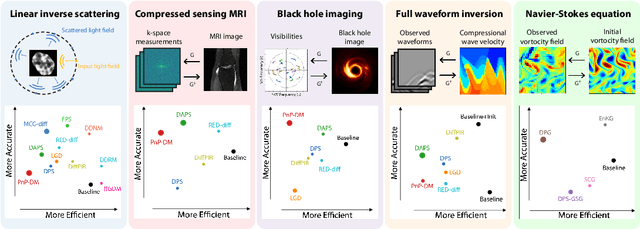
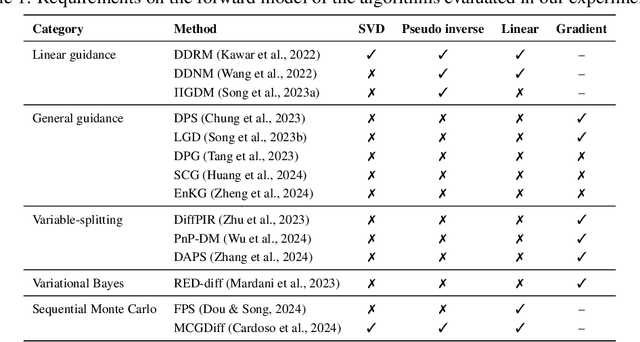
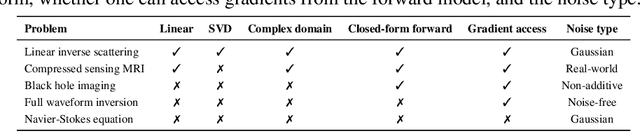
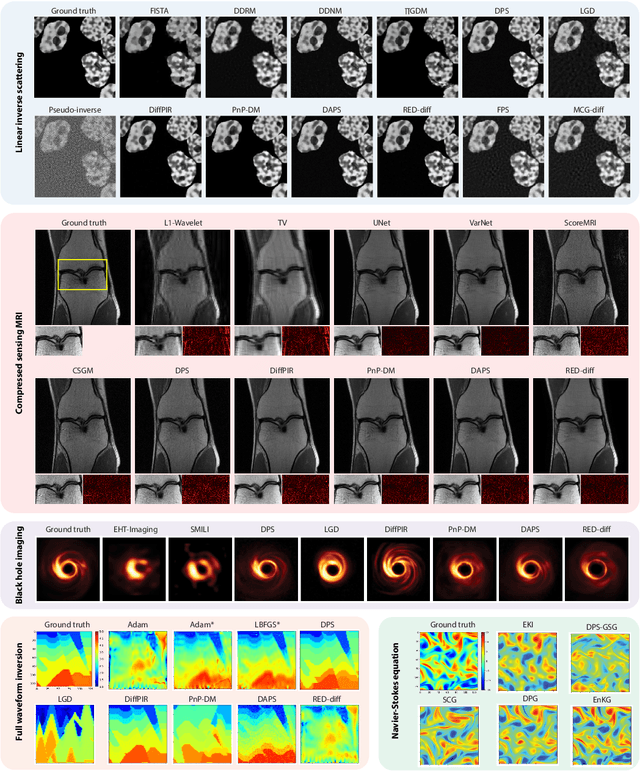
Plug-and-play diffusion priors (PnPDP) have emerged as a promising research direction for solving inverse problems. However, current studies primarily focus on natural image restoration, leaving the performance of these algorithms in scientific inverse problems largely unexplored. To address this gap, we introduce \textsc{InverseBench}, a framework that evaluates diffusion models across five distinct scientific inverse problems. These problems present unique structural challenges that differ from existing benchmarks, arising from critical scientific applications such as optical tomography, medical imaging, black hole imaging, seismology, and fluid dynamics. With \textsc{InverseBench}, we benchmark 14 inverse problem algorithms that use plug-and-play diffusion priors against strong, domain-specific baselines, offering valuable new insights into the strengths and weaknesses of existing algorithms. To facilitate further research and development, we open-source the codebase, along with datasets and pre-trained models, at https://devzhk.github.io/InverseBench/.
Split Gibbs Discrete Diffusion Posterior Sampling
Mar 03, 2025We study the problem of posterior sampling in discrete-state spaces using discrete diffusion models. While posterior sampling methods for continuous diffusion models have achieved remarkable progress, analogous methods for discrete diffusion models remain challenging. In this work, we introduce a principled plug-and-play discrete diffusion posterior sampling algorithm based on split Gibbs sampling, which we call SG-DPS. Our algorithm enables reward-guided generation and solving inverse problems in discrete-state spaces. We demonstrate that SG-DPS converges to the true posterior distribution on synthetic benchmarks, and enjoys state-of-the-art posterior sampling performance on a range of benchmarks for discrete data, achieving up to 2x improved performance compared to existing baselines.
Ensemble Kalman Diffusion Guidance: A Derivative-free Method for Inverse Problems
Sep 30, 2024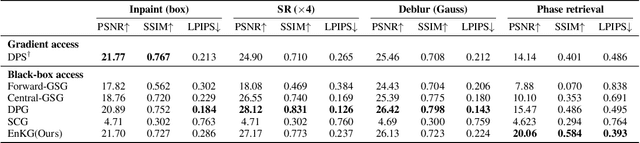
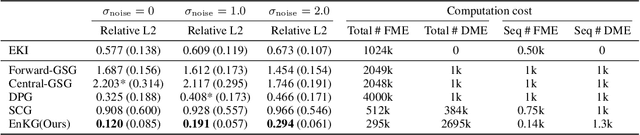
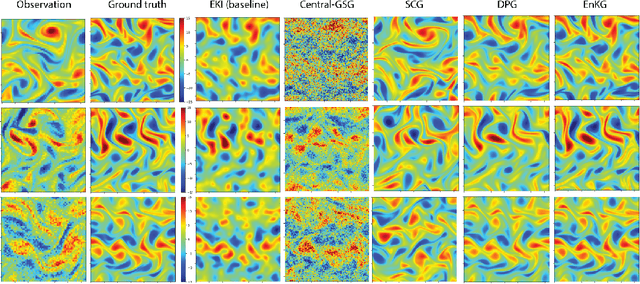
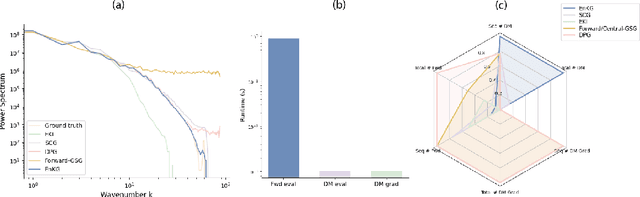
When solving inverse problems, it is increasingly popular to use pre-trained diffusion models as plug-and-play priors. This framework can accommodate different forward models without re-training while preserving the generative capability of diffusion models. Despite their success in many imaging inverse problems, most existing methods rely on privileged information such as derivative, pseudo-inverse, or full knowledge about the forward model. This reliance poses a substantial limitation that restricts their use in a wide range of problems where such information is unavailable, such as in many scientific applications. To address this issue, we propose Ensemble Kalman Diffusion Guidance (EnKG) for diffusion models, a derivative-free approach that can solve inverse problems by only accessing forward model evaluations and a pre-trained diffusion model prior. We study the empirical effectiveness of our method across various inverse problems, including scientific settings such as inferring fluid flows and astronomical objects, which are highly non-linear inverse problems that often only permit black-box access to the forward model.
Improving Diffusion Inverse Problem Solving with Decoupled Noise Annealing
Jul 01, 2024Diffusion models have recently achieved success in solving Bayesian inverse problems with learned data priors. Current methods build on top of the diffusion sampling process, where each denoising step makes small modifications to samples from the previous step. However, this process struggles to correct errors from earlier sampling steps, leading to worse performance in complicated nonlinear inverse problems, such as phase retrieval. To address this challenge, we propose a new method called Decoupled Annealing Posterior Sampling (DAPS) that relies on a novel noise annealing process. Specifically, we decouple consecutive steps in a diffusion sampling trajectory, allowing them to vary considerably from one another while ensuring their time-marginals anneal to the true posterior as we reduce noise levels. This approach enables the exploration of a larger solution space, improving the success rate for accurate reconstructions. We demonstrate that DAPS significantly improves sample quality and stability across multiple image restoration tasks, particularly in complicated nonlinear inverse problems. For example, we achieve a PSNR of 30.72dB on the FFHQ 256 dataset for phase retrieval, which is an improvement of 9.12dB compared to existing methods.
COMMIT: Certifying Robustness of Multi-Sensor Fusion Systems against Semantic Attacks
Mar 04, 2024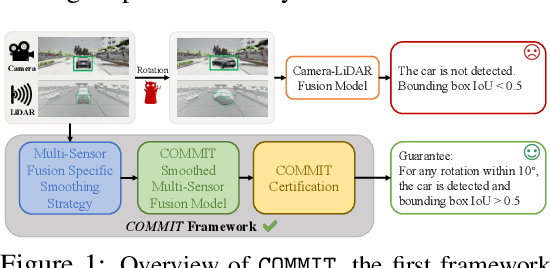
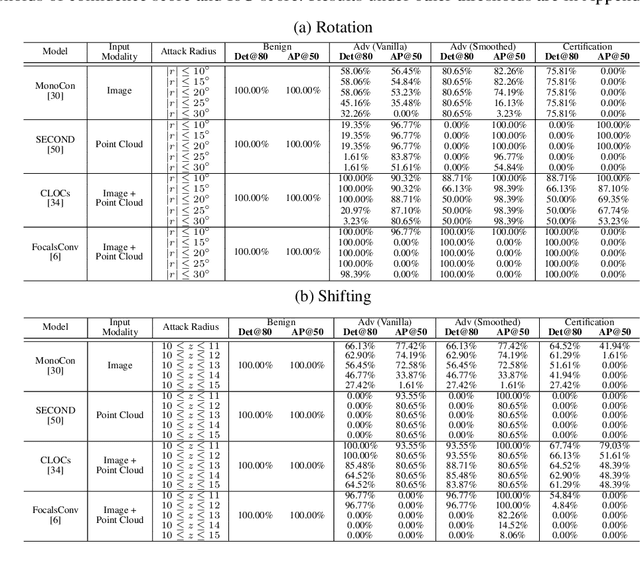
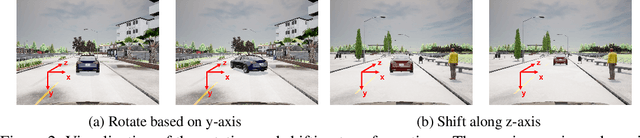
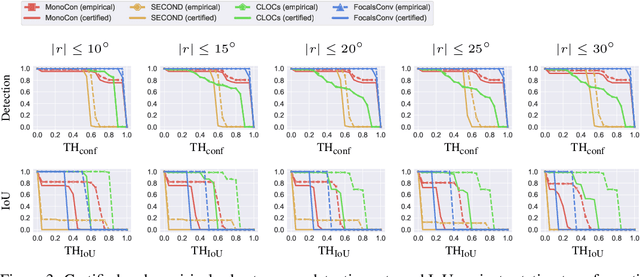
Multi-sensor fusion systems (MSFs) play a vital role as the perception module in modern autonomous vehicles (AVs). Therefore, ensuring their robustness against common and realistic adversarial semantic transformations, such as rotation and shifting in the physical world, is crucial for the safety of AVs. While empirical evidence suggests that MSFs exhibit improved robustness compared to single-modal models, they are still vulnerable to adversarial semantic transformations. Despite the proposal of empirical defenses, several works show that these defenses can be attacked again by new adaptive attacks. So far, there is no certified defense proposed for MSFs. In this work, we propose the first robustness certification framework COMMIT certify robustness of multi-sensor fusion systems against semantic attacks. In particular, we propose a practical anisotropic noise mechanism that leverages randomized smoothing with multi-modal data and performs a grid-based splitting method to characterize complex semantic transformations. We also propose efficient algorithms to compute the certification in terms of object detection accuracy and IoU for large-scale MSF models. Empirically, we evaluate the efficacy of COMMIT in different settings and provide a comprehensive benchmark of certified robustness for different MSF models using the CARLA simulation platform. We show that the certification for MSF models is at most 48.39% higher than that of single-modal models, which validates the advantages of MSF models. We believe our certification framework and benchmark will contribute an important step towards certifiably robust AVs in practice.
Physically Realizable Natural-Looking Clothing Textures Evade Person Detectors via 3D Modeling
Jul 04, 2023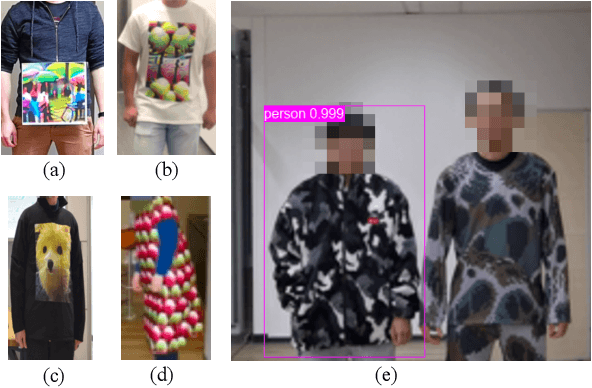
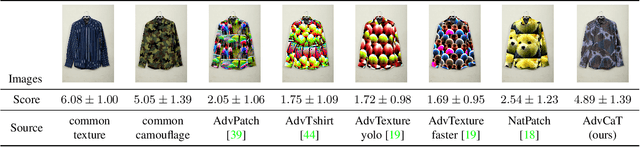
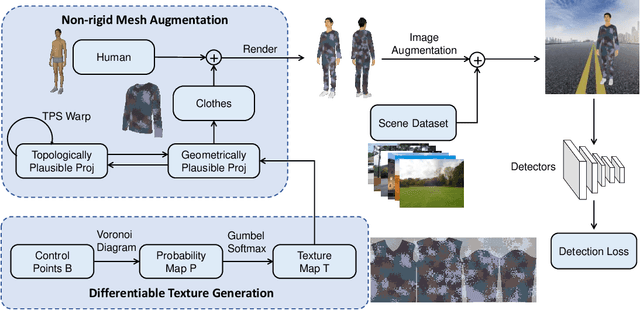
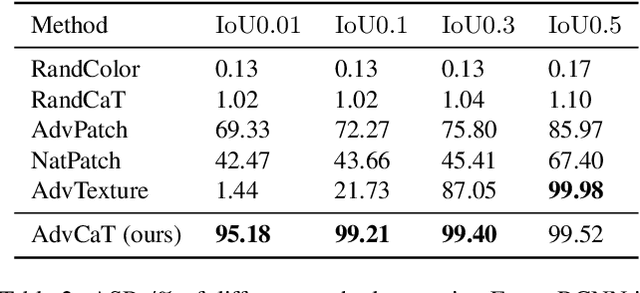
Recent works have proposed to craft adversarial clothes for evading person detectors, while they are either only effective at limited viewing angles or very conspicuous to humans. We aim to craft adversarial texture for clothes based on 3D modeling, an idea that has been used to craft rigid adversarial objects such as a 3D-printed turtle. Unlike rigid objects, humans and clothes are non-rigid, leading to difficulties in physical realization. In order to craft natural-looking adversarial clothes that can evade person detectors at multiple viewing angles, we propose adversarial camouflage textures (AdvCaT) that resemble one kind of the typical textures of daily clothes, camouflage textures. We leverage the Voronoi diagram and Gumbel-softmax trick to parameterize the camouflage textures and optimize the parameters via 3D modeling. Moreover, we propose an efficient augmentation pipeline on 3D meshes combining topologically plausible projection (TopoProj) and Thin Plate Spline (TPS) to narrow the gap between digital and real-world objects. We printed the developed 3D texture pieces on fabric materials and tailored them into T-shirts and trousers. Experiments show high attack success rates of these clothes against multiple detectors.
PerAda: Parameter-Efficient and Generalizable Federated Learning Personalization with Guarantees
Feb 13, 2023
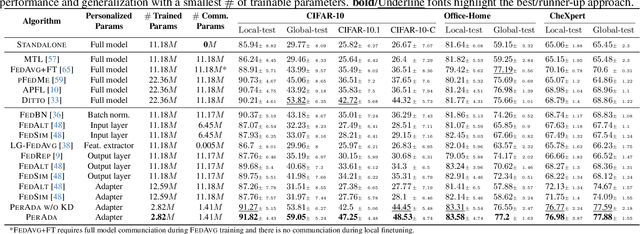
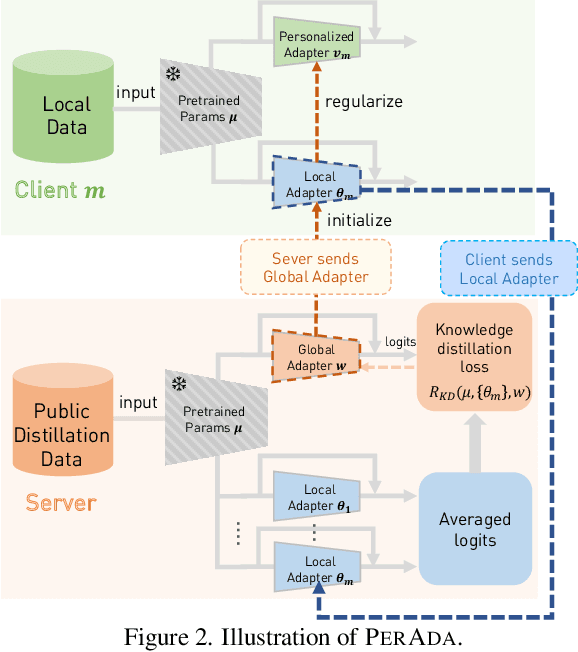
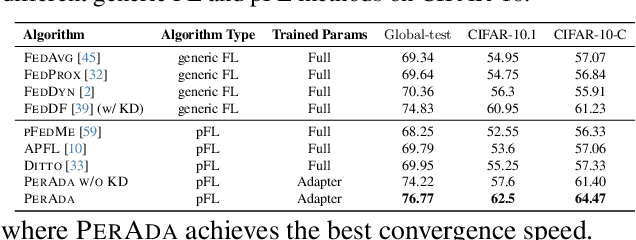
Personalized Federated Learning (pFL) has emerged as a promising solution to tackle data heterogeneity across clients in FL. However, existing pFL methods either (1) introduce high communication and computation costs or (2) overfit to local data, which can be limited in scope, and are vulnerable to evolved test samples with natural shifts. In this paper, we propose PerAda, a parameter-efficient pFL framework that reduces communication and computational costs and exhibits superior generalization performance, especially under test-time distribution shifts. PerAda reduces the costs by leveraging the power of pretrained models and only updates and communicates a small number of additional parameters from adapters. PerAda has good generalization since it regularizes each client's personalized adapter with a global adapter, while the global adapter uses knowledge distillation to aggregate generalized information from all clients. Theoretically, we provide generalization bounds to explain why PerAda improves generalization, and we prove its convergence to stationary points under non-convex settings. Empirically, PerAda demonstrates competitive personalized performance (+4.85% on CheXpert) and enables better out-of-distribution generalization (+5.23% on CIFAR-10-C) on different datasets across natural and medical domains compared with baselines, while only updating 12.6% of parameters per model based on the adapter.