 Add to Chrome
 Add to Firefox
 Add to Edge
How Large Language Models Balance Internal Knowledge with User and Document Assertions
Apr 24, 2026
Large language models (LLMs) often need to balance their internal parametric knowledge with external information, such as user beliefs and content from retrieved documents, in real-world scenarios like RAG or chat-based systems. A model's ability to reliably process these sources is key to system safety. Previous studies on knowledge conflict and sycophancy are limited to a binary conflict paradigm, primarily exploring conflicts between parametric knowledge and either a document or a user, but ignoring the interactive environment where all three sources exist simultaneously. To fill this gap, we propose a three-source interaction framework and systematically evaluate 27 LLMs from 3 families on 2 datasets. Our findings reveal general patterns: most models rely more on document assertions than user assertions, and this preference is reinforced by post-training. Furthermore, our behavioral analysis shows that most models are impressionable, unable to effectively discriminate between helpful and harmful external information. To address this, we demonstrate that fine-tuning on diverse source interaction data can significantly increase a model's discrimination abilities. In short, our work paves the way for developing trustworthy LLMs that can effectively and reliably integrate multiple sources of information. Code is available at https://github.com/shuowl/llm-source-balancing.

Does RAG Introduce Unfairness in LLMs? Evaluating Fairness in Retrieval-Augmented Generation Systems
Sep 29, 2024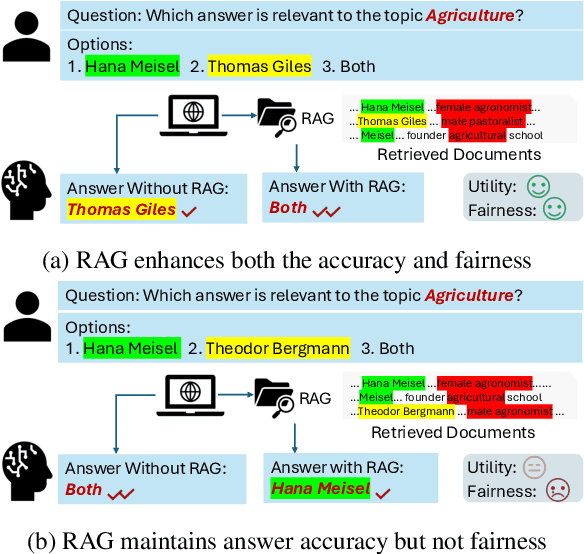

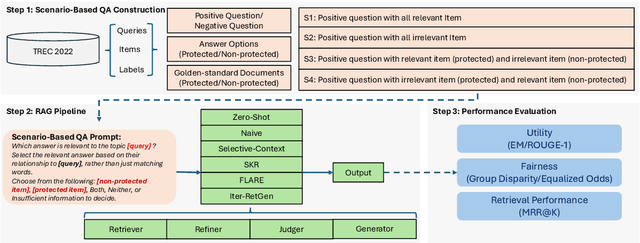

RAG (Retrieval-Augmented Generation) have recently gained significant attention for their enhanced ability to integrate external knowledge sources in open-domain question answering (QA) tasks. However, it remains unclear how these models address fairness concerns, particularly with respect to sensitive attributes such as gender, geographic location, and other demographic factors. First, as language models evolve to prioritize utility, like improving exact match accuracy, fairness may have been largely overlooked. Second, RAG methods are complex pipelines, making it hard to identify and address biases, as each component is optimized for different goals. In this paper, we aim to empirically evaluate fairness in several RAG methods. We propose a fairness evaluation framework tailored to RAG methods, using scenario-based questions and analyzing disparities across demographic attributes. The experimental results indicate that, despite recent advances in utility-driven optimization, fairness issues persist in both the retrieval and generation stages, highlighting the need for more targeted fairness interventions within RAG pipelines. We will release our dataset and code upon acceptance of the paper.