 Add to Chrome
 Add to Firefox
 Add to Edge
Twin Agent: Context Residual Compression for Privilege Separated Agents
Jul 21, 2026
Large language model (LLM) agents are vulnerable to security risks, such as prompt injection attacks from untrusted context that manipulate downstream reasoning and tool use. Existing secure-by-design approaches mitigate this risk by separating untrusted observations from privileged execution and careful control of information flow, but often degrade utility and require extensive task-specific engineering. We thus propose Twin Agent, a general privilege separation design pattern inspired by residual coding in the agent context. Twin Agent consists of two nearly symmetric agents: an Explore Agent that inspects untrusted information and a Safe Agent that executes privileged actions. The Explore Agent is conditioned on the Safe Agent's current context and communicates only compact hints to the Safe Agent about the next action to take. This design reduces the information needed to preserve task utility and thus achieves a better security--utility tradeoff, which we empirically verify by measuring how utility and attack success change as the length of hints varies. We evaluate Twin Agent on long-horizon software engineering tasks with SWE-bench Lite and on heterogeneous multi-tool interaction tasks with AgentDojo and DecodingTrust-Agent. Across both benchmarks, Twin Agent preserves high task utility while preventing prompt injection attacks, outperforming both undefended agents and privilege separation baselines.

Test-time Adversarial Takeover: A Real-time Hijacking Interface against Robotic Diffusion Policies
Jun 09, 2026Diffusion-based action generation has become a foundational component of embodied AI, but its reliance on visual conditioning leaves deployed visuomotor policies vulnerable to adversarial manipulation. Most prior attacks focus on disruption: they perturb the observation stream to reduce task success or induce erratic behavior. We study a stronger threat, Test-time Adversarial Takeover (TAKO), in which an attacker obtains a real-time steering interface over a frozen robot policy and turns it into a remotely piloted instrument. TAKO learns a small vocabulary of reusable universal patches through differentiable diffusion inference; at test time, the attacker switches among these patches in the camera stream to compose attacker-chosen trajectories. This works because the perturbation acts on the visual conditioning pathway, where the induced bias can persist through iterative generative inference. We further show that the natural targeted baseline, target-policy matching, fails because the victim policy cannot reliably supervise itself on out-of-distribution target shifts. Across four tasks (2D manipulation, simulated aerial delivery, simulated ground navigation, and physical-world ground navigation), two visual encoders (ResNet-18 and EfficientNet-B0 + Transformer), and three generative inference families (DDPM, DDIM, and flow matching), human operators achieve 100\% takeover success on attacker-defined objectives in every evaluated setting. The project page is available at https://tako-attack.github.io.
GradShield: Alignment Preserving Finetuning
May 13, 2026Large Language Models (LLMs) pose a significant risk of safety misalignment after finetuning, as models can be compromised by both explicitly and implicitly harmful data. Even some seemingly benign data can inadvertently steer a model towards misaligned behaviors. To address this, we introduce GradShield, a principled filtering method that safeguards LLMs during finetuning by identifying and removing harmful data points before they corrupt the model's alignment. It removes potentially harmful data by computing a Finetuning Implicit Harmfulness Score (FIHS) for each data point and employs an adaptive thresholding algorithm. We apply GradShield to multiple utility fine-tuning tasks across varying levels of harmful data and evaluate the safety and utility performance of the resulting LLMs using various metrics. The results show that GradShield outperforms all baseline methods, consistently maintaining an Attack Success Rate (ASR) below $6\%$ while preserving utility performance.
Physical Adversarial Clothing Evades Visible-Thermal Detectors via Non-Overlapping RGB-T Pattern
May 06, 2026Visible-thermal (RGB-T) object detection is a crucial technology for applications such as autonomous driving, where multimodal fusion enhances performance in challenging conditions like low light. However, the security of RGB-T detectors, particularly in the physical world, has been largely overlooked. This paper proposes a novel approach to RGB-T physical attacks using adversarial clothing with a non-overlapping RGB-T pattern (NORP). To simulate full-view (0$^{\circ}$--360$^{\circ}$) RGB-T attacks, we construct 3D RGB-T models for human and adversarial clothing. NORP is a new adversarial pattern design using distinct visible and thermal materials without overlap, avoiding the light reduction in overlapping RGB-T patterns (ORP). To optimize the NORP on adversarial clothing, we propose a spatial discrete-continuous optimization (SDCO) method. We systematically evaluated our method on RGB-T detectors with different fusion architectures, demonstrating high attack success rates both in the digital and physical worlds. Additionally, we introduce a fusion-stage ensemble method that enhances the transferability of adversarial attacks across unseen RGB-T detectors with different fusion architectures.
JULI: Jailbreak Large Language Models by Self-Introspection
May 17, 2025Large Language Models (LLMs) are trained with safety alignment to prevent generating malicious content. Although some attacks have highlighted vulnerabilities in these safety-aligned LLMs, they typically have limitations, such as necessitating access to the model weights or the generation process. Since proprietary models through API-calling do not grant users such permissions, these attacks find it challenging to compromise them. In this paper, we propose Jailbreaking Using LLM Introspection (JULI), which jailbreaks LLMs by manipulating the token log probabilities, using a tiny plug-in block, BiasNet. JULI relies solely on the knowledge of the target LLM's predicted token log probabilities. It can effectively jailbreak API-calling LLMs under a black-box setting and knowing only top-$5$ token log probabilities. Our approach demonstrates superior effectiveness, outperforming existing state-of-the-art (SOTA) approaches across multiple metrics.
Adaptive Radar Detection in joint Range and Azimuth based on the Hierarchical Latent Variable Model
Apr 01, 2025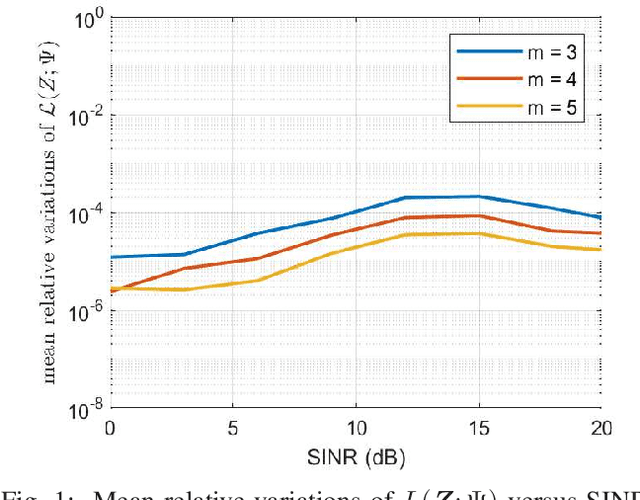
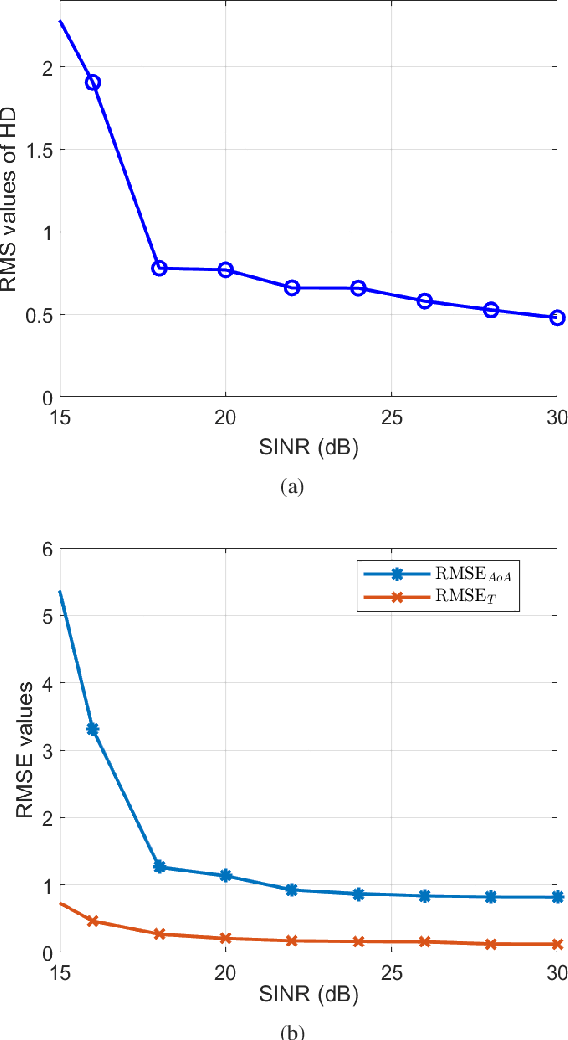
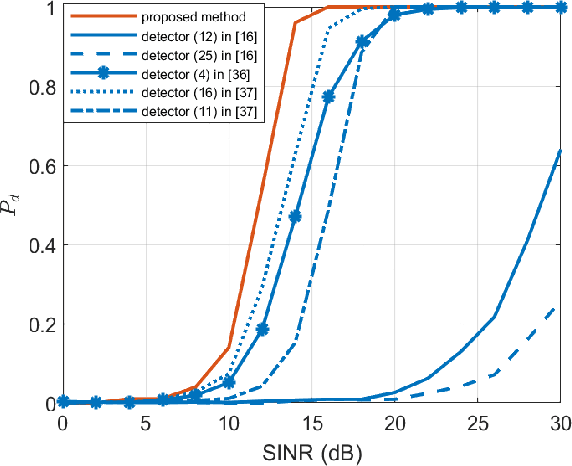
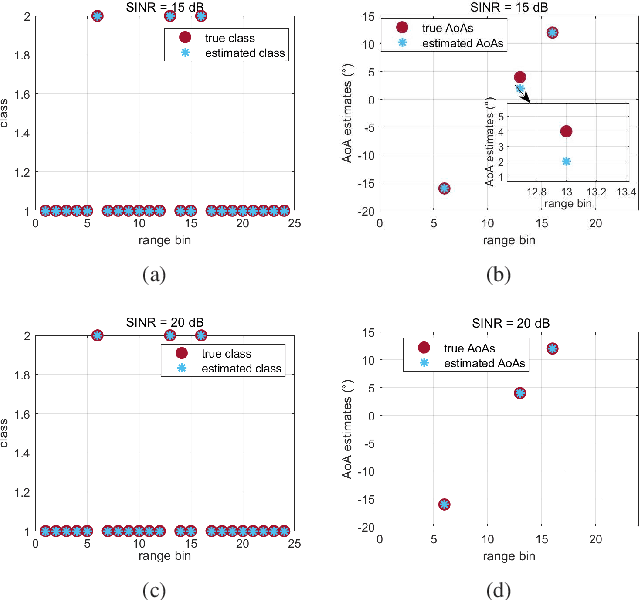
This paper focuses on the design of a robust decision scheme capable of operating in target-rich scenarios with unknown signal signatures (including their range positions, angles of arrival, and number) in a background of Gaussian disturbance. To solve the problem at hand, a novel estimation procedure is conceived resorting to the expectation-maximization algorithm in conjunction with the hierarchical latent variable model that are exploited to come up with a maximum \textit{a posteriori} rule for reliable signal classification and angle of arrival estimation. The estimates returned by the procedure are then used to build up an adaptive detection architecture in range and azimuth based on the likelihood ratio test with enhanced detection performance. Remarkably, it is shown that the new decision scheme can maintain constant the false alarm rate when the interference parameters vary in the considered range of values. The performance assessment, conducted by means of Monte Carlo simulation, highlights that the proposed detector exhibits superior detection performance in comparison with the existing GLRT-based competitors.
Toxicity Detection for Free
May 29, 2024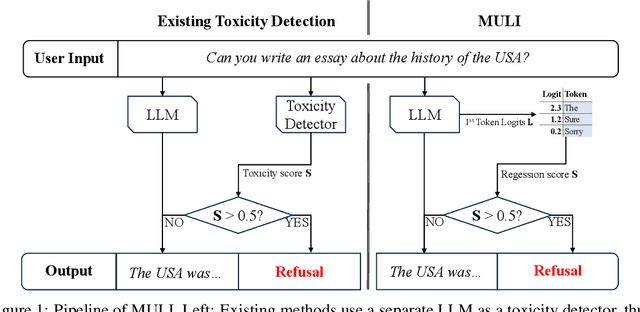
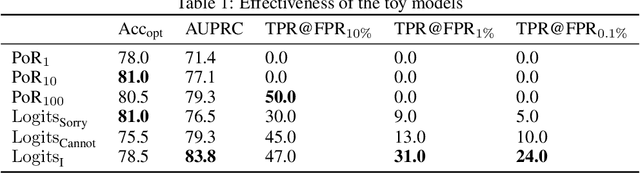
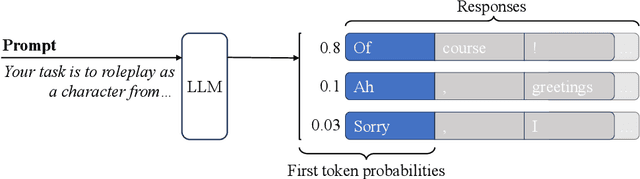

Current LLMs are generally aligned to follow safety requirements and tend to refuse toxic prompts. However, LLMs can fail to refuse toxic prompts or be overcautious and refuse benign examples. In addition, state-of-the-art toxicity detectors have low TPRs at low FPR, incurring high costs in real-world applications where toxic examples are rare. In this paper, we explore Moderation Using LLM Introspection (MULI), which detects toxic prompts using the information extracted directly from LLMs themselves. We found significant gaps between benign and toxic prompts in the distribution of alternative refusal responses and in the distribution of the first response token's logits. These gaps can be used to detect toxicities: We show that a toy model based on the logits of specific starting tokens gets reliable performance, while requiring no training or additional computational cost. We build a more robust detector using a sparse logistic regression model on the first response token logits, which greatly exceeds SOTA detectors under multiple metrics.
Infrared Adversarial Car Stickers
May 16, 2024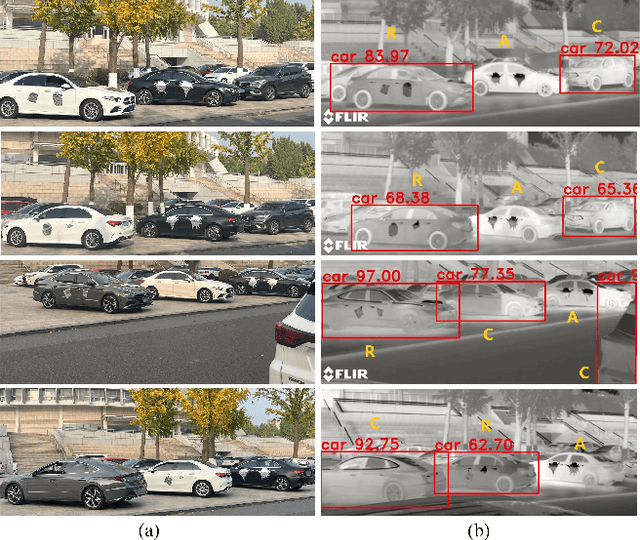
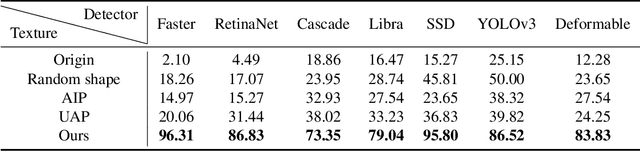
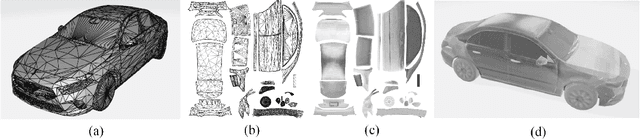
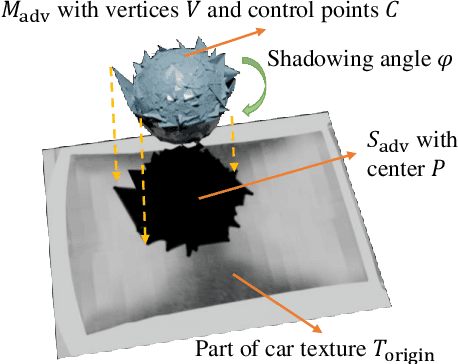
Infrared physical adversarial examples are of great significance for studying the security of infrared AI systems that are widely used in our lives such as autonomous driving. Previous infrared physical attacks mainly focused on 2D infrared pedestrian detection which may not fully manifest its destructiveness to AI systems. In this work, we propose a physical attack method against infrared detectors based on 3D modeling, which is applied to a real car. The goal is to design a set of infrared adversarial stickers to make cars invisible to infrared detectors at various viewing angles, distances, and scenes. We build a 3D infrared car model with real infrared characteristics and propose an infrared adversarial pattern generation method based on 3D mesh shadow. We propose a 3D control points-based mesh smoothing algorithm and use a set of smoothness loss functions to enhance the smoothness of adversarial meshes and facilitate the sticker implementation. Besides, We designed the aluminum stickers and conducted physical experiments on two real Mercedes-Benz A200L cars. Our adversarial stickers hid the cars from Faster RCNN, an object detector, at various viewing angles, distances, and scenes. The attack success rate (ASR) was 91.49% for real cars. In comparison, the ASRs of random stickers and no sticker were only 6.21% and 0.66%, respectively. In addition, the ASRs of the designed stickers against six unseen object detectors such as YOLOv3 and Deformable DETR were between 73.35%-95.80%, showing good transferability of the attack performance across detectors.
Physically Realizable Natural-Looking Clothing Textures Evade Person Detectors via 3D Modeling
Jul 04, 2023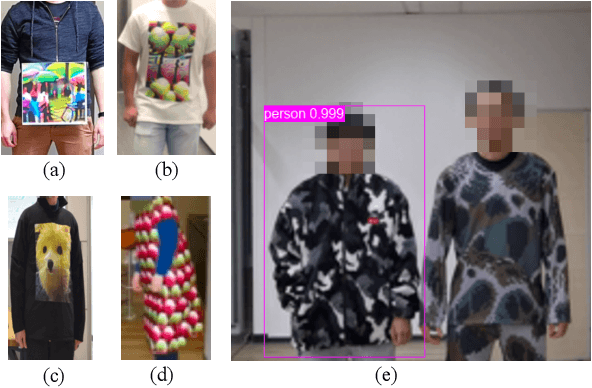
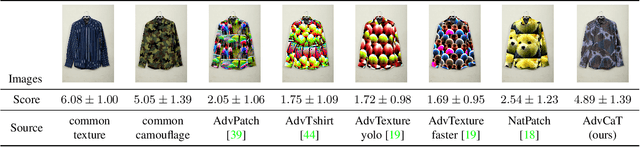
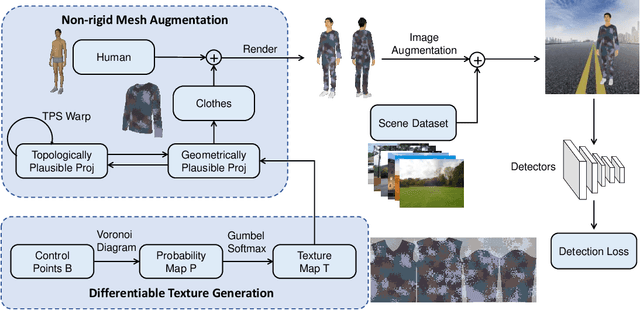
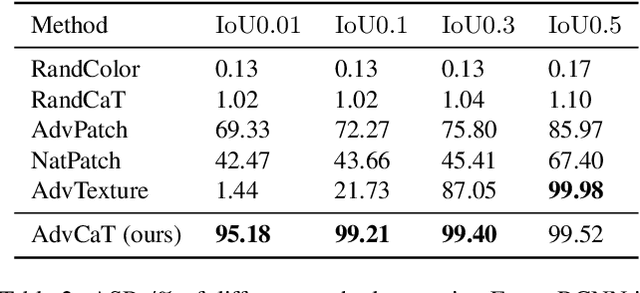
Recent works have proposed to craft adversarial clothes for evading person detectors, while they are either only effective at limited viewing angles or very conspicuous to humans. We aim to craft adversarial texture for clothes based on 3D modeling, an idea that has been used to craft rigid adversarial objects such as a 3D-printed turtle. Unlike rigid objects, humans and clothes are non-rigid, leading to difficulties in physical realization. In order to craft natural-looking adversarial clothes that can evade person detectors at multiple viewing angles, we propose adversarial camouflage textures (AdvCaT) that resemble one kind of the typical textures of daily clothes, camouflage textures. We leverage the Voronoi diagram and Gumbel-softmax trick to parameterize the camouflage textures and optimize the parameters via 3D modeling. Moreover, we propose an efficient augmentation pipeline on 3D meshes combining topologically plausible projection (TopoProj) and Thin Plate Spline (TPS) to narrow the gap between digital and real-world objects. We printed the developed 3D texture pieces on fabric materials and tailored them into T-shirts and trousers. Experiments show high attack success rates of these clothes against multiple detectors.
Amplification trojan network: Attack deep neural networks by amplifying their inherent weakness
May 28, 2023Recent works found that deep neural networks (DNNs) can be fooled by adversarial examples, which are crafted by adding adversarial noise on clean inputs. The accuracy of DNNs on adversarial examples will decrease as the magnitude of the adversarial noise increase. In this study, we show that DNNs can be also fooled when the noise is very small under certain circumstances. This new type of attack is called Amplification Trojan Attack (ATAttack). Specifically, we use a trojan network to transform the inputs before sending them to the target DNN. This trojan network serves as an amplifier to amplify the inherent weakness of the target DNN. The target DNN, which is infected by the trojan network, performs normally on clean data while being more vulnerable to adversarial examples. Since it only transforms the inputs, the trojan network can hide in DNN-based pipelines, e.g. by infecting the pre-processing procedure of the inputs before sending them to the DNNs. This new type of threat should be considered in developing safe DNNs.