 Add to Chrome
 Add to Firefox
 Add to Edge
Large-Scale 3D Ground-Motion Synthesis with Physics-Inspired Latent Operator Flow Matching
Mar 18, 2026
Earthquake hazard analysis and design of spatially distributed infrastructure, such as power grids and energy pipeline networks, require scenario-specific ground-motion time histories with realistic frequency content and spatiotemporal coherence. However, producing the large ensembles needed for uncertainty quantification with physics-based simulations is computationally intensive and impractical for engineering workflows. To address this challenge, we introduce Ground-Motion Flow (GMFlow), a physics-inspired latent operator flow matching framework that generates realistic, large-scale regional ground-motion time-histories conditioned on physical parameters. Validated on simulated earthquake scenarios in the San Francisco Bay Area, GMFlow generates spatially coherent ground motion across more than 9 million grid points in seconds, achieving a 10,000-fold speedup over the simulation workflow, which opens a path toward rapid and uncertainty-aware hazard assessment for distributed infrastructure. More broadly, GMFlow advances mesh-agnostic functional generative modeling and could potentially be extended to the synthesis of large-scale spatiotemporal physical fields in diverse scientific domains.

Enforcing Reciprocity in Operator Learning for Seismic Wave Propagation
Feb 12, 2026Accurate and efficient wavefield modeling underpins seismic structure and source studies. Traditional methods comply with physical laws but are computationally intensive. Data-driven methods, while opening new avenues for advancement, have yet to incorporate strict physical consistency. The principle of reciprocity is one of the most fundamental physical laws in wave propagation. We introduce the Reciprocity-Enforced Neural Operator (RENO), a transformer-based architecture for modeling seismic wave propagation that hard-codes the reciprocity principle. The model leverages the cross-attention mechanism and commutative operations to guarantee invariance under swapping source and receiver positions. Beyond improved physical consistency, the proposed architecture supports simultaneous realizations for multiple sources without crosstalk issues. This yields an order-of-magnitude inference speedup at a similar memory footprint over an reciprocity-unenforced neural operator on a realistic configuration. We demonstrate the functionality using the reciprocity relation for particle velocity fields under single forces. This architecture is also applicable to pressure fields under dilatational sources and travel-time fields governed by the eikonal equation, paving the way for encoding more complex reciprocity relations.
Ambient Noise Full Waveform Inversion with Neural Operators
Mar 19, 2025Numerical simulations of seismic wave propagation are crucial for investigating velocity structures and improving seismic hazard assessment. However, standard methods such as finite difference or finite element are computationally expensive. Recent studies have shown that a new class of machine learning models, called neural operators, can solve the elastodynamic wave equation orders of magnitude faster than conventional methods. Full waveform inversion is a prime beneficiary of the accelerated simulations. Neural operators, as end-to-end differentiable operators, combined with automatic differentiation, provide an alternative approach to the adjoint-state method. Since neural operators do not involve the Born approximation, when used for full waveform inversion they have the potential to include additional phases and alleviate cycle-skipping problems present in traditional adjoint-state formulations. In this study, we demonstrate the application of neural operators for full waveform inversion on a real seismic dataset, which consists of several nodal transects collected across the San Gabriel, Chino, and San Bernardino basins in the Los Angeles metropolitan area.
InverseBench: Benchmarking Plug-and-Play Diffusion Priors for Inverse Problems in Physical Sciences
Mar 14, 2025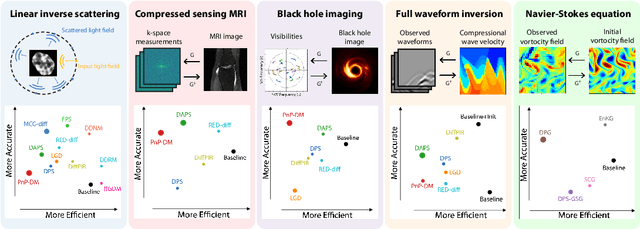
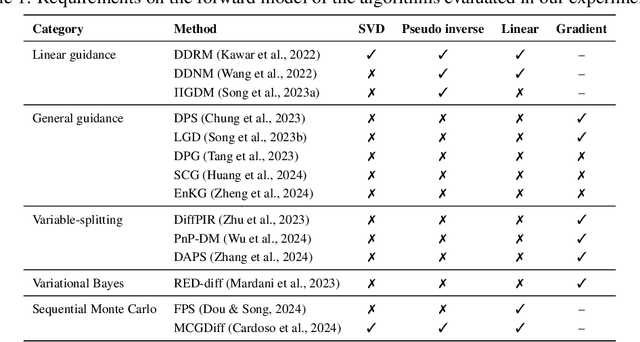
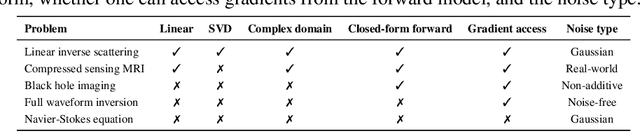
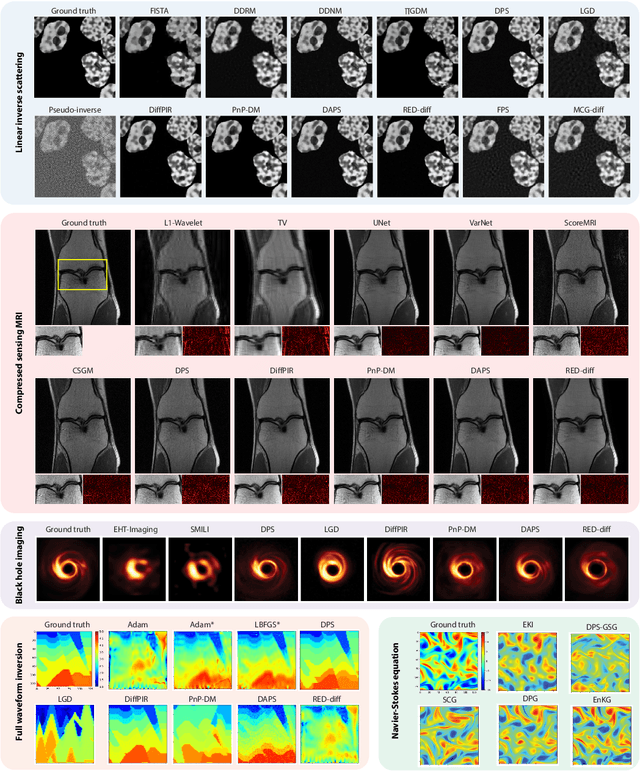
Plug-and-play diffusion priors (PnPDP) have emerged as a promising research direction for solving inverse problems. However, current studies primarily focus on natural image restoration, leaving the performance of these algorithms in scientific inverse problems largely unexplored. To address this gap, we introduce \textsc{InverseBench}, a framework that evaluates diffusion models across five distinct scientific inverse problems. These problems present unique structural challenges that differ from existing benchmarks, arising from critical scientific applications such as optical tomography, medical imaging, black hole imaging, seismology, and fluid dynamics. With \textsc{InverseBench}, we benchmark 14 inverse problem algorithms that use plug-and-play diffusion priors against strong, domain-specific baselines, offering valuable new insights into the strengths and weaknesses of existing algorithms. To facilitate further research and development, we open-source the codebase, along with datasets and pre-trained models, at https://devzhk.github.io/InverseBench/.