 Add to Chrome
 Add to Firefox
 Add to Edge
Reward-Driven Interaction: Enhancing Proactive Dialogue Agents through User Satisfaction Prediction
May 24, 2025
Reward-driven proactive dialogue agents require precise estimation of user satisfaction as an intrinsic reward signal to determine optimal interaction strategies. Specifically, this framework triggers clarification questions when detecting potential user dissatisfaction during interactions in the industrial dialogue system. Traditional works typically rely on training a neural network model based on weak labels which are generated by a simple model trained on user actions after current turn. However, existing methods suffer from two critical limitations in real-world scenarios: (1) Noisy Reward Supervision, dependence on weak labels derived from post-hoc user actions introduces bias, particularly failing to capture satisfaction signals in ASR-error-induced utterances; (2) Long-Tail Feedback Sparsity, the power-law distribution of user queries causes reward prediction accuracy to drop in low-frequency domains. The noise in the weak labels and a power-law distribution of user utterances results in that the model is hard to learn good representation of user utterances and sessions. To address these limitations, we propose two auxiliary tasks to improve the representation learning of user utterances and sessions that enhance user satisfaction prediction. The first one is a contrastive self-supervised learning task, which helps the model learn the representation of rare user utterances and identify ASR errors. The second one is a domain-intent classification task, which aids the model in learning the representation of user sessions from long-tailed domains and improving the model's performance on such domains. The proposed method is evaluated on DuerOS, demonstrating significant improvements in the accuracy of error recognition on rare user utterances and long-tailed domains.

NAN: A Training-Free Solution to Coefficient Estimation in Model Merging
May 22, 2025Model merging offers a training-free alternative to multi-task learning by combining independently fine-tuned models into a unified one without access to raw data. However, existing approaches often rely on heuristics to determine the merging coefficients, limiting their scalability and generality. In this work, we revisit model merging through the lens of least-squares optimization and show that the optimal merging weights should scale with the amount of task-specific information encoded in each model. Based on this insight, we propose NAN, a simple yet effective method that estimates model merging coefficients via the inverse of parameter norm. NAN is training-free, plug-and-play, and applicable to a wide range of merging strategies. Extensive experiments on show that NAN consistently improves performance of baseline methods.
Why Can Accurate Models Be Learned from Inaccurate Annotations?
May 22, 2025Learning from inaccurate annotations has gained significant attention due to the high cost of precise labeling. However, despite the presence of erroneous labels, models trained on noisy data often retain the ability to make accurate predictions. This intriguing phenomenon raises a fundamental yet largely unexplored question: why models can still extract correct label information from inaccurate annotations remains unexplored. In this paper, we conduct a comprehensive investigation into this issue. By analyzing weight matrices from both empirical and theoretical perspectives, we find that label inaccuracy primarily accumulates noise in lower singular components and subtly perturbs the principal subspace. Within a certain range, the principal subspaces of weights trained on inaccurate labels remain largely aligned with those learned from clean labels, preserving essential task-relevant information. We formally prove that the angles of principal subspaces exhibit minimal deviation under moderate label inaccuracy, explaining why models can still generalize effectively. Building on these insights, we propose LIP, a lightweight plug-in designed to help classifiers retain principal subspace information while mitigating noise induced by label inaccuracy. Extensive experiments on tasks with various inaccuracy conditions demonstrate that LIP consistently enhances the performance of existing algorithms. We hope our findings can offer valuable theoretical and practical insights to understand of model robustness under inaccurate supervision.
AdaCoT: Pareto-Optimal Adaptive Chain-of-Thought Triggering via Reinforcement Learning
May 17, 2025Large Language Models (LLMs) have demonstrated remarkable capabilities but often face challenges with tasks requiring sophisticated reasoning. While Chain-of-Thought (CoT) prompting significantly enhances reasoning, it indiscriminately generates lengthy reasoning steps for all queries, leading to substantial computational costs and inefficiency, especially for simpler inputs. To address this critical issue, we introduce AdaCoT (Adaptive Chain-of-Thought), a novel framework enabling LLMs to adaptively decide when to invoke CoT. AdaCoT framed adaptive reasoning as a Pareto optimization problem that seeks to balance model performance with the costs associated with CoT invocation (both frequency and computational overhead). We propose a reinforcement learning (RL) based method, specifically utilizing Proximal Policy Optimization (PPO), to dynamically control the CoT triggering decision boundary by adjusting penalty coefficients, thereby allowing the model to determine CoT necessity based on implicit query complexity. A key technical contribution is Selective Loss Masking (SLM), designed to counteract decision boundary collapse during multi-stage RL training, ensuring robust and stable adaptive triggering. Experimental results demonstrate that AdaCoT successfully navigates the Pareto frontier, achieving substantial reductions in CoT usage for queries not requiring elaborate reasoning. For instance, on our production traffic testset, AdaCoT reduced CoT triggering rates to as low as 3.18\% and decreased average response tokens by 69.06%, while maintaining high performance on complex tasks.
Skywork-VL Reward: An Effective Reward Model for Multimodal Understanding and Reasoning
May 12, 2025We propose Skywork-VL Reward, a multimodal reward model that provides reward signals for both multimodal understanding and reasoning tasks. Our technical approach comprises two key components: First, we construct a large-scale multimodal preference dataset that covers a wide range of tasks and scenarios, with responses collected from both standard vision-language models (VLMs) and advanced VLM reasoners. Second, we design a reward model architecture based on Qwen2.5-VL-7B-Instruct, integrating a reward head and applying multi-stage fine-tuning using pairwise ranking loss on pairwise preference data. Experimental evaluations show that Skywork-VL Reward achieves state-of-the-art results on multimodal VL-RewardBench and exhibits competitive performance on the text-only RewardBench benchmark. Furthermore, preference data constructed based on our Skywork-VL Reward proves highly effective for training Mixed Preference Optimization (MPO), leading to significant improvements in multimodal reasoning capabilities. Our results underscore Skywork-VL Reward as a significant advancement toward general-purpose, reliable reward models for multimodal alignment. Our model has been publicly released to promote transparency and reproducibility.
Learning Unknown Spoof Prompts for Generalized Face Anti-Spoofing Using Only Real Face Images
May 06, 2025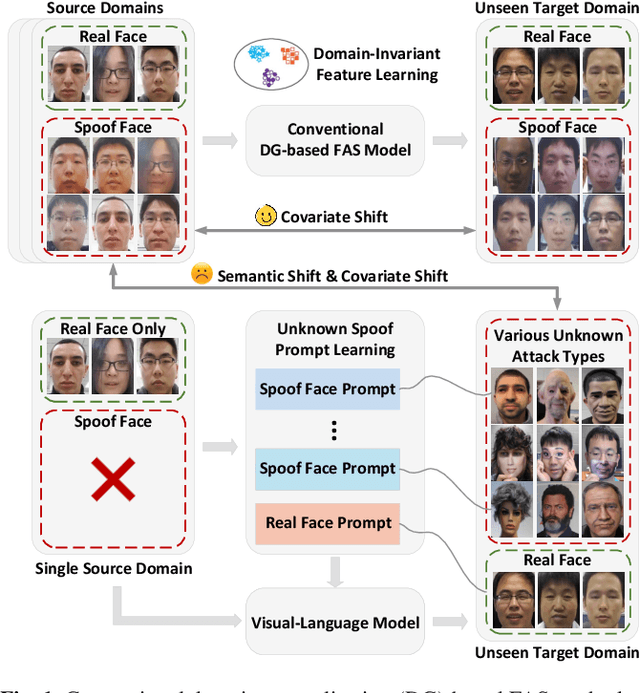
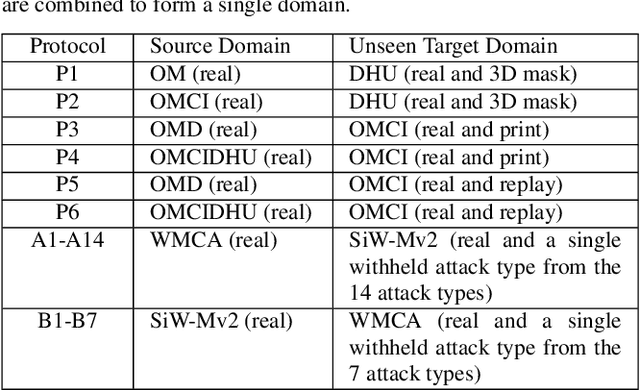
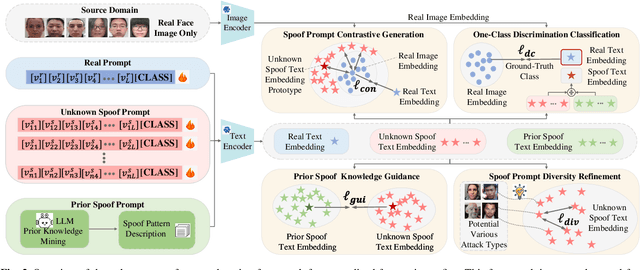
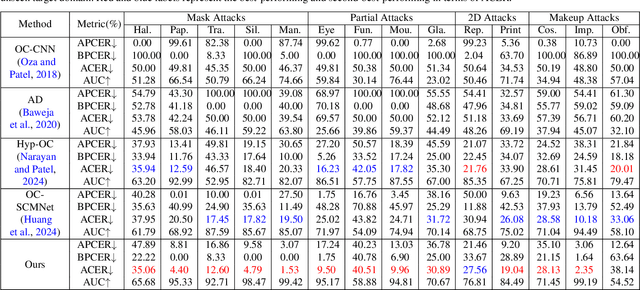
Face anti-spoofing is a critical technology for ensuring the security of face recognition systems. However, its ability to generalize across diverse scenarios remains a significant challenge. In this paper, we attribute the limited generalization ability to two key factors: covariate shift, which arises from external data collection variations, and semantic shift, which results from substantial differences in emerging attack types. To address both challenges, we propose a novel approach for learning unknown spoof prompts, relying solely on real face images from a single source domain. Our method generates textual prompts for real faces and potential unknown spoof attacks by leveraging the general knowledge embedded in vision-language models, thereby enhancing the model's ability to generalize to unseen target domains. Specifically, we introduce a diverse spoof prompt optimization framework to learn effective prompts. This framework constrains unknown spoof prompts within a relaxed prior knowledge space while maximizing their distance from real face images. Moreover, it enforces semantic independence among different spoof prompts to capture a broad range of spoof patterns. Experimental results on nine datasets demonstrate that the learned prompts effectively transfer the knowledge of vision-language models, enabling state-of-the-art generalization ability against diverse unknown attack types across unseen target domains without using any spoof face images.
Skywork R1V2: Multimodal Hybrid Reinforcement Learning for Reasoning
Apr 23, 2025We present Skywork R1V2, a next-generation multimodal reasoning model and a major leap forward from its predecessor, Skywork R1V. At its core, R1V2 introduces a hybrid reinforcement learning paradigm that harmonizes reward-model guidance with rule-based strategies, thereby addressing the long-standing challenge of balancing sophisticated reasoning capabilities with broad generalization. To further enhance training efficiency, we propose the Selective Sample Buffer (SSB) mechanism, which effectively counters the ``Vanishing Advantages'' dilemma inherent in Group Relative Policy Optimization (GRPO) by prioritizing high-value samples throughout the optimization process. Notably, we observe that excessive reinforcement signals can induce visual hallucinations--a phenomenon we systematically monitor and mitigate through calibrated reward thresholds throughout the training process. Empirical results affirm the exceptional capability of R1V2, with benchmark-leading performances such as 62.6 on OlympiadBench, 79.0 on AIME2024, 63.6 on LiveCodeBench, and 74.0 on MMMU. These results underscore R1V2's superiority over existing open-source models and demonstrate significant progress in closing the performance gap with premier proprietary systems, including Gemini 2.5 and OpenAI o4-mini. The Skywork R1V2 model weights have been publicly released to promote openness and reproducibility https://huggingface.co/Skywork/Skywork-R1V2-38B.
Pre-DPO: Improving Data Utilization in Direct Preference Optimization Using a Guiding Reference Model
Apr 22, 2025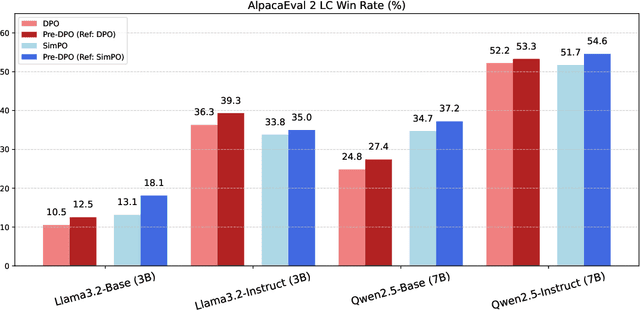
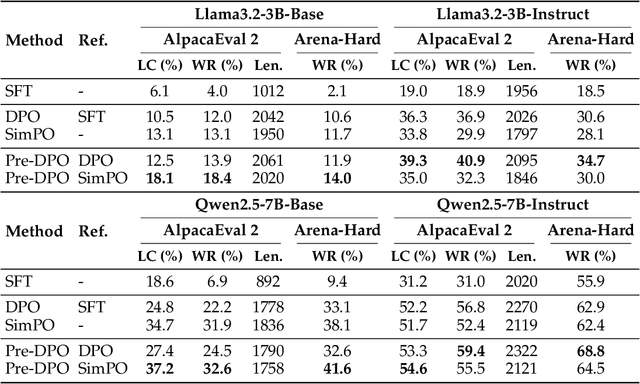
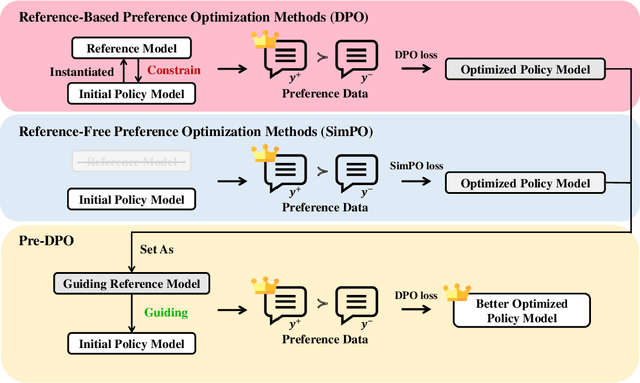
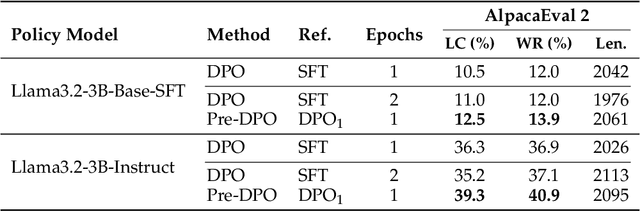
Direct Preference Optimization (DPO) simplifies reinforcement learning from human feedback (RLHF) for large language models (LLMs) by directly optimizing human preferences without an explicit reward model. We find that during DPO training, the reference model plays the role of a data weight adjuster. However, the common practice of initializing the policy and reference models identically in DPO can lead to inefficient data utilization and impose a performance ceiling. Meanwhile, the lack of a reference model in Simple Preference Optimization (SimPO) reduces training robustness and necessitates stricter conditions to prevent catastrophic forgetting. In this work, we propose Pre-DPO, a simple yet effective DPO-based training paradigm that enhances preference optimization performance by leveraging a guiding reference model. This reference model provides foresight into the optimal policy state achievable through the training preference data, serving as a guiding mechanism that adaptively assigns higher weights to samples more suitable for the model and lower weights to those less suitable. Extensive experiments on AlpacaEval 2.0 and Arena-Hard v0.1 benchmarks demonstrate that Pre-DPO consistently improves the performance of both DPO and SimPO, without relying on external models or additional data.
LeetCodeDataset: A Temporal Dataset for Robust Evaluation and Efficient Training of Code LLMs
Apr 20, 2025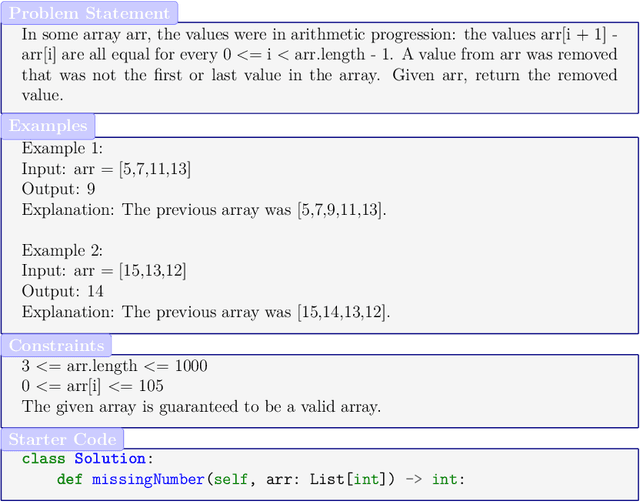
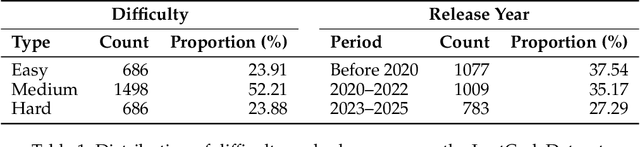
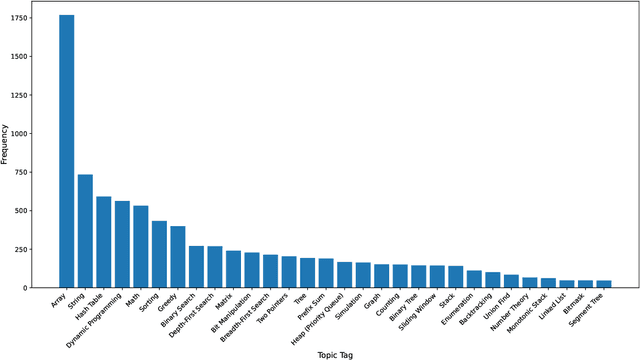
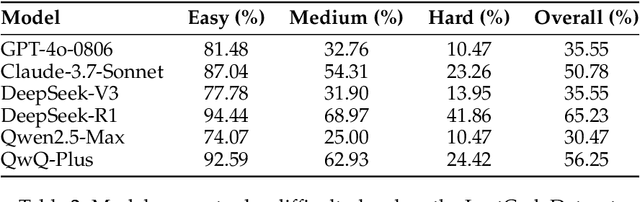
We introduce LeetCodeDataset, a high-quality benchmark for evaluating and training code-generation models, addressing two key challenges in LLM research: the lack of reasoning-focused coding benchmarks and self-contained training testbeds. By curating LeetCode Python problems with rich metadata, broad coverage, 100+ test cases per problem, and temporal splits (pre/post July 2024), our dataset enables contamination-free evaluation and efficient supervised fine-tuning (SFT). Experiments show reasoning models significantly outperform non-reasoning counterparts, while SFT with only 2.6K model-generated solutions achieves performance comparable to 110K-sample counterparts. The dataset and evaluation framework are available on Hugging Face and Github.
A Comprehensive Survey of Reward Models: Taxonomy, Applications, Challenges, and Future
Apr 12, 2025Reward Model (RM) has demonstrated impressive potential for enhancing Large Language Models (LLM), as RM can serve as a proxy for human preferences, providing signals to guide LLMs' behavior in various tasks. In this paper, we provide a comprehensive overview of relevant research, exploring RMs from the perspectives of preference collection, reward modeling, and usage. Next, we introduce the applications of RMs and discuss the benchmarks for evaluation. Furthermore, we conduct an in-depth analysis of the challenges existing in the field and dive into the potential research directions. This paper is dedicated to providing beginners with a comprehensive introduction to RMs and facilitating future studies. The resources are publicly available at github\footnote{https://github.com/JLZhong23/awesome-reward-models}.