 Add to Chrome
 Add to Firefox
 Add to Edge
F2STNet: Fair and Federated Spectral-Temporal Modeling for Graph Forecasting
Aug 10, 2026
Spatiotemporal prediction on graph-structured data is central to traffic forecasting and environmental monitoring, yet decentralized and heterogeneous data complicate both sequence modeling and collaborative training. We propose F$^2$STNet, a federated forecasting framework that combines truncated graph-Fourier features, a lightweight diagonal state-space temporal encoder, graph convolution, and Fairness-aware Federated Aggregation (FFA). The spectral branch exposes graph-frequency structure, while the state-space layer models long temporal dependencies with linear complexity in the sequence length. FFA adjusts the FedAvg prior using client validation losses and an increasing fairness schedule. Experiments on PeMS04, HZMetro, and KnowAir show favorable forecasting accuracy relative to the evaluated baselines; federated experiments on PeMS04 additionally improve worst-client and client-dispersion metrics.

ACE-SQL: Adaptive Co-Optimization via Empirical Credit Assignment for Text-to-SQL
Jun 04, 2026Text-to-SQL maps natural language questions to executable SQL queries. Modern databases often contain large and complex schemas, making schema linking a critical step for accurate SQL generation. Existing methods either rely on full-schema generation, which leaves schema linking implicit within a large search space, or use a separate retriever trained with static gold-column supervision, whose targets may be suboptimal for the current generator policy. To address this issue, we propose Adaptive Co-optimization via Empirical Credit Assignment for Text-to-SQL (ACE-SQL), a reinforcement learning (RL) framework that jointly optimizes schema retrieval and SQL generation under execution feedback. ACE-SQL constructs an online column-set pool from generator rollouts and derives adaptive on-policy retrieval targets from the column set most frequently associated with execution-correct rollouts. This induces bidirectional adaptation, where the retriever adapts toward column sets that the generator can execute correctly, while the generator adapts to the retriever's evolving schema selections under execution feedback. With approximately 3k synthetic Text-to-SQL question-database pairs for RL training, ACE-SQL achieves 65.3% greedy execution accuracy on BIRD Dev while using 0.93k output tokens per query. The repository is available at https://github.com/xbchen1/ACE-SQL.
TRUST-SQL: Tool-Integrated Multi-Turn Reinforcement Learning for Text-to-SQL over Unknown Schemas
Mar 17, 2026Text-to-SQL parsing has achieved remarkable progress under the Full Schema Assumption. However, this premise fails in real-world enterprise environments where databases contain hundreds of tables with massive noisy metadata. Rather than injecting the full schema upfront, an agent must actively identify and verify only the relevant subset, giving rise to the Unknown Schema scenario we study in this work. To address this, we propose TRUST-SQL (Truthful Reasoning with Unknown Schema via Tools). We formulate the task as a Partially Observable Markov Decision Process where our autonomous agent employs a structured four-phase protocol to ground reasoning in verified metadata. Crucially, this protocol provides a structural boundary for our novel Dual-Track GRPO strategy. By applying token-level masked advantages, this strategy isolates exploration rewards from execution outcomes to resolve credit assignment, yielding a 9.9% relative improvement over standard GRPO. Extensive experiments across five benchmarks demonstrate that TRUST-SQL achieves an average absolute improvement of 30.6% and 16.6% for the 4B and 8B variants respectively over their base models. Remarkably, despite operating entirely without pre-loaded metadata, our framework consistently matches or surpasses strong baselines that rely on schema prefilling.
Harmonizing Dense and Sparse Signals in Multi-turn RL: Dual-Horizon Credit Assignment for Industrial Sales Agents
Mar 02, 2026Optimizing large language models for industrial sales requires balancing long-term commercial objectives (e.g., conversion rate) with immediate linguistic constraints such as fluency and compliance. Conventional reinforcement learning often merges these heterogeneous goals into a single reward, causing high-magnitude session-level rewards to overwhelm subtler turn-level signals, which leads to unstable training or reward hacking. To address this issue, we propose Dual-Horizon Credit Assignment (DuCA), a framework that disentangles optimization across time scales. Its core, Horizon-Independent Advantage Normalization (HIAN), separately normalizes advantages from turn-level and session-level rewards before fusion, ensuring balanced gradient contributions from both immediate and long-term objectives to the policy update. Extensive experiments with a high-fidelity user simulator show DuCA outperforms the state-of-the-art GRPO baseline, achieving a 6.82% relative improvement in conversion rate, reducing inter-sentence repetition by 82.28%, and lowering identity detection rate by 27.35%, indicating a substantial improvement for an industrial sales scenario that effectively balances the dual demands of strategic performance and naturalistic language generation.
CSVQA: A Chinese Multimodal Benchmark for Evaluating STEM Reasoning Capabilities of VLMs
May 30, 2025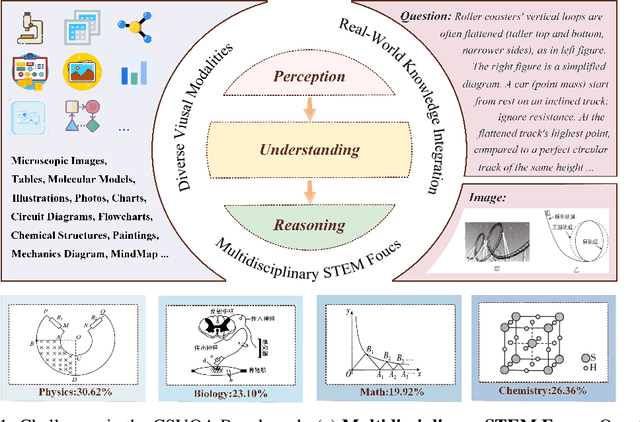
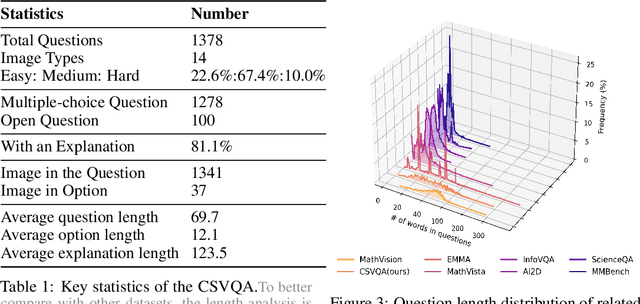
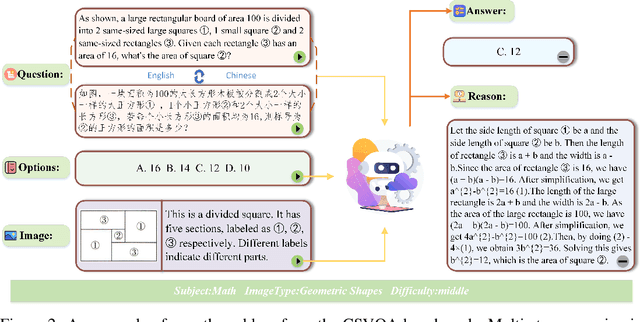
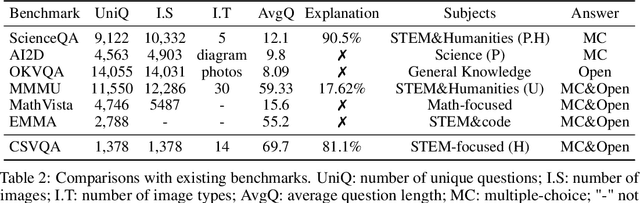
Vision-Language Models (VLMs) have demonstrated remarkable progress in multimodal understanding, yet their capabilities for scientific reasoning remains inadequately assessed. Current multimodal benchmarks predominantly evaluate generic image comprehension or text-driven reasoning, lacking authentic scientific contexts that require domain-specific knowledge integration with visual evidence analysis. To fill this gap, we present CSVQA, a diagnostic multimodal benchmark specifically designed for evaluating scientific reasoning through domain-grounded visual question answering.Our benchmark features 1,378 carefully constructed question-answer pairs spanning diverse STEM disciplines, each demanding domain knowledge, integration of visual evidence, and higher-order reasoning. Compared to prior multimodal benchmarks, CSVQA places greater emphasis on real-world scientific content and complex reasoning.We additionally propose a rigorous evaluation protocol to systematically assess whether model predictions are substantiated by valid intermediate reasoning steps based on curated explanations. Our comprehensive evaluation of 15 VLMs on this benchmark reveals notable performance disparities, as even the top-ranked proprietary model attains only 49.6\% accuracy.This empirical evidence underscores the pressing need for advancing scientific reasoning capabilities in VLMs. Our CSVQA is released at https://huggingface.co/datasets/Skywork/CSVQA.
Skywork-VL Reward: An Effective Reward Model for Multimodal Understanding and Reasoning
May 12, 2025We propose Skywork-VL Reward, a multimodal reward model that provides reward signals for both multimodal understanding and reasoning tasks. Our technical approach comprises two key components: First, we construct a large-scale multimodal preference dataset that covers a wide range of tasks and scenarios, with responses collected from both standard vision-language models (VLMs) and advanced VLM reasoners. Second, we design a reward model architecture based on Qwen2.5-VL-7B-Instruct, integrating a reward head and applying multi-stage fine-tuning using pairwise ranking loss on pairwise preference data. Experimental evaluations show that Skywork-VL Reward achieves state-of-the-art results on multimodal VL-RewardBench and exhibits competitive performance on the text-only RewardBench benchmark. Furthermore, preference data constructed based on our Skywork-VL Reward proves highly effective for training Mixed Preference Optimization (MPO), leading to significant improvements in multimodal reasoning capabilities. Our results underscore Skywork-VL Reward as a significant advancement toward general-purpose, reliable reward models for multimodal alignment. Our model has been publicly released to promote transparency and reproducibility.
Skywork R1V: Pioneering Multimodal Reasoning with Chain-of-Thought
Apr 08, 2025We introduce Skywork R1V, a multimodal reasoning model extending the an R1-series Large language models (LLM) to visual modalities via an efficient multimodal transfer method. Leveraging a lightweight visual projector, Skywork R1V facilitates seamless multimodal adaptation without necessitating retraining of either the foundational language model or the vision encoder. To strengthen visual-text alignment, we propose a hybrid optimization strategy that combines Iterative Supervised Fine-Tuning (SFT) with Group Relative Policy Optimization (GRPO), significantly enhancing cross-modal integration efficiency. Additionally, we introduce an adaptive-length Chain-of-Thought distillation approach for reasoning data generation. This approach dynamically optimizes reasoning chain lengths, thereby enhancing inference efficiency and preventing excessive reasoning overthinking. Empirical evaluations demonstrate that Skywork R1V, with only 38B parameters, delivers competitive performance, achieving a score of 69.0 on the MMMU benchmark and 67.5 on MathVista. Meanwhile, it maintains robust textual reasoning performance, evidenced by impressive scores of 72.0 on AIME and 94.0 on MATH500. The Skywork R1V model weights have been publicly released to promote openness and reproducibility.