 Add to Chrome
 Add to Firefox
 Add to Edge
Why AI Detection Fails for Academic Integrity
Aug 06, 2026
Institutions use commercial AI detectors for academic integrity, yet detectors cannot distinguish AI editing from full LLM drafts and may treat both as misconduct. In a controlled study of published English abstracts (four domains; 2013 to 2015 vs. 2023 to 2025), we quantify this policy failure under proxy human/AI labels at tau=0.50. Light "refine abstract only" edits, a proxy for guideline-compliant AI assistance, are flagged at 64 to 80% (Pangram/GPTZero). Unmodified 2023 to 2025 originals are flagged at 9 to 15%, with non-STEM rates far above STEM (p<0.001); elevated scores track long-token and Academic Word List density, not authorship intent alone. After Undetectable AI humanization, evasion is near-total: fewer than 4% of AI-labeled rewrites remain flagged (post-humanization detection rate <4%; FNR >96%). Honest AI-editing results in a higher sanction risk than humanizer-assisted evasion. Therefore, detector scores should not serve as standalone misconduct evidence.

Learning from Synthetic Data without Model Collapse in Iterative Instruction Tuning
Jul 19, 2026Model collapse is a central challenge in learning from synthetic data: as later-generation large language models (LLMs) are trained on an increasing proportion of model-generated data, performance can degrade due to narrowed coverage and accumulated bias. Existing work mainly studies how to bound this degradation. In iterative model evolution, however, the more meaningful objective is to ensure that each successive model improves over its predecessor, which requires diagnosing collapse at a granularity that is actionable for data curation. We study this problem in synthetic data self-improving for instruction tuning. We show that collapse in this setting is not simply uniform performance degradation, but can appear as a polarization of competence, where synthetic training reinforces already strong skills while further degrading weak ones. Motivated by this observation, we propose KITE (Knowledge-boundary Instruction Tuning via Exploration), a two-stage framework that combines failure-guided data generation with boundary-aware uncertainty curation. Experiments across several datasets and multiple open-source LLMs show that KITE yields more stable improvement than strong synthetic-data baselines.
TeachingCoach: A Fine-Tuned Scaffolding Chatbot for Instructional Guidance to Instructors
Mar 18, 2026Higher education instructors often lack timely and pedagogically grounded support, as scalable instructional guidance remains limited and existing tools rely on generic chatbot advice or non-scalable teaching center human-human consultations. We present TeachingCoach, a pedagogically grounded chatbot designed to support instructor professional development through real-time, conversational guidance. TeachingCoach is built on a data-centric pipeline that extracts pedagogical rules from educational resources and uses synthetic dialogue generation to fine-tune a specialized language model that guides instructors through problem identification, diagnosis, and strategy development. Expert evaluations show TeachingCoach produces clearer, more reflective, and more responsive guidance than a GPT-4o mini baseline, while a user study with higher education instructors highlights trade-offs between conversational depth and interaction efficiency. Together, these results demonstrate that pedagogically grounded, synthetic data driven chatbots can improve instructional support and offer a scalable design approach for future instructional chatbot systems.
Generalist Large Language Models for Molecular Property Prediction: Distilling Knowledge from Specialist Models
Mar 12, 2026Molecular Property Prediction (MPP) is a central task in drug discovery. While Large Language Models (LLMs) show promise as generalist models for MPP, their current performance remains below the threshold for practical adoption. We propose TreeKD, a novel knowledge distillation method that transfers complementary knowledge from tree-based specialist models into LLMs. Our approach trains specialist decision trees on functional group features, then verbalizes their learned predictive rules as natural language to enable rule-augmented context learning. This enables LLMs to leverage structural insights that are difficult to extract from SMILES strings alone. We further introduce rule-consistency, a test-time scaling technique inspired by bagging that ensembles predictions across diverse rules from a Random Forest. Experiments on 22 ADMET properties from the TDC benchmark demonstrate that TreeKD substantially improves LLM performance, narrowing the gap with SOTA specialist models and advancing toward practical generalist models for molecular property prediction.
Transform-Augmented GRPO Improves Pass@k
Jan 30, 2026Large language models trained via next-token prediction are fundamentally pattern-matchers: sensitive to superficial phrasing variations even when the underlying problem is identical. Group Relative Policy Optimization (GRPO) was designed to improve reasoning, but in fact it worsens this situation through two failure modes: diversity collapse, where training amplifies a single solution strategy while ignoring alternatives of gradient signal, and gradient diminishing, where a large portion of questions yield zero gradients because all rollouts receive identical rewards. We propose TA-GRPO (Transform-Augmented GRPO), which generates semantically equivalent transformed variants of each question (via paraphrasing, variable renaming, and format changes) and computes advantages by pooling rewards across the entire group. This pooled computation ensures mixed rewards even when the original question is too easy or too hard, while training on diverse phrasings promotes multiple solution strategies. We provide theoretical justification showing that TA-GRPO reduces zero-gradient probability and improves generalization via reduced train-test distribution shift. Experiments on mathematical reasoning benchmarks show consistent Pass@k improvements, with gains up to 9.84 points on competition math (AMC12, AIME24) and 5.05 points on out-of-distribution scientific reasoning (GPQA-Diamond).
Automated Benchmark Generation from Domain Guidelines Informed by Bloom's Taxonomy
Jan 28, 2026Open-ended question answering (QA) evaluates a model's ability to perform contextualized reasoning beyond factual recall. This challenge is especially acute in practice-based domains, where knowledge is procedural and grounded in professional judgment, while most existing LLM benchmarks depend on pre-existing human exam datasets that are often unavailable in such settings. We introduce a framework for automated benchmark generation from expert-authored guidelines informed by Bloom's Taxonomy. It converts expert practices into implicit violation-based scenarios and expands them into auto-graded multiple-choice questions (MCQs) and multi-turn dialogues across four cognitive levels, enabling deterministic, reproducible, and scalable evaluation. Applied to three applied domains: teaching, dietetics, and caregiving, we find differences between model and human-like reasoning: LLMs sometimes perform relatively better on higher-order reasoning (Analyze) but fail more frequently on lower-level items (Remember). We produce large-scale, psychometrically informed benchmarks that surface these non-intuitive model behaviors and enable evaluation of contextualized reasoning in real-world settings.
HyperEdit: Unlocking Instruction-based Text Editing in LLMs via Hypernetworks
Dec 14, 2025Instruction-based text editing is increasingly critical for real-world applications such as code editors (e.g., Cursor), but Large Language Models (LLMs) continue to struggle with this task. Unlike free-form generation, editing requires faithfully implementing user instructions while preserving unchanged content, as even minor unintended modifications can break functionality. Existing approaches treat editing as generic text generation, leading to two key failures: they struggle to faithfully align edits with diverse user intents, and they often over-edit unchanged regions. We propose HyperEdit to address both issues. First, we introduce hypernetwork-based dynamic adaptation that generates request-specific parameters, enabling the model to tailor its editing strategy to each instruction. Second, we develop difference-aware regularization that focuses supervision on modified spans, preventing over-editing while ensuring precise, minimal changes. HyperEdit achieves a 9%--30% relative improvement in BLEU on modified regions over state-of-the-art baselines, despite utilizing only 3B parameters.
Dynamic Noise Preference Optimization for LLM Self-Improvement via Synthetic Data
Feb 08, 2025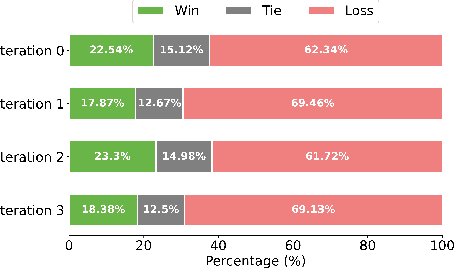
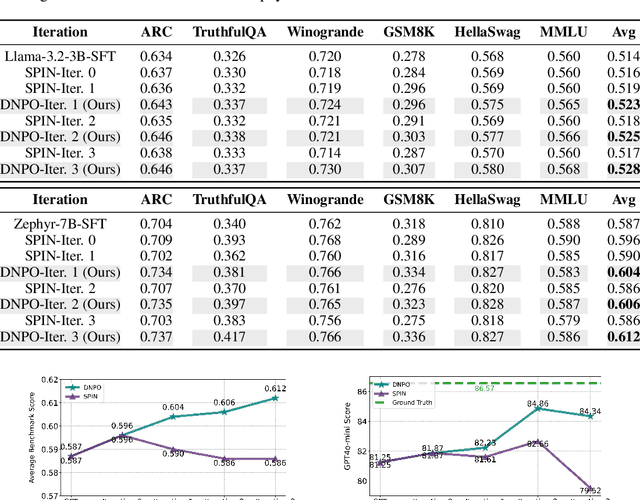
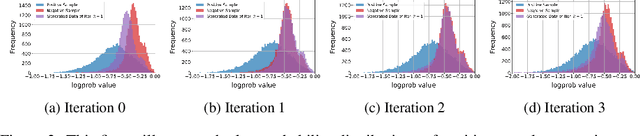
Although LLMs have achieved significant success, their reliance on large volumes of human-annotated data has limited their potential for further scaling. In this situation, utilizing self-generated synthetic data has become crucial for fine-tuning LLMs without extensive human annotation. However, current methods often fail to ensure consistent improvements across iterations, with performance stagnating after only minimal updates. To overcome these challenges, we introduce Dynamic Noise Preference Optimization (DNPO). DNPO employs a dynamic sample labeling mechanism to construct preference pairs for training and introduces controlled, trainable noise into the preference optimization process. Our approach effectively prevents stagnation and enables continuous improvement. In experiments with Zephyr-7B, DNPO consistently outperforms existing methods, showing an average performance boost of 2.6% across multiple benchmarks. Additionally, DNPO shows a significant improvement in model-generated data quality, with a 29.4% win-loss rate gap compared to the baseline in GPT-4 evaluations. This highlights its effectiveness in enhancing model performance through iterative refinement.
ToMoE: Converting Dense Large Language Models to Mixture-of-Experts through Dynamic Structural Pruning
Jan 25, 2025Large Language Models (LLMs) have demonstrated remarkable abilities in tackling a wide range of complex tasks. However, their huge computational and memory costs raise significant challenges in deploying these models on resource-constrained devices or efficiently serving them. Prior approaches have attempted to alleviate these problems by permanently removing less important model structures, yet these methods often result in substantial performance degradation due to the permanent deletion of model parameters. In this work, we tried to mitigate this issue by reducing the number of active parameters without permanently removing them. Specifically, we introduce a differentiable dynamic pruning method that pushes dense models to maintain a fixed number of active parameters by converting their MLP layers into a Mixture of Experts (MoE) architecture. Our method, even without fine-tuning, consistently outperforms previous structural pruning techniques across diverse model families, including Phi-2, LLaMA-2, LLaMA-3, and Qwen-2.5.
DISP-LLM: Dimension-Independent Structural Pruning for Large Language Models
Oct 15, 2024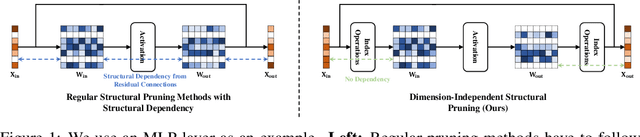
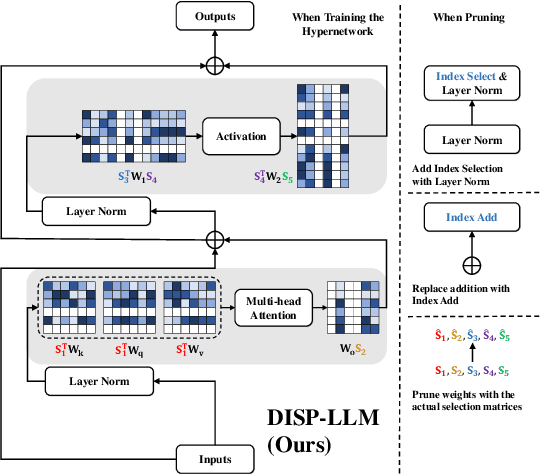
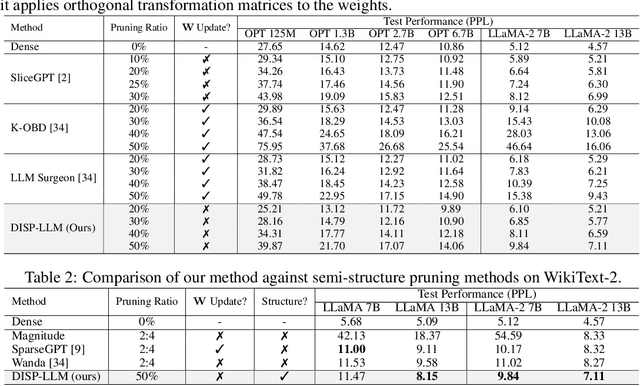
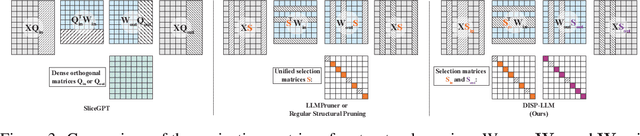
Large Language Models (LLMs) have achieved remarkable success in various natural language processing tasks, including language modeling, understanding, and generation. However, the increased memory and computational costs associated with these models pose significant challenges for deployment on resource-limited devices. Structural pruning has emerged as a promising solution to reduce the costs of LLMs without requiring post-processing steps. Prior structural pruning methods either follow the dependence of structures at the cost of limiting flexibility, or introduce non-trivial additional parameters by incorporating different projection matrices. In this work, we propose a novel approach that relaxes the constraint imposed by regular structural pruning methods and eliminates the structural dependence along the embedding dimension. Our dimension-independent structural pruning method offers several benefits. Firstly, our method enables different blocks to utilize different subsets of the feature maps. Secondly, by removing structural dependence, we facilitate each block to possess varying widths along its input and output dimensions, thereby significantly enhancing the flexibility of structural pruning. We evaluate our method on various LLMs, including OPT, LLaMA, LLaMA-2, Phi-1.5, and Phi-2. Experimental results demonstrate that our approach outperforms other state-of-the-art methods, showing for the first time that structural pruning can achieve an accuracy similar to semi-structural pruning.