 Add to Chrome
 Add to Firefox
 Add to Edge
Transform-Augmented GRPO Improves Pass@k
Jan 30, 2026
Large language models trained via next-token prediction are fundamentally pattern-matchers: sensitive to superficial phrasing variations even when the underlying problem is identical. Group Relative Policy Optimization (GRPO) was designed to improve reasoning, but in fact it worsens this situation through two failure modes: diversity collapse, where training amplifies a single solution strategy while ignoring alternatives of gradient signal, and gradient diminishing, where a large portion of questions yield zero gradients because all rollouts receive identical rewards. We propose TA-GRPO (Transform-Augmented GRPO), which generates semantically equivalent transformed variants of each question (via paraphrasing, variable renaming, and format changes) and computes advantages by pooling rewards across the entire group. This pooled computation ensures mixed rewards even when the original question is too easy or too hard, while training on diverse phrasings promotes multiple solution strategies. We provide theoretical justification showing that TA-GRPO reduces zero-gradient probability and improves generalization via reduced train-test distribution shift. Experiments on mathematical reasoning benchmarks show consistent Pass@k improvements, with gains up to 9.84 points on competition math (AMC12, AIME24) and 5.05 points on out-of-distribution scientific reasoning (GPQA-Diamond).

VOYAGER: A Training Free Approach for Generating Diverse Datasets using LLMs
Dec 12, 2025Large language models (LLMs) are increasingly being used to generate synthetic datasets for the evaluation and training of downstream models. However, prior work has noted that such generated data lacks diversity. In this paper, we propose Voyager, a novel principled approach to generate diverse datasets. Our approach is iterative and directly optimizes a mathematical quantity that optimizes the diversity of the dataset using the machinery of determinantal point processes. Furthermore, our approach is training-free, applicable to closed-source models, and scalable. In addition to providing theoretical justification for the working of our method, we also demonstrate through comprehensive experiments that Voyager significantly outperforms popular baseline approaches by providing a 1.5-3x improvement in diversity.
MossNet: Mixture of State-Space Experts is a Multi-Head Attention
Oct 30, 2025Large language models (LLMs) have significantly advanced generative applications in natural language processing (NLP). Recent trends in model architectures revolve around efficient variants of transformers or state-space/gated-recurrent models (SSMs, GRMs). However, prevailing SSM/GRM-based methods often emulate only a single attention head, potentially limiting their expressiveness. In this work, we propose MossNet, a novel mixture-of-state-space-experts architecture that emulates a linear multi-head attention (MHA). MossNet leverages a mixture-of-experts (MoE) implementation not only in channel-mixing multi-layered perceptron (MLP) blocks but also in the time-mixing SSM kernels to realize multiple "attention heads." Extensive experiments on language modeling and downstream evaluations show that MossNet outperforms both transformer- and SSM-based architectures of similar model size and data budgets. Larger variants of MossNet, trained on trillions of tokens, further confirm its scalability and superior performance. In addition, real-device profiling on a Samsung Galaxy S24 Ultra and an Nvidia A100 GPU demonstrate favorable runtime speed and resource usage compared to similarly sized baselines. Our results suggest that MossNet is a compelling new direction for efficient, high-performing recurrent LLM architectures.
Your contrastive learning problem is secretly a distribution alignment problem
Feb 27, 2025Despite the success of contrastive learning (CL) in vision and language, its theoretical foundations and mechanisms for building representations remain poorly understood. In this work, we build connections between noise contrastive estimation losses widely used in CL and distribution alignment with entropic optimal transport (OT). This connection allows us to develop a family of different losses and multistep iterative variants for existing CL methods. Intuitively, by using more information from the distribution of latents, our approach allows a more distribution-aware manipulation of the relationships within augmented sample sets. We provide theoretical insights and experimental evidence demonstrating the benefits of our approach for {\em generalized contrastive alignment}. Through this framework, it is possible to leverage tools in OT to build unbalanced losses to handle noisy views and customize the representation space by changing the constraints on alignment. By reframing contrastive learning as an alignment problem and leveraging existing optimization tools for OT, our work provides new insights and connections between different self-supervised learning models in addition to new tools that can be more easily adapted to incorporate domain knowledge into learning.
* 10 pages, 5 figures, NeurIPS 2024 submission, includes supplementary material
ToMoE: Converting Dense Large Language Models to Mixture-of-Experts through Dynamic Structural Pruning
Jan 25, 2025Large Language Models (LLMs) have demonstrated remarkable abilities in tackling a wide range of complex tasks. However, their huge computational and memory costs raise significant challenges in deploying these models on resource-constrained devices or efficiently serving them. Prior approaches have attempted to alleviate these problems by permanently removing less important model structures, yet these methods often result in substantial performance degradation due to the permanent deletion of model parameters. In this work, we tried to mitigate this issue by reducing the number of active parameters without permanently removing them. Specifically, we introduce a differentiable dynamic pruning method that pushes dense models to maintain a fixed number of active parameters by converting their MLP layers into a Mixture of Experts (MoE) architecture. Our method, even without fine-tuning, consistently outperforms previous structural pruning techniques across diverse model families, including Phi-2, LLaMA-2, LLaMA-3, and Qwen-2.5.
FlexiGPT: Pruning and Extending Large Language Models with Low-Rank Weight Sharing
Jan 24, 2025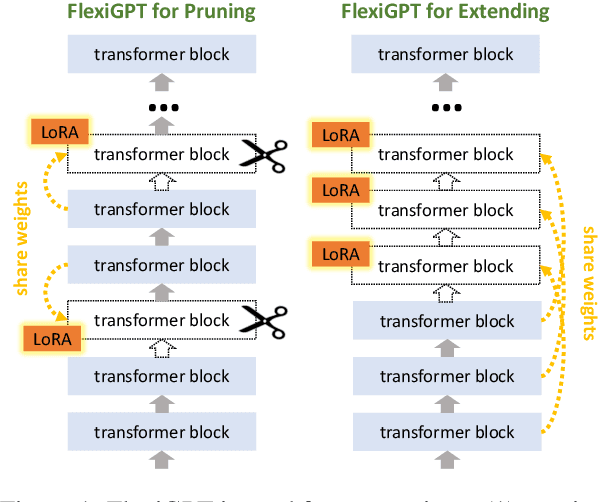
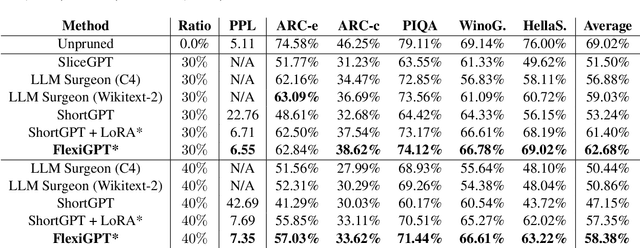


The rapid proliferation of large language models (LLMs) in natural language processing (NLP) has created a critical need for techniques that enable efficient deployment on memory-constrained devices without compromising performance. We present a method to prune LLMs that selectively prunes model blocks based on an importance score and replaces them with a low-parameter replacement strategy. Specifically, we propose a principled metric to replace each pruned block using a weight-sharing mechanism that leverages unpruned counterparts from the model and block-specific low-rank adapters. Furthermore, we facilitate the learning of these replacement blocks with output feature normalization and an adapter initialization scheme built on low-rank SVD reconstructions. Empirical evaluations demonstrate substantial performance gains over existing methods, achieving state-of-the-art performance on 5/6 benchmarks for a compression rate of 30% and 6/6 benchmarks for a compression rate of 40%. We also demonstrate that our approach can extend smaller models, boosting performance on 6/6 benchmarks using only ~0.3% tokens of extended training with minimal additional parameter costs.
DISP-LLM: Dimension-Independent Structural Pruning for Large Language Models
Oct 15, 2024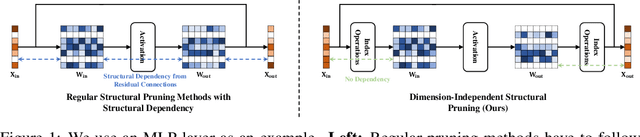
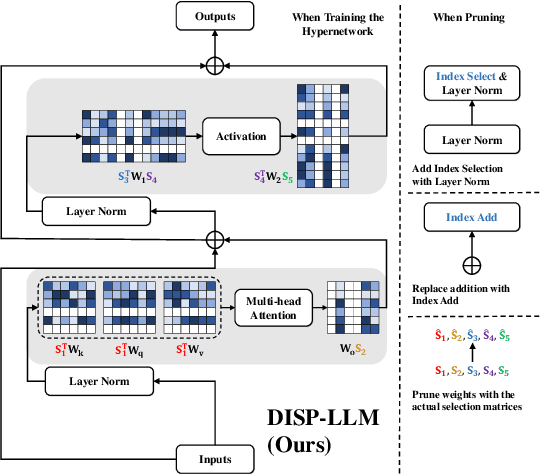
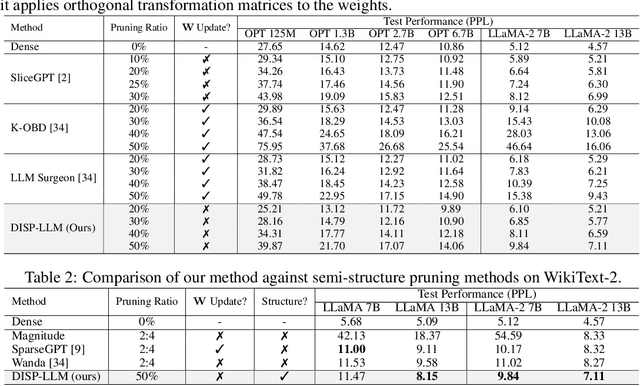
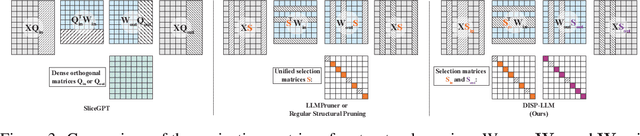
Large Language Models (LLMs) have achieved remarkable success in various natural language processing tasks, including language modeling, understanding, and generation. However, the increased memory and computational costs associated with these models pose significant challenges for deployment on resource-limited devices. Structural pruning has emerged as a promising solution to reduce the costs of LLMs without requiring post-processing steps. Prior structural pruning methods either follow the dependence of structures at the cost of limiting flexibility, or introduce non-trivial additional parameters by incorporating different projection matrices. In this work, we propose a novel approach that relaxes the constraint imposed by regular structural pruning methods and eliminates the structural dependence along the embedding dimension. Our dimension-independent structural pruning method offers several benefits. Firstly, our method enables different blocks to utilize different subsets of the feature maps. Secondly, by removing structural dependence, we facilitate each block to possess varying widths along its input and output dimensions, thereby significantly enhancing the flexibility of structural pruning. We evaluate our method on various LLMs, including OPT, LLaMA, LLaMA-2, Phi-1.5, and Phi-2. Experimental results demonstrate that our approach outperforms other state-of-the-art methods, showing for the first time that structural pruning can achieve an accuracy similar to semi-structural pruning.
MoDeGPT: Modular Decomposition for Large Language Model Compression
Aug 20, 2024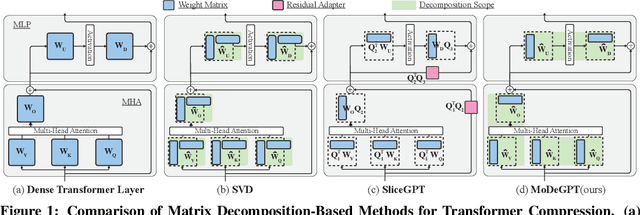
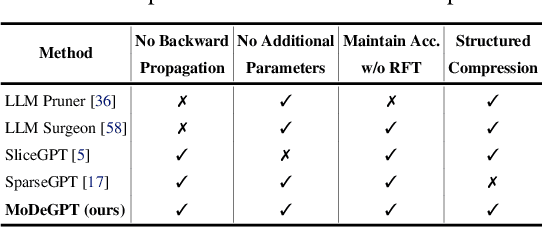
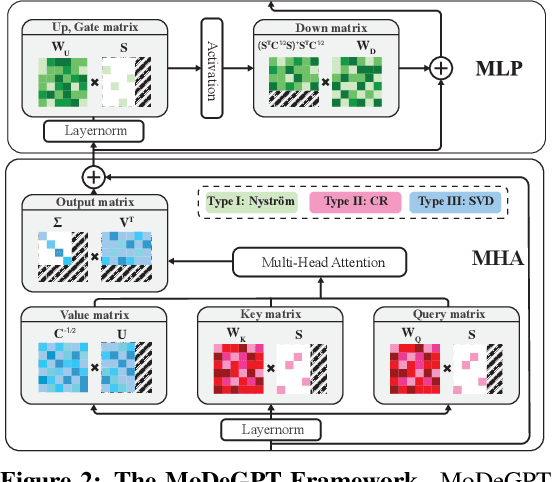
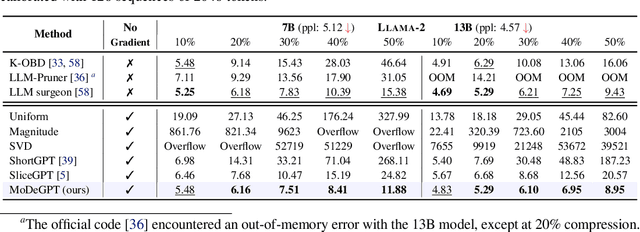
Large Language Models (LLMs) have reshaped the landscape of artificial intelligence by demonstrating exceptional performance across various tasks. However, substantial computational requirements make their deployment challenging on devices with limited resources. Recently, compression methods using low-rank matrix techniques have shown promise, yet these often lead to degraded accuracy or introduce significant overhead in parameters and inference latency. This paper introduces \textbf{Mo}dular \textbf{De}composition (MoDeGPT), a novel structured compression framework that does not need recovery fine-tuning while resolving the above drawbacks. MoDeGPT partitions the Transformer block into modules comprised of matrix pairs and reduces the hidden dimensions via reconstructing the module-level outputs. MoDeGPT is developed based on a theoretical framework that utilizes three well-established matrix decomposition algorithms -- Nystr\"om approximation, CR decomposition, and SVD -- and applies them to our redefined transformer modules. Our comprehensive experiments show MoDeGPT, without backward propagation, matches or surpasses previous structured compression methods that rely on gradient information, and saves 98% of compute costs on compressing a 13B model. On \textsc{Llama}-2/3 and OPT models, MoDeGPT maintains 90-95% zero-shot performance with 25-30% compression rates. Moreover, the compression can be done on a single GPU within a few hours and increases the inference throughput by up to 46%.
DynaMo: Accelerating Language Model Inference with Dynamic Multi-Token Sampling
May 01, 2024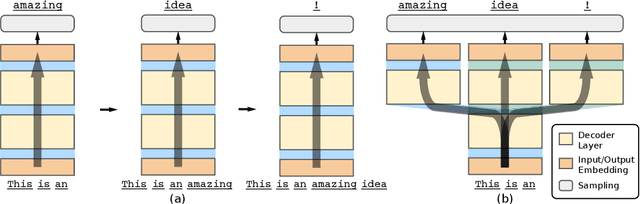
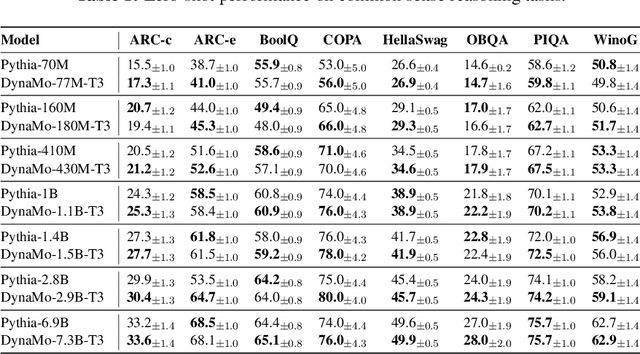
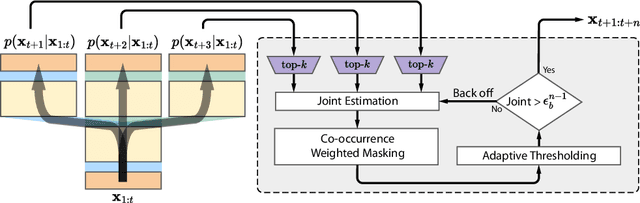
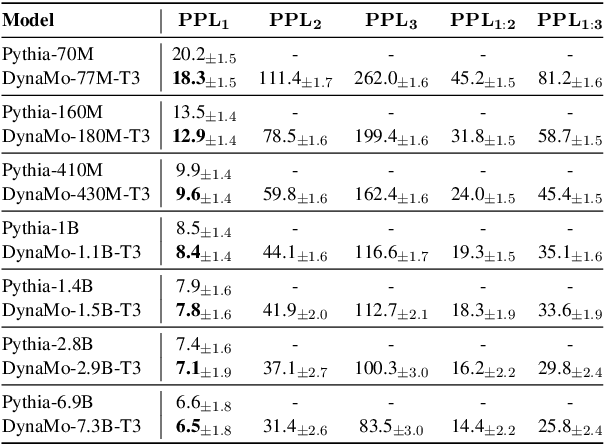
Traditional language models operate autoregressively, i.e., they predict one token at a time. Rapid explosion in model sizes has resulted in high inference times. In this work, we propose DynaMo, a suite of multi-token prediction language models that reduce net inference times. Our models $\textit{dynamically}$ predict multiple tokens based on their confidence in the predicted joint probability distribution. We propose a lightweight technique to train these models, leveraging the weights of traditional autoregressive counterparts. Moreover, we propose novel ways to enhance the estimated joint probability to improve text generation quality, namely co-occurrence weighted masking and adaptive thresholding. We also propose systematic qualitative and quantitative methods to rigorously test the quality of generated text for non-autoregressive generation. One of the models in our suite, DynaMo-7.3B-T3, achieves same-quality generated text as the baseline (Pythia-6.9B) while achieving 2.57$\times$ speed-up with only 5.87% and 2.67% parameter and training time overheads, respectively.
Balanced Data, Imbalanced Spectra: Unveiling Class Disparities with Spectral Imbalance
Feb 18, 2024


Classification models are expected to perform equally well for different classes, yet in practice, there are often large gaps in their performance. This issue of class bias is widely studied in cases of datasets with sample imbalance, but is relatively overlooked in balanced datasets. In this work, we introduce the concept of spectral imbalance in features as a potential source for class disparities and study the connections between spectral imbalance and class bias in both theory and practice. To build the connection between spectral imbalance and class gap, we develop a theoretical framework for studying class disparities and derive exact expressions for the per-class error in a high-dimensional mixture model setting. We then study this phenomenon in 11 different state-of-the-art pretrained encoders and show how our proposed framework can be used to compare the quality of encoders, as well as evaluate and combine data augmentation strategies to mitigate the issue. Our work sheds light on the class-dependent effects of learning, and provides new insights into how state-of-the-art pretrained features may have unknown biases that can be diagnosed through their spectra.