 Add to Chrome
 Add to Firefox
 Add to Edge
MUGEN: A Unified Framework for Efficient Motion Understanding and Generation
Jul 30, 2026
Grounding human motion in language, and language in motion, is a central step toward physical AI systems that can understand, generate, and communicate human behavior. Unified motion--language systems first coupled the two directions through a shared discrete motion codebook, but quantization limits generation quality. The strongest generators buy quality back at growing cost: stacked residual codebooks enlarge the representation; masked decoding stages, long autoregressive rollouts, and denoising chains of tens to hundreds of steps stretch inference; even the continuous-latent designs among them reach their latent only through an iterative diffusion head; and none of this decoding machinery serves understanding. We therefore propose MUGEN, a unified motion--language framework that pays neither cost: no codebook, one draw. A single adaptive-length autoencoder compresses any-length motion into a few continuous latent slots, the system's only motion representation: the language model generates them for text-to-motion and reads them back for motion understanding. Depth-routed hidden states let each slot read from the transformer depth it needs, and a calibrated head predicts a joint distribution over the full latent set, so a single draw carries the text-conditional, cross-slot variation a description permits. At a decoding cost of K language-model steps, one draw, and one decoder pass, MUGEN leads language-model baselines on FID on HumanML3D while raising retrieval precision above the real-motion reference under the standard evaluator, achieves the best CIDEr and BLEU@4 scores, and surpasses the discrete-token state of the art on every retrieval and alignment metric on SnapMoGen.

GSPan: A Continuous Gaussian Primitive Representation for Arbitrary-Scale Pansharpening
Jun 16, 2026Pansharpening aims to generate high-resolution multispectral (HRMS) images by fusing low-resolution multispectral (LRMS) and panchromatic (PAN) observations. Most existing deep learning methods treat pansharpening as fixed-grid prediction, which limits scale adaptation. To address this, we propose GSPan, a framework that introduces 2D Gaussian Splatting (GS) into pansharpening. Instead of directly predicting pixels, GSPan represents band-wise residual details as continuous and learnable 2D Gaussian primitives. We design a Dual-Stream Hierarchical Interaction (DSHI) architecture with a Spatial-Spectral Interactive Attention (SSIA) module to estimate these primitives from complementary PAN and MS observations. The predicted primitives are rendered as a residual detail field and injected into the upsampled MS image. This continuous representation allows GSPan to render fused images on arbitrary target sampling grids without scale-specific retraining. It further enables a Scale-Decoupled Asymmetric Inference (SDAI) strategy, which estimates primitives at a reduced resolution and renders the fused image at the target resolution for efficient large-scene pansharpening. Experiments on QuickBird, GaoFen-2, WorldView-3, and WorldView-3-4K datasets show that GSPan delivers state-of-the-art fusion performance. Moreover, SDAI markedly accelerates inference, achieving a favorable trade-off between computational efficiency and fusion quality. Our results demonstrate the potential of continuous Gaussian residual representations as a flexible and scale-decoupled alternative to fixed-grid prediction.
ToMoE: Converting Dense Large Language Models to Mixture-of-Experts through Dynamic Structural Pruning
Jan 25, 2025Large Language Models (LLMs) have demonstrated remarkable abilities in tackling a wide range of complex tasks. However, their huge computational and memory costs raise significant challenges in deploying these models on resource-constrained devices or efficiently serving them. Prior approaches have attempted to alleviate these problems by permanently removing less important model structures, yet these methods often result in substantial performance degradation due to the permanent deletion of model parameters. In this work, we tried to mitigate this issue by reducing the number of active parameters without permanently removing them. Specifically, we introduce a differentiable dynamic pruning method that pushes dense models to maintain a fixed number of active parameters by converting their MLP layers into a Mixture of Experts (MoE) architecture. Our method, even without fine-tuning, consistently outperforms previous structural pruning techniques across diverse model families, including Phi-2, LLaMA-2, LLaMA-3, and Qwen-2.5.
All-in-One Tuning and Structural Pruning for Domain-Specific LLMs
Dec 19, 2024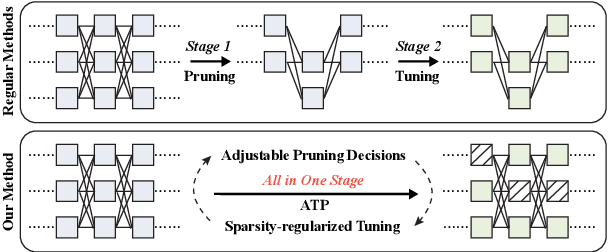

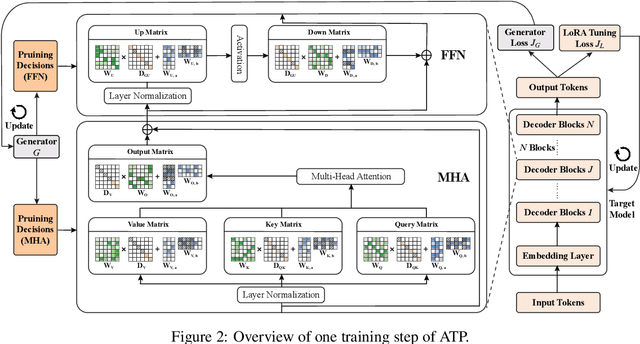

Existing pruning techniques for large language models (LLMs) targeting domain-specific applications typically follow a two-stage process: pruning the pretrained general-purpose LLMs and then fine-tuning the pruned LLMs on specific domains. However, the pruning decisions, derived from the pretrained weights, remain unchanged during fine-tuning, even if the weights have been updated. Therefore, such a combination of the pruning decisions and the finetuned weights may be suboptimal, leading to non-negligible performance degradation. To address these limitations, we propose ATP: All-in-One Tuning and Structural Pruning, a unified one-stage structural pruning and fine-tuning approach that dynamically identifies the current optimal substructure throughout the fine-tuning phase via a trainable pruning decision generator. Moreover, given the limited available data for domain-specific applications, Low-Rank Adaptation (LoRA) becomes a common technique to fine-tune the LLMs. In ATP, we introduce LoRA-aware forward and sparsity regularization to ensure that the substructures corresponding to the learned pruning decisions can be directly removed after the ATP process. ATP outperforms the state-of-the-art two-stage pruning methods on tasks in the legal and healthcare domains. More specifically, ATP recovers up to 88% and 91% performance of the dense model when pruning 40% parameters of LLaMA2-7B and LLaMA3-8B models, respectively.
Relational Pretrained Transformers towards Democratizing Data Preparation [Vision]
Dec 04, 2020![Figure 1 for Relational Pretrained Transformers towards Democratizing Data Preparation [Vision]](/_next/image?url=https%3A%2F%2Fai2-s2-public.s3.amazonaws.com%2Ffigures%2F2017-08-08%2Fd51bec1426494f23de57b2c4184c7e26583eda53%2F1-Figure1-1.png&w=640&q=75)
![Figure 2 for Relational Pretrained Transformers towards Democratizing Data Preparation [Vision]](/_next/image?url=https%3A%2F%2Fai2-s2-public.s3.amazonaws.com%2Ffigures%2F2017-08-08%2Fd51bec1426494f23de57b2c4184c7e26583eda53%2F4-Table1-1.png&w=640&q=75)
![Figure 3 for Relational Pretrained Transformers towards Democratizing Data Preparation [Vision]](/_next/image?url=https%3A%2F%2Fai2-s2-public.s3.amazonaws.com%2Ffigures%2F2017-08-08%2Fd51bec1426494f23de57b2c4184c7e26583eda53%2F3-Figure2-1.png&w=640&q=75)
![Figure 4 for Relational Pretrained Transformers towards Democratizing Data Preparation [Vision]](/_next/image?url=https%3A%2F%2Fai2-s2-public.s3.amazonaws.com%2Ffigures%2F2017-08-08%2Fd51bec1426494f23de57b2c4184c7e26583eda53%2F6-Table2-1.png&w=640&q=75)
Can AI help automate human-easy but computer-hard data preparation tasks (for example, data cleaning, data integration, and information extraction), which currently heavily involve data scientists, practitioners, and crowd workers? We envision that human-easy data preparation for relational data can be automated. To this end, we first identify the desiderata for computers to achieve near-human intelligence for data preparation: computers need a deep-learning architecture (or model) that can read and understand millions of tables; computers require unsupervised learning to perform self-learning without labeled data, and can gain knowledge from existing tasks and previous experience; and computers desire few-shot learn-ing that can adjust to new tasks with a few examples. Our proposal is called Relational Pretrained Transformers (RPTs), a general frame-work for various data preparation tasks, which typically consists of the following models/methods: (1) transformer, a general and powerful deep-learning model, that can read tables/texts/images;(2) masked language model for self-learning and collaborative train-ing for transferring knowledge and experience; and (3) pattern-exploiting training that better interprets a task from a few examples.We further present concrete RPT architectures for three classical data preparation tasks, namely data cleaning, entity resolution, and information extraction. We demonstrate RPTs with some initial yet promising results. Last but not least, we identify activities that will unleash a series of research opportunities to push forward the field of data preparation.