 Add to Chrome
 Add to Firefox
 Add to Edge
J-Miner: Recovering Executable Decision Knowledge from Language-Model Classifiers
Aug 17, 2026
Large language models can be fine-tuned into specialized classifiers that perform well across diverse text tasks and make complex judgments, but they typically expose only final labels, leaving the decision knowledge acquired through fine-tuning implicit within the model. We study how to mine this internal decision knowledge from a fine-tuned classifier and encode it in an executable representation that can be inspected, validated, and reused beyond the source classifier. We introduce J-Miner, which mines text-level named concepts by aggregating vocabulary-aligned internal signals across layers and token positions, and uses the classifier's own predictions to learn executable decision rules over them. This process distills local internal readouts into an explicit classifier-level knowledge representation. Across multiple classification tasks, J-Miner rules reproduce up to 98.3\% of source-classifier decisions and achieve 6.0--29.5 percentage points higher behavioral fidelity than equally compact rules learned from input words. Further analysis shows that the named concepts reflect internal semantic evidence associated with task decisions, while the learned rules consolidate these distributed signals into inspectable decision structures. The resulting decision knowledge also transfers to lightweight standalone students: using about 1/24 as many parameters as the source classifiers, they reconstruct and execute the representation from raw text while retaining 99.8\% of the source classifiers' mean task accuracy. These findings show that task-specific decision knowledge can be faithfully represented in an explicit, executable form and reused beyond the classifier in which it was learned.

PLSQLBench: Benchmarking LLM Systems for Executable Procedural Database Programming
Aug 16, 2026We present PLSQLBench, to our knowledge the first benchmark for evaluating whether LLMs can write executable PL/SQL programs, with correctness measured through execution-based tests. Existing LLM evaluations largely target general-purpose code generation or declarative text-to-SQL, leaving procedural database programming underexplored. PLSQLBench contains 2,865 instances: 2,594 single-turn tasks and 271 multi-turn conversations spanning 978 turns. The benchmark combines complex schema-grounded tasks over enterprise-style Spider 2 databases, simpler schema-grounded tasks derived from Spider, and MBPP-derived procedural problems, covering varying levels of database grounding and procedural complexity. Experiments with eight LLMs reveal recurring difficulties in schema grounding, PL/SQL dialect fidelity, procedural control flow, exception handling, and cross-turn consistency. Tool-augmented LLM agents improve performance on several schema-grounded evaluations, although substantial gaps remain. These results highlight procedural database programming capabilities not directly assessed by conventional code generation or text-to-SQL benchmarks. Our code is available at https://github.com/oracle-samples/plsqlbench.
SOMA-SQL: Resolving Multi-Source Ambiguity in NL-to-SQL via Synthetic Log and Execution Probing
Jun 09, 2026Natural language interfaces to databases aim to translate user questions into executable SQL, yet remain brittle in real-world settings where questions are underspecified and schemas are large and ambiguous. Ambiguity across user questions, database schemas, and model interpretations are central failure modes in NL2SQL, leading to misaligned intent, incorrect schema grounding, and erroneous SQL generation. Existing approaches rely on human clarification or treat ambiguity as a schema representation problem, but these do not scale nor resolve ambiguity autonomously. We propose SOMA-SQL to automatically resolve ambiguity via targeted synthetic query log and ambiguity-driven probing. SOMA-SQL constructs synthetic query log to ground schema interpretation and guide candidate SQL generation; it then executes targeted probing queries, driven by a structured ambiguity taxonomy and candidate disagreements, to produce disambiguation evidence for final SQL selection and repair. This active approach to ambiguity discovery and resolution generalizes across unseen schemas and query distributions without human-in-the-loop. Experiments on six public benchmarks demonstrate that SOMA-SQL improves execution accuracy by 13.0% on average over state-of-the-art baselines, with gains of up to 16.7% on ambiguous questions.
Do Image-Text Metrics Respect Semantic Invariances?
May 23, 2026Reference-free image-to-text evaluators are now standard for scoring image-caption alignment, yet it is unclear whether they respect semantic invariances. We present an invariance probe on five popular evaluators (CLIPScore, PAC-S, UMIC, FLEUR, and a deterministic LLM judge) under semantics-preserving perturbations along three axes -- spatial (flips, context-preserving repositioning, light rotations), object (scale, category), and socio-linguistic framing (cultural/economic adjectives with neutral and length-matched controls). Across curated slices of three detection datasets and three caption evaluation suites, we find consistent non-semantic sensitivities, where benign spatial edits and simple phrasing changes shift scores by $\approx$6--9\% on average, and for systems separated by just 0.7\%, these shifts can cause ranking flips in up to $\sim$37\% of cases, particularly under spatial changes. A small human study also supports this finding and confirms that annotators generally judge perturbed pairs as equally correct, so these shifts reflect metric behavior rather than semantic change. We further propose invariance-calibrated scoring, a post-hoc adjustment that roughly halves median absolute sensitivity while retaining correlation with learned caption evaluators.
Robust Audio-Text Retrieval via Cross-Modal Attention and Hybrid Loss
Apr 25, 2026Audio-text retrieval enables semantic alignment between audio content and natural language queries, supporting applications in multimedia search, accessibility, and surveillance. However, current state-of-the-art approaches struggle with long, noisy, and weakly labeled audio due to their reliance on contrastive learning and large-batch training. We propose a novel multimodal retrieval framework that refines audio and text embeddings using a cross-modal embedding refinement module combining transformer-based projection, linear mapping, and bidirectional attention. To further improve robustness, we introduce a hybrid loss function blending cosine similarity, $\mathcal{L}_{1}$, and contrastive objectives, enabling stable training even under small-batch constraints. Our approach efficiently handles long-form and noisy audio (SNR 5 to 15) via silence-aware chunking and attention-based pooling. Experiments on benchmark datasets demonstrate improvements over prior methods.
Au-M-ol: A Unified Model for Medical Audio and Language Understanding
Apr 25, 2026In this work, we present Au-M-ol, a novel multimodal architecture that extends Large Language Models (LLMs) with audio processing. It is designed to improve performance on clinically relevant tasks such as Automatic Speech Recognition (ASR). Au-M-ol has three main components: (1) an audio encoder that extracts rich acoustic features from medical speech, (2) an adaptation layer that maps audio features into the LLM input space, and (3) a pretrained LLM that performs transcription and clinical language understanding. This design allows the model to interpret spoken medical content directly, improving both accuracy and robustness. In experiments, Au-M-ol reduces Word Error Rate (WER) by 56\% compared to state-of-the-art baselines on medical transcription tasks. The model also performs well in challenging conditions, including noisy environments, domain-specific terminology, and speaker variability. These results suggest that Au-M-ol is a strong candidate for real-world clinical applications, where reliable and context-aware audio understanding is essential.
PAR$^2$-RAG: Planned Active Retrieval and Reasoning for Multi-Hop Question Answering
Mar 30, 2026Large language models (LLMs) remain brittle on multi-hop question answering (MHQA), where answering requires combining evidence across documents through retrieval and reasoning. Iterative retrieval systems can fail by locking onto an early low-recall trajectory and amplifying downstream errors, while planning-only approaches may produce static query sets that cannot adapt when intermediate evidence changes. We propose \textbf{Planned Active Retrieval and Reasoning RAG (PAR$^2$-RAG)}, a two-stage framework that separates \emph{coverage} from \emph{commitment}. PAR$^2$-RAG first performs breadth-first anchoring to build a high-recall evidence frontier, then applies depth-first refinement with evidence sufficiency control in an iterative loop. Across four MHQA benchmarks, PAR$^2$-RAG consistently outperforms existing state-of-the-art baselines, compared with IRCoT, PAR$^2$-RAG achieves up to \textbf{23.5\%} higher accuracy, with retrieval gains of up to \textbf{10.5\%} in NDCG.
GraphER: An Efficient Graph-Based Enrichment and Reranking Method for Retrieval-Augmented Generation
Mar 26, 2026Semantic search in retrieval-augmented generation (RAG) systems is often insufficient for complex information needs, particularly when relevant evidence is scattered across multiple sources. Prior approaches to this problem include agentic retrieval strategies, which expand the semantic search space by generating additional queries. However, these methods do not fully leverage the organizational structure of the data and instead rely on iterative exploration, which can lead to inefficient retrieval. Another class of approaches employs knowledge graphs to model non-semantic relationships through graph edges. Although effective in capturing richer proximities, such methods incur significant maintenance costs and are often incompatible with the vector stores used in most production systems. To address these limitations, we propose GraphER, a graph-based enrichment and reranking method that captures multiple forms of proximity beyond semantic similarity. GraphER independently enriches data objects during offline indexing and performs graph-based reranking over candidate objects at query time. This design does not require a knowledge graph, allowing GraphER to integrate seamlessly with standard vector stores. In addition, GraphER is retriever-agnostic and introduces negligible latency overhead. Experiments on multiple retrieval benchmarks demonstrate the effectiveness of the proposed approach.
LLM NL2SQL Robustness: Surface Noise vs. Linguistic Variation in Traditional and Agentic Settings
Mar 17, 2026Robustness evaluation for Natural Language to SQL (NL2SQL) systems is essential because real-world database environments are dynamic, noisy, and continuously evolving, whereas conventional benchmark evaluations typically assume static schemas and well-formed user inputs. In this work, we introduce a robustness evaluation benchmark containing approximately ten types of perturbations and conduct evaluations under both traditional and agentic settings. We assess multiple state-of-the-art large language models (LLMs), including Grok-4.1, Gemini-3-Pro, Claude-Opus-4.6, and GPT-5.2. Our results show that these models generally maintain strong performance under several perturbations; however, notable performance degradation is observed for surface-level noise (e.g., character-level corruption) and linguistic variation that preserves semantics while altering lexical or syntactic forms. Furthermore, we observe that surface-level noise causes larger performance drops in traditional pipelines, whereas linguistic variation presents greater challenges in agentic settings. These findings highlight the remaining challenges in achieving robust NL2SQL systems, particularly in handling linguistic variability.
LAD-RAG: Layout-aware Dynamic RAG for Visually-Rich Document Understanding
Oct 08, 2025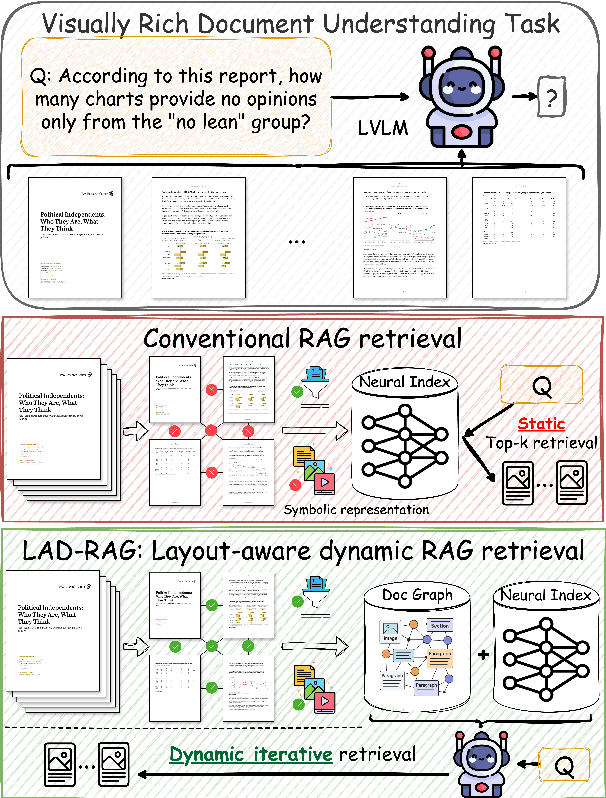
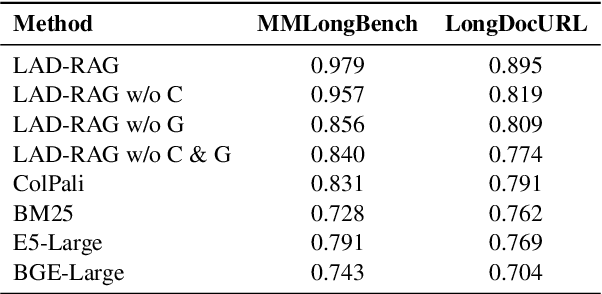
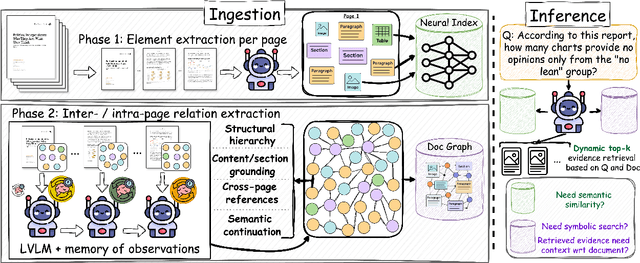
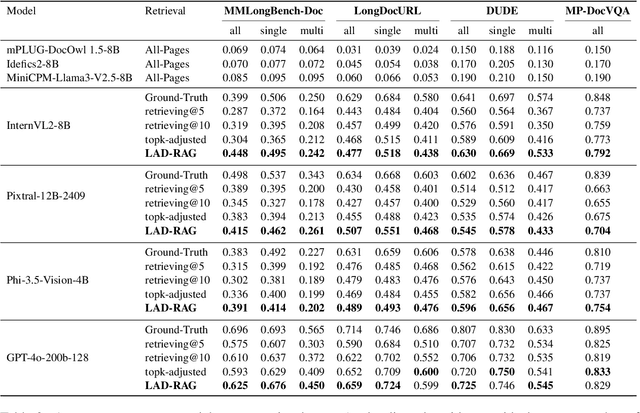
Question answering over visually rich documents (VRDs) requires reasoning not only over isolated content but also over documents' structural organization and cross-page dependencies. However, conventional retrieval-augmented generation (RAG) methods encode content in isolated chunks during ingestion, losing structural and cross-page dependencies, and retrieve a fixed number of pages at inference, regardless of the specific demands of the question or context. This often results in incomplete evidence retrieval and degraded answer quality for multi-page reasoning tasks. To address these limitations, we propose LAD-RAG, a novel Layout-Aware Dynamic RAG framework. During ingestion, LAD-RAG constructs a symbolic document graph that captures layout structure and cross-page dependencies, adding it alongside standard neural embeddings to yield a more holistic representation of the document. During inference, an LLM agent dynamically interacts with the neural and symbolic indices to adaptively retrieve the necessary evidence based on the query. Experiments on MMLongBench-Doc, LongDocURL, DUDE, and MP-DocVQA demonstrate that LAD-RAG improves retrieval, achieving over 90% perfect recall on average without any top-k tuning, and outperforming baseline retrievers by up to 20% in recall at comparable noise levels, yielding higher QA accuracy with minimal latency.