 Add to Chrome
 Add to Firefox
 Add to Edge
Do Image-Text Metrics Respect Semantic Invariances?
May 23, 2026
Reference-free image-to-text evaluators are now standard for scoring image-caption alignment, yet it is unclear whether they respect semantic invariances. We present an invariance probe on five popular evaluators (CLIPScore, PAC-S, UMIC, FLEUR, and a deterministic LLM judge) under semantics-preserving perturbations along three axes -- spatial (flips, context-preserving repositioning, light rotations), object (scale, category), and socio-linguistic framing (cultural/economic adjectives with neutral and length-matched controls). Across curated slices of three detection datasets and three caption evaluation suites, we find consistent non-semantic sensitivities, where benign spatial edits and simple phrasing changes shift scores by $\approx$6--9\% on average, and for systems separated by just 0.7\%, these shifts can cause ranking flips in up to $\sim$37\% of cases, particularly under spatial changes. A small human study also supports this finding and confirms that annotators generally judge perturbed pairs as equally correct, so these shifts reflect metric behavior rather than semantic change. We further propose invariance-calibrated scoring, a post-hoc adjustment that roughly halves median absolute sensitivity while retaining correlation with learned caption evaluators.

Lightweight and Production-Ready PDF Visual Element Parsing
Apr 25, 2026PDF documents contain critical visual elements such as figures, tables, and forms whose accurate extraction is essential for document understanding and multimodal retrieval-augmented generation (RAG). Existing PDF parsers often miss complex visuals, extract non-informative artifacts (e.g., watermarks, logos), produce fragmented elements, and fail to reliably associate captions with their corresponding elements, which degrades downstream retrieval and question answering. We present a lightweight and production level PDF parsing framework that can accurately detect visual elements and associates captions using a combination of spatial heuristics, layout analysis, and semantic similarity. On popular benchmark datasets and internal product data, the proposed solution achieves $\geq96\%$ visual element detection accuracy and $93\%$ caption association accuracy. When used as a preprocessing step for multimodal RAG, it significantly outperforms state-of-the-art parsers and large vision-language models on both internal data and the MMDocRAG benchmark, while reducing latency by over $2\times$. We have deployed the proposed system in challenging production environment.
Au-M-ol: A Unified Model for Medical Audio and Language Understanding
Apr 25, 2026In this work, we present Au-M-ol, a novel multimodal architecture that extends Large Language Models (LLMs) with audio processing. It is designed to improve performance on clinically relevant tasks such as Automatic Speech Recognition (ASR). Au-M-ol has three main components: (1) an audio encoder that extracts rich acoustic features from medical speech, (2) an adaptation layer that maps audio features into the LLM input space, and (3) a pretrained LLM that performs transcription and clinical language understanding. This design allows the model to interpret spoken medical content directly, improving both accuracy and robustness. In experiments, Au-M-ol reduces Word Error Rate (WER) by 56\% compared to state-of-the-art baselines on medical transcription tasks. The model also performs well in challenging conditions, including noisy environments, domain-specific terminology, and speaker variability. These results suggest that Au-M-ol is a strong candidate for real-world clinical applications, where reliable and context-aware audio understanding is essential.
Robust Audio-Text Retrieval via Cross-Modal Attention and Hybrid Loss
Apr 25, 2026Audio-text retrieval enables semantic alignment between audio content and natural language queries, supporting applications in multimedia search, accessibility, and surveillance. However, current state-of-the-art approaches struggle with long, noisy, and weakly labeled audio due to their reliance on contrastive learning and large-batch training. We propose a novel multimodal retrieval framework that refines audio and text embeddings using a cross-modal embedding refinement module combining transformer-based projection, linear mapping, and bidirectional attention. To further improve robustness, we introduce a hybrid loss function blending cosine similarity, $\mathcal{L}_{1}$, and contrastive objectives, enabling stable training even under small-batch constraints. Our approach efficiently handles long-form and noisy audio (SNR 5 to 15) via silence-aware chunking and attention-based pooling. Experiments on benchmark datasets demonstrate improvements over prior methods.
Political Posters Identification with Appearance-Text Fusion
Dec 19, 2020
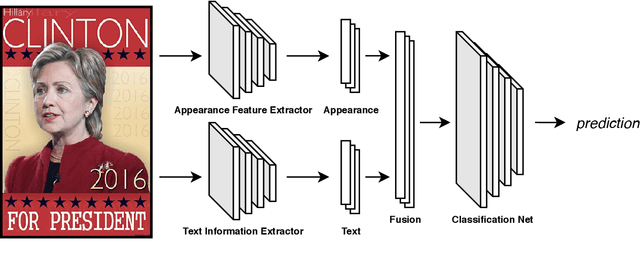
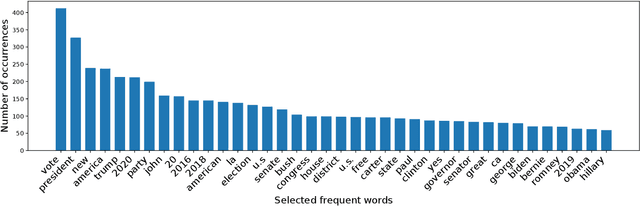

In this paper, we propose a method that efficiently utilizes appearance features and text vectors to accurately classify political posters from other similar political images. The majority of this work focuses on political posters that are designed to serve as a promotion of a certain political event, and the automated identification of which can lead to the generation of detailed statistics and meets the judgment needs in a variety of areas. Starting with a comprehensive keyword list for politicians and political events, we curate for the first time an effective and practical political poster dataset containing 13K human-labeled political images, including 3K political posters that explicitly support a movement or a campaign. Second, we make a thorough case study for this dataset and analyze common patterns and outliers of political posters. Finally, we propose a model that combines the power of both appearance and text information to classify political posters with significantly high accuracy.
Nationality Classification Using Name Embeddings
Aug 25, 2017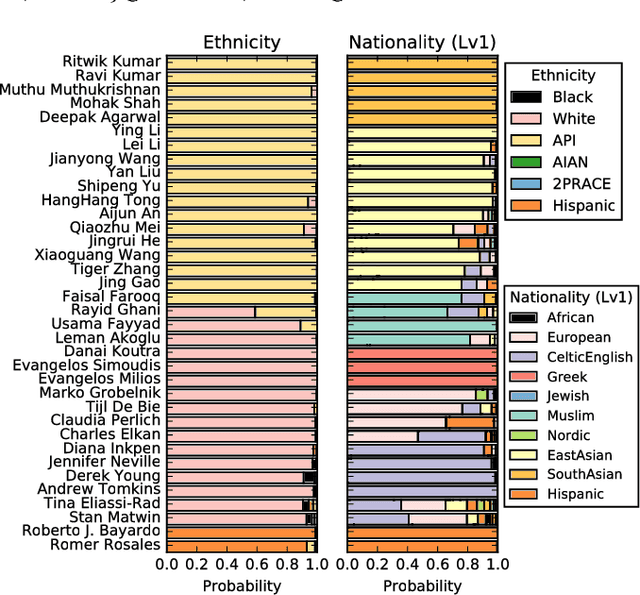
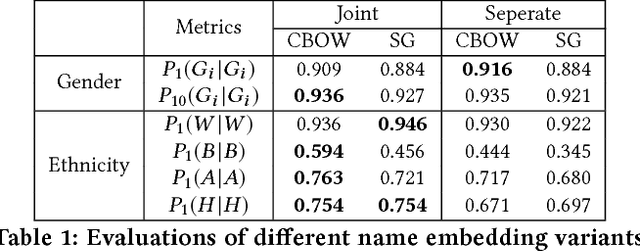
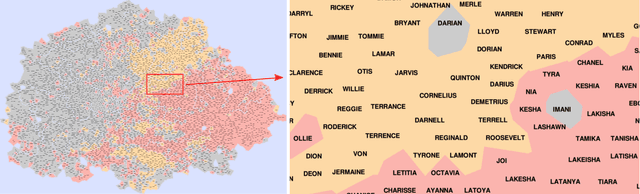
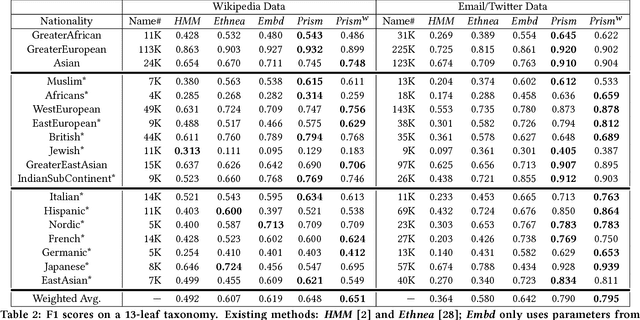
Nationality identification unlocks important demographic information, with many applications in biomedical and sociological research. Existing name-based nationality classifiers use name substrings as features and are trained on small, unrepresentative sets of labeled names, typically extracted from Wikipedia. As a result, these methods achieve limited performance and cannot support fine-grained classification. We exploit the phenomena of homophily in communication patterns to learn name embeddings, a new representation that encodes gender, ethnicity, and nationality which is readily applicable to building classifiers and other systems. Through our analysis of 57M contact lists from a major Internet company, we are able to design a fine-grained nationality classifier covering 39 groups representing over 90% of the world population. In an evaluation against other published systems over 13 common classes, our F1 score (0.795) is substantial better than our closest competitor Ethnea (0.580). To the best of our knowledge, this is the most accurate, fine-grained nationality classifier available. As a social media application, we apply our classifiers to the followers of major Twitter celebrities over six different domains. We demonstrate stark differences in the ethnicities of the followers of Trump and Obama, and in the sports and entertainments favored by different groups. Finally, we identify an anomalous political figure whose presumably inflated following appears largely incapable of reading the language he posts in.
Coarse-to-Fine Classification via Parametric and Nonparametric Models for Computer-Aided Diagnosis
May 16, 2014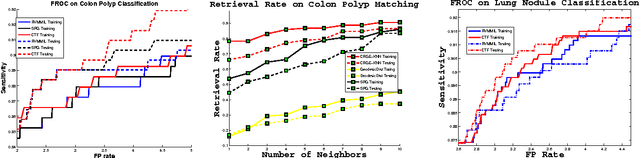
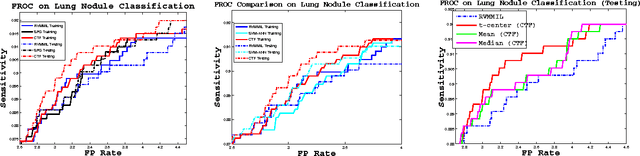
Classification is one of the core problems in Computer-Aided Diagnosis (CAD), targeting for early cancer detection using 3D medical imaging interpretation. High detection sensitivity with desirably low false positive (FP) rate is critical for a CAD system to be accepted as a valuable or even indispensable tool in radiologists' workflow. Given various spurious imagery noises which cause observation uncertainties, this remains a very challenging task. In this paper, we propose a novel, two-tiered coarse-to-fine (CTF) classification cascade framework to tackle this problem. We first obtain classification-critical data samples (e.g., samples on the decision boundary) extracted from the holistic data distributions using a robust parametric model (e.g., \cite{Raykar08}); then we build a graph-embedding based nonparametric classifier on sampled data, which can more accurately preserve or formulate the complex classification boundary. These two steps can also be considered as effective "sample pruning" and "feature pursuing + $k$NN/template matching", respectively. Our approach is validated comprehensively in colorectal polyp detection and lung nodule detection CAD systems, as the top two deadly cancers, using hospital scale, multi-site clinical datasets. The results show that our method achieves overall better classification/detection performance than existing state-of-the-art algorithms using single-layer classifiers, such as the support vector machine variants \cite{Wang08}, boosting \cite{Slabaugh10}, logistic regression \cite{Ravesteijn10}, relevance vector machine \cite{Raykar08}, $k$-nearest neighbor \cite{Murphy09} or spectral projections on graph \cite{Cai08}.
Semantic Context Forests for Learning-Based Knee Cartilage Segmentation in 3D MR Images
Apr 22, 2014
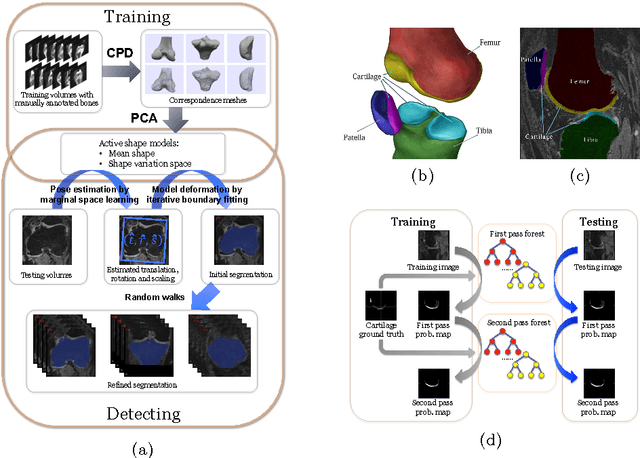
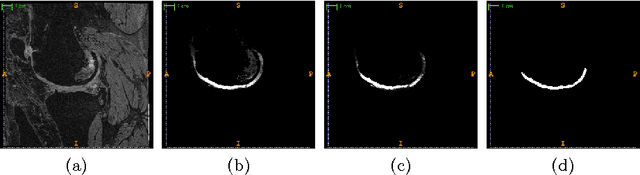
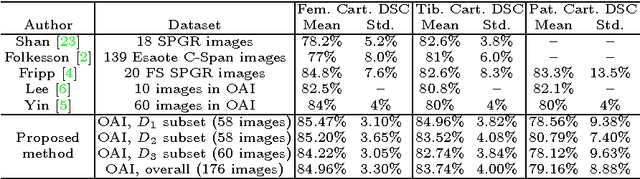
The automatic segmentation of human knee cartilage from 3D MR images is a useful yet challenging task due to the thin sheet structure of the cartilage with diffuse boundaries and inhomogeneous intensities. In this paper, we present an iterative multi-class learning method to segment the femoral, tibial and patellar cartilage simultaneously, which effectively exploits the spatial contextual constraints between bone and cartilage, and also between different cartilages. First, based on the fact that the cartilage grows in only certain area of the corresponding bone surface, we extract the distance features of not only to the surface of the bone, but more informatively, to the densely registered anatomical landmarks on the bone surface. Second, we introduce a set of iterative discriminative classifiers that at each iteration, probability comparison features are constructed from the class confidence maps derived by previously learned classifiers. These features automatically embed the semantic context information between different cartilages of interest. Validated on a total of 176 volumes from the Osteoarthritis Initiative (OAI) dataset, the proposed approach demonstrates high robustness and accuracy of segmentation in comparison with existing state-of-the-art MR cartilage segmentation methods.