 Add to Chrome
 Add to Firefox
 Add to Edge
GraphER: An Efficient Graph-Based Enrichment and Reranking Method for Retrieval-Augmented Generation
Mar 26, 2026
Semantic search in retrieval-augmented generation (RAG) systems is often insufficient for complex information needs, particularly when relevant evidence is scattered across multiple sources. Prior approaches to this problem include agentic retrieval strategies, which expand the semantic search space by generating additional queries. However, these methods do not fully leverage the organizational structure of the data and instead rely on iterative exploration, which can lead to inefficient retrieval. Another class of approaches employs knowledge graphs to model non-semantic relationships through graph edges. Although effective in capturing richer proximities, such methods incur significant maintenance costs and are often incompatible with the vector stores used in most production systems. To address these limitations, we propose GraphER, a graph-based enrichment and reranking method that captures multiple forms of proximity beyond semantic similarity. GraphER independently enriches data objects during offline indexing and performs graph-based reranking over candidate objects at query time. This design does not require a knowledge graph, allowing GraphER to integrate seamlessly with standard vector stores. In addition, GraphER is retriever-agnostic and introduces negligible latency overhead. Experiments on multiple retrieval benchmarks demonstrate the effectiveness of the proposed approach.

Informative core identification in complex networks
Jan 16, 2021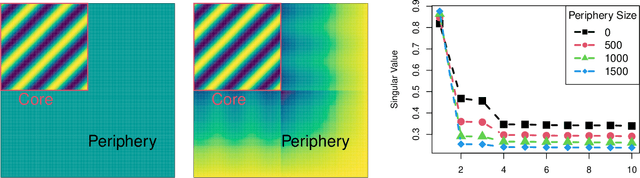
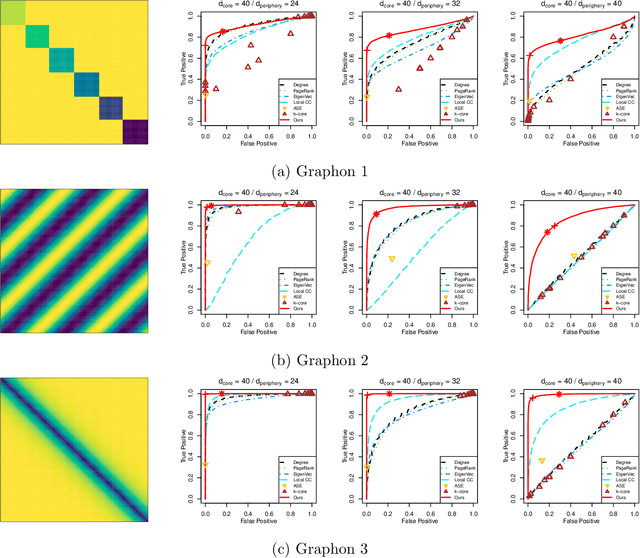
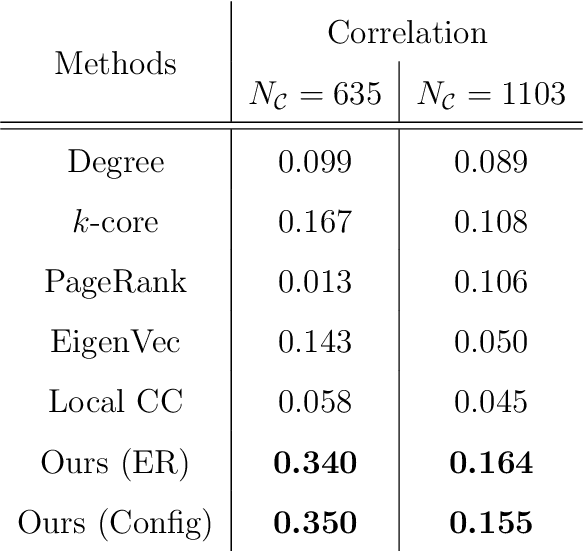
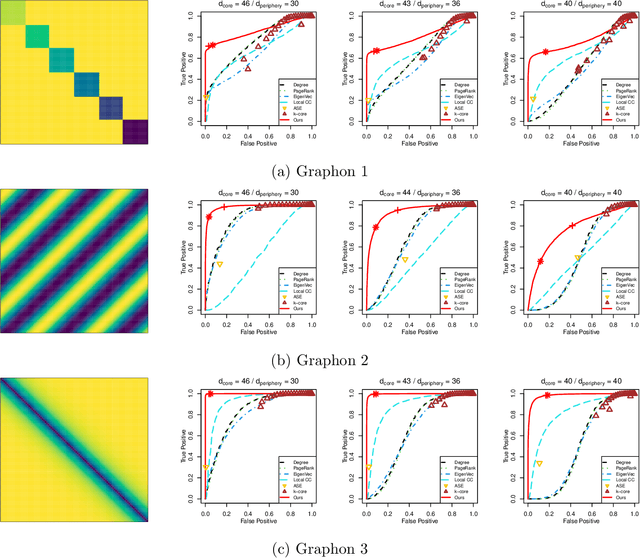
In network analysis, the core structure of modeling interest is usually hidden in a larger network in which most structures are not informative. The noise and bias introduced by the non-informative component in networks can obscure the salient structure and limit many network modeling procedures' effectiveness. This paper introduces a novel core-periphery model for the non-informative periphery structure of networks without imposing a specific form for the informative core structure. We propose spectral algorithms for core identification as a data preprocessing step for general downstream network analysis tasks based on the model. The algorithm enjoys a strong theoretical guarantee of accuracy and is scalable for large networks. We evaluate the proposed method by extensive simulation studies demonstrating various advantages over many traditional core-periphery methods. The method is applied to extract the informative core structure from a citation network and give more informative results in the downstream hierarchical community detection.