 Add to Chrome
 Add to Firefox
 Add to Edge
PAR$^2$-RAG: Planned Active Retrieval and Reasoning for Multi-Hop Question Answering
Mar 30, 2026
Large language models (LLMs) remain brittle on multi-hop question answering (MHQA), where answering requires combining evidence across documents through retrieval and reasoning. Iterative retrieval systems can fail by locking onto an early low-recall trajectory and amplifying downstream errors, while planning-only approaches may produce static query sets that cannot adapt when intermediate evidence changes. We propose \textbf{Planned Active Retrieval and Reasoning RAG (PAR$^2$-RAG)}, a two-stage framework that separates \emph{coverage} from \emph{commitment}. PAR$^2$-RAG first performs breadth-first anchoring to build a high-recall evidence frontier, then applies depth-first refinement with evidence sufficiency control in an iterative loop. Across four MHQA benchmarks, PAR$^2$-RAG consistently outperforms existing state-of-the-art baselines, compared with IRCoT, PAR$^2$-RAG achieves up to \textbf{23.5\%} higher accuracy, with retrieval gains of up to \textbf{10.5\%} in NDCG.

LAD-RAG: Layout-aware Dynamic RAG for Visually-Rich Document Understanding
Oct 08, 2025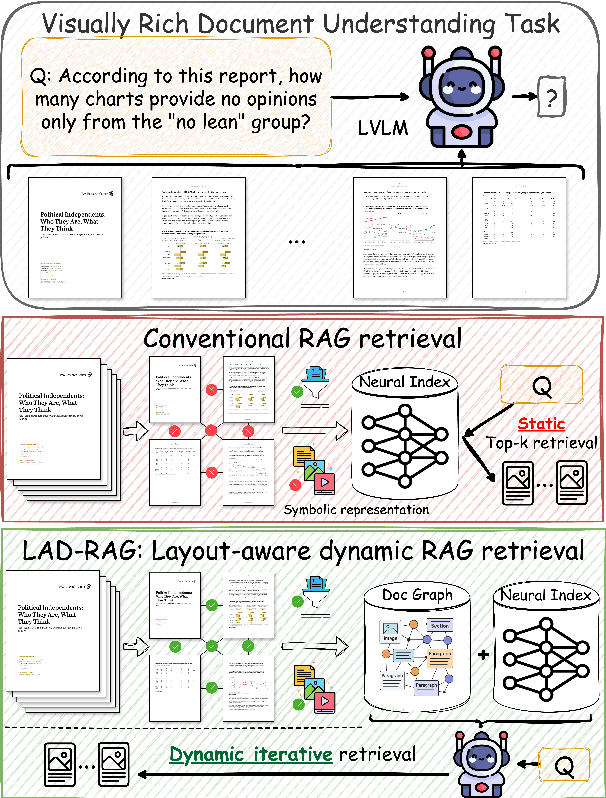
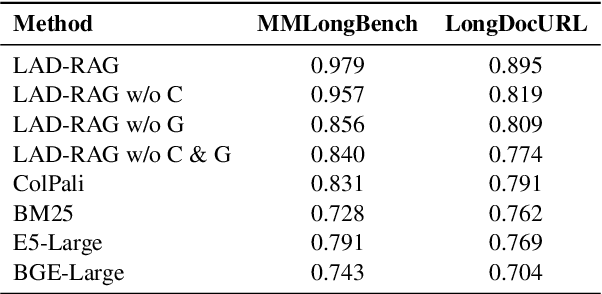
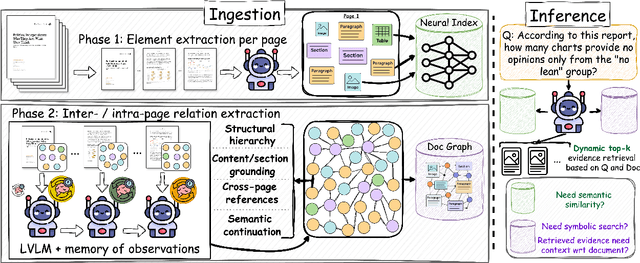
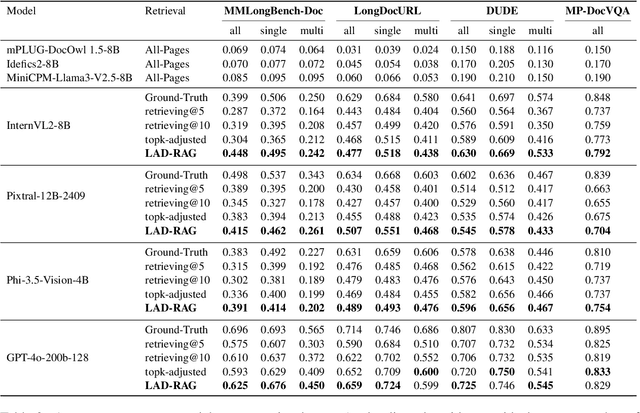
Question answering over visually rich documents (VRDs) requires reasoning not only over isolated content but also over documents' structural organization and cross-page dependencies. However, conventional retrieval-augmented generation (RAG) methods encode content in isolated chunks during ingestion, losing structural and cross-page dependencies, and retrieve a fixed number of pages at inference, regardless of the specific demands of the question or context. This often results in incomplete evidence retrieval and degraded answer quality for multi-page reasoning tasks. To address these limitations, we propose LAD-RAG, a novel Layout-Aware Dynamic RAG framework. During ingestion, LAD-RAG constructs a symbolic document graph that captures layout structure and cross-page dependencies, adding it alongside standard neural embeddings to yield a more holistic representation of the document. During inference, an LLM agent dynamically interacts with the neural and symbolic indices to adaptively retrieve the necessary evidence based on the query. Experiments on MMLongBench-Doc, LongDocURL, DUDE, and MP-DocVQA demonstrate that LAD-RAG improves retrieval, achieving over 90% perfect recall on average without any top-k tuning, and outperforming baseline retrievers by up to 20% in recall at comparable noise levels, yielding higher QA accuracy with minimal latency.