 Add to Chrome
 Add to Firefox
 Add to Edge
PLSQLBench: Benchmarking LLM Systems for Executable Procedural Database Programming
Aug 16, 2026
We present PLSQLBench, to our knowledge the first benchmark for evaluating whether LLMs can write executable PL/SQL programs, with correctness measured through execution-based tests. Existing LLM evaluations largely target general-purpose code generation or declarative text-to-SQL, leaving procedural database programming underexplored. PLSQLBench contains 2,865 instances: 2,594 single-turn tasks and 271 multi-turn conversations spanning 978 turns. The benchmark combines complex schema-grounded tasks over enterprise-style Spider 2 databases, simpler schema-grounded tasks derived from Spider, and MBPP-derived procedural problems, covering varying levels of database grounding and procedural complexity. Experiments with eight LLMs reveal recurring difficulties in schema grounding, PL/SQL dialect fidelity, procedural control flow, exception handling, and cross-turn consistency. Tool-augmented LLM agents improve performance on several schema-grounded evaluations, although substantial gaps remain. These results highlight procedural database programming capabilities not directly assessed by conventional code generation or text-to-SQL benchmarks. Our code is available at https://github.com/oracle-samples/plsqlbench.

SOMA-SQL: Resolving Multi-Source Ambiguity in NL-to-SQL via Synthetic Log and Execution Probing
Jun 09, 2026Natural language interfaces to databases aim to translate user questions into executable SQL, yet remain brittle in real-world settings where questions are underspecified and schemas are large and ambiguous. Ambiguity across user questions, database schemas, and model interpretations are central failure modes in NL2SQL, leading to misaligned intent, incorrect schema grounding, and erroneous SQL generation. Existing approaches rely on human clarification or treat ambiguity as a schema representation problem, but these do not scale nor resolve ambiguity autonomously. We propose SOMA-SQL to automatically resolve ambiguity via targeted synthetic query log and ambiguity-driven probing. SOMA-SQL constructs synthetic query log to ground schema interpretation and guide candidate SQL generation; it then executes targeted probing queries, driven by a structured ambiguity taxonomy and candidate disagreements, to produce disambiguation evidence for final SQL selection and repair. This active approach to ambiguity discovery and resolution generalizes across unseen schemas and query distributions without human-in-the-loop. Experiments on six public benchmarks demonstrate that SOMA-SQL improves execution accuracy by 13.0% on average over state-of-the-art baselines, with gains of up to 16.7% on ambiguous questions.
PAR$^2$-RAG: Planned Active Retrieval and Reasoning for Multi-Hop Question Answering
Mar 30, 2026Large language models (LLMs) remain brittle on multi-hop question answering (MHQA), where answering requires combining evidence across documents through retrieval and reasoning. Iterative retrieval systems can fail by locking onto an early low-recall trajectory and amplifying downstream errors, while planning-only approaches may produce static query sets that cannot adapt when intermediate evidence changes. We propose \textbf{Planned Active Retrieval and Reasoning RAG (PAR$^2$-RAG)}, a two-stage framework that separates \emph{coverage} from \emph{commitment}. PAR$^2$-RAG first performs breadth-first anchoring to build a high-recall evidence frontier, then applies depth-first refinement with evidence sufficiency control in an iterative loop. Across four MHQA benchmarks, PAR$^2$-RAG consistently outperforms existing state-of-the-art baselines, compared with IRCoT, PAR$^2$-RAG achieves up to \textbf{23.5\%} higher accuracy, with retrieval gains of up to \textbf{10.5\%} in NDCG.
GraphER: An Efficient Graph-Based Enrichment and Reranking Method for Retrieval-Augmented Generation
Mar 26, 2026Semantic search in retrieval-augmented generation (RAG) systems is often insufficient for complex information needs, particularly when relevant evidence is scattered across multiple sources. Prior approaches to this problem include agentic retrieval strategies, which expand the semantic search space by generating additional queries. However, these methods do not fully leverage the organizational structure of the data and instead rely on iterative exploration, which can lead to inefficient retrieval. Another class of approaches employs knowledge graphs to model non-semantic relationships through graph edges. Although effective in capturing richer proximities, such methods incur significant maintenance costs and are often incompatible with the vector stores used in most production systems. To address these limitations, we propose GraphER, a graph-based enrichment and reranking method that captures multiple forms of proximity beyond semantic similarity. GraphER independently enriches data objects during offline indexing and performs graph-based reranking over candidate objects at query time. This design does not require a knowledge graph, allowing GraphER to integrate seamlessly with standard vector stores. In addition, GraphER is retriever-agnostic and introduces negligible latency overhead. Experiments on multiple retrieval benchmarks demonstrate the effectiveness of the proposed approach.
LLM NL2SQL Robustness: Surface Noise vs. Linguistic Variation in Traditional and Agentic Settings
Mar 17, 2026Robustness evaluation for Natural Language to SQL (NL2SQL) systems is essential because real-world database environments are dynamic, noisy, and continuously evolving, whereas conventional benchmark evaluations typically assume static schemas and well-formed user inputs. In this work, we introduce a robustness evaluation benchmark containing approximately ten types of perturbations and conduct evaluations under both traditional and agentic settings. We assess multiple state-of-the-art large language models (LLMs), including Grok-4.1, Gemini-3-Pro, Claude-Opus-4.6, and GPT-5.2. Our results show that these models generally maintain strong performance under several perturbations; however, notable performance degradation is observed for surface-level noise (e.g., character-level corruption) and linguistic variation that preserves semantics while altering lexical or syntactic forms. Furthermore, we observe that surface-level noise causes larger performance drops in traditional pipelines, whereas linguistic variation presents greater challenges in agentic settings. These findings highlight the remaining challenges in achieving robust NL2SQL systems, particularly in handling linguistic variability.
Fidelity-Imposed Displacement Editing for the Learn2Reg 2024 SHG-BF Challenge
Oct 28, 2024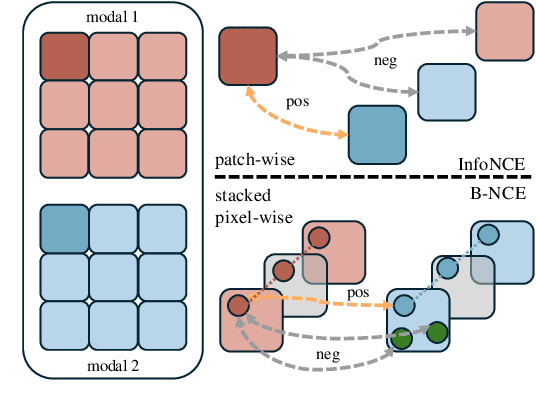


Co-examination of second-harmonic generation (SHG) and bright-field (BF) microscopy enables the differentiation of tissue components and collagen fibers, aiding the analysis of human breast and pancreatic cancer tissues. However, large discrepancies between SHG and BF images pose challenges for current learning-based registration models in aligning SHG to BF. In this paper, we propose a novel multi-modal registration framework that employs fidelity-imposed displacement editing to address these challenges. The framework integrates batch-wise contrastive learning, feature-based pre-alignment, and instance-level optimization. Experimental results from the Learn2Reg COMULISglobe SHG-BF Challenge validate the effectiveness of our method, securing the 1st place on the online leaderboard.
NeuroSynth: MRI-Derived Neuroanatomical Generative Models and Associated Dataset of 18,000 Samples
Jul 17, 2024
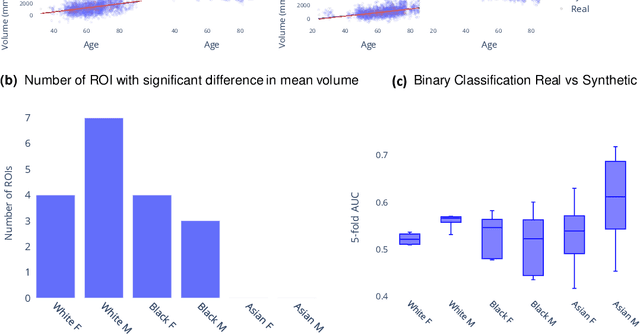

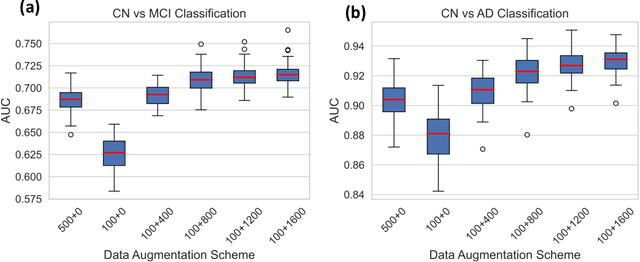
Availability of large and diverse medical datasets is often challenged by privacy and data sharing restrictions. For successful application of machine learning techniques for disease diagnosis, prognosis, and precision medicine, large amounts of data are necessary for model building and optimization. To help overcome such limitations in the context of brain MRI, we present NeuroSynth: a collection of generative models of normative regional volumetric features derived from structural brain imaging. NeuroSynth models are trained on real brain imaging regional volumetric measures from the iSTAGING consortium, which encompasses over 40,000 MRI scans across 13 studies, incorporating covariates such as age, sex, and race. Leveraging NeuroSynth, we produce and offer 18,000 synthetic samples spanning the adult lifespan (ages 22-90 years), alongside the model's capability to generate unlimited data. Experimental results indicate that samples generated from NeuroSynth agree with the distributions obtained from real data. Most importantly, the generated normative data significantly enhance the accuracy of downstream machine learning models on tasks such as disease classification. Data and models are available at: https://huggingface.co/spaces/rongguangw/neuro-synth.
MemWarp: Discontinuity-Preserving Cardiac Registration with Memorized Anatomical Filters
Jul 10, 2024Many existing learning-based deformable image registration methods impose constraints on deformation fields to ensure they are globally smooth and continuous. However, this assumption does not hold in cardiac image registration, where different anatomical regions exhibit asymmetric motions during respiration and movements due to sliding organs within the chest. Consequently, such global constraints fail to accommodate local discontinuities across organ boundaries, potentially resulting in erroneous and unrealistic displacement fields. In this paper, we address this issue with MemWarp, a learning framework that leverages a memory network to store prototypical information tailored to different anatomical regions. MemWarp is different from earlier approaches in two main aspects: firstly, by decoupling feature extraction from similarity matching in moving and fixed images, it facilitates more effective utilization of feature maps; secondly, despite its capability to preserve discontinuities, it eliminates the need for segmentation masks during model inference. In experiments on a publicly available cardiac dataset, our method achieves considerable improvements in registration accuracy and producing realistic deformations, outperforming state-of-the-art methods with a remarkable 7.1\% Dice score improvement over the runner-up semi-supervised method. Source code will be available at https://github.com/tinymilky/Mem-Warp.
Slicer Networks
Jan 18, 2024In medical imaging, scans often reveal objects with varied contrasts but consistent internal intensities or textures. This characteristic enables the use of low-frequency approximations for tasks such as segmentation and deformation field estimation. Yet, integrating this concept into neural network architectures for medical image analysis remains underexplored. In this paper, we propose the Slicer Network, a novel architecture designed to leverage these traits. Comprising an encoder utilizing models like vision transformers for feature extraction and a slicer employing a learnable bilateral grid, the Slicer Network strategically refines and upsamples feature maps via a splatting-blurring-slicing process. This introduces an edge-preserving low-frequency approximation for the network outcome, effectively enlarging the effective receptive field. The enhancement not only reduces computational complexity but also boosts overall performance. Experiments across different medical imaging applications, including unsupervised and keypoints-based image registration and lesion segmentation, have verified the Slicer Network's improved accuracy and efficiency.
Dimensional Neuroimaging Endophenotypes: Neurobiological Representations of Disease Heterogeneity Through Machine Learning
Jan 17, 2024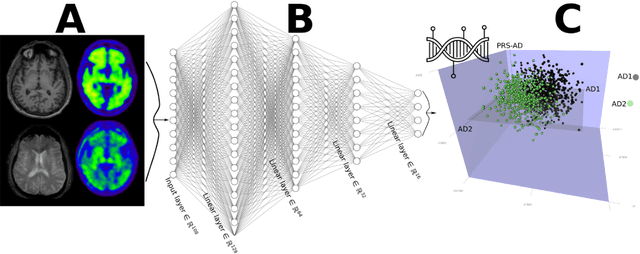

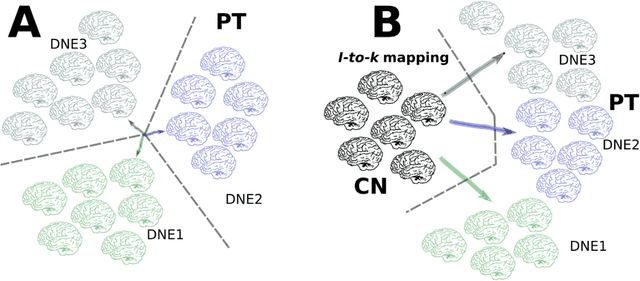
Machine learning has been increasingly used to obtain individualized neuroimaging signatures for disease diagnosis, prognosis, and response to treatment in neuropsychiatric and neurodegenerative disorders. Therefore, it has contributed to a better understanding of disease heterogeneity by identifying disease subtypes that present significant differences in various brain phenotypic measures. In this review, we first present a systematic literature overview of studies using machine learning and multimodal MRI to unravel disease heterogeneity in various neuropsychiatric and neurodegenerative disorders, including Alzheimer disease, schizophrenia, major depressive disorder, autism spectrum disorder, multiple sclerosis, as well as their potential in transdiagnostic settings. Subsequently, we summarize relevant machine learning methodologies and discuss an emerging paradigm which we call dimensional neuroimaging endophenotype (DNE). DNE dissects the neurobiological heterogeneity of neuropsychiatric and neurodegenerative disorders into a low dimensional yet informative, quantitative brain phenotypic representation, serving as a robust intermediate phenotype (i.e., endophenotype) largely reflecting underlying genetics and etiology. Finally, we discuss the potential clinical implications of the current findings and envision future research avenues.