 Add to Chrome
 Add to Firefox
 Add to Edge
Bringing analytic rigor to agentic AI for science: The Brain Researcher platform for neuroimaging data analysis
Aug 20, 2026
AI agents can execute scientific analyses, but an analytic output becomes a defensible claim only after alternatives are weighed and the claim is limited to what the evidence supports. Agents may reproduce failures including selective analysis, premature declarations of success and optimization of imperfect criteria. We present Brain Researcher, an agentic research harness operating in a neuroimaging researcher's computational environment under rules for admissible analyses, required checks and claim scope. In benchmarks, Brain Researcher increased first-choice tool-selection accuracy across seven models by 70.2 percentage points (23.3% without it versus 93.6% with it) and verifiable grounding from 4.6% to 22.0%. In collaborator-led and self-evolving studies, multiverse analyses exposed analytic-choice sensitivity, and scientific review classified claims as accepted, qualified, revised, blocked, rejected or deferred. By linking decisions to evidence and provenance, Brain Researcher embeds methodological judgment within the workflow, not after it.

OpenThoughts-Agent: Data Recipes for Agentic Models
Jun 23, 2026Agentic language models dramatically expand the applications of AI yet little is publicly known about how to curate training data for broadly capable agents. Existing open efforts such as SWE-Smith, SERA, and Nemotron-Terminal typically target a single benchmark, leaving open the question of how to train models that generalize across diverse agentic tasks. The OpenThoughts-Agent (OT-Agent) project addresses this gap with a fully open data curation pipeline for training agentic models. We conduct more than 100 controlled ablation experiments to systematically investigate each stage of the pipeline, yielding insights on the importance of task sources and diversity. We then assemble a training set of 100K examples from our pipeline and fine-tune Qwen3-32B on this dataset, which yields an average accuracy of 44.8% across seven agentic benchmarks and a 3.9 percentage point improvement over the strongest existing open data agentic model (Nemotron-Terminal-32B, 40.9%). Moreover, our training data exhibits strong scaling properties, outperforming alternative open datasets at every training set size in compute-controlled comparisons. We publicly release our training sets, data pipeline, experimental data, and models at openthoughts.ai to support future open research on agentic model training.
Every Eval Ever: A Unifying Schema and Community Repository for AI Evaluation Results
Jun 12, 2026AI evaluations are widely used for testing and understanding progress. However, the diverse evaluators bring with them inconsistencies that challenge analysis and comparison. First, results are saved in incompatible formats, scattered across leaderboards, papers, blog posts, evaluation harness logs, and custom repositories. Second, results are created by different evaluation frameworks, which produce divergent scores for nominally identical evaluations and record metadata inconsistently, hindering comparison, cross-community evaluation science, cost reduction, and reuse. We introduce Every Eval Ever, the first shared schema and community-crowdsourced repository for AI evaluation results. The schema standardizes how evaluations are represented in a unified, single JSON document. It is source-agnostic by design, ingesting results from evaluation harnesses and papers alike, and optionally stores per-instance outputs for fine-grained analysis. We contribute: (i) a community-governed metadata schema with a companion instance-level schema, the first standardization effort of its kind; (ii) automatic converters from popular formats, evaluation harnesses, and leaderboards to the unified schema; and (iii) a crowdsourced community database hosted on Hugging Face, currently spanning to date 22,235 models, 2,273 unique benchmarks, and 31 evaluation formats.
SWE-Marathon: Can Agents Autonomously Complete Ultra-Long-Horizon Software Work?
Jun 05, 2026AI agents are increasingly expected to complete long-horizon workflows that require sustained progress over hours, millions of tokens, and complex environments. Yet current agent benchmarks largely evaluate short-form tasks, such as single pull requests, small tickets, or 5-10 minute exercises, limiting our ability to measure agents' capabilities in planning, long-context understanding, and memory use. We introduce SWE-Marathon, a benchmark of 20 long-horizon tasks spanning software engineering and adjacent technical domains. Each task consists of a unique executable environment, a human-written reference solution, and a multi-layer verification suite. Logged agent attempts average 27.2M total tokens, making SWE-Marathon substantially longer-horizon than existing SWE and command-line agent benchmarks. Current frontier coding agents solve fewer than 30% of tasks. Failures often arise from poor self-verification, self-reported infeasibility, and premature termination. We also observe reward-hacking behavior in 13.8% of rollouts, where agents attempt to exploit the environment or verifier to bypass the intended workflow. SWE-Marathon includes adversarial review of test suites and execution environments, as well as multi-layer checks designed to prevent shortcut solutions. We release SWE-Marathon, evaluation code, and agent trajectories at https://swe-marathon.org/.
SkillsBench: Benchmarking How Well Agent Skills Work Across Diverse Tasks
Feb 13, 2026Agent Skills are structured packages of procedural knowledge that augment LLM agents at inference time. Despite rapid adoption, there is no standard way to measure whether they actually help. We present SkillsBench, a benchmark of 86 tasks across 11 domains paired with curated Skills and deterministic verifiers. Each task is evaluated under three conditions: no Skills, curated Skills, and self-generated Skills. We test 7 agent-model configurations over 7,308 trajectories. Curated Skills raise average pass rate by 16.2 percentage points(pp), but effects vary widely by domain (+4.5pp for Software Engineering to +51.9pp for Healthcare) and 16 of 84 tasks show negative deltas. Self-generated Skills provide no benefit on average, showing that models cannot reliably author the procedural knowledge they benefit from consuming. Focused Skills with 2--3 modules outperform comprehensive documentation, and smaller models with Skills can match larger models without them.
Opportunities in AI/ML for the Rubin LSST Dark Energy Science Collaboration
Jan 20, 2026The Vera C. Rubin Observatory's Legacy Survey of Space and Time (LSST) will produce unprecedented volumes of heterogeneous astronomical data (images, catalogs, and alerts) that challenge traditional analysis pipelines. The LSST Dark Energy Science Collaboration (DESC) aims to derive robust constraints on dark energy and dark matter from these data, requiring methods that are statistically powerful, scalable, and operationally reliable. Artificial intelligence and machine learning (AI/ML) are already embedded across DESC science workflows, from photometric redshifts and transient classification to weak lensing inference and cosmological simulations. Yet their utility for precision cosmology hinges on trustworthy uncertainty quantification, robustness to covariate shift and model misspecification, and reproducible integration within scientific pipelines. This white paper surveys the current landscape of AI/ML across DESC's primary cosmological probes and cross-cutting analyses, revealing that the same core methodologies and fundamental challenges recur across disparate science cases. Since progress on these cross-cutting challenges would benefit multiple probes simultaneously, we identify key methodological research priorities, including Bayesian inference at scale, physics-informed methods, validation frameworks, and active learning for discovery. With an eye on emerging techniques, we also explore the potential of the latest foundation model methodologies and LLM-driven agentic AI systems to reshape DESC workflows, provided their deployment is coupled with rigorous evaluation and governance. Finally, we discuss critical software, computing, data infrastructure, and human capital requirements for the successful deployment of these new methodologies, and consider associated risks and opportunities for broader coordination with external actors.
Terminal-Bench: Benchmarking Agents on Hard, Realistic Tasks in Command Line Interfaces
Jan 17, 2026AI agents may soon become capable of autonomously completing valuable, long-horizon tasks in diverse domains. Current benchmarks either do not measure real-world tasks, or are not sufficiently difficult to meaningfully measure frontier models. To this end, we present Terminal-Bench 2.0: a carefully curated hard benchmark composed of 89 tasks in computer terminal environments inspired by problems from real workflows. Each task features a unique environment, human-written solution, and comprehensive tests for verification. We show that frontier models and agents score less than 65\% on the benchmark and conduct an error analysis to identify areas for model and agent improvement. We publish the dataset and evaluation harness to assist developers and researchers in future work at https://www.tbench.ai/ .
Learning Representations of Event Time Series with Sparse Autoencoders for Anomaly Detection, Similarity Search, and Unsupervised Classification
Jul 15, 2025Event time series are sequences of discrete events occurring at irregular time intervals, each associated with a domain-specific observational modality. They are common in domains such as high-energy astrophysics, computational social science, cybersecurity, finance, healthcare, neuroscience, and seismology. Their unstructured and irregular structure poses significant challenges for extracting meaningful patterns and identifying salient phenomena using conventional techniques. We propose novel two- and three-dimensional tensor representations for event time series, coupled with sparse autoencoders that learn physically meaningful latent representations. These embeddings support a variety of downstream tasks, including anomaly detection, similarity-based retrieval, semantic clustering, and unsupervised classification. We demonstrate our approach on a real-world dataset from X-ray astronomy, showing that these representations successfully capture temporal and spectral signatures and isolate diverse classes of X-ray transients. Our framework offers a flexible, scalable, and generalizable solution for analyzing complex, irregular event time series across scientific and industrial domains.
Building Machine Learning Challenges for Anomaly Detection in Science
Mar 03, 2025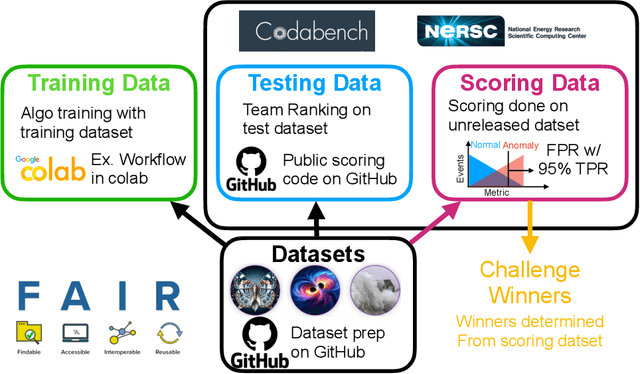
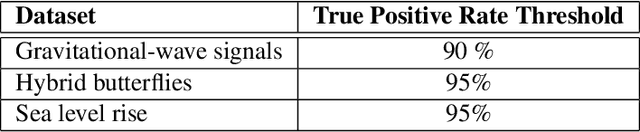
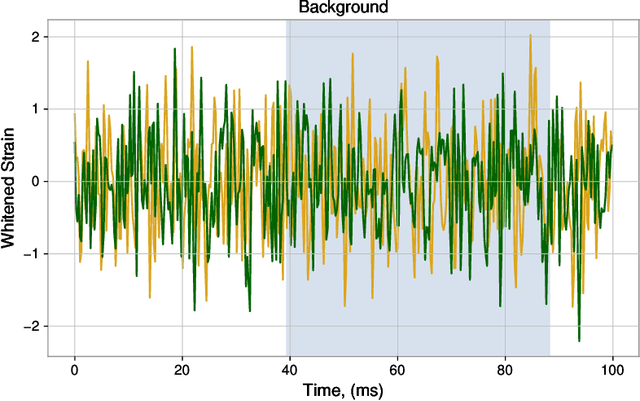
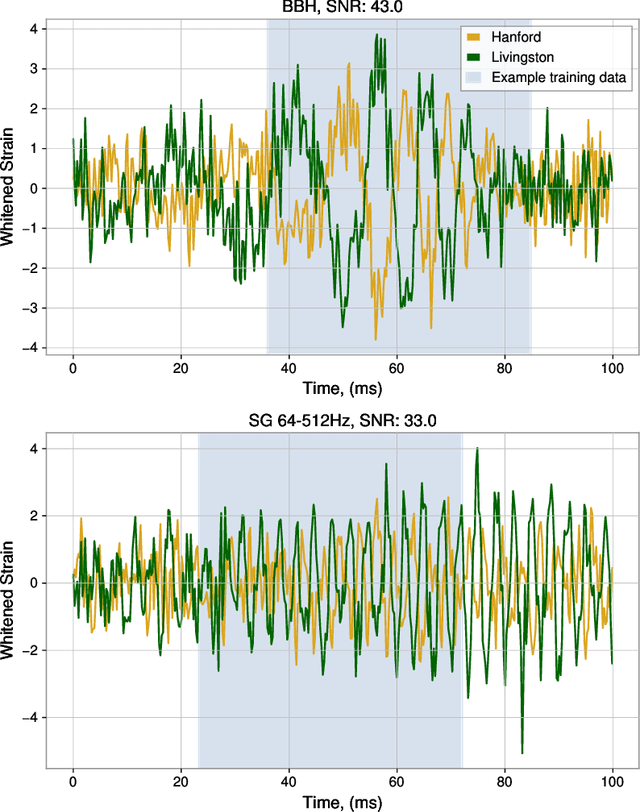
Scientific discoveries are often made by finding a pattern or object that was not predicted by the known rules of science. Oftentimes, these anomalous events or objects that do not conform to the norms are an indication that the rules of science governing the data are incomplete, and something new needs to be present to explain these unexpected outliers. The challenge of finding anomalies can be confounding since it requires codifying a complete knowledge of the known scientific behaviors and then projecting these known behaviors on the data to look for deviations. When utilizing machine learning, this presents a particular challenge since we require that the model not only understands scientific data perfectly but also recognizes when the data is inconsistent and out of the scope of its trained behavior. In this paper, we present three datasets aimed at developing machine learning-based anomaly detection for disparate scientific domains covering astrophysics, genomics, and polar science. We present the different datasets along with a scheme to make machine learning challenges around the three datasets findable, accessible, interoperable, and reusable (FAIR). Furthermore, we present an approach that generalizes to future machine learning challenges, enabling the possibility of large, more compute-intensive challenges that can ultimately lead to scientific discovery.
A Poisson Process AutoDecoder for X-ray Sources
Feb 03, 2025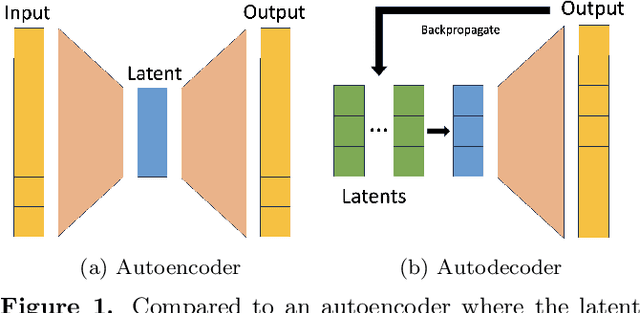
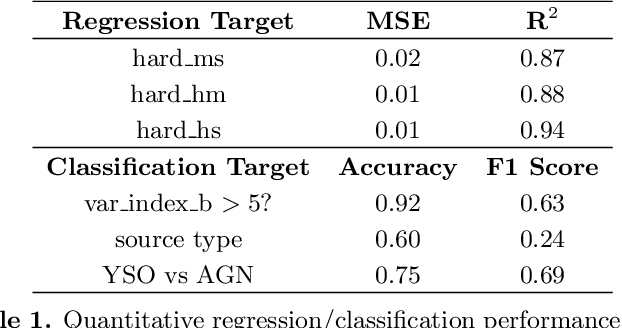

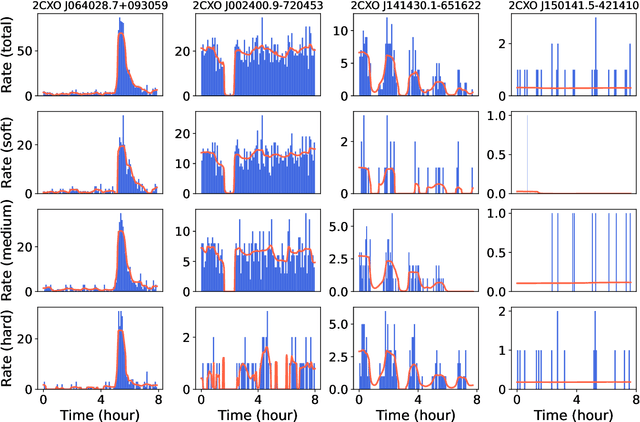
X-ray observing facilities, such as the Chandra X-ray Observatory and the eROSITA, have detected millions of astronomical sources associated with high-energy phenomena. The arrival of photons as a function of time follows a Poisson process and can vary by orders-of-magnitude, presenting obstacles for common tasks such as source classification, physical property derivation, and anomaly detection. Previous work has either failed to directly capture the Poisson nature of the data or only focuses on Poisson rate function reconstruction. In this work, we present Poisson Process AutoDecoder (PPAD). PPAD is a neural field decoder that maps fixed-length latent features to continuous Poisson rate functions across energy band and time via unsupervised learning. PPAD reconstructs the rate function and yields a representation at the same time. We demonstrate the efficacy of PPAD via reconstruction, regression, classification and anomaly detection experiments using the Chandra Source Catalog.