 Add to Chrome
 Add to Firefox
 Add to Edge
Synthetic Persona Pretraining: Alignment from Token Zero
Aug 13, 2026
As language-model-based AI is increasingly deployed in autonomous settings, aligning its goals and values with those of humans becomes critical. Today, alignment, and the assistant identity itself, are typically introduced only after pretraining, once behavioral priors are already established. This can make values a thin overlay, rather than deeply rooted, and facilitate subsequent misalignment. Pursuing a different paradigm, we introduce Synthetic Persona Pretraining (SPP), which installs the desired assistant persona from token zero in pretraining. First, we annotate pretraining documents with value-aligned first-person reflections derived from a normative value constitution. Second, we pretrain via the standard cross-entropy loss on standard pretraining documents as well as their reflections, which installs the desired persona among a multitude of other personas. Finally, we post-train on user-assistant dialogue data, which binds this desired persona to the assistant identity, a process we call persona binding. By pretraining models up to 3B parameters on 500B tokens, we show that SPP improves constitution following and jailbreak robustness, and reduces the misalignment rate in out-of-distribution moral dilemmas, while preserving capabilities. Early intervention matters: compared with alignment from token zero, introducing SPP only at the end of pretraining yields weaker constitution adherence, does not shift value priorities, and leads to less aligned choices in dilemmas. This advantage depends on persona binding and, importantly, increases with pretraining budget. Overall, our results show that shaping values early is critical for alignment and establish pretraining-time persona interventions as an effective approach to do so.

Model or Harness? An Interaction-Centric Taxonomy for Localizing Agent Failures
Jul 30, 2026Existing evaluations often reduce agent failures to system-level outcomes, obscuring where the fault originated and which intervention would improve the agent system. This creates a repair-assignment problem: the same visible failure may call for model post-training, harness engineering, environment redesign, or benchmark repair depending on its source. Because agent behavior emerges from interactions among models, harnesses, users, tools, memory, and environments, outcome-level labels are often insufficient for improvement. Most failure taxonomies do little to resolve this problem because they are benchmark-specific and lack a shared structure. We introduce an interaction-centric taxonomy that localizes failures to the interactions in which they originate and identifies the responsible component. It organizes 41 failure modes by assigning each to an edge between two components and a fault side indicating where the repair belongs. This makes the taxonomy actionable: model-side failures identify targets for post-training, harness-side failures point to scaffolding and tool-integration fixes, and environment or grader failures reveal evaluation conditions requiring redesign. The schema applies across agent architectures, from coding assistants to long-horizon personal assistants and multi-agent systems. We ground the taxonomy in worked examples from public benchmarks, model system cards, published reports, and logged agent trajectories, and evaluate its reproducibility using independent reasoning agents as judges. Across four frontier models, the strongest judge reaches Cohen's $κ=0.76$ against human category labels, suggesting that the categories capture shared structure rather than annotator-specific preferences.
OpenThoughts-Agent: Data Recipes for Agentic Models
Jun 23, 2026Agentic language models dramatically expand the applications of AI yet little is publicly known about how to curate training data for broadly capable agents. Existing open efforts such as SWE-Smith, SERA, and Nemotron-Terminal typically target a single benchmark, leaving open the question of how to train models that generalize across diverse agentic tasks. The OpenThoughts-Agent (OT-Agent) project addresses this gap with a fully open data curation pipeline for training agentic models. We conduct more than 100 controlled ablation experiments to systematically investigate each stage of the pipeline, yielding insights on the importance of task sources and diversity. We then assemble a training set of 100K examples from our pipeline and fine-tune Qwen3-32B on this dataset, which yields an average accuracy of 44.8% across seven agentic benchmarks and a 3.9 percentage point improvement over the strongest existing open data agentic model (Nemotron-Terminal-32B, 40.9%). Moreover, our training data exhibits strong scaling properties, outperforming alternative open datasets at every training set size in compute-controlled comparisons. We publicly release our training sets, data pipeline, experimental data, and models at openthoughts.ai to support future open research on agentic model training.
Joint Antenna Placement and Power Allocation for RSMA-Enabled Pinching Antenna Systems
Jun 14, 2026This letter investigates a rate-splitting multiple access (RSMA)-enabled multi-user pinching antenna system (PASS). A fairness-aware sum-rate maximization problem is formulated to jointly optimize pinching antenna locations and common/private stream power allocation. The resulting mixed discrete-continuous non-convex problem is addressed using an alternating optimization framework that combines greedy antenna placement with successive convex approximation (SCA)-based power allocation. Numerical results demonstrate that the proposed RSMA-enabled PASS significantly improves achievable sum-rate, user fairness, and bit error rate (BER) performance compared with conventional non-RSMA PASS schemes.
RSMA Technique for Multi-User Downlink Single-Waveguide Multi-Pinching Antenna Systems
Jun 08, 2026Pinching antennas have recently emerged as a promising technology for reconfigurable wireless systems due to their ability to dynamically radiate signals from flexible positions along a waveguide. This letter investigates a multi-user communication framework by integrating rate-splitting multiple access (RSMA) into a single-input single-output (SISO) single-waveguide architecture equipped with multiple pinching antennas. Multiple antennas are activated along a shared waveguide to radiate a common guided signal toward distributed users, enabling strong near-field line-of-sight (LoS) links with low hardware complexity and a single radiofrequency (RF) chain. To manage multi-user interference, RSMA is employed within the proposed architecture. Simulation results show that the proposed framework improves system sum-rate, enhances user rate fairness, and achieves lower bit error rate (BER) while preserving the low-cost and scalable characteristics of pinching antenna systems (PASS).
Consistency as a Testable Property: Statistical Methods to Evaluate AI Agent Reliability
May 11, 2026This paper establishes a rigorous measurement science for AI agent reliability, providing a foundational framework for quantifying consistency under semantically preserving perturbations. By leveraging $U$-statistics for output-level reliability and kernel-based metrics for trajectory-level stability, we offer a principled approach to evaluating agents across diverse operating conditions. Our proposal highlights the important distinction between the core capability and execution robustness of an agent, showing that minor task-level variations can induce complete strategy breakdowns despite the agent possessing the requisite knowledge for the task. We validate our framework through extensive experiments on three agentic benchmarks, demonstrating that trajectory-level consistency metrics provide far greater diagnostic sensitivity than traditional pass@1 rates. By providing the mathematical tools to isolate where and why agents deviate, we enable the identification and rectification of architectural concerns that hinder the deployment of agents in high-stakes, real-world environments.
Terminal-Bench: Benchmarking Agents on Hard, Realistic Tasks in Command Line Interfaces
Jan 17, 2026AI agents may soon become capable of autonomously completing valuable, long-horizon tasks in diverse domains. Current benchmarks either do not measure real-world tasks, or are not sufficiently difficult to meaningfully measure frontier models. To this end, we present Terminal-Bench 2.0: a carefully curated hard benchmark composed of 89 tasks in computer terminal environments inspired by problems from real workflows. Each task features a unique environment, human-written solution, and comprehensive tests for verification. We show that frontier models and agents score less than 65\% on the benchmark and conduct an error analysis to identify areas for model and agent improvement. We publish the dataset and evaluation harness to assist developers and researchers in future work at https://www.tbench.ai/ .
Improving Consistency in Large Language Models through Chain of Guidance
Feb 21, 2025Consistency is a fundamental dimension of trustworthiness in Large Language Models (LLMs). For humans to be able to trust LLM-based applications, their outputs should be consistent when prompted with inputs that carry the same meaning or intent. Despite this need, there is no known mechanism to control and guide LLMs to be more consistent at inference time. In this paper, we introduce a novel alignment strategy to maximize semantic consistency in LLM outputs. Our proposal is based on Chain of Guidance (CoG), a multistep prompting technique that generates highly consistent outputs from LLMs. For closed-book question-answering (Q&A) tasks, when compared to direct prompting, the outputs generated using CoG show improved consistency. While other approaches like template-based responses and majority voting may offer alternative paths to consistency, our work focuses on exploring the potential of guided prompting. We use synthetic data sets comprised of consistent input-output pairs to fine-tune LLMs to produce consistent and correct outputs. Our fine-tuned models are more than twice as consistent compared to base models and show strong generalization capabilities by producing consistent outputs over datasets not used in the fine-tuning process.
On the Performance of IRS-Assisted SSK and RPM over Rician Fading Channels
Apr 10, 2024
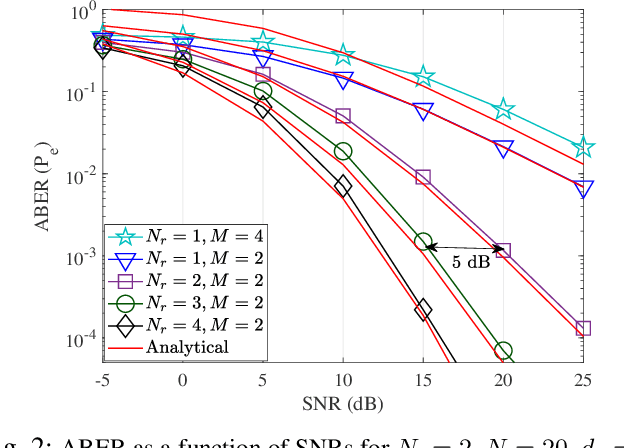
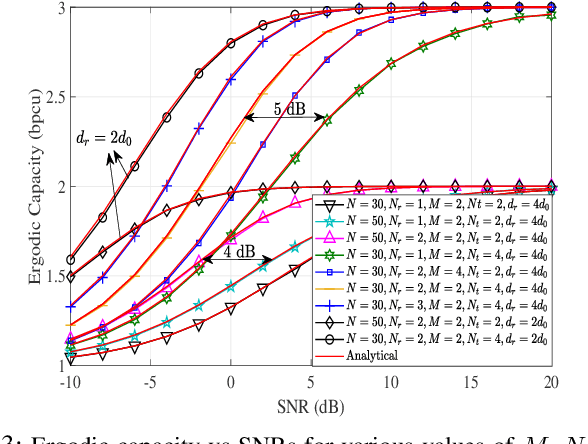
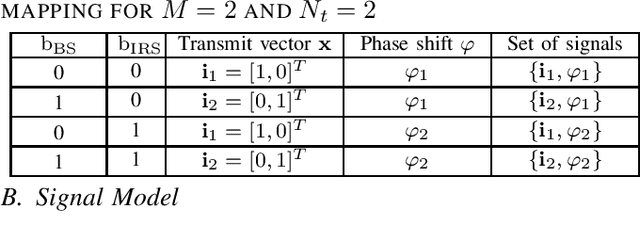
This paper presents the index modulation, that is, the space-shift keying (SSK) and reflection phase modulation (RPM) schemes for intelligent reflecting surface (IRS)-assisted wireless network. IRS simultaneously reflects the incoming information signal from the base station and explicitly encodes the local information bits in the reflection phase shift of IRS elements. The phase shift of the IRS elements is employed according to local data from the RPM constellation. A joint detection using a maximum-likelihood (ML) decoder is performed for the SSK and RPM symbols over a realistic fading scenario modeled as the Rician fading channel. The pairwise error probability over Rician fading channels is derived and utilized to determine the average bit error rate. In addition, the ergodic capacity of the presented system is derived. The derived analytical results are verified and are in exact agreement with Monte-Carlo simulations.
Semantic Consistency for Assuring Reliability of Large Language Models
Aug 17, 2023Large Language Models (LLMs) exhibit remarkable fluency and competence across various natural language tasks. However, recent research has highlighted their sensitivity to variations in input prompts. To deploy LLMs in a safe and reliable manner, it is crucial for their outputs to be consistent when prompted with expressions that carry the same meaning or intent. While some existing work has explored how state-of-the-art LLMs address this issue, their evaluations have been confined to assessing lexical equality of single- or multi-word answers, overlooking the consistency of generative text sequences. For a more comprehensive understanding of the consistency of LLMs in open-ended text generation scenarios, we introduce a general measure of semantic consistency, and formulate multiple versions of this metric to evaluate the performance of various LLMs. Our proposal demonstrates significantly higher consistency and stronger correlation with human evaluations of output consistency than traditional metrics based on lexical consistency. Finally, we propose a novel prompting strategy, called Ask-to-Choose (A2C), to enhance semantic consistency. When evaluated for closed-book question answering based on answer variations from the TruthfulQA benchmark, A2C increases accuracy metrics for pretrained and finetuned LLMs by up to 47%, and semantic consistency metrics for instruction-tuned models by up to 7-fold.