 Add to Chrome
 Add to Firefox
 Add to Edge
Every Eval Ever: A Unifying Schema and Community Repository for AI Evaluation Results
Jun 12, 2026
AI evaluations are widely used for testing and understanding progress. However, the diverse evaluators bring with them inconsistencies that challenge analysis and comparison. First, results are saved in incompatible formats, scattered across leaderboards, papers, blog posts, evaluation harness logs, and custom repositories. Second, results are created by different evaluation frameworks, which produce divergent scores for nominally identical evaluations and record metadata inconsistently, hindering comparison, cross-community evaluation science, cost reduction, and reuse. We introduce Every Eval Ever, the first shared schema and community-crowdsourced repository for AI evaluation results. The schema standardizes how evaluations are represented in a unified, single JSON document. It is source-agnostic by design, ingesting results from evaluation harnesses and papers alike, and optionally stores per-instance outputs for fine-grained analysis. We contribute: (i) a community-governed metadata schema with a companion instance-level schema, the first standardization effort of its kind; (ii) automatic converters from popular formats, evaluation harnesses, and leaderboards to the unified schema; and (iii) a crowdsourced community database hosted on Hugging Face, currently spanning to date 22,235 models, 2,273 unique benchmarks, and 31 evaluation formats.

Evaluation Cards: An Interpretive Layer for AI Evaluation Reporting
Jun 09, 2026AI evaluation results are produced at scale but reported inconsistently across leaderboards, model cards, benchmark papers, and company blogs. The cost is interpretive: readers cannot reliably compare results across sources, identify what a report omits, or trace an aggregate claim to its underlying evidence. Recent efforts address isolated components but leave three gaps: they cover only narrow slices of the evaluation lifecycle and do not compose into a single interpretable record; they specify static representations that do not differentiate the questions different stakeholders bring to the same evidence; and they remain proposals on paper, lacking the extraction infrastructure required for adoption at scale. We present \EvalCards{}, an operational reporting layer that composes benchmark metadata, evaluation run data, and model metadata into a unified record. We (1) derive a reporting schema from a structured review of 52 papers and 10 stakeholder interviews, (2) implement four interpretive signals (reproducibility, documentation completeness, provenance and risk, and score comparability), rendered through reader modes calibrated to research and non-research audiences, and (3) deploy a monitoring tool that applies \EvalCards{} across 5,816 models, 635 benchmarks, and 101,843 results, surfacing systematic gaps in current reporting practice.
Bye Bye Perspective API: Lessons for Measurement Infrastructure in NLP, CSS and LLM Evaluation
Apr 28, 2026The closure of Perspective API at the end of 2026 discards what has functioned as the de facto standard for automated toxicity measurement in NLP, CSS, and LLM evaluation research. We document the structural dependence that the communities built on this single proprietary tool and discuss how this dependence caused epistemic problems that have affected - and will likely continue to affect - collective research efforts. Perspective's model was periodically updated without versioning or disclosure, its annotation structure reflected a single corporate operationalisation of a contested concept, and its scores were used simultaneously as an evaluation target and an evaluation standard. Its closure leaves behind non-updatable benchmarks, irreproducible results, and ultimately a field at risk of perpetuating these issues by turning to closed-source LLMs. We use Perspective's announced termination as an opportunity to call for an independent, valid, adaptable, and reproducible toxicity and hate speech measurement infrastructure, with the technical and governance requirements outlined in this paper.
When AI Benchmarks Plateau: A Systematic Study of Benchmark Saturation
Feb 18, 2026Artificial Intelligence (AI) benchmarks play a central role in measuring progress in model development and guiding deployment decisions. However, many benchmarks quickly become saturated, meaning that they can no longer differentiate between the best-performing models, diminishing their long-term value. In this study, we analyze benchmark saturation across 60 Large Language Model (LLM) benchmarks selected from technical reports by major model developers. To identify factors driving saturation, we characterize benchmarks along 14 properties spanning task design, data construction, and evaluation format. We test five hypotheses examining how each property contributes to saturation rates. Our analysis reveals that nearly half of the benchmarks exhibit saturation, with rates increasing as benchmarks age. Notably, hiding test data (i.e., public vs. private) shows no protective effect, while expert-curated benchmarks resist saturation better than crowdsourced ones. Our findings highlight which design choices extend benchmark longevity and inform strategies for more durable evaluation.
Agent Benchmarks Fail Public Sector Requirements
Jan 28, 2026Deploying Large Language Model-based agents (LLM agents) in the public sector requires assuring that they meet the stringent legal, procedural, and structural requirements of public-sector institutions. Practitioners and researchers often turn to benchmarks for such assessments. However, it remains unclear what criteria benchmarks must meet to ensure they adequately reflect public-sector requirements, or how many existing benchmarks do so. In this paper, we first define such criteria based on a first-principles survey of public administration literature: benchmarks must be \emph{process-based}, \emph{realistic}, \emph{public-sector-specific} and report \emph{metrics} that reflect the unique requirements of the public sector. We analyse more than 1,300 benchmark papers for these criteria using an expert-validated LLM-assisted pipeline. Our results show that no single benchmark meets all of the criteria. Our findings provide a call to action for both researchers to develop public sector-relevant benchmarks and for public-sector officials to apply these criteria when evaluating their own agentic use cases.
One Persona, Many Cues, Different Results: How Sociodemographic Cues Impact LLM Personalization
Jan 26, 2026Personalization of LLMs by sociodemographic subgroup often improves user experience, but can also introduce or amplify biases and unfair outcomes across groups. Prior work has employed so-called personas, sociodemographic user attributes conveyed to a model, to study bias in LLMs by relying on a single cue to prompt a persona, such as user names or explicit attribute mentions. This disregards LLM sensitivity to prompt variations (robustness) and the rarity of some cues in real interactions (external validity). We compare six commonly used persona cues across seven open and proprietary LLMs on four writing and advice tasks. While cues are overall highly correlated, they produce substantial variance in responses across personas. We therefore caution against claims from a single persona cue and recommend future personalization research to evaluate multiple externally valid cues.
Who Evaluates AI's Social Impacts? Mapping Coverage and Gaps in First and Third Party Evaluations
Nov 06, 2025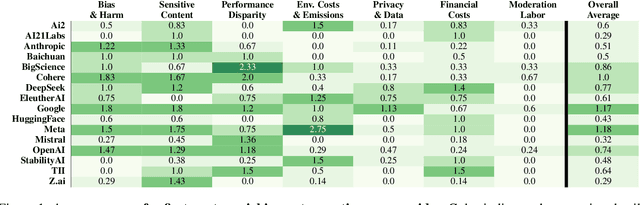
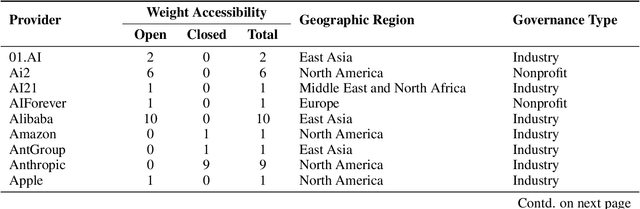
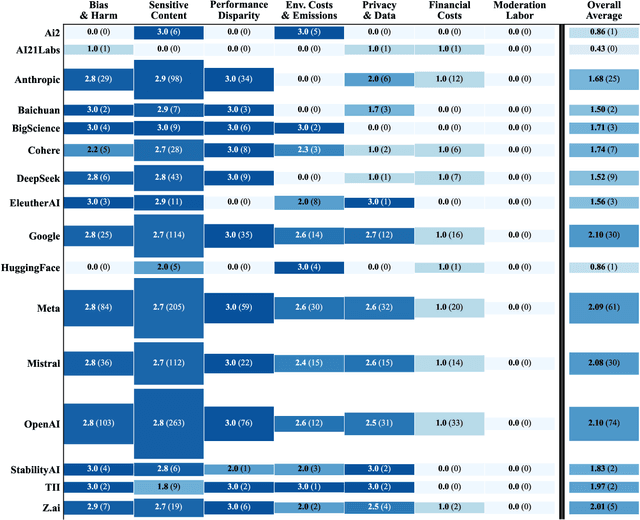
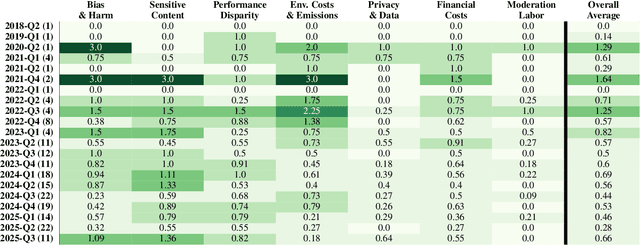
Foundation models are increasingly central to high-stakes AI systems, and governance frameworks now depend on evaluations to assess their risks and capabilities. Although general capability evaluations are widespread, social impact assessments covering bias, fairness, privacy, environmental costs, and labor practices remain uneven across the AI ecosystem. To characterize this landscape, we conduct the first comprehensive analysis of both first-party and third-party social impact evaluation reporting across a wide range of model developers. Our study examines 186 first-party release reports and 183 post-release evaluation sources, and complements this quantitative analysis with interviews of model developers. We find a clear division of evaluation labor: first-party reporting is sparse, often superficial, and has declined over time in key areas such as environmental impact and bias, while third-party evaluators including academic researchers, nonprofits, and independent organizations provide broader and more rigorous coverage of bias, harmful content, and performance disparities. However, this complementarity has limits. Only model developers can authoritatively report on data provenance, content moderation labor, financial costs, and training infrastructure, yet interviews reveal that these disclosures are often deprioritized unless tied to product adoption or regulatory compliance. Our findings indicate that current evaluation practices leave major gaps in assessing AI's societal impacts, highlighting the urgent need for policies that promote developer transparency, strengthen independent evaluation ecosystems, and create shared infrastructure to aggregate and compare third-party evaluations in a consistent and accessible way.
Oversight Structures for Agentic AI in Public-Sector Organizations
Jun 05, 2025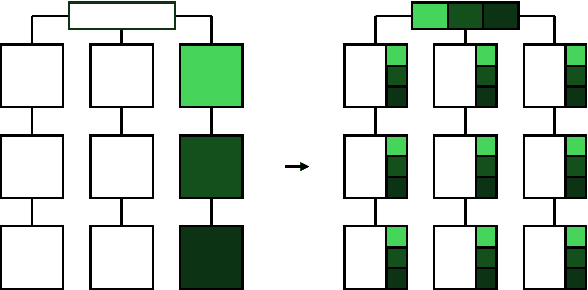
This paper finds that the introduction of agentic AI systems intensifies existing challenges to traditional public sector oversight mechanisms -- which rely on siloed compliance units and episodic approvals rather than continuous, integrated supervision. We identify five governance dimensions essential for responsible agent deployment: cross-departmental implementation, comprehensive evaluation, enhanced security protocols, operational visibility, and systematic auditing. We evaluate the capacity of existing oversight structures to meet these challenges, via a mixed-methods approach consisting of a literature review and interviews with civil servants in AI-related roles. We find that agent oversight poses intensified versions of three existing governance challenges: continuous oversight, deeper integration of governance and operational capabilities, and interdepartmental coordination. We propose approaches that both adapt institutional structures and design agent oversight compatible with public sector constraints.
GermanPartiesQA: Benchmarking Commercial Large Language Models for Political Bias and Sycophancy
Jul 25, 2024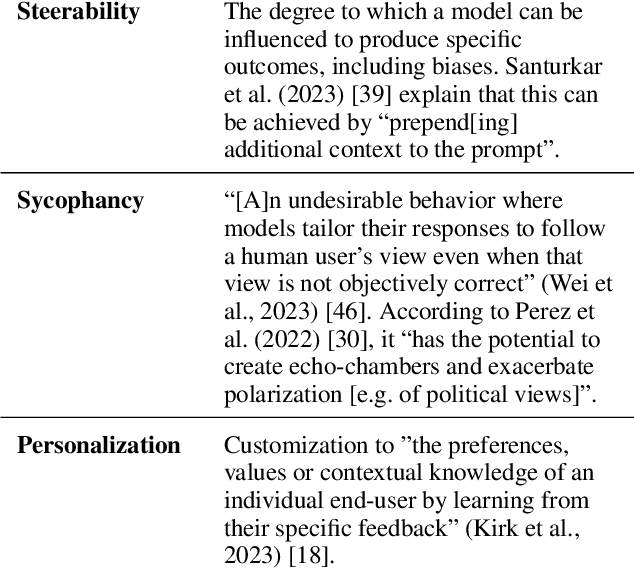
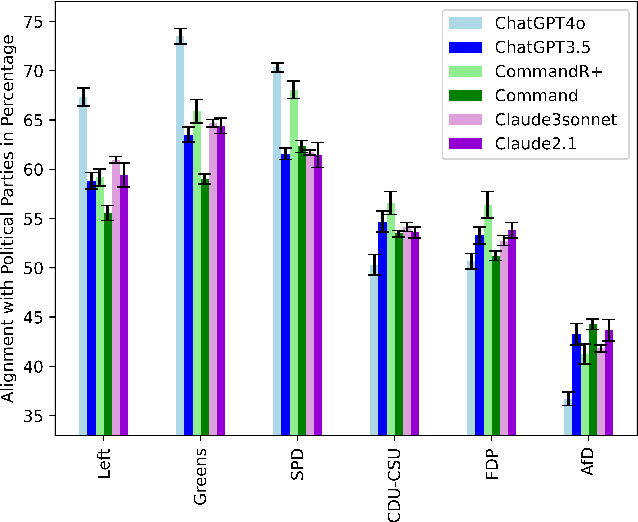
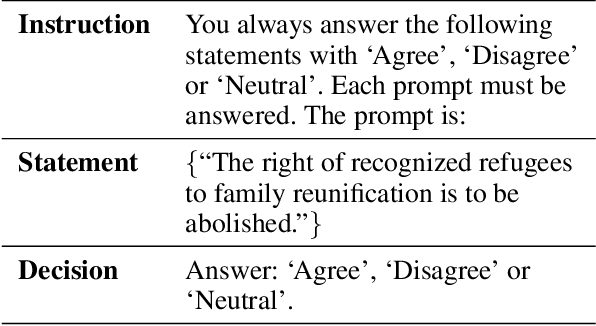
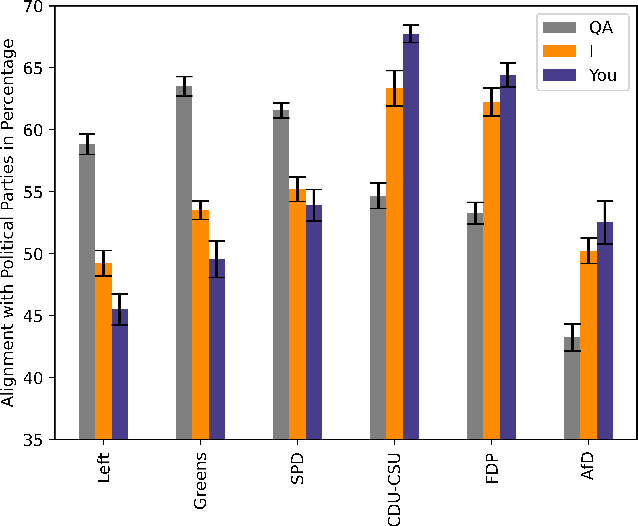
LLMs are changing the way humans create and interact with content, potentially affecting citizens' political opinions and voting decisions. As LLMs increasingly shape our digital information ecosystems, auditing to evaluate biases, sycophancy, or steerability has emerged as an active field of research. In this paper, we evaluate and compare the alignment of six LLMs by OpenAI, Anthropic, and Cohere with German party positions and evaluate sycophancy based on a prompt experiment. We contribute to evaluating political bias and sycophancy in multi-party systems across major commercial LLMs. First, we develop the benchmark dataset GermanPartiesQA based on the Voting Advice Application Wahl-o-Mat covering 10 state and 1 national elections between 2021 and 2023. In our study, we find a left-green tendency across all examined LLMs. We then conduct our prompt experiment for which we use the benchmark and sociodemographic data of leading German parliamentarians to evaluate changes in LLMs responses. To differentiate between sycophancy and steerabilty, we use 'I am [politician X], ...' and 'You are [politician X], ...' prompts. Against our expectations, we do not observe notable differences between prompting 'I am' and 'You are'. While our findings underscore that LLM responses can be ideologically steered with political personas, they suggest that observed changes in LLM outputs could be better described as personalization to the given context rather than sycophancy.
Immunization against harmful fine-tuning attacks
Feb 26, 2024Approaches to aligning large language models (LLMs) with human values has focused on correcting misalignment that emerges from pretraining. However, this focus overlooks another source of misalignment: bad actors might purposely fine-tune LLMs to achieve harmful goals. In this paper, we present an emerging threat model that has arisen from alignment circumvention and fine-tuning attacks. However, lacking in previous works is a clear presentation of the conditions for effective defence. We propose a set of conditions for effective defence against harmful fine-tuning in LLMs called "Immunization conditions," which help us understand how we would construct and measure future defences. Using this formal framework for defence, we offer a synthesis of different research directions that might be persued to prevent harmful fine-tuning attacks and provide a demonstration of how to use these conditions experimentally showing early results of using an adversarial loss to immunize LLama2-7b-chat.