 Add to Chrome
 Add to Firefox
 Add to Edge
Vector-Bench: Can Models Surgically Edit SVG Code?
Jul 21, 2026
Instruction-based vector editing requires two capabilities: making a requested change and leaving everything else alone. The second is easy to miss when an output is judged only as a raster image. We introduce Vector-Bench, a compact, difficult benchmark of 40 SVG repair tasks. Each task pairs a corrupted SVG program with an author-written visual instruction, a hidden target program, 5.05 annotated repairs on average, and an average of 60.55 protected objects. Instructions describe visible defects without exposing element identifiers, coordinates, color codes, or path data. We define a deterministic binary specification reward: requested repairs use attribute-aware perceptual tolerances, while unrequested rendering- or application-relevant structure must remain semantically unchanged and the result must be a valid SVG. Canonical target equality and stricter source fidelity are retained as diagnostics. Validity-gated repair progress, a near-complete tier, and valid-output Unintended Change Rate (UCR) explain partial outcomes. We evaluate 34 model endpoints (25 listed as open-weight, 5 inexpensive controls, and 4 frontier closed endpoints) over 1360 requests. The strongest endpoint reaches only 15.0% full specification success, despite 43.7% mean repair progress, showing that apparent repair progress and specification-faithful editing remain substantially different. All prompts, outputs, scoring code, costs, and per-task reports are released.

SWE-Marathon: Can Agents Autonomously Complete Ultra-Long-Horizon Software Work?
Jun 05, 2026AI agents are increasingly expected to complete long-horizon workflows that require sustained progress over hours, millions of tokens, and complex environments. Yet current agent benchmarks largely evaluate short-form tasks, such as single pull requests, small tickets, or 5-10 minute exercises, limiting our ability to measure agents' capabilities in planning, long-context understanding, and memory use. We introduce SWE-Marathon, a benchmark of 20 long-horizon tasks spanning software engineering and adjacent technical domains. Each task consists of a unique executable environment, a human-written reference solution, and a multi-layer verification suite. Logged agent attempts average 27.2M total tokens, making SWE-Marathon substantially longer-horizon than existing SWE and command-line agent benchmarks. Current frontier coding agents solve fewer than 30% of tasks. Failures often arise from poor self-verification, self-reported infeasibility, and premature termination. We also observe reward-hacking behavior in 13.8% of rollouts, where agents attempt to exploit the environment or verifier to bypass the intended workflow. SWE-Marathon includes adversarial review of test suites and execution environments, as well as multi-layer checks designed to prevent shortcut solutions. We release SWE-Marathon, evaluation code, and agent trajectories at https://swe-marathon.org/.
SIA: Self Improving AI with Harness & Weight Updates
May 28, 2026Humans are the bottleneck in building and improving AI. Both the models and the agents that wrap them are written, tuned, and corrected by people. The long-horizon goal of an AI that can figure out how to improve itself remains open. Two largely disjoint research lines attack this bottleneck. The harness-update school has a meta-agent rewrite the scaffold of a task-specific agent (its tools, prompts, retry logic, and search procedure) while the model weights are held fixed. The test-time training school uses hand-written RL pipelines to update the model's own weights on task feedback while the harness is held fixed. These two silos operate in isolation. We propose SIA, a self-improving loop in which a language-model agent (the Feedback-Agent) updates both the harness and the weights of a task-specific agent. We evaluate across three contrasting domains: Chinese legal charge classification, low-level GPU kernel optimisation, and single-cell RNA denoising. Combining both levers outperforms scaffold iteration alone on all three benchmarks. SIA-W+H achieves 25.1% over prior SOTA on LawBench, 12.4% faster GPU kernels than prior SOTA (1,017 vs 1,161 μs), and 20.4% over prior SOTA on denoising. Harness updates make the model agentic, shaping how it searches and acts, while weight updates build the domain intuition that no prompt or scaffold can instil.
REAL: Benchmarking Autonomous Agents on Deterministic Simulations of Real Websites
Apr 15, 2025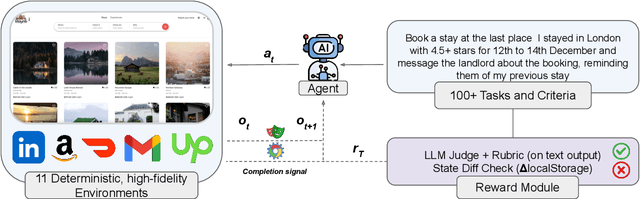
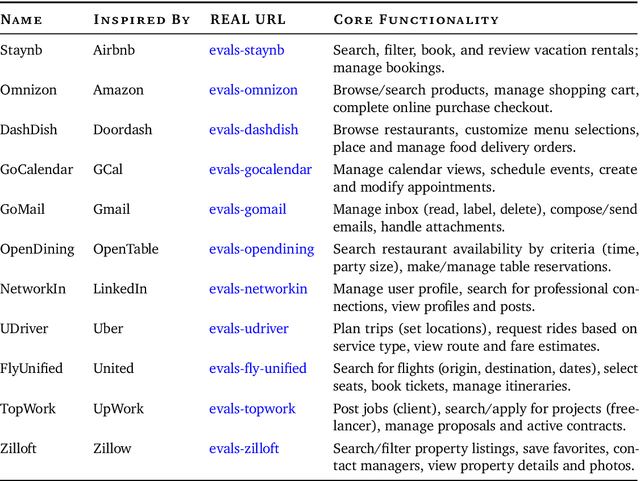
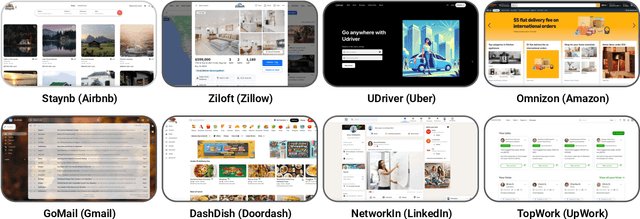
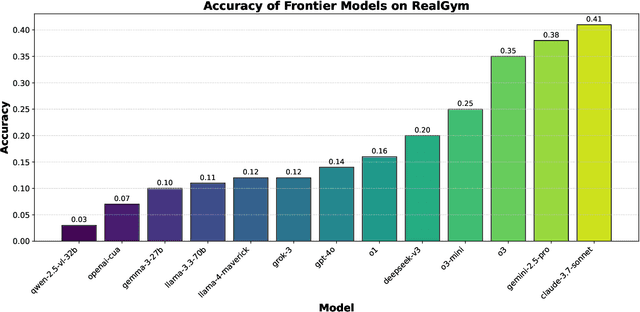
We introduce REAL, a benchmark and framework for multi-turn agent evaluations on deterministic simulations of real-world websites. REAL comprises high-fidelity, deterministic replicas of 11 widely-used websites across domains such as e-commerce, travel, communication, and professional networking. We also release a benchmark consisting of 112 practical tasks that mirror everyday complex user interactions requiring both accurate information retrieval and state-changing actions. All interactions occur within this fully controlled setting, eliminating safety risks and enabling robust, reproducible evaluation of agent capability and reliability. Our novel evaluation framework combines programmatic checks of website state for action-based tasks with rubric-guided LLM-based judgments for information retrieval. The framework supports both open-source and proprietary agent systems through a flexible evaluation harness that accommodates black-box commands within browser environments, allowing research labs to test agentic systems without modification. Our empirical results show that frontier language models achieve at most a 41% success rate on REAL, highlighting critical gaps in autonomous web navigation and task completion capabilities. Our framework supports easy integration of new tasks, reproducible evaluation, and scalable data generation for training web agents. The websites, framework, and leaderboard are available at https://realevals.xyz and https://github.com/agi-inc/REAL.