 Add to Chrome
 Add to Firefox
 Add to Edge
FAIR Universe Weak Lensing ML Uncertainty Challenge: Handling Uncertainties and Distribution Shifts for Precision Cosmology
Apr 15, 2026
Weak gravitational lensing, the correlated distortion of background galaxy shapes by foreground structures, is a powerful probe of the matter distribution in our universe and allows accurate constraints on the cosmological model. In recent years, high-order statistics and machine learning (ML) techniques have been applied to weak lensing data to extract the nonlinear information beyond traditional two-point analysis. However, these methods typically rely on cosmological simulations, which poses several challenges: simulations are computationally expensive, limiting most realistic setups to a low training data regime; inaccurate modeling of systematics in the simulations create distribution shifts that can bias cosmological parameter constraints; and varying simulation setups across studies make method comparison difficult. To address these difficulties, we present the first weak lensing benchmark dataset with several realistic systematics and launch the FAIR Universe Weak Lensing Machine Learning Uncertainty Challenge. The challenge focuses on measuring the fundamental properties of the universe from weak lensing data with limited training set and potential distribution shifts, while providing a standardized benchmark for rigorous comparison across methods. Organized in two phases, the challenge will bring together the physics and ML communities to advance the methodologies for handling systematic uncertainties, data efficiency, and distribution shifts in weak lensing analysis with ML, ultimately facilitating the deployment of ML approaches into upcoming weak lensing survey analysis.

Machine Learning on Heterogeneous, Edge, and Quantum Hardware for Particle Physics (ML-HEQUPP)
Feb 24, 2026The next generation of particle physics experiments will face a new era of challenges in data acquisition, due to unprecedented data rates and volumes along with extreme environments and operational constraints. Harnessing this data for scientific discovery demands real-time inference and decision-making, intelligent data reduction, and efficient processing architectures beyond current capabilities. Crucial to the success of this experimental paradigm are several emerging technologies, such as artificial intelligence and machine learning (AI/ML) and silicon microelectronics, and the advent of quantum algorithms and processing. Their intersection includes areas of research such as low-power and low-latency devices for edge computing, heterogeneous accelerator systems, reconfigurable hardware, novel codesign and synthesis strategies, readout for cryogenic or high-radiation environments, and analog computing. This white paper presents a community-driven vision to identify and prioritize research and development opportunities in hardware-based ML systems and corresponding physics applications, contributing towards a successful transition to the new data frontier of fundamental science.
EveNet: A Foundation Model for Particle Collision Data Analysis
Jan 23, 2026While deep learning is transforming data analysis in high-energy physics, computational challenges limit its potential. We address these challenges in the context of collider physics by introducing EveNet, an event-level foundation model pretrained on 500 million simulated collision events using a hybrid objective of self-supervised learning and physics-informed supervision. By leveraging a shared particle-cloud representation, EveNet outperforms state-of-the-art baselines across diverse tasks, including searches for heavy resonances and exotic Higgs decays, and demonstrates exceptional data efficiency in low-statistics regimes. Crucially, we validate the transferability of the model to experimental data by rediscovering the $Υ$ meson in CMS Open Data and show its capacity for precision physics through the robust extraction of quantum correlation observables stable against systematic uncertainties. These results indicate that EveNet can successfully encode the fundamental physical structure of particle interactions, which offers a unified and resource-efficient framework to accelerate discovery at current and future colliders.
Building Machine Learning Challenges for Anomaly Detection in Science
Mar 03, 2025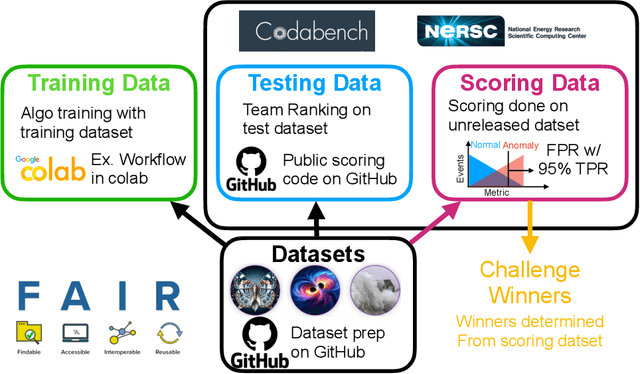
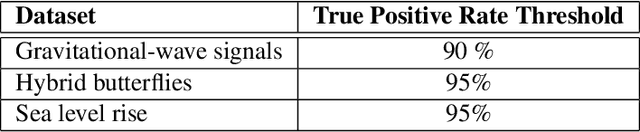
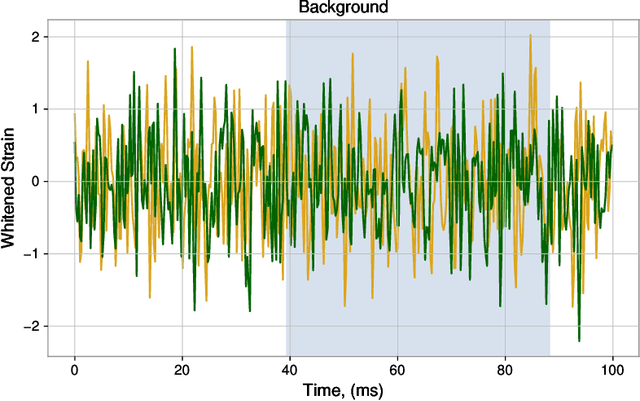
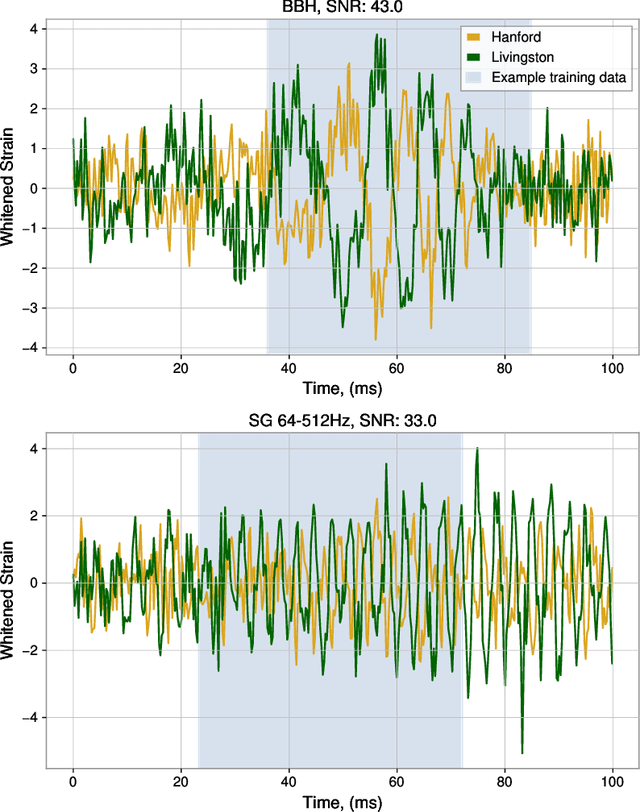
Scientific discoveries are often made by finding a pattern or object that was not predicted by the known rules of science. Oftentimes, these anomalous events or objects that do not conform to the norms are an indication that the rules of science governing the data are incomplete, and something new needs to be present to explain these unexpected outliers. The challenge of finding anomalies can be confounding since it requires codifying a complete knowledge of the known scientific behaviors and then projecting these known behaviors on the data to look for deviations. When utilizing machine learning, this presents a particular challenge since we require that the model not only understands scientific data perfectly but also recognizes when the data is inconsistent and out of the scope of its trained behavior. In this paper, we present three datasets aimed at developing machine learning-based anomaly detection for disparate scientific domains covering astrophysics, genomics, and polar science. We present the different datasets along with a scheme to make machine learning challenges around the three datasets findable, accessible, interoperable, and reusable (FAIR). Furthermore, we present an approach that generalizes to future machine learning challenges, enabling the possibility of large, more compute-intensive challenges that can ultimately lead to scientific discovery.
FAIR Universe HiggsML Uncertainty Challenge Competition
Oct 03, 2024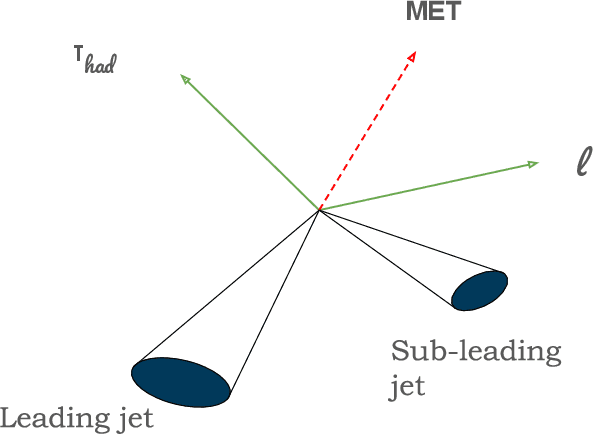
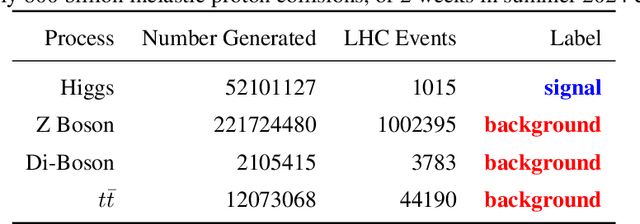


The FAIR Universe -- HiggsML Uncertainty Challenge focuses on measuring the physics properties of elementary particles with imperfect simulators due to differences in modelling systematic errors. Additionally, the challenge is leveraging a large-compute-scale AI platform for sharing datasets, training models, and hosting machine learning competitions. Our challenge brings together the physics and machine learning communities to advance our understanding and methodologies in handling systematic (epistemic) uncertainties within AI techniques.