 Add to Chrome
 Add to Firefox
 Add to Edge
AI Scientists as Engines of Discovery: A Case for Development within Reformed Institutions
Jun 22, 2026
Agentic artificial intelligence (AI) systems are beginning to assist, accelerate, and partially automate scientific discovery, performing tasks that span literature synthesis, code generation, data analysis, hypothesis proposal, and model criticism. We argue that this transition is qualitative rather than incremental, and that suitably designed multi-agent systems may evolve from passive computational tools into ``AI scientists'' that can expand the hypothesis-generating and verification capacity of science. Such systems must be developed and deployed within a scientific ecosystem fit for purpose: institutions must be redesigned for verification, accountability, interpretability, and dual-use safety. We sketch how multi-agent architectures, illustrated by the prototype framework \textit{Denario}, accelerate the discovery cycle and traverse model spaces beyond human reach; examine what this implies for authorship, peer review, and the enduring role of human scientists; and close with recommendations for governing AI as an epistemic actor rather than a mere instrument.

Opportunities in AI/ML for the Rubin LSST Dark Energy Science Collaboration
Jan 20, 2026The Vera C. Rubin Observatory's Legacy Survey of Space and Time (LSST) will produce unprecedented volumes of heterogeneous astronomical data (images, catalogs, and alerts) that challenge traditional analysis pipelines. The LSST Dark Energy Science Collaboration (DESC) aims to derive robust constraints on dark energy and dark matter from these data, requiring methods that are statistically powerful, scalable, and operationally reliable. Artificial intelligence and machine learning (AI/ML) are already embedded across DESC science workflows, from photometric redshifts and transient classification to weak lensing inference and cosmological simulations. Yet their utility for precision cosmology hinges on trustworthy uncertainty quantification, robustness to covariate shift and model misspecification, and reproducible integration within scientific pipelines. This white paper surveys the current landscape of AI/ML across DESC's primary cosmological probes and cross-cutting analyses, revealing that the same core methodologies and fundamental challenges recur across disparate science cases. Since progress on these cross-cutting challenges would benefit multiple probes simultaneously, we identify key methodological research priorities, including Bayesian inference at scale, physics-informed methods, validation frameworks, and active learning for discovery. With an eye on emerging techniques, we also explore the potential of the latest foundation model methodologies and LLM-driven agentic AI systems to reshape DESC workflows, provided their deployment is coupled with rigorous evaluation and governance. Finally, we discuss critical software, computing, data infrastructure, and human capital requirements for the successful deployment of these new methodologies, and consider associated risks and opportunities for broader coordination with external actors.
Enhancing Agentic Autonomous Scientific Discovery with Vision-Language Model Capabilities
Nov 18, 2025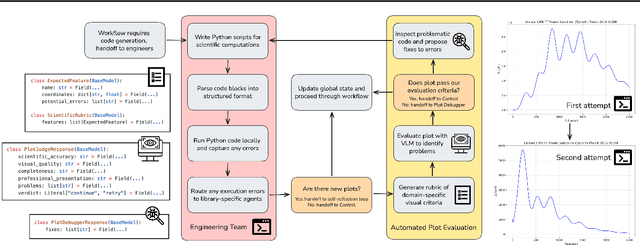

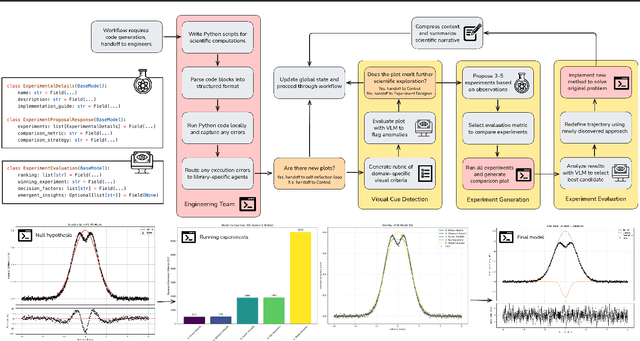
We show that multi-agent systems guided by vision-language models (VLMs) improve end-to-end autonomous scientific discovery. By treating plots as verifiable checkpoints, a VLM-as-a-judge evaluates figures against dynamically generated domain-specific rubrics, enabling agents to correct their own errors and steer exploratory data analysis in real-time. Case studies in cosmology and astrochemistry demonstrate recovery from faulty reasoning paths and adaptation to new datasets without human intervention. On a 10-task benchmark for data-driven discovery, VLM-augmented systems achieve pass at 1 scores of 0.7-0.8, compared to 0.2-0.3 for code-only and 0.4-0.5 for code-and-text baselines, while also providing auditable reasoning traces that improve interpretability. Code available here: https://github.com/CMBAgents/cmbagent
The Denario project: Deep knowledge AI agents for scientific discovery
Oct 30, 2025We present Denario, an AI multi-agent system designed to serve as a scientific research assistant. Denario can perform many different tasks, such as generating ideas, checking the literature, developing research plans, writing and executing code, making plots, and drafting and reviewing a scientific paper. The system has a modular architecture, allowing it to handle specific tasks, such as generating an idea, or carrying out end-to-end scientific analysis using Cmbagent as a deep-research backend. In this work, we describe in detail Denario and its modules, and illustrate its capabilities by presenting multiple AI-generated papers generated by it in many different scientific disciplines such as astrophysics, biology, biophysics, biomedical informatics, chemistry, material science, mathematical physics, medicine, neuroscience and planetary science. Denario also excels at combining ideas from different disciplines, and we illustrate this by showing a paper that applies methods from quantum physics and machine learning to astrophysical data. We report the evaluations performed on these papers by domain experts, who provided both numerical scores and review-like feedback. We then highlight the strengths, weaknesses, and limitations of the current system. Finally, we discuss the ethical implications of AI-driven research and reflect on how such technology relates to the philosophy of science. We publicly release the code at https://github.com/AstroPilot-AI/Denario. A Denario demo can also be run directly on the web at https://huggingface.co/spaces/astropilot-ai/Denario, and the full app will be deployed on the cloud.
Open Source Planning & Control System with Language Agents for Autonomous Scientific Discovery
Jul 09, 2025We present a multi-agent system for automation of scientific research tasks, cmbagent. The system is formed by about 30 Large Language Model (LLM) agents and implements a Planning & Control strategy to orchestrate the agentic workflow, with no human-in-the-loop at any point. Each agent specializes in a different task (performing retrieval on scientific papers and codebases, writing code, interpreting results, critiquing the output of other agents) and the system is able to execute code locally. We successfully apply cmbagent to carry out a PhD level cosmology task (the measurement of cosmological parameters using supernova data) and evaluate its performance on two benchmark sets, finding superior performance over state-of-the-art LLMs. The source code is available on GitHub, demonstration videos are also available, and the system is deployed on HuggingFace and will be available on the cloud.
Evaluating Retrieval-Augmented Generation Agents for Autonomous Scientific Discovery in Astrophysics
Jul 09, 2025We evaluate 9 Retrieval Augmented Generation (RAG) agent configurations on 105 Cosmology Question-Answer (QA) pairs that we built specifically for this purpose.The RAG configurations are manually evaluated by a human expert, that is, a total of 945 generated answers were assessed. We find that currently the best RAG agent configuration is with OpenAI embedding and generative model, yielding 91.4\% accuracy. Using our human evaluation results we calibrate LLM-as-a-Judge (LLMaaJ) system which can be used as a robust proxy for human evaluation. These results allow us to systematically select the best RAG agent configuration for multi-agent system for autonomous scientific discovery in astrophysics (e.g., cmbagent presented in a companion paper) and provide us with an LLMaaJ system that can be scaled to thousands of cosmology QA pairs. We make our QA dataset, human evaluation results, RAG pipelines, and LLMaaJ system publicly available for further use by the astrophysics community.