 Add to Chrome
 Add to Firefox
 Add to Edge
Opportunities in AI/ML for the Rubin LSST Dark Energy Science Collaboration
Jan 20, 2026
The Vera C. Rubin Observatory's Legacy Survey of Space and Time (LSST) will produce unprecedented volumes of heterogeneous astronomical data (images, catalogs, and alerts) that challenge traditional analysis pipelines. The LSST Dark Energy Science Collaboration (DESC) aims to derive robust constraints on dark energy and dark matter from these data, requiring methods that are statistically powerful, scalable, and operationally reliable. Artificial intelligence and machine learning (AI/ML) are already embedded across DESC science workflows, from photometric redshifts and transient classification to weak lensing inference and cosmological simulations. Yet their utility for precision cosmology hinges on trustworthy uncertainty quantification, robustness to covariate shift and model misspecification, and reproducible integration within scientific pipelines. This white paper surveys the current landscape of AI/ML across DESC's primary cosmological probes and cross-cutting analyses, revealing that the same core methodologies and fundamental challenges recur across disparate science cases. Since progress on these cross-cutting challenges would benefit multiple probes simultaneously, we identify key methodological research priorities, including Bayesian inference at scale, physics-informed methods, validation frameworks, and active learning for discovery. With an eye on emerging techniques, we also explore the potential of the latest foundation model methodologies and LLM-driven agentic AI systems to reshape DESC workflows, provided their deployment is coupled with rigorous evaluation and governance. Finally, we discuss critical software, computing, data infrastructure, and human capital requirements for the successful deployment of these new methodologies, and consider associated risks and opportunities for broader coordination with external actors.

Complete identification of complex salt-geometries from inaccurate migrated images using Deep Learning
Apr 22, 2022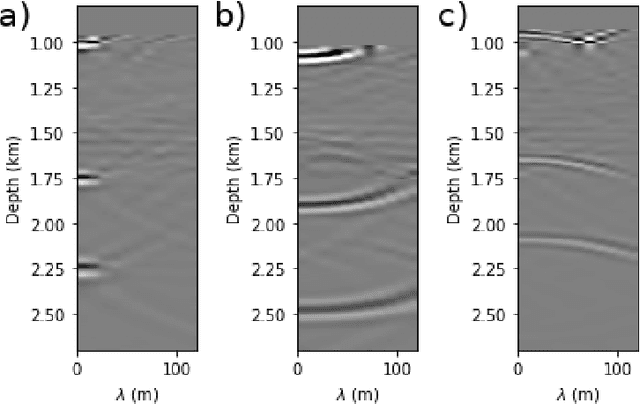
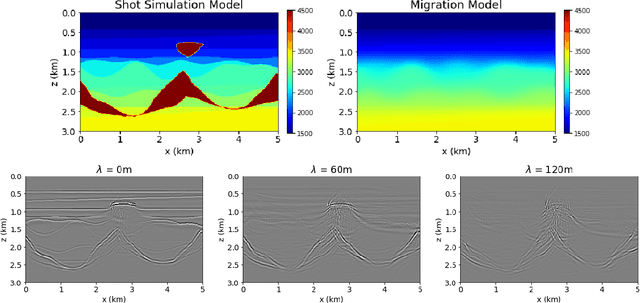
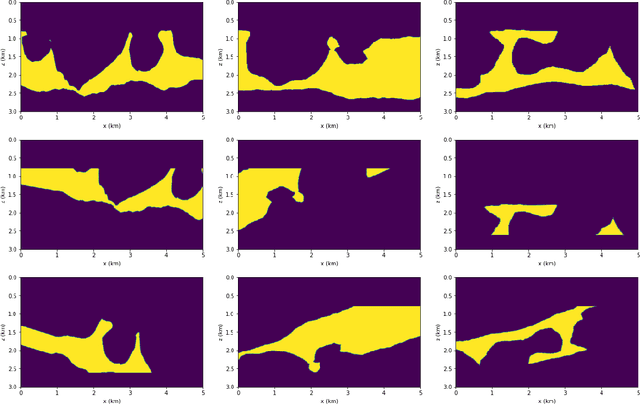
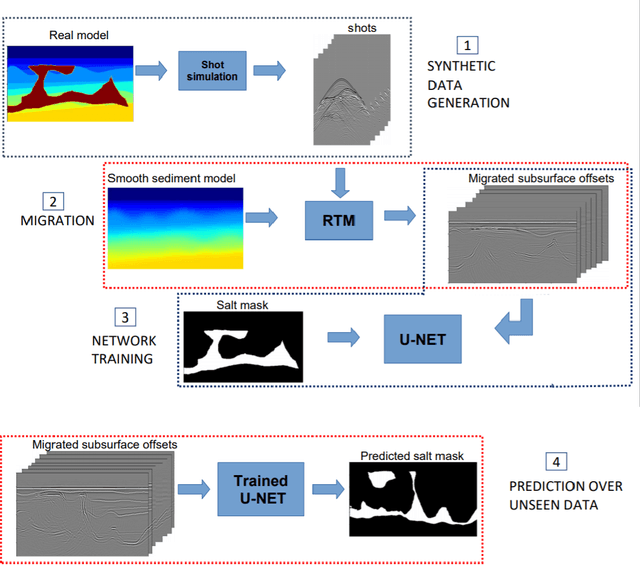
Delimiting salt inclusions from migrated images is a time-consuming activity that relies on highly human-curated analysis and is subject to interpretation errors or limitations of the methods available. We propose to use migrated images produced from an inaccurate velocity model (with a reasonable approximation of sediment velocity, but without salt inclusions) to predict the correct salt inclusions shape using a Convolutional Neural Network (CNN). Our approach relies on subsurface Common Image Gathers to focus the sediments' reflections around the zero offset and to spread the energy of salt reflections over large offsets. Using synthetic data, we trained a U-Net to use common-offset subsurface images as input channels for the CNN and the correct salt-masks as network output. The network learned to predict the salt inclusions masks with high accuracy; moreover, it also performed well when applied to synthetic benchmark data sets that were not previously introduced. Our training process tuned the U-Net to successfully learn the shape of complex salt bodies from partially focused subsurface offset images.